Lana Rhoades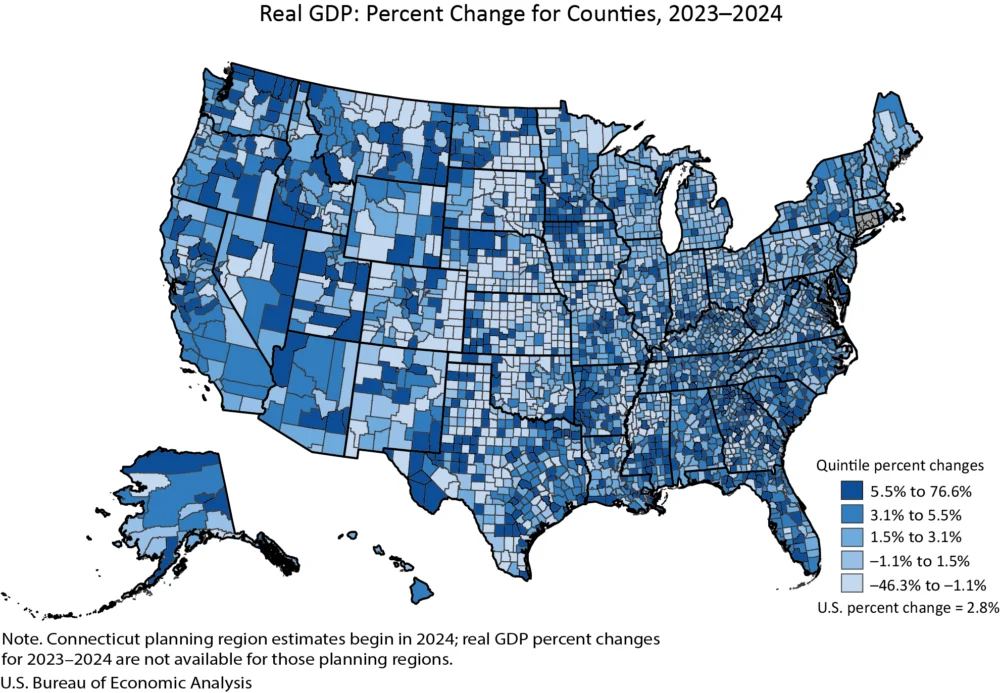
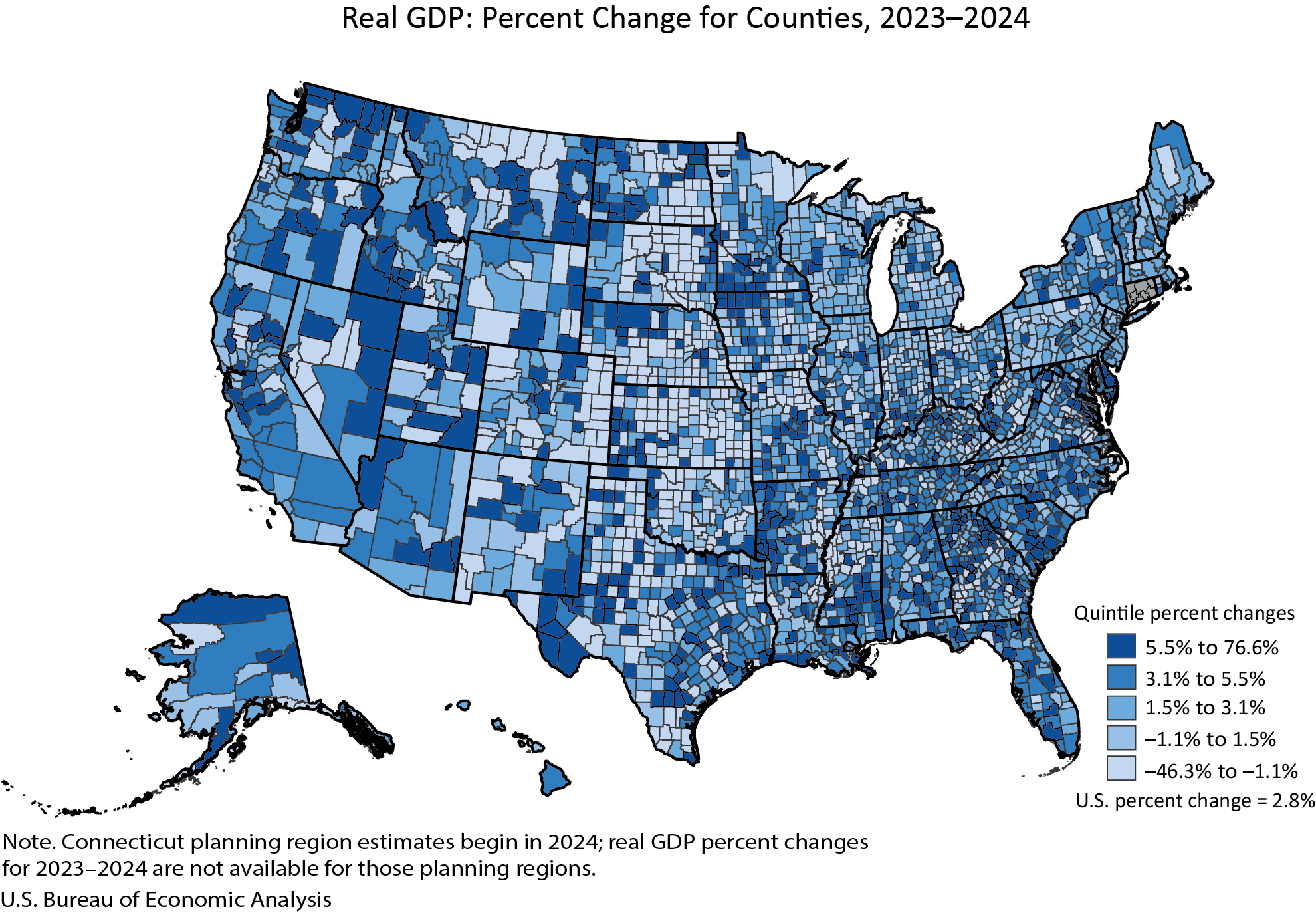
Real gross domestic product (GDP) experienced an upswing in 2,273 counties across the United States in 2024, while 809 counties saw a decline and 24 remained unchanged, according to the latest estimates released by the U.S. Bureau of Economic Analysis (BEA). This geographical distribution of economic activity highlights a complex and varied landscape, with significant disparities in growth and contraction. The percent change in real GDP across these counties presented a wide spectrum, ranging from a remarkable 76.6 percent surge in Carter County, Montana, to a substantial 46.3 percent decrease in Baca County, Colorado.
These figures, part of the BEA’s annual update of county-level economic data, provide a granular view of the nation’s economic health at its most localized level. The disparity in growth rates underscores the diverse economic drivers and vulnerabilities present in different regions of the country. Factors such as industry concentration, natural resource endowments, demographic shifts, and proximity to major economic hubs likely contribute to these varied outcomes.
The sheer scale of the U.S. economy is further illustrated by the significant differences in the total level of real GDP from county to county. In 2024, New York County, New York, anchored the top of the economic output scale with a staggering $813.7 billion in real GDP. In stark contrast, Issaquena County, Mississippi, registered the lowest output at $15.7 million, a difference of several orders of magnitude. This vast range in economic size reflects the concentration of economic activity in urban centers and major metropolitan areas, while many rural and less populated counties contribute a smaller but nonetheless vital share to the national economy.
County Economic Performance by Size and Type
The BEA’s data also offers insights into economic trends categorized by county population size, revealing distinct patterns in growth and contraction.
Large Counties (Population > 500,000)
In large counties, defined as those with a population exceeding 500,000, the economic landscape in 2024 showed robust growth. A total of 145 such counties experienced an increase in real GDP, with zero counties reporting a decline and one county showing no appreciable change. The range of this growth was notable, with Pinal County, Arizona, leading the pack with a 10.7 percent increase in real GDP. On the other end of the spectrum within this group, Johnson County, Kansas, recorded a 0.0 percent change, indicating stability. The economic output of these large counties is substantial, with New York County, New York, again leading at $813.7 billion. Pinal County, Arizona, also a significant economic player, registered $12.7 billion in real GDP.
Medium Counties (Population 100,000 to 500,000)
Counties with populations between 100,000 and 500,000 exhibited a more mixed, though generally positive, trend. Of these, 451 counties saw their real GDP increase, while 20 experienced a decline, and 3 remained unchanged. Jefferson County, Texas, posted the highest growth rate in this category at 12.4 percent. Black Hawk County, Iowa, registered a decline of 2.6 percent. The economic scale in medium counties also shows significant variation, with Mercer County, New Jersey, reporting $46.6 billion in real GDP and Liberty County, Texas, at $2.6 billion.
Small Counties (Population < 100,000)
Small counties, those with populations under 100,000, presented the most dramatic variations in economic performance. A total of 1,677 small counties experienced GDP growth, while a significant 789 counties saw a decline, and 20 reported no change. This category contained the extremes of the national GDP percentage change: Carter County, Montana, with its impressive 76.6 percent increase, and Baca County, Colorado, with its substantial 46.3 percent decrease. The economic size in these counties also spans a broad range, from Martin County, Texas, at $15.1 billion, down to Issaquena County, Mississippi, at $15.7 million.
Personal Income Trends Mirror GDP Landscape
Parallel to the GDP trends, personal income also saw a widespread increase across the nation’s counties in 2024. Personal income, measured in current dollars, rose in 2,768 counties, fell in 331, and remained unchanged in 7. The percent change in personal income ranged from a robust 22.6 percent increase in Harding County, South Dakota, to a notable 23.3 percent decline in Issaquena County, Mississippi.
The distribution of personal income levels across counties mirrors the GDP distribution, with significant concentrations in populous areas. Los Angeles County, California, reported the highest total personal income at $818.5 billion. At the other end of the spectrum, Loving County, Texas, had the lowest personal income at $10.6 million.
Similar to GDP, personal income trends also vary by county population size:
Large Counties (Population > 500,000)
In large counties, 146 experienced an increase in personal income. The growth range was significant, with San Joaquin County, California, seeing a 9.7 percent increase, while Philadelphia County, Pennsylvania, reported a 2.7 percent increase. The economic scale is immense, with Los Angeles County, California, leading at $818.5 billion and Pinal County, Arizona, at $26.1 billion.
Medium Counties (Population 100,000 to 500,000)
For medium-sized counties, 474 recorded an increase in personal income. Merced County, California, led with a 10.9 percent rise, and Genesee County, Michigan, saw a 1.6 percent increase. Collier County, Florida, reported $62.5 billion in personal income, while Floyd County, Georgia, had $4.9 billion.
Small Counties (Population < 100,000)
Small counties displayed the most pronounced variations in personal income trends. Harding County, South Dakota, saw the highest growth at 22.6 percent, while Issaquena County, Mississippi, experienced the largest decline at 23.3 percent. Teton County, Wyoming, reported $12.4 billion in personal income, and Loving County, Texas, had $10.6 million.
Methodology and Data Updates
The release of the 2024 county-level GDP and personal income statistics marks a significant update to the BEA’s regional economic accounts. These estimates incorporate the results of the BEA’s annual updates to GDP and personal income by county, which include revisions to data from 2020 to 2023. These revisions are crucial as they integrate new and more complete source data, ensuring greater accuracy and consistency. The update also aligns county data with the national income and product accounts and state-level statistics, released in late September 2025, providing a cohesive economic picture across different levels of aggregation.
A notable methodological change is the incorporation of Connecticut’s planning region geographic definitions, replacing traditional county definitions for that state. This shift, beginning with the 2024 estimates, means that Connecticut’s regional economic data will now be reported based on these planning regions. Because these new regional estimates are only available for 2024, they are not included in the percent change calculations or ranges presented in this release, which focus on year-over-year comparisons.
The BEA also utilized U.S. Census Bureau population figures to calculate per capita personal income estimates for the period of 2020 through 2024, offering another dimension to the analysis of individual economic well-being at the county level.
New Combined Release and Discontinuation of Metropolitan Area Statistics
For the first time, the BEA has published annual GDP and personal income by county in a single, consolidated news release. This integrated approach aims to provide a more comprehensive and holistic view of county economies and replaces the previous practice of issuing two separate releases on different dates. This consolidation enhances efficiency and offers a more unified perspective for data users.
In conjunction with the release of 2024 county-level data, the BEA has announced the discontinuation of publication for statistics related to metropolitan statistical areas, micropolitan statistical areas, metropolitan divisions, combined statistical areas, and metropolitan and nonmetropolitan portions. While GDP and personal income estimates will continue to be available by county, the shift away from broader metropolitan area aggregates signifies a strategic decision by the BEA to focus on the most granular available data. This move is intended to streamline data dissemination and leverage the increasing availability of detailed county-level information. A frequently asked questions document has been published by the BEA to provide further clarification on this change.
Enhanced Data Access and Presentation
In line with modernization efforts, the BEA has also updated the presentation of its data tables. Tables that were previously embedded within county news releases are now accessible simultaneously with the release through the BEA’s Interactive Data Application. This change, effective immediately, aims to reduce redundancy and direct users to a more dynamic and flexible data platform. Links within the news release provide direct access to these customizable tables, which include full time series and offer download options in PDF, Excel, and CSV formats. This approach ensures that data users have access to the most complete and up-to-date information in a format that suits their analytical needs.
The BEA has provided direct links to the relevant interactive data tables for both GDP by county and personal income by county. These tables allow users to explore percent change from the preceding period and levels of economic activity in chained 2017 dollars for GDP, and in thousands of dollars for personal income. These resources are critical for researchers, policymakers, and the public seeking to understand the detailed economic dynamics within every U.S. county.
Looking Ahead
The next release of GDP and personal income by county statistics is scheduled for December 2, 2026, at 8:30 a.m. EST, which will cover the 2025 data. Upon the release of the 2025 data, the 2024 figures will be superseded. Historical data from this release will remain accessible through BEA’s Data Archive, ensuring continuity and historical research capabilities. These ongoing updates and data accessibility initiatives underscore the BEA’s commitment to providing timely and comprehensive economic information to inform decision-making and foster a deeper understanding of the U.S. economy at all levels.