Lana Rhoades
As the 2026 fiscal year progresses, sales tax holidays have once again emerged as a pivotal focal point for both consumer spending strategies and corporate compliance departments. While these temporary tax-free windows are framed as significant financial relief for households—particularly those preparing for the academic year or impending weather seasons—they represent a sophisticated administrative hurdle for the retail sector. For businesses operating across multiple jurisdictions, the 2026 calendar presents a fragmented mosaic of dates, product categories, and price thresholds that require meticulous oversight to avoid audit risks and filing discrepancies.
The concept of the sales tax holiday has evolved significantly since its inception. Originally designed as a localized tool to prevent cross-border shopping in the late 20th century, these events have transformed into a standard legislative instrument used by nearly twenty states to stimulate economic activity. However, the benefits to the consumer often mask the "compliance chaos" that retailers must manage. In 2026, the complexity is heightened by the fact that many states rely on annual legislative re-authorization, meaning that dates and qualifying items can shift with little notice, necessitating a state-by-state analysis of the current tax landscape.
The Economic Context and Strategic Importance of Tax Holidays
Sales tax holidays are generally categorized into four primary types: back-to-school, emergency preparedness, energy efficiency, and niche categories such as "Second Amendment" weekends. From a macroeconomic perspective, these holidays serve as a catalyst for retail traffic. According to historical data from the National Retail Federation, back-to-school spending remains one of the largest consumer expenditure periods of the year, second only to the winter holiday season. By removing the 4% to 7% state sales tax, governments effectively provide a targeted discount that encourages lower-income families to complete essential purchases.
However, the fiscal impact on state budgets is a subject of ongoing debate among policy analysts. Critics, including organizations like the Tax Foundation, often argue that tax holidays do not necessarily increase total consumer spending but rather shift the timing of purchases that would have occurred anyway. For retailers, this "timing shift" creates logistical pressure, requiring temporary surges in inventory and staffing, coupled with the immediate need to update Point of Sale (POS) systems to reflect the temporary tax exemptions.
Chronology of the 2026 Sales Tax Holiday Calendar
The 2026 schedule begins in the first quarter with a focus on energy efficiency and emergency readiness, peaking in late summer with a concentrated wave of back-to-school events.
First and Second Quarter: Energy and Emergency Preparedness
The year opens with Maryland’s "Shop Maryland Energy" weekend from February 14 to 16, focusing on Energy Star-certified appliances. Alabama follows shortly after, from February 21 to 23, with its Severe Weather Preparedness holiday, an event designed to encourage the purchase of generators, batteries, and first-aid kits before the peak of the hurricane and tornado seasons.
In April, Missouri introduces its "Show Me Green" holiday (April 19–25), which offers a week-long exemption on energy-efficient appliances up to a $1,500 limit per item. Texas also enters the fray in late April (April 25–27) with an emergency preparation supplies holiday, followed by a dual Energy Star and WaterSense holiday in late May (May 23–25). These events highlight a growing trend among state legislatures to use tax policy to promote environmental sustainability and disaster resilience.
Third Quarter: The Back-to-School Peak
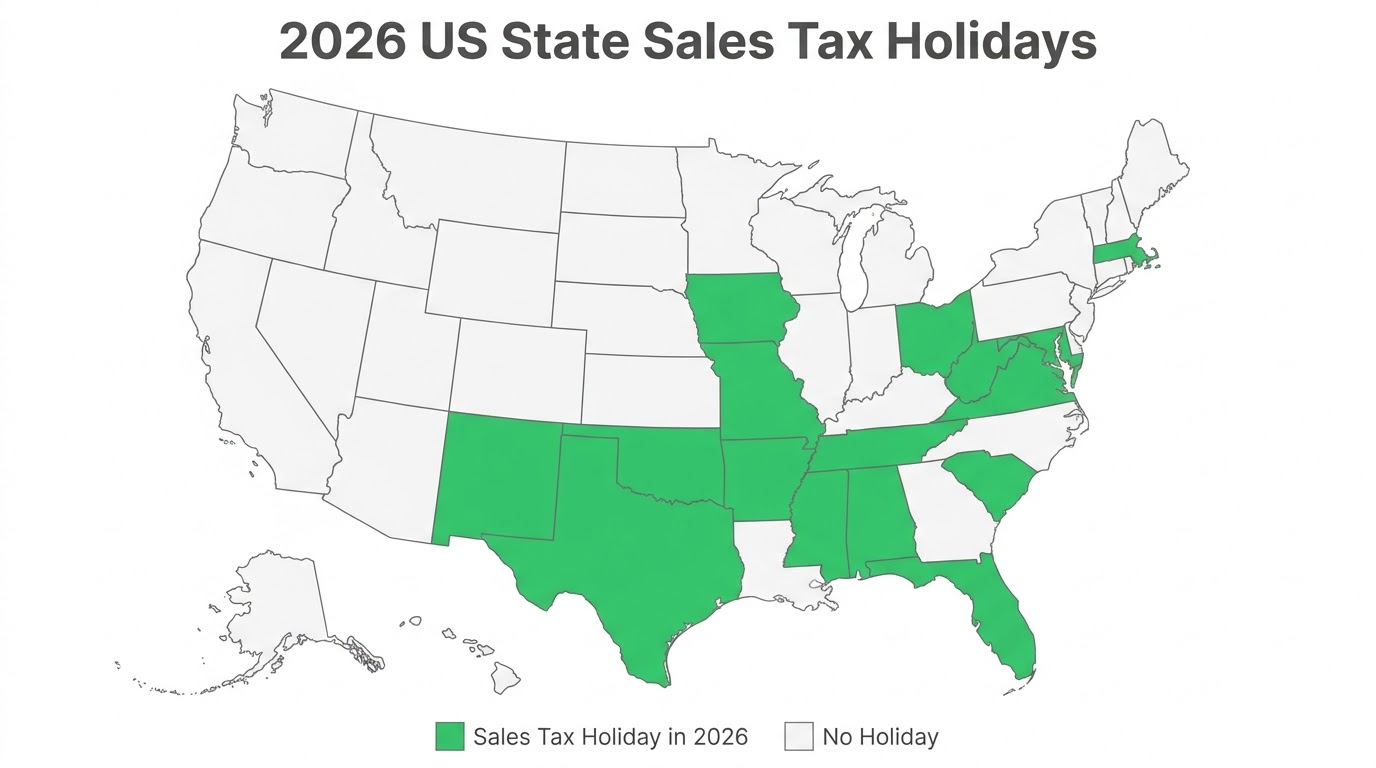
July and August represent the most active months for tax compliance departments. Mississippi kicks off the back-to-school season (July 10–12), followed by Puerto Rico and Alabama in mid-July. Florida offers one of the longest windows in the country, with a month-long back-to-school holiday running from July 20 to August 20.
The first weekend of August (August 7–9) serves as the "Super Bowl" of tax holidays, with no fewer than seven states—Iowa, Missouri, Ohio, Oklahoma, South Carolina, Texas, and Virginia—hosting simultaneous events. This concentration of dates poses a significant challenge for e-commerce retailers who must ensure their automated tax engines are correctly calibrated for different state thresholds simultaneously.
State-Specific Exemptions and Threshold Analysis
Compliance in 2026 is not merely about knowing the dates; it is about understanding the granular "caps" or price limits imposed by each state. A failure to apply these limits correctly is a primary driver of tax audits.
Alabama Case Study:
Alabama serves as a prime example of the "local opt-in" complexity. While the state waives its 4% sales tax during the July 17–19 holiday, individual counties and municipalities have the choice to participate. A retailer must know if a specific store location—or the customer’s delivery address in an e-commerce transaction—is in a jurisdiction that has opted out. Furthermore, Alabama enforces strict caps: clothing must be $100 or less, school supplies $50 or less, and computers must not exceed $750.
Florida’s Broad Scope:
Florida’s 2026 strategy includes a massive "Hunting, Fishing, and Camping" holiday from September 1 through the end of the year. Unlike the short-lived back-to-school windows, this four-month exemption covers a vast array of outdoor gear, from bait and tackle to binoculars and safety gear. The extended duration requires a different level of long-term system monitoring compared to a three-day weekend event.
Missouri and West Virginia Specifics:
Missouri offers a high threshold for computers ($1,500), while West Virginia provides a more modest $500 limit for laptops. Such discrepancies mean that a laptop priced at $800 would be tax-free in St. Louis but partially or fully taxable in Charleston, depending on how the state handles "excess" amounts.
Compliance Traps for E-Commerce and Multichannel Retailers
For modern businesses, the "hidden chaos" of these holidays lies in the intersection of digital commerce and physical geography. Most states now follow "destination-based" sourcing rules, meaning the tax rate is determined by where the buyer receives the goods.
- Shipping and Handling Charges: One of the most common errors is the treatment of shipping fees. In some states, if the item is tax-exempt, the shipping charge is also exempt. In others, the shipping remains taxable, or it may even be added to the price of the item to determine if it exceeds the state’s price cap (e.g., a $95 pair of shoes with $10 shipping might suddenly exceed a $100 threshold).
- Bundled Transactions: If a retailer sells a "Back-to-School Bundle" containing a laptop (exempt), a backpack (exempt), and a software subscription (taxable), the entire bundle may become taxable unless the items are priced separately on the invoice.
- Rain Checks and Returns: If a customer buys an item during the holiday but returns it a week later, the retailer must ensure the refund reflects the $0 tax paid. Conversely, if a customer uses a rain check for an item that was out of stock during the holiday, the tax treatment varies by state.
- Marketplace Facilitator Laws: Platforms like Amazon or Etsy are responsible for collecting tax, but the individual sellers must still ensure their product categorization (tax codes) are accurate so the platform applies the holiday exemption correctly.
Official Responses and Industry Sentiment
State Departments of Revenue (DOR) typically view these holidays as a public relations success, even if the administrative burden is high. Official statements from various DOR offices emphasize that these windows are "designed to put money back into the pockets of hardworking families."
Conversely, retail advocacy groups, while supportive of the sales boost, often call for more lead time and uniformity. The Retail Council has frequently pointed out that the lack of a national standard for tax-free dates makes it difficult for national chains to coordinate marketing and system updates. To mitigate these issues, many states have begun moving toward "permanent" holiday statutes to provide more predictability, though many still require annual legislative "tweaks."
Broader Implications: The Role of Automation
As the 2026 calendar illustrates, the manual management of sales tax holidays is no longer feasible for any business operating beyond a single storefront. The shift toward automation is no longer a luxury but a necessity for survival in a high-audit environment.
Cloud-based tax engines have become the industry standard for managing these complexities. By integrating directly with e-commerce platforms, these tools use real-time data to identify the customer’s location, cross-reference it with the 2026 holiday schedule, and apply the correct exemption based on the specific product code. As states continue to experiment with "tax-free" periods for everything from "green" energy to firearms, the reliance on sophisticated, real-time compliance technology will only intensify.
In conclusion, the 2026 sales tax holidays offer a significant opportunity for retail growth, provided that businesses approach the season with a robust compliance strategy. By understanding the specific timelines, jurisdictional nuances, and price thresholds outlined in this guide, retailers can ensure a seamless experience for their customers while protecting themselves from the fiscal risks of non-compliance. Consumers should remain vigilant and bookmark official state schedules, as the fluid nature of state legislation means that more dates and categories may be announced as the peak summer season approaches.