Julia Chirkova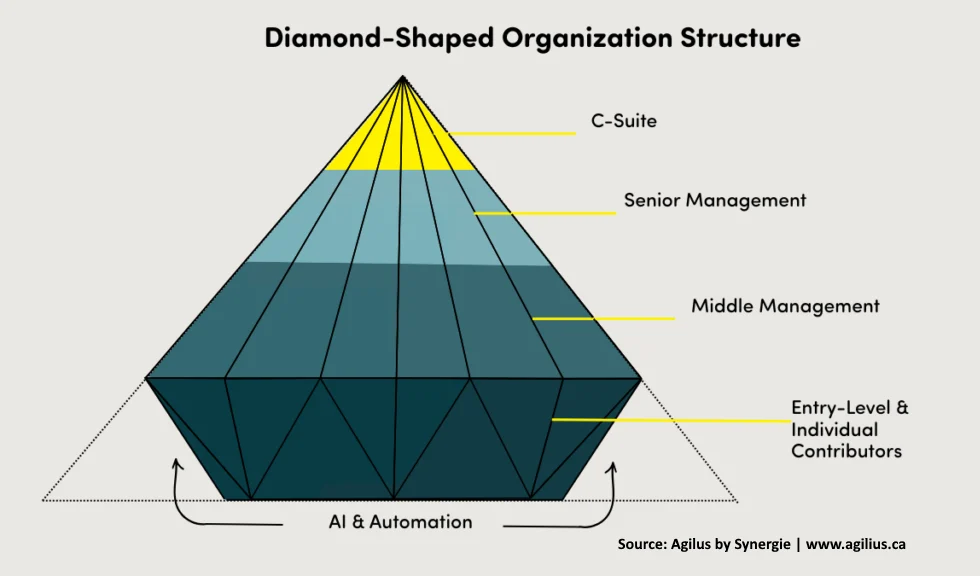
The accounting profession is currently navigating a structural transformation more profound than any technological advancement witnessed in the past two decades. While cloud software redefined the physical location of work and workflow tools optimized its movement, the advent of artificial intelligence (AI) is fundamentally altering who performs the tasks, carrying the potential to reshape the very architecture of accounting firms. This seismic shift necessitates a reevaluation of traditional firm structures, moving away from the long-standing pyramid model towards a more agile and value-centric diamond framework.
For over half a century, the accounting profession has operated under a hierarchical pyramid structure. This model was built upon layers of manual labor, characterized by a broad base of entry-level staff engaged in repetitive tasks, a narrowing middle tier of reviewers and managers, and a small apex of partners focused on client relationships and strategic oversight. This structure was functional when firms scaled by adding more hands to perform data entry, reconciliations, document collection, tie-outs, and the essential administrative follow-ups that propelled engagements forward. These tasks, while time-consuming, were predictable and served as the foundational training ground for new accountants, who learned the intricacies of the profession through hands-on, manual execution.
However, the pervasive integration of AI is systematically dismantling the bedrock of this traditional model. As AI-powered automation takes over the often unseen yet crucial tasks of intake, preparation, routing, and initial data analysis, the reliance on a large cohort of junior labor diminishes significantly. The calculus of firm growth is no longer solely about expanding the workforce at the bottom. Instead, scalability is now achieved by amplifying the leverage of professionals who possess the critical skills to interpret AI outputs, manage exceptions, and guide clients through increasingly intricate financial decisions.
This evolving landscape necessitates a reimagining of firm structure. A compelling alternative gaining traction is the "diamond" model. In this configuration, the entry-level layer is intentionally downsized, shifting its focus from performing repetitive tasks to cultivating crucial judgment and analytical skills. The middle tier expands considerably, becoming the primary engine of value creation within the firm. These mid-level professionals are the linchpins responsible for validating anomalies flagged by AI, contextualizing complex financial data, and spearheading client consultations. At the apex, partners continue to concentrate on high-level advisory work, long-term strategic planning, and the cultivation of enduring client relationships. This diamond shape more accurately reflects a profession transitioning from a production-centric to an interpretation-driven paradigm, moving from a focus on compliance to a role as trusted counsel, and evolving from mere task execution to a strategic partnership with clients. It is a structure meticulously designed for an era where technology handles the background operations, liberating human capital to focus on the truly meaningful and value-adding aspects of the work.
The Mid-Tier as the New Nexus of Value Creation
In an AI-augmented accounting practice, the expanded middle layer emerges as the firm’s operational and intellectual powerhouse. These professionals are no longer relegated to the role of mere reviewers. They are transformed into strategists, tasked with ensuring that automated workflows generate accurate, contextually relevant, and actionable outcomes. Their remit includes translating complex data into clear, understandable insights for clients, effectively managing inherent risks, exercising sound judgment in ambiguous situations, and orchestrating cross-functional collaboration within the firm. Their contributions are not measured by the mere completion of a checklist, but by their capacity to navigate clients through periods of uncertainty and to proactively identify opportunities for growth and optimization.
This profound shift underscores the escalating importance of uniquely human skills. Effective communication, deep empathy, insatiable curiosity, and the ability to forge and maintain trust are rapidly becoming the firm’s most significant competitive advantages. Rather than rendering accountants obsolete, technology is paradoxically elevating the value of the human elements that define the profession.
Strategic Staffing and Talent Development for the Diamond Model
The adoption of a diamond-shaped firm structure necessitates a fundamental recalibration of talent acquisition and development strategies. With the diminished need for entry-level staff performing manual repetition, the traditional apprenticeship model of learning through rote tasks becomes misaligned with the evolving demands of the profession. Consequently, firms will increasingly seek mid-career professionals possessing the acumen to manage exceptions, uphold rigorous quality control standards, and cultivate strong client relationships. Furthermore, there will be a growing imperative to integrate non-traditional roles into the firm’s operational fabric, including data analysts, technology specialists, and AI experts, who will provide essential support to the firm’s new operational paradigm.
Firms that persist in hiring for the outdated pyramid model risk becoming overstaffed at the entry level while simultaneously experiencing deficiencies in the critical mid-tier. Conversely, those that strategically hire for the diamond structure will be positioned for sustainable growth without a commensurate escalation in payroll.
Parallel to hiring practices, training and development must undergo a significant metamorphosis. New accountants will no longer acquire their foundational understanding of the profession through the execution of repetitive tasks. Their learning journey will pivot towards interpreting data, validating AI-generated insights, and mastering advanced communication techniques. This demands a radical redesign of onboarding processes and professional development programs. Critical thinking, scenario-based judgment, the application of sophisticated advisory frameworks, and a deep fluency in relevant technologies will form the new bedrock of professional growth. Mentorship will increasingly supplant manual labor as the primary mechanism for knowledge transfer and skill development.
Evolving Leadership for a Diamond-Shaped Firm
The transition to an AI-driven, diamond-shaped firm requires a fundamental rethinking of leadership responsibilities. Leaders must adapt their approaches to performance measurement, resource allocation, and workflow design. The autonomous firm demands standardized processes that are inherently supportive of automation, coupled with robust quality control frameworks. Client experiences must be meticulously crafted around principles of transparency and ease of interaction. Technology investments should be strategically directed towards friction reduction rather than the introduction of further complexity. Above all, leaders must champion and cultivate a organizational culture that prizes adaptability, embraces continuous learning, and fosters authentic human connection. The firms poised for success will be those that proactively and intentionally redesign their internal structures, rather than passively awaiting the inevitable structural shifts of the industry.
The Next Decade: A Mandate for Reshaping
The adage "diamonds are a girl’s best friend" may well extend to the strategic imperative for accounting firms in the coming decade. The fundamental structure of the profession is undergoing an unprecedented transformation. The opportunity lies in embracing this evolution rather than resisting it. AI is not poised to replace accountants; rather, it is poised to dismantle the archaic pyramid model that has long defined the profession. Firms that wholeheartedly adopt the diamond-shaped structure will operate with enhanced capacity, cultivate more robust client relationships, and implement a more resilient talent strategy. They will be inherently built for advisory services, designed for greater autonomy, and strategically positioned for the human-centered future of accounting.
This transformative period, amplified by the rapid advancements in AI, began to accelerate significantly in the early 2020s. Initial explorations into AI in accounting were largely focused on automating routine tasks, such as data entry and basic reconciliation. However, as AI capabilities matured, particularly in areas like natural language processing and predictive analytics, its potential to impact higher-value cognitive tasks became apparent. By 2023, numerous accounting firms had begun pilot programs integrating AI into their workflows, with early adopters reporting significant gains in efficiency and accuracy for tasks like document review and initial audit sampling. The COVID-19 pandemic further catalyzed this shift, accelerating the adoption of cloud-based technologies and remote work capabilities, which laid essential groundwork for more sophisticated AI integrations. This period of experimentation and early adoption has set the stage for the widespread structural changes now being advocated.
The implications of this structural shift are far-reaching. For clients, it signals a move towards more proactive, strategic, and value-driven advisory services. Instead of simply receiving historical financial reports, clients can expect more forward-looking insights, risk assessments, and strategic guidance derived from AI-enhanced data analysis. This can empower businesses to make more informed decisions, identify growth opportunities, and navigate complex regulatory environments with greater confidence.
For the profession itself, the diamond model promises a more intellectually stimulating and professionally rewarding career path. By offloading repetitive tasks to AI, accountants can dedicate more time to complex problem-solving, client relationship management, and strategic advisory. This elevation of the human element not only enhances job satisfaction but also positions accounting as a more attractive career choice for future generations of talent. The emphasis on critical thinking, judgment, and communication skills will foster a more dynamic and adaptable workforce, capable of thriving in an ever-evolving economic landscape.
Furthermore, the increased efficiency and leverage offered by the diamond model can lead to improved profitability for accounting firms. By optimizing resource allocation and enhancing the productivity of their professional staff, firms can achieve greater output with a more streamlined operational structure. This can translate into competitive pricing for clients and improved margins for firms, fostering a more sustainable and prosperous ecosystem for all stakeholders. The future of accounting, therefore, is not one of automation replacing humans, but of humans and machines collaborating to achieve unprecedented levels of insight, efficiency, and client value.
Luke Frye, CPA, is the Accountant in Residence at Canopy, where he leverages his extensive background in accounting technology startups and private practice to assist firms in developing smarter, more scalable business operations.