Candice Horbacz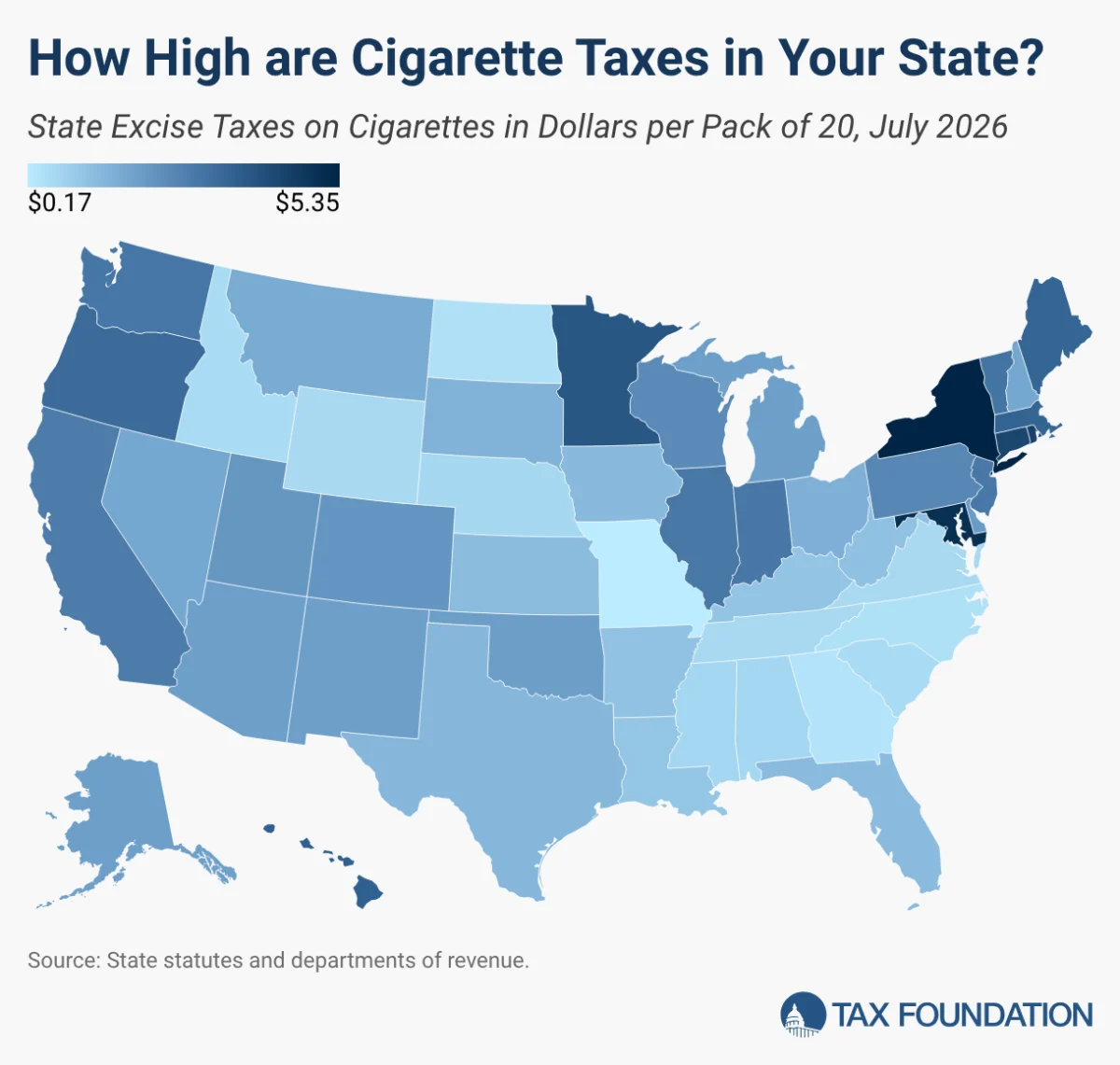
Cigarettes stand as one of the most heavily taxed consumer products across the United States, often leaving smokers unaware of the substantial portion of their purchase price dedicated to various government levies. This intricate web of taxation, encompassing both federal and state excise duties, reflects a multifaceted policy approach aimed at public health, behavioral deterrence, and revenue generation. However, this strategy also brings forth significant economic and social implications, including issues of regressivity, revenue volatility, and the proliferation of illicit markets.
The Landscape of Cigarette Taxation: A State-by-State Overview
Every state in the U.S. imposes an excise tax on cigarettes, with rates varying dramatically across jurisdictions. As of July 2026, the state with the highest cigarette tax is New York, levying an imposing $5.35 per pack of 20 cigarettes. Following closely are the District of Columbia at $5.07 per pack, Maryland at $5.00 per pack, Rhode Island at $4.50 per pack, and Connecticut at $4.35 per pack. These high-tax states often cite public health initiatives and the deterrence of smoking as primary motivations for their aggressive tax policies.
Conversely, consumers in Missouri face the lowest state tax burden, with a mere $0.17 per pack. Other states with notably low cigarette taxes include Georgia at $0.37 per pack, North Dakota at $0.44 per pack, and North Carolina at $0.45 per pack of 20. These significant disparities in tax rates—a spread of over $5.00 between the highest and lowest—create distinct economic incentives and challenges across state lines.
Why Tax Tobacco? The Policy Rationales Behind Excise Duties
The rationale behind taxing cigarettes is generally categorized into three main objectives:
- Correcting for Externalities: This economic principle posits that taxes can be used to internalize the costs that consumption of a product imposes on society but are not directly borne by the consumer. For cigarettes, these externalities include the healthcare costs associated with treating smoking-related illnesses, the burden of secondhand smoke on non-smokers, and productivity losses. Proponents argue that a cigarette tax helps offset these societal costs.
- Discouraging "Sinful" or Undesirable Behavior: Often termed "sin taxes," these levies are applied to products deemed harmful or socially undesirable, such as tobacco, alcohol, and sometimes sugary drinks. Policymakers use these taxes as a tool to discourage consumption, aiming to improve public health outcomes and reduce associated social problems.
- Generating Revenue: For many states, cigarette taxes represent a consistent, albeit increasingly volatile, revenue stream. This revenue can be allocated to general government services, specific public health programs, or tobacco cessation initiatives. The allure of easily collectable revenue has historically made cigarette taxes an attractive option for state legislatures, particularly when facing budget shortfalls.
A Detailed Look at State Excise Taxes on Cigarettes (Dollars per Pack of 20, July 2026)
The following table provides a comprehensive breakdown of state cigarette tax rates and their respective ranks:
| State | Cigarette Tax Rate per Pack of 20 | Rank |
|---|---|---|
| Alabama | $0.68 | 40 |
| Alaska | $2.00 | 22 |
| Arizona | $2.00 | 22 |
| Arkansas | $1.15 | 36 |
| California | $2.87 | 15 |
| Colorado | $2.24 | 18 |
| Connecticut | $4.35 | 4 |
| Delaware | $2.10 | 20 |
| Florida | $1.34 | 33 |
| Georgia | $0.37 | 49 |
| Hawaii | $3.60 | 6 |
| Idaho | $0.57 | 45 |
| Illinois | $2.98 | 14 |
| Indiana | $3.00 | 13 |
| Iowa | $1.36 | 32 |
| Kansas | $1.29 | 34 |
| Kentucky | $1.10 | 37 |
| Louisiana | $1.08 | 38 |
| Maine | $3.50 | 8 |
| Maryland | $5.00 | 2 |
| Massachusetts | $3.51 | 7 |
| Michigan | $2.00 | 22 |
| Minnesota | $3.88 | 5 |
| Mississippi | $0.68 | 39 |
| Missouri | $0.17 | 50 |
| Montana | $1.70 | 28 |
| Nebraska | $0.64 | 41 |
| Nevada | $1.80 | 26 |
| New Hampshire | $1.78 | 27 |
| New Jersey | $3.00 | 12 |
| New Mexico | $2.00 | 22 |
| New York | $5.35 | 1 |
| North Carolina | $0.45 | 47 |
| North Dakota | $0.44 | 48 |
| Ohio | $1.60 | 29 |
| Oklahoma | $2.03 | 21 |
| Oregon | $3.33 | 9 |
| Pennsylvania | $2.60 | 16 |
| Rhode Island | $4.50 | 3 |
| South Carolina | $0.57 | 45 |
| South Dakota | $1.53 | 30 |
| Tennessee | $0.62 | 42 |
| Texas | $1.41 | 31 |
| Utah | $2.20 | 19 |
| Vermont | $3.08 | 10 |
| Virginia | $0.60 | 43 |
| Washington | $3.03 | 11 |
| West Virginia | $1.20 | 35 |
| Wisconsin | $2.52 | 17 |
| Wyoming | $0.60 | 43 |
| DC | $5.07 | 2 |
Source: State statutes and departments of revenue.
The Federal Layer: An Additional Burden
Beyond state-specific taxes, cigarettes sold in every state bear an additional burden from the federal excise tax. Currently, every pack of 20 cigarettes is taxed an additional $1.01 at the federal level. This federal levy further contributes to the overall cost of cigarettes and serves similar purposes of revenue generation and public health deterrence on a national scale. When combined with state taxes, the total tax burden can become exceptionally high, particularly in states like New York, where a pack can effectively cost over $6.36 in combined state and federal taxes before any local taxes or sales taxes are even considered.
Evolving Revenue Streams: The Challenge of Declining Smoking Rates
A significant dynamic shaping cigarette tax policy is the continuous decline in smoking rates across the United States over several decades. This trend, widely celebrated by public health organizations as a major achievement, has a complex fiscal implication: fewer packs of cigarettes purchased translate directly into less tax revenue generated for states and the federal government.
Historically, the revenues generated by excise taxes, due to their narrow tax bases, have been prone to fluctuation. The consistent fall in smoking rates has made cigarette tax revenues notably volatile and generally declining. While this success in public health is paramount, it creates a dilemma for states that have become fiscally reliant on these revenues. When fewer people smoke, what was once a steady income stream for public budgets becomes a challenge.
To counter these declining revenues, many states have resorted to increasing tax rates. While this can provide a short-term spike in revenue, experience suggests it often accelerates the long-term decline. Higher prices can further discourage smoking, push consumers towards lower-tax jurisdictions through cross-border shopping, or, more concerningly, divert them to illicit markets that evade all taxation and regulation. This creates a perpetual cycle where states chase declining revenue with tax hikes, often finding themselves with ever-decreasing real revenues, especially when accounting for inflation. This inherent volatility makes cigarette excise taxes a poor option for policymakers seeking reliable funds for general government services.
The Regressive Nature of Cigarette Taxes: A Social Equity Concern
One of the most significant criticisms leveled against cigarette excise taxes is their highly regressive nature. Consumption taxes, including excise taxes, are almost always regressive because lower-income individuals tend to spend a larger proportion of their disposable income on consumption goods, while higher-income individuals save or invest a greater share. For cigarette taxes, this effect is particularly pronounced because smoking prevalence is generally higher among lower-income groups.
This disproportionate burden means that cigarette taxes place a drastically higher effective tax rate on those with lower incomes compared to those with higher incomes. To illustrate this disparity, data from 2023 shows that the top 10 percent of income earners paid an estimated 32.2 percent of federal alcohol taxes but only 18.9 percent of tobacco taxes. For context, the top 10 percent of income earners paid approximately 70 percent of federal income taxes in the same year, according to Tax Foundation analysis.
This regressivity is also stark at the state level. New York, with its high tax rate, also exhibits the most regressive cigarette tax, where the effective tax rate on the lowest income quintile is a staggering 22.2 times higher than the effective tax rate on the highest income quintile. Even in Utah, which has the least regressive cigarette tax among states, the effective tax rate on the lowest income quintile is still 11.2 times higher than that on the highest income quintile. This stark disparity raises serious questions about social equity and the fairness of the overall tax system.
Beyond Borders: Smuggling and Illicit Markets
The significant differentials in cigarette tax rates across states inadvertently incentivize smuggling and cross-border trade. When a short drive across a state border can save consumers substantial amounts—for example, a $4.40 difference per pack between Maryland ($5.00) and Virginia ($0.60)—many smokers are economically rational to shop in lower-tax jurisdictions. This phenomenon results in substantial tax revenue losses for high-tax states. Estimates suggest that more than 1.5 billion packs of cigarettes are smuggled annually in the United States, diverting significant funds from legitimate state coffers.
Illicit activity avoids all taxes and regulations, posing a dual threat to both public health and public finance. Black markets thrive when policymakers enact prohibitive policies, such as flavor bans, which can effectively grant illicit actors a monopoly on certain product types. Similarly, overly burdensome tax policies can grant competitive advantages to illicit products, undermining the revenues of legitimate businesses and state tax collections, while also making it harder to monitor and regulate product safety. Enforcement efforts by agencies like the ATF continue, but the illicit market for cigarettes remains resilient.
An International Perspective: Comparing US and EU Rates
Placing U.S. cigarette taxes in an international context reveals varying approaches. The European Union’s minimum cigarette excise tax of $2.11 per pack of 20 cigarettes, if applied in the U.S., would rank as the 19th highest rate among states. However, the highest state rate in New York, at $5.35 per pack, would rank as the 7th highest among EU countries, indicating that some U.S. states impose taxes comparable to, or even exceeding, those in many European nations. This comparison highlights the aggressive stance taken by some U.S. states in their tobacco taxation policies.
On average, excise taxes accounted for approximately 31.1 percent of the final retail price of cigarettes in 2025, according to Orzechowski and Walker data. This percentage ranged from a low of 14.7 percent in Missouri to a high of 44.8 percent in Maryland. These figures do not include additional sales taxes, business taxes, or local taxes, which would further increase the total tax burden on consumers.
Policy Implications and Future Outlook
The notorious unreliability of cigarette tax revenues and the severe regressivity of excise taxes on cigarettes make them particularly ill-suited for raising general funds. Tax policy experts and fiscal conservatives often argue that excise taxes should be reserved for funding related programs, such as tobacco cessation initiatives or healthcare costs associated with smoking, rather than being directed towards general government spending. They advocate for looking to more broad-based taxes for funding general expenditures in a reliable and principled way.
Public health advocates, on the other hand, often champion higher cigarette taxes as an effective tool to reduce smoking rates, especially among youth, and improve overall public health. They might argue that the health benefits outweigh the fiscal and regressivity concerns, or that mitigating strategies can be implemented to address the impact on low-income individuals.
Policymakers are thus caught in a complex balancing act: leveraging taxes to improve public health outcomes while grappling with the fiscal instability and social equity challenges these taxes present. As smoking rates continue to decline, states will increasingly need to re-evaluate their reliance on cigarette excise taxes and explore alternative, more stable, and less regressive revenue streams to fund essential government services. The ongoing debate underscores the intricate relationship between public health, economic policy, and social justice in the realm of tobacco taxation.
Stay informed on the tax policies impacting you.
Subscribe to our free newsletter to get the latest tax data, news and analysis.