Pevita Pearce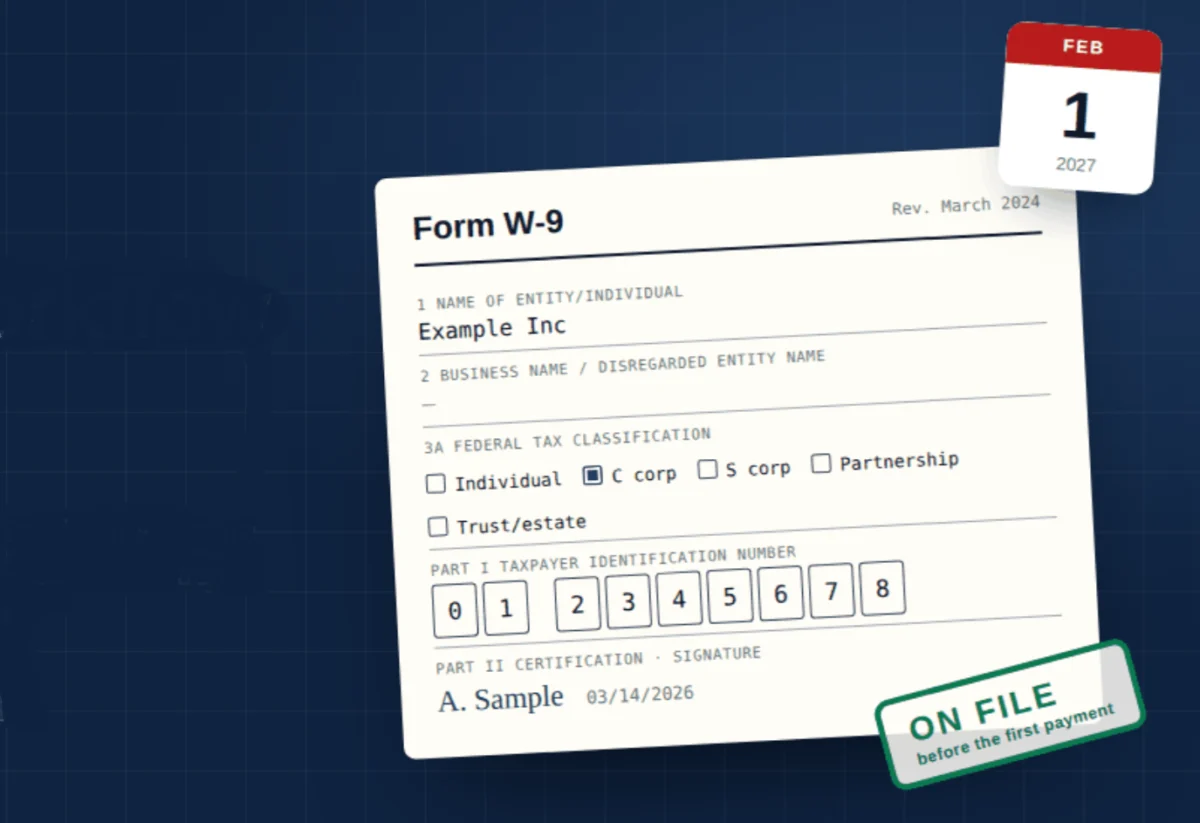
The annual scramble to file Form 1099 information returns, often referred to as the "1099 rush," is a recurring challenge for businesses and accounting firms. However, characterizing this widespread difficulty as merely a "deadline problem" significantly understates the core issue. The reality is that the 1099 rush is, at its heart, a fundamental data management crisis, stemming from a reactive approach to collecting crucial taxpayer information. This reactive posture, characterized by last-minute efforts to gather data, creates a cascade of complications that extend far beyond a simple calendar crunch.
The Problematic Year-End Data Collection Cycle
As the calendar flips to January, many firms find themselves inundated with accounts payable reports that list vendors added throughout the previous year. The critical deficiency in these reports is the frequent absence of a properly completed Form W-9, a confirmed mailing address, a reliable payee classification, or a clear description of the services or goods provided. This lack of foundational data forces accounting and finance staff into a frenzied, backward sequence of operations. They must then:
- Identify Potentially Reportable Payments: Sifting through transactions to determine which ones meet the IRS reporting thresholds for various 1099 forms.
- Obtain Sensitive Taxpayer Information: This often involves reaching out to vendors who may be unresponsive or have changed contact personnel, and then securely collecting their Taxpayer Identification Numbers (TINs) and other sensitive data.
- Untangle Vendor Records: Correcting inconsistencies between operational names, doing-business-as (DBA) names, and legal tax names, and verifying mailing addresses.
- Communicate Extensively with Clients: Explaining reporting requirements, chasing down client-provided information, and addressing discrepancies.
- Prepare and File Returns Against a Fixed Deadline: All this must be accomplished under the stringent IRS filing deadlines, most notably January 31st for Form 1099-NEC.
This entire sequence is fundamentally flawed because it prioritizes the final output – the filed return – over the essential input – accurate and complete data collected proactively.
The IRS Mandate: The Form W-9 as the Cornerstone of Reporting
The Internal Revenue Service (IRS) mandates the use of Form W-9, Request for Taxpayer Identification Number and Certification, as the primary tool for collecting essential payee information. According to the IRS, Form W-9 is used by any person required to file an information return to obtain the payee’s correct name and Taxpayer Identification Number (TIN). A valid W-9 must include the payee’s name and TIN, and crucially, be signed and dated under penalties of perjury by the payee or an authorized signer. This certification underscores the legal weight and importance of the information provided.
The failure to obtain a valid W-9 before making reportable payments has significant implications. It not only hinders accurate tax reporting but can also expose businesses to potential penalties. The IRS guidance on Form W-9 explicitly states that backup withholding requirements can be triggered if a payee fails to provide a TIN, if the IRS notifies the payer that a TIN is incorrect, or if the payee fails to make a required certification. Backup withholding requires the payer to withhold a percentage of payments, typically 24%, and remit it to the IRS, creating an unexpected financial burden and administrative headache.
The Critical Role of W-9 Collection in Vendor Onboarding
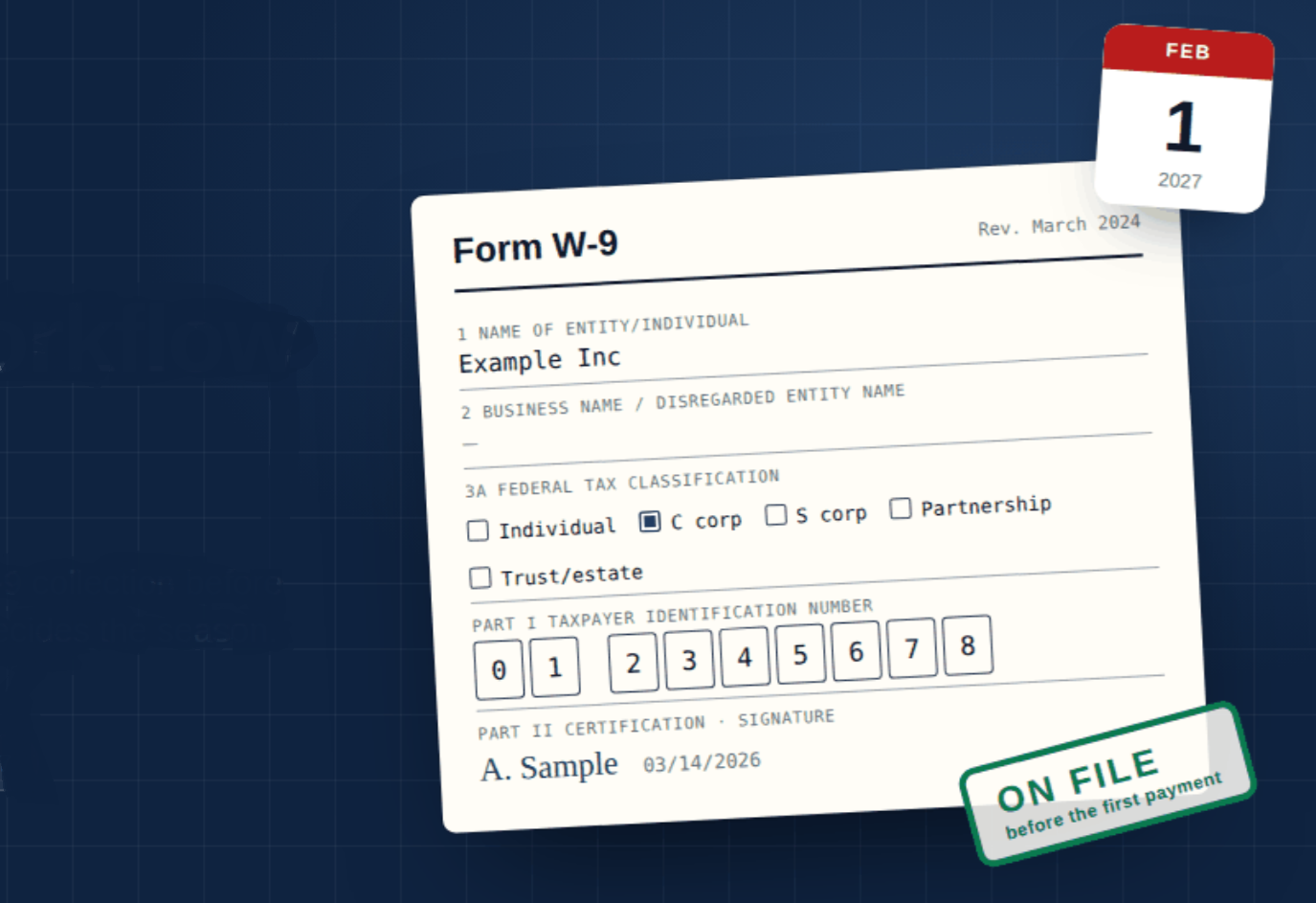
The optimal moment to request a Form W-9 is not in the frenzied days of January, but rather at the very beginning of the vendor relationship – before the first potentially reportable payment is made. This proactive approach, integrating W-9 collection into the vendor onboarding process, offers several compelling advantages:
- Maximum Leverage: When a vendor is being set up for payment, they are typically more receptive to providing necessary documentation. The business has the greatest practical leverage at this stage.
- Clean Record Creation: Finance teams can establish a clean, accurate vendor record from the outset, minimizing the need for extensive corrections later.
- Reduced Risk of Errors and Omissions: By collecting information upfront, businesses significantly reduce the likelihood of missing crucial data points, incorrect names, or outdated addresses that plague year-end reporting.
Conversely, a late request for a W-9 breeds predictable problems. Vendors may no longer respond promptly to requests from unknown contacts. The original point of contact within the vendor’s organization might have left. Clients may struggle to recall the specific nature of payments made months ago. Vendor records might have been initially entered using informal or abbreviated names rather than their legal tax names, leading to inconsistencies that are then replicated across multiple systems.
The January Deadline: A Symptom, Not the Cause
The IRS’s general due date for filing most information returns, including Form 1099-NEC, with the IRS is January 31st. This early deadline, whether the return is filed electronically or on paper, necessitates a workflow that is substantially complete well before the end of December. The current practice of treating W-9 collection as a January task directly conflicts with this requirement, creating an impossible situation for many organizations.
Rethinking the Workflow: A Strategic Approach to Data Management
A truly effective approach to 1099 compliance requires a fundamental shift in operational strategy. Instead of viewing the 1099 process as a singular, rushed year-end event, it should be conceptualized as a series of distinct, yet interconnected, phases managed throughout the year. This strategic separation of tasks ensures that data collection, classification, exception management, and filing preparation are handled efficiently and accurately.
1. Establishing Robust Vendor Onboarding Requirements:
The initial step in building a sound data management system is to define clear onboarding requirements that must be met before any payment is processed. This includes:
- Legal Tax Name: The official name of the individual or entity as it appears on their tax identification documents.
- Business or DBA Name (if applicable): Any trade name or operating name used by the business.
- Mailing Address: A verifiable and current mailing address.
- Taxpayer Identification Number (TIN) and TIN Type: This includes Social Security Numbers (SSNs) for individuals or Employer Identification Numbers (EINs) for businesses.
- Federal Tax Classification: Whether the vendor is an individual, partnership, corporation (S or C), LLC, etc.
- Signed Certification: Confirmation under penalties of perjury that the information provided is correct.
- Vendor Contact Information: For future reference and communication.
- Description of Services or Payment Purpose: A clear understanding of what the payment is for, which aids in classification.
- Documentation Dates: Recording when the W-9 was requested, received, and reviewed provides an audit trail.
2. Creating Tax-Ready Vendor Records:
Once the onboarding information is collected, it must be meticulously entered into a vendor management system. This system should be designed to distinguish between operational data and tax reporting requirements. Key fields should include:
- Legal Tax Name: Distinct from any operational or DBA name.
- DBA or Business Name: Clearly labeled as such.
- TIN Type and Number: Accurately recorded.
- Recipient Mailing Address: Verified.
- Entity Classification: Correctly identified.
- W-9 Status: Indicating whether a valid W-9 has been received and reviewed.
- Payment Category: A preliminary classification of the type of payment (e.g., services, rent, royalties).
- Exception Status: Flagging any vendors with incomplete or questionable data.
3. Continuous Review of Payment Coding:
A completed W-9 is a prerequisite for accurate reporting, but it does not automatically trigger a 1099. Throughout the year, businesses must review how payments are coded. This involves understanding the nuances of IRS reporting requirements for various payment types, including:
- Nonemployee compensation
- Rents
- Royalties
- Medical and health-care payments
- Attorney payments
- Prizes and awards
- Other payments subject to information reporting as detailed in IRS instructions.
It’s important to note that certain payment methods, such as those made via payment card or through specific third-party networks, may be subject to reporting by the payment settlement entity on Form 1099-K, rather than by the payer on Forms 1099-NEC or 1099-MISC. This distinction requires ongoing vigilance and understanding of evolving IRS guidance.
4. Managing Missing Information as an Exception Queue:
Instead of relying on informal reminders or last-minute searches for missing W-9s or unresolved vendor records, a structured exception management process is crucial. Each outstanding issue should have a defined status, an assigned owner responsible for resolution, and a clear set of next actions. This ensures accountability and prevents issues from falling through the cracks.
5. Implementing Secure Data Handling Practices:
Form W-9 contains highly sensitive personal and financial information. Firms must adopt secure collection and storage processes. This includes:
- Secure Online Collection: Utilizing secure platforms for vendors to submit their W-9 information electronically, rather than relying on unsecured email attachments.
- Access Control: Limiting access to W-9 data to only those staff members who have a legitimate business need.
- Data Encryption: Ensuring that stored sensitive data is encrypted.
- Avoiding Unrestricted Storage: Preventing W-9s from being saved in easily accessible email inboxes or shared network drives without proper security measures.
Ensuring Name and TIN Accuracy: A Pre-Filing Imperative
The accuracy of the name associated with a Taxpayer Identification Number is paramount. Many vendor records are maintained with trade names, shortened company identifiers, or the names of specific contact individuals. While these may be useful for day-to-day operations, they are often insufficient and can lead to significant reporting errors if used directly on tax forms.
For example, a bookkeeping file might list a vendor as "Northside Creative," but the vendor’s W-9 may legally identify the payee as "Jordan R. Smith" with "Northside Creative" listed as the business name. The firm must diligently cross-reference the name and TIN used in the tax reporting with the payee’s certified information on the W-9.
TIN Matching: A Valuable Quality Control Tool
The IRS offers a valuable tool called TIN matching through its e-services program. This program allows eligible payers and authorized agents to compare submitted name-and-TIN combinations with IRS records before information returns are filed. While TIN matching is not a substitute for obtaining a completed W-9, it serves as an essential pre-filing quality control measure.
TIN matching helps identify potential mismatches that could lead to penalties. Common reasons for mismatches include:
- Data Entry Errors: Simple typos or incorrect entry of names or TINs.
- Legal Name Changes: Businesses or individuals may have legally changed their names.
- DBA vs. Legal Name Confusion: Using a trade name instead of the legal tax name.
- Entity Selection Issues: A business may have changed its legal structure (e.g., from a sole proprietorship to an LLC).
- Outdated W-9 Information: The W-9 on file may no longer reflect the vendor’s current legal name or TIN.
It is crucial to understand that a mismatch is a prompt for investigation, not definitive proof of improper conduct by the payee. The mismatch could stem from any of the reasons listed above. The process should involve investigating the discrepancy, requesting corrected documentation if necessary, and meticulously documenting the resolution before preparing and filing the returns.
A Practical Year-End Timetable: Shifting the Focus
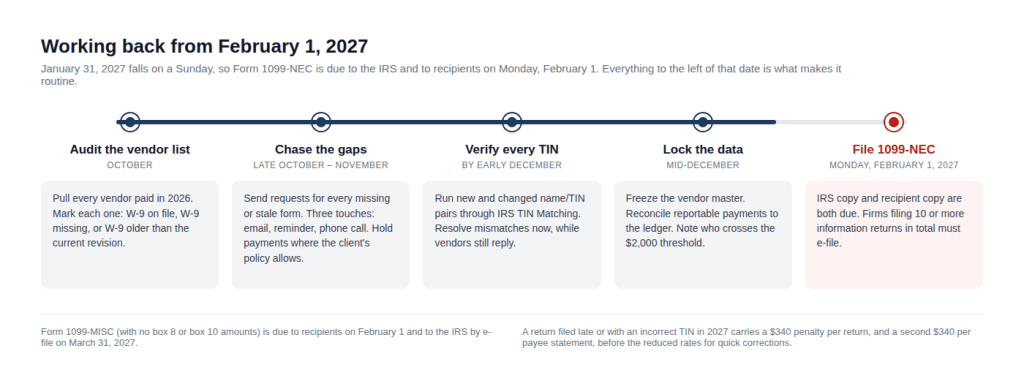
To mitigate the annual 1099 rush and transform it into a manageable process, a revised timetable is essential. This shifts the bulk of the critical data collection and validation activities to earlier in the year.
- Q1 (January-March): Focus on onboarding new vendors, meticulously collecting W-9s, and establishing accurate vendor records. Begin reviewing payment coding for potential reporting requirements.
- Q2 (April-June): Continue proactive W-9 collection for any new vendors. Conduct mid-year reviews of payment categories and identify any vendors that may cross reporting thresholds. Initiate preliminary TIN matching for vendors with known reportable payments.
- Q3 (July-September): Deepen the review of payment classifications. Address any outstanding vendor onboarding issues. Perform more comprehensive TIN matching for vendors anticipated to receive 1099s. Begin addressing any exceptions flagged in the vendor records.
- Q4 (October-December): Finalize payment classifications. Conduct a final round of TIN matching. Address any remaining exceptions and missing W-9s. Prepare and review draft 1099 forms. Begin preparing for electronic filing, as the IRS generally requires electronic filing for filers submitting 10 or more information returns.
By adopting this proactive, year-round approach, the "rush" in January is significantly diminished, allowing for more strategic review, validation, and accurate filing.
Frequently Asked Questions (FAQs) Clarifying W-9 and Reporting
-
Q: Does every vendor need to complete a W-9?
A: Not every vendor will necessarily receive a Form 1099. However, requesting a W-9 from vendors that may receive reportable payments provides the business with the necessary information to make accurate reporting decisions later. It’s a precautionary measure to ensure readiness. -
Q: Does a completed W-9 guarantee a vendor must receive a 1099?
A: No. A W-9 supplies the payee’s certified tax information. The decision to issue a 1099 depends on a variety of factors, including the type of payment, the recipient’s classification, payment thresholds, the method of payment, applicable exceptions, and current IRS guidance. -
Q: What is the most critical data point on a W-9?
A: The correct legal name and the corresponding Taxpayer Identification Number (TIN) are both critically important. The requester needs a complete, valid, and certified record, not merely a nine-digit number. -
Q: Does TIN matching replace the need for a W-9?
A: No. The Form W-9 serves as the payee’s certification of their information. TIN matching is a separate process that compares submitted name/TIN data with IRS records. Both steps are valuable components of a robust compliance process but serve distinct functions. -
Q: What should happen if a vendor refuses to provide a W-9?
A: In such instances, the firm and client should meticulously document their requests and efforts to obtain the W-9. The issue should be escalated to an authorized decision-maker within the client’s organization. The implications for reporting and potential backup withholding must then be evaluated based on applicable IRS guidance and the specific circumstances. -
Q: What is the single most impactful improvement a CPA firm can make to its 1099 process?
A: The most effective improvement is to designate W-9 collection as a mandatory, trackable vendor onboarding requirement. This proactive step allows firms the necessary time to validate records, accurately classify payments, resolve any exceptions, and prepare year-end filings without turning January into a chaotic document chase.
By reframing the 1099 challenge from a deadline-driven panic to a year-round data management discipline, businesses and their accounting partners can achieve greater accuracy, reduce compliance risks, and foster more efficient operations. The key lies in proactive collection, meticulous record-keeping, and a commitment to robust data governance throughout the entire fiscal year.
About the Author:
Nazrul Huda, MSA, is the founder of Tax Form Hero LLC, which operates TaxFormHero, an IRS-authorized e-filing platform for 1099, W-2, and ACA information returns. He writes extensively on information-return compliance for small businesses and the accounting firms that serve them.
Photo Credit: gstudioimagen/Freepik