Dwi Wanna
The modern accounting landscape is no longer defined solely by seasonal tax preparation or statutory audits. Instead, it is characterized by an increasing demand for real-time financial insights and technological integration. For professionals seeking to bridge the gap between median pay and elite-tier earnings, the focus must shift toward controllable variables: service mix, pricing strategy, and specialized certification.
Historical Evolution and the Shift to Strategic Advisory
The accounting profession has historically been viewed as a back-office necessity, primarily focused on historical data recording and tax compliance. In the early 2000s, the introduction of the Sarbanes-Oxley Act significantly increased the demand for auditors, leading to a surge in entry-level salaries. However, the last decade has seen a secondary shift driven by cloud computing and automation. As basic bookkeeping tasks become increasingly automated, the "compliance trap"—where professionals spend the majority of their time on low-margin data entry—has become a barrier to higher earnings.
Industry analysts observe that the current "talent gap" in accounting is creating a seller’s market. With fewer graduates entering the field and a high volume of retirements among senior partners, those remaining in the profession have unprecedented leverage. To capitalize on this, professionals are moving toward a "Value-Added" model. This chronology of professional evolution suggests that the highest earners are no longer those who work the most hours, but those who provide the most significant impact on a client’s bottom line through strategic financial management.
Optimization of Revenue Through Upselling and Cross-Selling
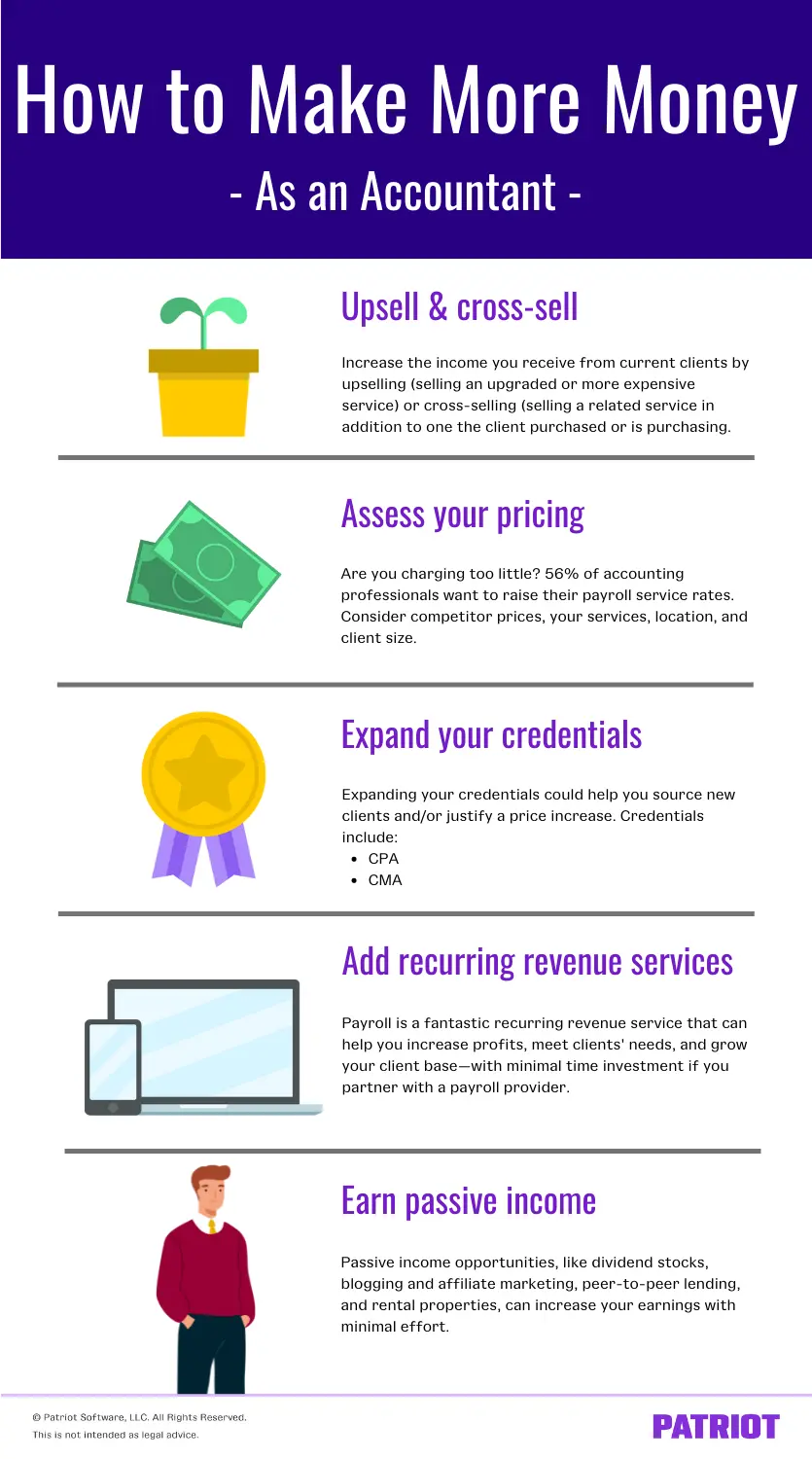
A fundamental strategy for increasing income without the heavy cost of new client acquisition is the optimization of the existing client base. In the context of professional services, this is achieved through upselling—encouraging clients to purchase a higher-end version of a service—and cross-selling—offering complementary services that provide additional value.
Data from recent sales surveys indicates that upselling and cross-selling can drive up to 30% of a firm’s total revenue. For an accountant, this might involve transitioning a client from a basic annual tax filing to a comprehensive quarterly tax planning package. While the initial engagement focuses on compliance, the upsell focuses on tax mitigation and long-term wealth preservation.
Cross-selling opportunities often arise in the realm of business advisory. An auditor might identify weaknesses in a client’s internal controls and offer to implement a new enterprise resource planning (ERP) system. By diversifying the touchpoints with a single client, the professional increases the client’s "switching cost" while simultaneously increasing the average revenue per user (ARPU). This approach is more cost-effective than traditional marketing, as it leverages the trust already established in the professional relationship.
Economic Reassessment of Pricing Models
One of the most immediate levers for increasing income is the rigorous assessment of pricing structures. Market data suggests that a significant portion of the industry is currently underpricing its services; approximately 56% of accounting professionals have expressed a desire to raise rates for recurring services such as payroll. The hesitation to increase prices often stems from a fear of client attrition, yet industry benchmarks show that modest, justified increases rarely lead to significant losses, especially in a high-inflation environment.
The transition from hourly billing to value-based pricing is a hallmark of high-earning firms. Hourly billing creates an inherent conflict of interest: the more efficient the accountant becomes through experience or technology, the less they are paid. Value-based pricing, conversely, aligns the fee with the perceived benefit to the client. When assessing pricing, professionals must consider:
- Competitive Benchmarking: Analyzing regional rates and the pricing of specialized niche competitors.
- Firm Location and Overhead: Adjusting for the cost of living and the cost of maintaining high-tier technological infrastructure.
- Client Scale: Implementing tiered pricing based on the complexity and revenue of the client’s business.
The ROI of Advanced Credentials and Specialization
In the accounting sector, credentials act as a proxy for expertise and reliability, directly influencing an individual’s ability to command higher fees or salaries. The pursuit of advanced certifications is a long-term investment that historically yields a high return on investment (ROI).

Key credentials currently influencing market rates include:
- Certified Public Accountant (CPA): The gold standard for the industry, often required for partnership tracks and high-level corporate roles.
- Certified Management Accountant (CMA): Focused on corporate finance and management, often leading to roles as CFOs or controllers.
- Certified Internal Auditor (CIA): Essential for those specializing in risk management and internal controls.
- Enrolled Agent (EA): A federal credential that grants unlimited representation rights before the IRS, highly valuable for tax resolution specialists.
The American Institute of Certified Public Accountants (AICPA) has noted that specialized knowledge in areas such as forensic accounting, cybersecurity audits, and Environmental, Social, and Governance (ESG) reporting is currently in high demand. By positioning themselves as specialists rather than generalists, accountants can justify premium pricing and attract a more sophisticated clientele.
Scaling Income with Recurring Revenue Streams
The traditional accounting cycle is often criticized for its "feast or famine" nature, with intense workloads during tax season followed by periods of lower activity. To achieve a six-figure income and stabilize cash flow, many professionals are integrating recurring revenue services into their practice.
Payroll services represent one of the most effective recurring revenue models. Historically, many small firms avoided payroll due to the complexity of tax filings and the risk of penalties. However, the advent of cloud-based payroll software has transformed this service into a high-margin, low-effort offering. Modern software automates tax rate updates, filings, and deposits, allowing accountants to act as the "reviewer" rather than the "doer."
The benefits of offering payroll and similar recurring services (such as outsourced CFO services or monthly bookkeeping) include:
- Sticky Revenue: Clients are less likely to leave a firm that handles their critical weekly operations.
- Predictability: Stable monthly income allows for better firm budgeting and reinvestment.
- Efficiency: Using white-label or partner programs allows firms to offer these services without significant increases in headcount.
Diversification and Passive Income Opportunities
Beyond traditional practice, the most successful accountants are exploring passive income and the "gig economy" to supplement their primary earnings. Passive income requires an initial investment of time or capital but yields ongoing returns with minimal maintenance.
Opportunities for accountants in this space include:
- Educational Content: Developing and selling online courses for small business owners or tutoring accounting students.
- Affiliate Partnerships: Recommending financial software or insurance products and receiving a commission for successful referrals.
- Financial Writing: Contributing to trade publications or developing a monetized financial blog.
- Side Engagements: Freelance consulting for startups or non-profits that do not require the full overhead of a traditional firm engagement.
Broader Industry Implications and Future Outlook
The drive for increased earnings in the accounting profession is occurring against a backdrop of significant industry consolidation and technological disruption. As larger firms acquire smaller practices to gain market share, independent practitioners must differentiate themselves through high-touch advisory services and technological proficiency.
The integration of Artificial Intelligence (AI) is expected to further bifurcate the market. Professionals who use AI to automate routine tasks will have more time to focus on high-value consulting, while those who resist technology may find their margins squeezed by competitors who can offer lower prices for basic compliance.
Ultimately, the secret to reaching the top 10% of earners lies in the shift from being a "cost center" for a client to being a "profit center." When an accountant can demonstrate that their advice has saved a client $50,000 in taxes or improved their cash flow by 20%, a fee of $10,000 becomes an easy investment for the client to justify. By focusing on the controllable factors of credentials, pricing, and service diversification, accountants can successfully navigate the 2024 economic landscape and maximize their professional earning potential.