Candice Horbacz
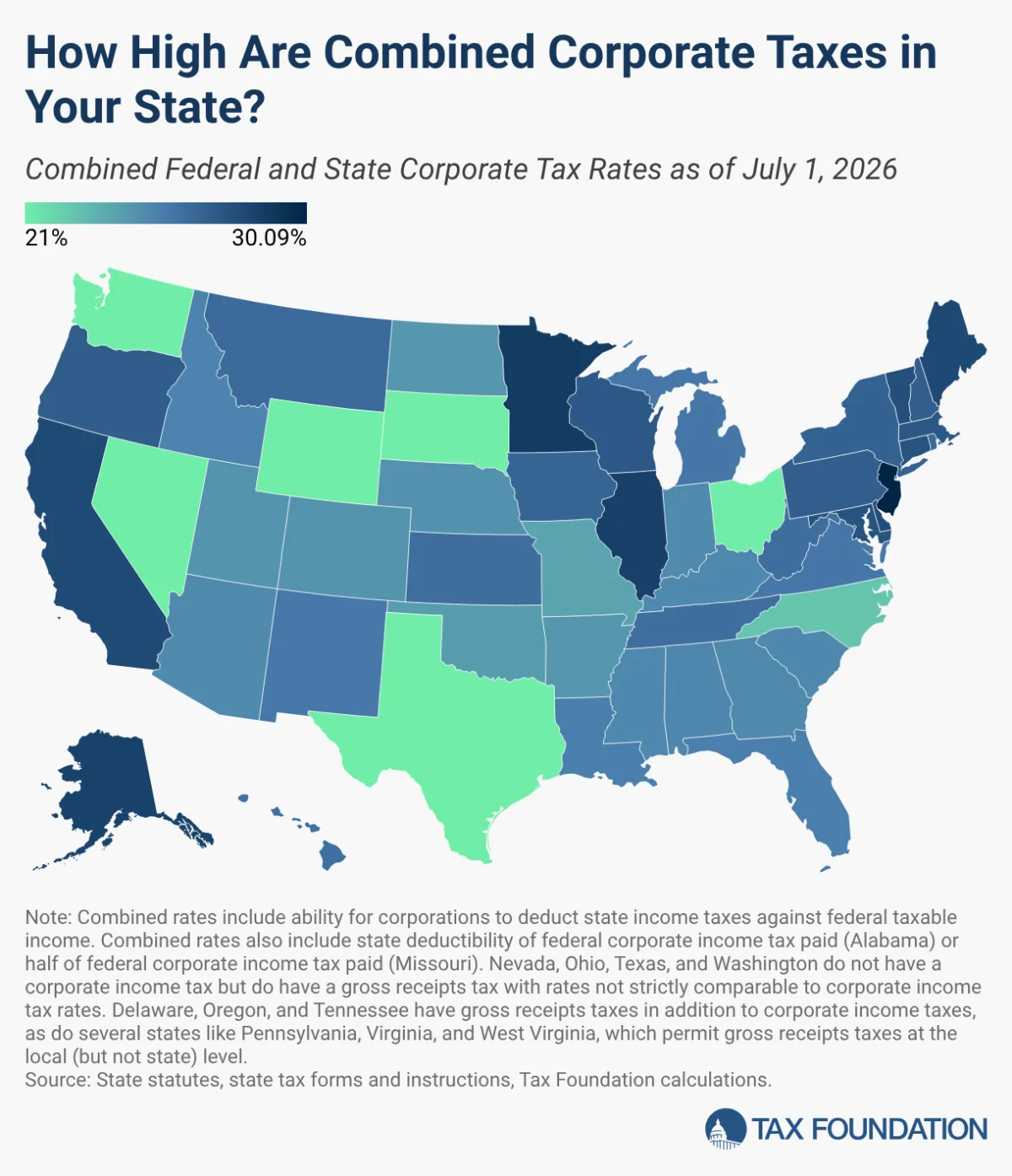
Corporations operating within the United States face a multifaceted and often intricate tax landscape, comprising a federal corporate income tax alongside a diverse array of state-level levies. At the federal level, businesses are subject to a corporate income tax (CIT) applied at a flat rate of 21 percent. This foundational federal rate is then compounded by state taxation, where forty-four states and the District of Columbia also impose taxes on corporate income. The top marginal rates for these state-level corporate income taxes exhibit significant variance, ranging from a comparatively low 2.0 percent in North Carolina to a robust 11.5 percent in New Jersey, reflecting diverse state fiscal strategies and economic priorities. The structure of these state taxes also differs, with thirteen states employing graduated corporate income tax rates—meaning the rate increases with higher levels of income—while thirty-one states and the District of Columbia opt for a flat rate system, applying a single percentage across all taxable corporate income.
The Federal Corporate Income Tax: A Post-TCJA Foundation
The current 21 percent federal corporate income tax rate was established by the Tax Cuts and Jobs Act (TCJA) of 2017. Prior to this landmark legislation, the federal corporate tax rate stood at 35 percent, a rate that had long been criticized for being among the highest in the industrialized world. The TCJA’s reduction was primarily aimed at enhancing the competitiveness of U.S. corporations on a global scale, encouraging domestic investment, and stemming the tide of corporate inversions—where U.S. companies reincorporate abroad to reduce their tax burden. Proponents argued that a lower rate would stimulate economic growth, lead to higher wages, and encourage businesses to keep profits and operations within the U.S. The federal corporate income tax, levied on a company’s profits after deductions for business expenses, remains a significant source of federal revenue, despite the rate reduction.
A State-Level Mosaic: Divergent Tax Philosophies
The heterogeneity of state corporate tax policies creates a complex environment for businesses. The range of top marginal rates, from North Carolina’s 2.0 percent to New Jersey’s 11.5 percent, underscores fundamental differences in how states approach revenue generation and economic development.
Rate Variation and Economic Strategy:
States like North Carolina, with its notably low 2.0 percent rate, often use their corporate tax structure as an incentive to attract new businesses, foster job creation, and encourage capital investment. The philosophy here is that a lower tax burden will draw companies, expanding the tax base through increased economic activity and potentially higher individual income and sales tax revenues. Conversely, states like New Jersey, with a top marginal rate of 11.5 percent, may prioritize direct revenue generation from corporate profits to fund public services. The higher rate could also reflect a state’s unique economic structure, reliance on specific industries, or broader fiscal needs. For instance, New Jersey’s diverse economy and high cost of living may necessitate a more aggressive corporate tax posture to maintain state budgets.
Graduated vs. Flat Rate Structures:
The choice between graduated and flat rate structures further distinguishes state approaches.
- Graduated Rates: Thirteen states employ graduated rates, which typically mean smaller businesses pay a lower rate on their initial profits, while larger corporations with higher profits face progressively higher rates. This structure is often seen as a more progressive approach, aiming to distribute the tax burden more equitably based on a company’s financial capacity. However, critics sometimes argue that graduated rates can add complexity and potentially disincentivize growth for companies nearing a higher tax bracket.
- Flat Rates: The majority of states (thirty-one states and the District of Columbia) utilize a flat rate system. This approach simplifies tax calculations and provides predictability for businesses of all sizes, as the same rate applies regardless of income level. Proponents emphasize the administrative ease and perceived fairness of a single rate, while opponents might argue it places a disproportionate burden on smaller enterprises compared to larger, more profitable ones.
Beyond Income: The Pervasive Reach of Gross Receipts Taxes
While corporate income taxes are the predominant form of state business taxation, a significant number of states have adopted or augmented their systems with gross receipts taxes (GRT). Unlike a corporate income tax, which is levied on a company’s net profits after deducting expenses, a gross receipts tax is applied to a company’s gross sales or total revenue, without deductions for business expenses such as compensation, cost of goods sold, or overhead. This fundamental difference has profound implications for businesses and the economy.
States Relying Solely on GRT:
Four states—Nevada, Ohio, Texas, and Washington—have opted to impose a gross receipts tax instead of a traditional corporate income tax at the state level. These states often cite reasons such as revenue stability (gross receipts tend to be less volatile than net profits, especially during economic downturns) and a broader tax base. For instance, Texas’s "margin tax" and Ohio’s "commercial activity tax" are well-known examples of this approach. While these states do not levy a state corporate income tax, businesses operating within them are still subject to the federal 21 percent corporate income tax, along with the state-level GRT. The absence of deductions in GRT can lead to a phenomenon known as "tax pyramiding," where the tax is levied at multiple stages of production, embedding the tax into the price of goods and services at each step and potentially increasing the final cost to consumers.
Hybrid Models: CIT and GRT:
A further layer of complexity is introduced by states that levy both a corporate income tax and a separate gross receipts tax. Delaware, Oregon, and Tennessee fall into this category. These hybrid models aim to diversify state revenue streams and address specific policy goals. For example, Oregon’s corporate activity tax (CAT), implemented in 2020, is a form of GRT that complements its corporate income tax, aiming to fund education and other public services. This dual approach means businesses in these states must navigate two distinct corporate-level tax regimes, potentially increasing compliance costs and overall tax burden.
Local Gross Receipts Taxes:
The complexity extends even to the local level in some states. Pennsylvania, Virginia, and West Virginia, for example, levy gross receipts taxes at the local (but not state) level. This adds another dimension for businesses, particularly those with operations across multiple municipalities or counties within these states. Managing local GRTs can be particularly challenging due to varying local rates, definitions, and administrative requirements, potentially creating competitive disparities between businesses located in different jurisdictions.
States Without Corporate-Level Taxes:
Standing in stark contrast to the majority are South Dakota and Wyoming, which levy neither a state corporate income tax nor a statewide gross receipts tax. These two states offer a unique tax advantage for corporations, attracting businesses seeking to minimize their state-level tax obligations. These states typically rely more heavily on other revenue sources, such as sales taxes, property taxes, severance taxes on natural resources, or tourism-related levies, to fund public services. Their "no corporate tax" status is a significant factor in their economic development strategies, aiming to create a highly attractive business environment.
The True Burden: Combined Federal and State Rates
To accurately assess the tax burden on corporations, it is essential to consider the combined effect of federal and state taxes. The interaction between these two levels of taxation can result in significantly higher overall rates than either component alone.
Highest Combined Rates:
New Jersey stands out with the highest combined corporate income tax rate in the nation, reaching an estimated 30.1 percent when factoring in both federal and state levies. This elevated rate reflects its high state corporate income tax. Other states where corporations face combined corporate income tax rates at or above 28 percent include Alaska, Illinois, Maine, and Minnesota. Such high combined rates can influence business location decisions, capital investment strategies, and the overall competitiveness of companies operating in these jurisdictions. Businesses may consider relocating or expanding in states with lower combined tax burdens to improve their profitability and investment capacity.
States with Lower Combined Burdens:
Conversely, states that levy no state corporate income tax—namely Ohio, Nevada, South Dakota, Texas, Washington, and Wyoming—effectively subject corporations to only the federal tax rate of 21 percent. It is important to remember, however, that four of these states (Ohio, Nevada, Texas, and Washington) do levy statewide gross receipts taxes, which, while not an income tax, still represent a significant state-level business burden. South Dakota and Wyoming truly stand out as the states with the lowest corporate-level tax burden, as businesses there face only the 21 percent federal corporate income tax and no state-level corporate income or gross receipts taxes.
The Nuance of Deductibility: Adjusting Effective Rates
The interaction between federal and state tax systems is further complicated by provisions allowing for the deductibility of certain taxes. These provisions can significantly lower a corporation’s effective tax rate.
State CIT Deduction Against Federal Taxable Income:
A crucial aspect of U.S. corporate taxation is that corporations are generally permitted to deduct state corporate income taxes paid against their federal taxable income. This deduction effectively reduces the base upon which the federal 21 percent corporate income tax is calculated, thereby lowering the effective federal corporate income tax rate. For example, consider a corporation subject to Rhode Island’s flat corporate income tax rate of 7 percent. While the nominal federal rate is 21 percent, the deduction of the 7 percent state tax reduces the federal taxable income. Assuming a company has $100 in taxable income, paying $7 in state tax, its federal taxable income becomes $93. The federal tax would then be 21% of $93, or $19.53. Adding the $7 state tax, the total tax paid is $26.53, resulting in a combined effective rate of 26.53 percent ($26.53/$100), rather than a simple sum of 21% + 7% = 28%. This mechanism means the federal government implicitly shares a portion of the burden of state corporate taxes.
Federal CIT Deduction Against State Tax Liability:
Adding another layer of complexity, two states allow corporations to deduct federal corporate income tax against some portion of their state corporate income tax liability. Alabama permits full deductibility of federal corporate income tax liability against state liability, while Missouri allows a 50 percent deduction. This policy aims to further reduce the overall corporate tax burden within these specific states, making them potentially more attractive for businesses. By allowing federal taxes to reduce the state tax base, these states essentially offer an additional incentive, lowering the effective corporate income tax rate faced by corporations operating within their borders. This approach is less common but represents a deliberate policy choice to mitigate the cumulative impact of federal and state taxation.
Historical Context and Evolution of Corporate Taxation
The U.S. corporate tax system has undergone significant transformations throughout its history. First enacted in 1909 as an excise tax on corporate income, it evolved into a formal income tax in 1913. Rates fluctuated considerably, peaking during World War II at over 50 percent to fund the war effort. Post-war, rates generally remained high, often around 40-50%, through the mid-20th century. Major reforms in 1986 under President Reagan dramatically lowered the top corporate rate from 46 percent to 34 percent, aiming to simplify the code and boost competitiveness. This trend of rate reduction continued, culminating in the TCJA of 2017, which reduced the rate from 35 percent to the current 21 percent. These historical shifts illustrate a continuous balancing act between revenue needs, economic competitiveness, and perceived fairness. Recent international discussions, such as the OECD’s efforts towards a global minimum corporate tax, further underscore the ongoing evolution and interconnectedness of corporate tax policies worldwide, potentially influencing future U.S. federal and state reforms.
Economic Implications and Policy Debates
The structure and level of corporate taxation are subjects of continuous economic analysis and policy debate. The Tax Foundation, a prominent non-profit tax policy think tank, characterizes corporate taxes as among the "most economically damaging ways to raise revenue." This assertion stems from economic research suggesting that corporate income taxes can discourage investment, reduce innovation, and ultimately lead to slower economic growth.
Incidence of Corporate Tax: A key aspect of this debate revolves around the "incidence" of the corporate tax—who ultimately bears the burden. While corporations legally pay the tax, economists often argue that the burden is effectively passed on to various stakeholders:
- Shareholders: Through lower dividends and reduced stock values.
- Workers: Through lower wages or fewer job opportunities, as companies may have less capital to invest in expansion or productivity improvements.
- Consumers: Through higher prices for goods and services, as companies pass on some of the tax cost.
The precise distribution of this burden is a complex area of economic study, with different models yielding varying estimates.
Competitiveness and Investment: The combined federal and state corporate tax rates directly impact the competitiveness of U.S. businesses, both domestically and internationally. High rates can deter foreign direct investment, encourage domestic companies to move operations overseas (corporate inversions), and disincentivize capital formation within the country. Conversely, a competitive tax environment can attract investment, foster business expansion, and create jobs. This competitive dynamic is a primary driver behind calls for corporate tax reform at both federal and state levels.
Revenue Stability vs. Economic Growth: States face a perennial challenge in balancing the need for stable revenue streams to fund public services with the desire to foster economic growth through lower tax burdens. Gross receipts taxes, while potentially more stable in revenue generation, carry the risk of tax pyramiding and disproportionately affecting businesses with low-profit margins. Corporate income taxes, while linked to profitability, can be more volatile, especially during economic downturns. Policymakers continuously weigh these trade-offs when designing or reforming their tax systems.
Calls for Reform: The complexity and economic implications of the current corporate tax system fuel ongoing calls for reform. Advocates for lower rates argue for further reductions to boost competitiveness and stimulate the economy. Others focus on simplification, aiming to reduce compliance costs and create a more transparent system. Addressing issues like tax pyramiding from gross receipts taxes and harmonizing federal and state tax interactions are also frequently cited areas for potential reform. The average combined state and corporate tax rate imposed in the U.S. is approximately 25.5 percent, a figure that provides a snapshot of the aggregate burden but masks the significant variations and underlying complexities faced by individual businesses across different states.
In conclusion, the U.S. corporate tax landscape is a dynamic and intricate system characterized by a uniform federal rate complemented by a diverse patchwork of state and local levies. From traditional corporate income taxes with widely varying rates and structures to the proliferation of gross receipts taxes and the unique positions of states with no corporate-level taxes, businesses must navigate a complex web of obligations. Understanding the interplay of these taxes, including the crucial mechanisms of deductibility, is paramount for corporations in strategic planning and for policymakers aiming to foster a competitive and prosperous economic environment. The ongoing debate surrounding corporate taxation underscores its significant impact on investment, employment, and the overall economic health of the nation.