Candice Horbacz
The intricate tapestry of property taxation across Europe, and indeed globally, traces its origins back to feudal times, where levies were primarily imposed on land and predominantly borne by farmers. This ancient fiscal mechanism, rooted in the agrarian economies of past centuries, has undergone a profound transformation, evolving into a sophisticated system that, in modern times, encompasses not only land but also a broad spectrum of assets such as real estate, levied recurrently on individuals and legal entities alike. This evolution reflects centuries of economic, social, and political change, adapting from a simple land rent to a complex instrument of public finance, shaping urban development, investment patterns, and the fiscal autonomy of local governments.
Historical Trajectories and Economic Principles of Property Taxation
The concept of taxing property, particularly land, is one of the oldest forms of government revenue generation. In feudal societies, land was the primary source of wealth and power, and taxes on its ownership or use were a direct reflection of a ruler’s authority and a means to fund military endeavors and public works. These early systems were often rudimentary, based on assessments of agricultural output or land area, and were inextricably linked to the social hierarchy of the time. The shift from feudalism to market economies necessitated a re-evaluation of tax bases. As economies diversified and urbanization accelerated, the value embedded in buildings and structures became increasingly significant, leading to the expansion of property tax bases beyond mere land value.
Ideally, a well-designed property tax system can serve as a potent tool for local governments, offering a valuable fiscal incentive for new development. By linking local government revenue directly to the value of local property, it encourages municipalities to foster economic growth and permit construction, as these activities expand their tax base. Furthermore, property taxes offer a robust and stable mechanism to fund essential local public services—such as schools, roads, sanitation, police, and fire departments—whose value is often capitalized into property prices, meaning that property owners directly benefit from the services they help fund. This creates a virtuous cycle where local investments enhance property values, which in turn generate more tax revenue for further public services.
However, the implementation of property taxes is not without its complexities and potential drawbacks. High property taxes, particularly when levied not only on land but also on buildings and structures, can inadvertently discourage investment in these assets. Businesses, in particular, may face substantial additional tax burdens on new constructions, renovations, or expansions. This disincentive can manifest as businesses opting to locate their operations away from jurisdictions with punitive property tax rates, thereby hindering local economic development and job creation. The cumulative effect of high property taxes on commercial and industrial properties can thus impact a region’s competitiveness, influencing decisions ranging from factory siting to retail expansion. Economic analysis consistently points to the potential for such taxes to distort investment decisions, especially when they are not deductible against corporate income.
A Diverse European Landscape: From Zero Tax to Land-Only Models
The diversity of property tax regimes across Europe underscores the varying economic philosophies and fiscal priorities of its nations. Of the 34 European countries surveyed in recent analyses, two outliers stand out for their complete absence of recurrent property taxes: Liechtenstein and Malta. These microstates rely on alternative revenue streams, often benefiting from specific economic niches such as financial services or tourism, which allow them to forgo this common form of local government finance. Their unique economic structures and small geographical sizes may contribute to the feasibility of such an approach, distinguishing them from larger, more industrialized nations.
Estonia, a Baltic nation renowned for its digital governance and innovative economic policies, presents another distinct model. It is the sole country within the surveyed group that levies property taxes exclusively on land. This land-only tax system is frequently cited by economic experts as the most efficient form of real property taxation. The rationale behind this efficiency stems from several economic principles. Land, being a fixed and finite resource, cannot be moved or created, meaning that a tax on land value does not distort economic activity in the same way a tax on improvements (buildings, infrastructure) might. A tax on land value captures the unearned increment in value that arises from public investment (e.g., infrastructure development, school improvements) and population growth, rather than penalizing productive investment. This approach encourages optimal land use, as landowners are incentivized to develop their plots efficiently to cover the tax, regardless of whether they build upon it or not.
Deductibility and the Specter of Double Taxation
Among the 32 European countries that do levy recurrent property taxes, a crucial distinction emerges regarding their treatment in corporate accounting: deductibility. A significant majority—28 countries—allow businesses to deduct property or land taxes from their corporate income. This provision is vital for mitigating the overall tax burden on businesses and serves as a powerful incentive for investment. By treating property taxes as a legitimate business expense, similar to rent or utility costs, these countries reduce the effective cost of owning and improving property for commercial purposes. This policy fosters a more favorable investment climate, encouraging companies to expand operations, modernize facilities, and contribute to the local economy without facing an excessively high tax load. It aligns with the principle of taxing net income, where expenses incurred to generate that income are recognized.
However, a quartet of European nations—Austria, Iceland, Italy, and Slovenia—stand apart by prohibiting the deduction of property taxes from business income. This policy leads to a phenomenon known as double taxation of business properties. In these countries, a business’s income is taxed, and then the property it owns (which is essential for generating that income) is taxed separately, without the property tax expense being offset against the income tax. This means that the same economic activity effectively faces two layers of taxation without proper relief. Double taxation can significantly increase the operational costs for businesses, potentially reducing profitability, discouraging capital investment in real estate, and making these countries less attractive for businesses seeking to establish or expand their physical presence. The implications are particularly acute for capital-intensive industries or those requiring substantial real estate holdings, where the non-deductibility can translate into a considerable competitive disadvantage.
Comparative Revenue Generation: A Spectrum of Fiscal Reliance
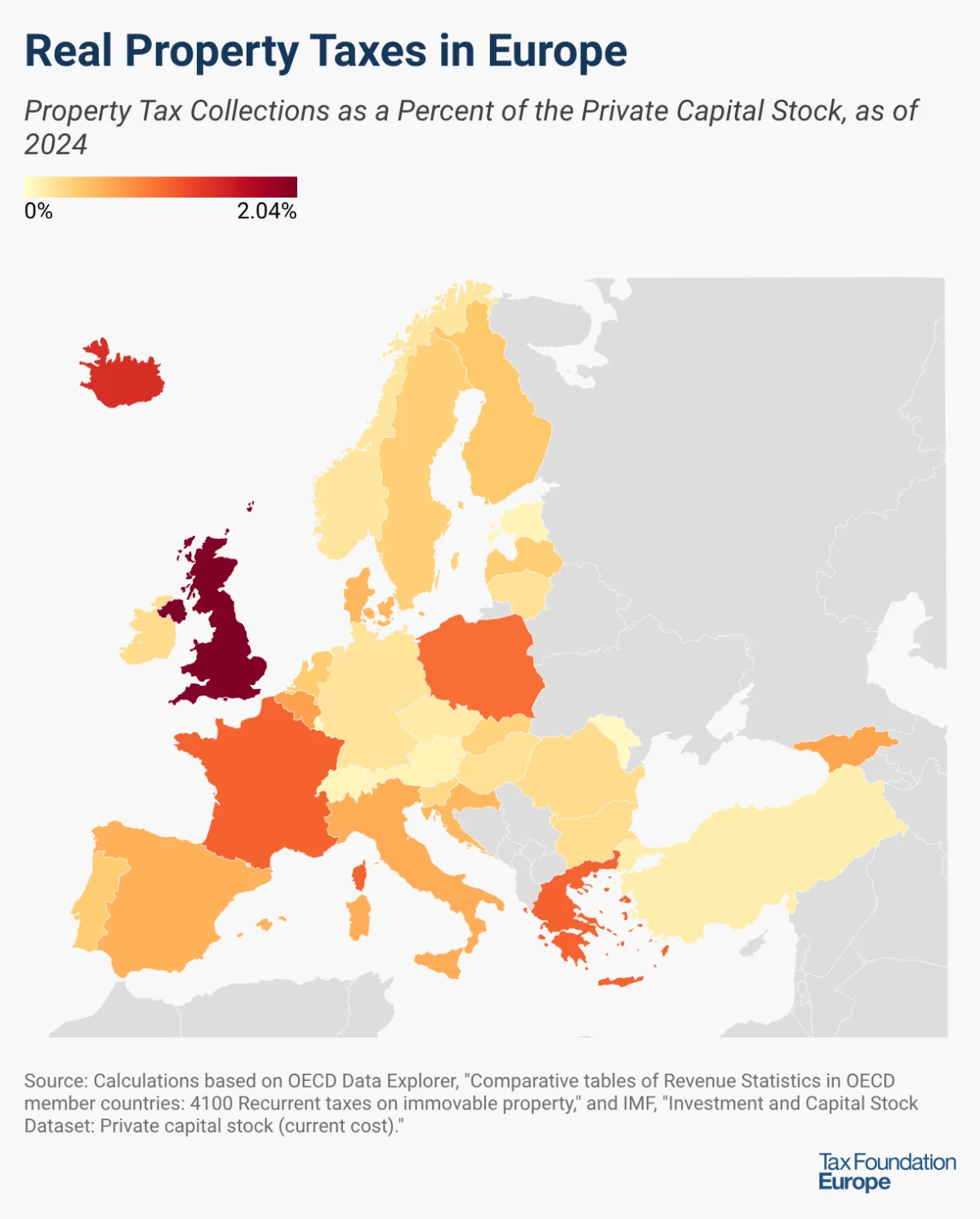
The extent to which countries rely on property taxes as a share of their private capital stock varies dramatically across Europe, reflecting differing fiscal priorities and economic structures. At the lower end of the spectrum, Luxembourg and Moldova raise the lowest property tax revenues, at approximately 0.05 percent of their private capital stock. These figures suggest a relatively low reliance on this revenue stream, possibly indicating strong alternative tax bases (e.g., corporate taxes in Luxembourg, or different economic structures in Moldova) or a policy choice to minimize the burden on property owners. Switzerland and Estonia follow closely, with property tax revenues representing 0.08 percent and 0.09 percent of their private capital stock, respectively. Estonia’s low figure, despite its efficient land-only tax, suggests that while the tax is well-structured, the rates applied might be moderate, or its overall capital stock is substantial. Switzerland, known for its decentralized fiscal system, might see more revenue raised at the local level that isn’t fully captured in this metric, or it might prioritize other forms of taxation.
In stark contrast, the United Kingdom stands out with the highest property taxes as a share of private capital stock, reaching an impressive 2.04 percent. This high figure is largely attributable to the UK’s extensive system of local property taxes, including council tax on residential properties and business rates on commercial properties, which are significant revenue generators for local authorities. Iceland follows with 1.43 percent, and France with 1.08 percent, both indicating a substantial reliance on property-related revenues to fund public services. These higher percentages suggest that property taxation plays a much more central role in the fiscal architecture of these nations, contributing significantly to local and, in some cases, national budgets.
On average, the 32 European countries that levy recurrent property taxes generate approximately 0.45 percent of their private capital stocks from this source. This average provides a benchmark for understanding the general European approach. However, a compelling comparison emerges when looking across the Atlantic: the United States raises a substantially higher proportion, collecting as much as 1.88 percent of its private capital stock in property taxes. This significant difference underscores the greater reliance of the highly decentralized U.S. local government system on property taxes to fund a vast array of local services, particularly public education, compared to many of its European counterparts. This difference also reflects historical and constitutional distinctions in how public services are funded and how fiscal power is distributed between central and local governments.
Distribution of the Tax Burden: Households vs. Businesses
Understanding who bears the brunt of property tax is crucial for assessing its economic and social impact. For the 16 European countries that provide data on the split of property tax revenues between businesses and households, the general trend indicates that households remit around 60 percent of the total property tax revenue. This suggests that residential property owners, whether individuals or families, are the primary contributors to this tax stream across much of Europe.
However, this average masks considerable variation. At one extreme, the Slovak Republic demonstrates a unique distribution, with households contributing only 7.4 percent of receipts. This implies that businesses in Slovakia bear an exceptionally large share of the property tax burden, a policy choice that could significantly influence corporate investment decisions and the competitiveness of its business sector. Conversely, France represents the other end of the spectrum, with households accounting for a substantial 71.4 percent of property tax revenue. This indicates a heavier reliance on residential property owners for funding local services, potentially reflecting higher residential property values, different assessment methodologies, or a policy decision to place less of the burden on commercial enterprises. These disparities highlight the diverse strategies employed by European nations to balance revenue generation with economic incentives and social equity concerns.
Recent Policy Shifts and Their Broader Implications
The landscape of property taxation is not static; it is continually evolving in response to economic pressures, political mandates, and a quest for greater efficiency and fairness. Recent changes in Germany and Croatia illustrate this ongoing evolution.
Starting from 2025, Germany is embarking on a significant reform, devolving its property tax base to the state level. This decentralization allows individual states greater autonomy in designing their property tax systems, moving away from a uniform federal approach. The state of Baden-Württemberg has seized this opportunity to implement a progressive model, choosing to apply property taxes solely to the value of land. This move by a prominent German state aligns with the efficiency arguments for land value taxation, mirroring Estonia’s approach. The rationale behind such a shift is to encourage efficient land use, reduce disincentives for investment in buildings, and capture the value created by public investments and economic growth that accrues to land. Economic analysts view this as a potentially positive development for investment and urban planning in Baden-Württemberg, though its long-term effects on revenue stability and equity will be closely watched. This reform is expected to lead to a more tailored property tax landscape across Germany, with other states potentially adopting different models based on their specific needs and economic contexts.
Croatia, also from 2025, is introducing a recurrent property tax. This represents a significant policy shift for the country, moving towards a more established form of local government finance. The tax will be levied based on the square meters of land and floor area, indicating a broader base that includes both land and improvements. The introduction of such a tax often aims to bolster local government revenues, providing a more stable and predictable funding source for public services. It also brings Croatia more in line with the majority of European countries that utilize recurrent property taxes. The implementation will involve challenges related to property valuation, administrative capacity, and public acceptance, but the long-term goal is likely to enhance fiscal decentralization and improve the provision of local public goods.
Conclusion: Navigating the Complexities of Property Taxation
The journey of property taxation from its feudal origins to its modern manifestations is a testament to its enduring relevance as a fiscal instrument. The European experience, characterized by a spectrum of approaches—from no property tax to land-only models, and diverse rules on deductibility—underscores the complex interplay between historical legacy, economic theory, and political priorities. While ideally serving as a stable source of local revenue and an incentive for development, poorly designed property taxes can stifle investment and create economic distortions.
The comparative analysis reveals profound differences in fiscal reliance and burden distribution, with countries like the UK and France leaning heavily on property taxes, while others like Luxembourg and Moldova use them sparingly. The significant divergence between Europe’s average reliance and the US’s much higher figure highlights distinct governance models and funding philosophies. Recent reforms in Germany and Croatia demonstrate an ongoing commitment to refining these systems, with a discernible trend towards models that aim for greater efficiency and local fiscal autonomy.
As European economies continue to evolve, the debate over property tax design—its base, rates, deductibility, and allocation of burden—will remain central to discussions on local governance, urban planning, investment climate, and social equity. Policymakers face the continuous challenge of crafting property tax regimes that are not only effective in generating revenue but also equitable, efficient, and supportive of sustainable economic growth and vibrant communities. The ongoing evolution of these taxes will shape the fiscal health of nations and the economic landscape for businesses and households across the continent for decades to come.