Nila Kartika Wati

In the landscape of American democracy, the integrity of voter rolls is often presented as a matter of administrative hygiene. However, recent data from Louisiana and several neighboring states suggest that the process of "cleaning" these rolls has evolved into a mechanism that disproportionately sidelines specific demographics. In January 2025, Louisiana reported 178,395 voters on its "inactive" list, representing approximately six percent of the total registered population. By July 2026, that figure had surged to 450,086. Today, more than one in seven registered voters in the state carries the "inactive" label, a designation that serves as a precursor to removal and introduces significant hurdles at the polling place.
While state officials maintain that inactive status is not an outright removal, voting rights advocates argue that the label creates "fictional friction." An inactive voter who arrives at the polls must navigate additional bureaucratic steps, such as signing written affirmations of their address, before being allowed to cast a regular ballot. Data indicates that these are not merely "ghost" voters or citizens who have abandoned the democratic process. Of the 450,000 individuals currently listed as inactive in Louisiana, 52,981 cast ballots in the November 2024 election. Furthermore, nearly 84,000 others participated in the 2020 or 2022 election cycles. These figures suggest that the system is flagging active, engaged citizens as effectively "out of office."
The Mechanism of Inactivity: Cleanup by Mailbox
The primary driver behind this statistical spike is a 2024 state law that expanded the authority of the Secretary of State’s office. Secretary of State Nancy Landry has noted that the increase is largely the result of address-confirmation mailings sent to individuals who had not voted in ten or more years. This cycle marked the first time the tool was deployed on such a massive scale. Under the law, any voter who fails to respond to these mailings is automatically transitioned to inactive status.

While federal law requires states to make "reasonable efforts" to maintain accurate voter rolls to prevent mail being sent to deceased individuals or vacated addresses, the methodology utilized in Louisiana has proven to be a blunt instrument. Mail-based verification assumes a level of residential stability and literacy that does not reflect the reality of many vulnerable populations. Mail often fails to reach individuals who have moved within the same city, those who reside in multi-family housing with shared mailboxes, or those with limited English proficiency. Furthermore, official-looking government correspondence is frequently discarded by recipients who mistake it for unsolicited junk mail or predatory solicitations.
The impact of this blunt-force administrative tool is visible across all 64 of Louisiana’s parishes. While the law ostensibly targeted those who had not voted in a decade, tens of thousands of individuals who participated in the 2024 general election found themselves on the inactive list regardless. This is because the state’s inactive list also captures voters whose addresses could not be verified during annual reviews, including anyone whose mail was returned as undeliverable—even if that individual had cast a ballot just months prior.
Demographic Disparities and the Burden of Inactivity
A comprehensive analysis conducted by the Rise Forward Foundation and the ACLU of Louisiana reveals that the burden of inactive status is not distributed equally across the electorate. Examining voter files from January 2025 through July 2026, researchers found stark racial and geographic divides. Asian American voters, for instance, experienced the most dramatic shift; their inactive rate more than tripled, jumping from 5.9 percent to 18.7 percent in less than two years.
The ACLU of Louisiana’s report, titled Who Gets Flagged Inactive?, confirms that the "burden of inactivity" correlates strongly with race and political affiliation. In East Carroll Parish, the inactive rate rose by more than 17 percentage points to reach 32.6 percent—the highest in the state. Within that parish, nearly 39 percent of Black voters are now classified as inactive, compared to just 16 percent of white voters.
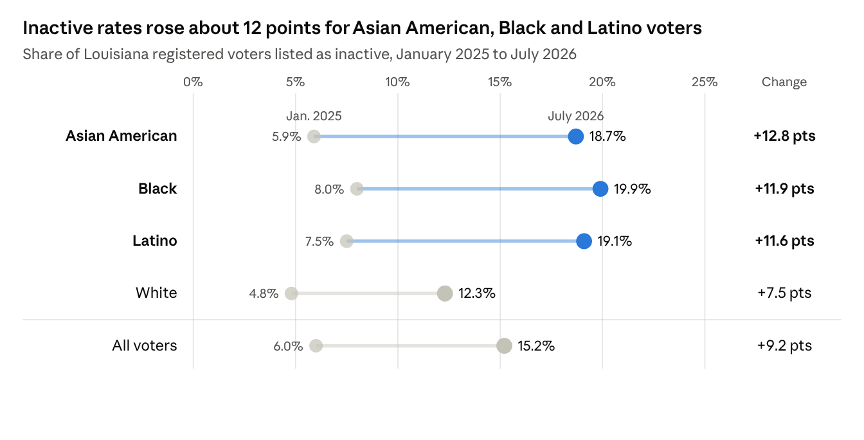
The situation is similarly pronounced in Tangipahoa Parish, where 41.7 percent of Black voters—totaling more than 9,000 individuals—are inactive. In contrast, the inactive rate for white voters in the same parish stands at 23.7 percent. The historical context of Tangipahoa Parish adds weight to these findings; the parish’s school system only recently achieved "unitary status," resolving a 60-year-old desegregation case. Advocates argue that in regions where public systems have a history of exclusion, the disproportionate flagging of minority voters is particularly alarming.
A Historical Context of Disenfranchisement
The current surge in inactive designations does not exist in a vacuum. Louisiana has a long history of utilizing administrative maneuvers to shrink its electorate. Following the adoption of the state’s 1898 constitution, which introduced poll taxes, literacy tests, and the infamous "grandfather clause," Black voter registration plummeted. In 1897, nearly 44 percent of registered voters were Black (approximately 130,344 people). By 1900, that number had been decimated to just 5,320.
In the 1950s, as Black registration began to climb again, the state legislature and the Citizens’ Councils initiated what the U.S. Supreme Court would later describe as a "wholesale challenging of Negro names." This era saw thousands of Black voters purged from the rolls over minor clerical discrepancies, while white voters remained largely untouched. This history necessitated the federal "pre-clearance" requirements of the Voting Rights Act of 1965, which forced Louisiana to seek federal approval before changing voting rules.
However, the 2013 Supreme Court decision in Shelby County v. Holder effectively ended these protections. The 2024 mailing law is precisely the type of policy change that previously would have required federal scrutiny to ensure it did not have a discriminatory impact. Without that oversight, the impact of these policies is only understood after the fact, through the retrospective analysis of voter data.

Administrative Failures and the "Human Error" Factor
The fragility of the current system was highlighted on October 5, 2026, when a "human error" during routine database maintenance by the Secretary of State’s office inadvertently switched approximately 67,000 voters statewide to inactive status. While the office claimed the mistake was caught quickly and corrected, the incident caused significant alarm among voters.
Individuals like Courtney Price of East Baton Rouge Parish reported finding themselves listed as inactive despite having lived at the same address for over a decade. Such errors are particularly consequential because the safeguard—signing an affirmation at the polls—depends entirely on the consistent training of poll workers across all parishes and the awareness of the voters themselves. Furthermore, inactive status starts a legal countdown: any voter who remains inactive and fails to vote in two consecutive federal general elections can have their registration permanently canceled.
The stakes are high. In the 2024 presidential election, Louisiana rejected 77 percent of the 3,926 provisional ballots cast. Historically, the state has rejected roughly 70 percent of provisional ballots over the last four election cycles. While data does not explicitly state how many of these rejections stemmed from inactive voters, the high rejection rate suggests that voters who fall out of "active" standing face an uphill battle in having their voices heard.
A Regional Trend: The Growth of Inactive Rolls in the South
Louisiana is not the only state seeing a massive expansion of inactive voter lists. Across the American South, legislative shifts have tightened list-maintenance requirements, leading to millions of voters being moved to the sidelines.

- Florida: In 2023, nearly one million voters were moved off the active rolls following new state laws that mandated more frequent and aggressive list maintenance.
- Georgia: The state currently maintains nearly one million inactive voters out of a pool of 8.4 million. In 2025, a "no contact" audit flagged an additional 219,000 voters who had no recorded activity in five years.
- Alabama: Between 2020 and 2024, Alabama’s inactive list nearly doubled, now encompassing roughly 11 percent of the state’s electorate.
- Mississippi: The state has implemented even stricter hurdles for inactive voters. In Mississippi, inactive individuals cannot use standard voting machines; they must cast signed paper ballots which are only counted if the voter affirms they still reside in the same precinct.
Mississippi has also drawn criticism for its use of unverified third-party data. The Secretary of State’s office reportedly used Experian’s "TrueTrace" product—a tool designed for debt collection—to flag approximately 50,000 voters as inactive without prior confirmation. Critics argue that credit bureau data is fundamentally unsuitable for determining voting eligibility, as it prioritizes financial tracking over the nuances of residency and civic engagement.
Looking Forward: The Need for Structural Solutions
As the 2026 election cycle progresses, the task of re-engaging inactive voters has fallen largely to nonprofit organizations. The Rise Forward Foundation has mailed tens of thousands of registration forms and status notifications to voters in Mississippi and Louisiana. However, advocates argue that community outreach is a reactive solution to a systemic problem.
"Nonprofits are left reverse-engineering a problem the state created in a single mailing," organizers stated. "We would never accept that in disaster response—handing out sandbags one at a time after the levee has already been breached."
Experts suggest that the solution lies in modernizing voting infrastructure. Proposed fixes include:

- Automatic Voter Registration (AVR): Updating voter addresses automatically when citizens interact with the DMV or other state agencies.
- Same-Day Registration: Allowing voters to correct registration errors or update addresses at the polling place on Election Day.
- Data Integration: Moving away from blunt mailings and toward more accurate, multi-state database systems like the Electronic Registration Information Center (ERIC) to track moves more reliably.
For the immediate future, the primary recommendation for voters is to proactively check their status via official portals like Louisiana’s GeauxVote. As the Rise Forward Foundation and the ACLU prepare for a post-election analysis in November 2026, the data will likely serve as a referendum on whether "inactive" status is a tool for integrity or a modern-day barrier to the ballot. The results will be instrumental in shaping future legislative challenges and advocacy efforts aimed at ensuring that the "housekeeping" of democracy does not result in the eviction of its citizens.