
 Lana Rhoades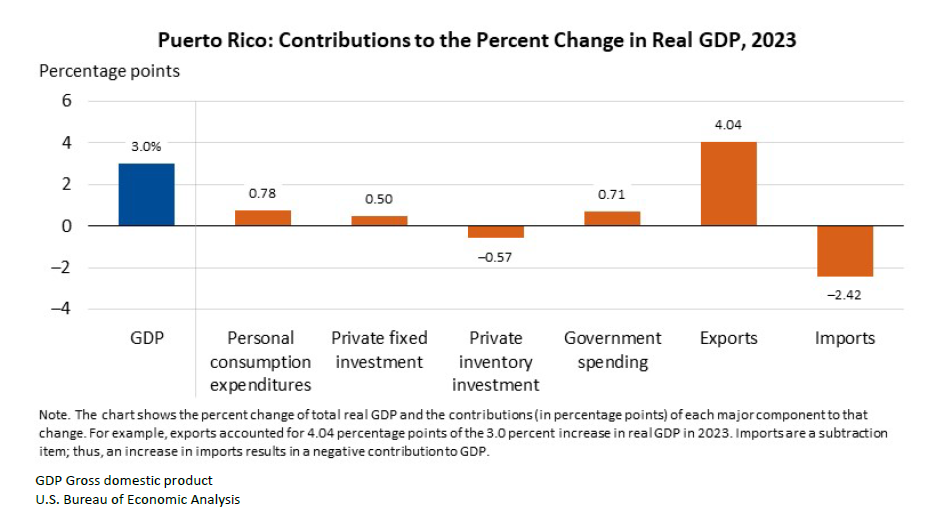
Puerto Rico’s economy demonstrated a significant rebound in 2023, with real gross domestic product (GDP) experiencing a robust increase of 3.0 percent. This marks a notable turnaround from the 2.1 percent contraction observed in 2022, according to the latest statistics released by the U.S. Bureau of Economic Analysis (BEA). The upward trajectory in 2023 was primarily propelled by a substantial surge in exports, complemented by growth in personal consumption expenditures, government spending, and private fixed investment. These positive contributions were partially tempered by a decline in private inventory investment and an increase in imports, which are subtracted in GDP calculations.
Economic Rebound Driven by Export Strength and Domestic Demand
The 3.0 percent expansion in Puerto Rico’s real GDP in 2023 signifies a positive shift in economic momentum. This growth contrasts sharply with the preceding year’s contraction, suggesting a recovery fueled by a combination of robust external demand and strengthening domestic economic activity. The BEA data highlights that exports, a key engine of economic growth, played a pivotal role in this resurgence.
Key Drivers of GDP Growth in 2023:
- Exports: Real exports saw a significant increase of 6.4 percent, encompassing both goods and services. Exports of goods rose by 6.6 percent, while exports of services grew by 5.6 percent. This surge indicates a heightened demand for Puerto Rican products and services in international markets.
- Personal Consumption Expenditures (PCE): Real PCE, a measure of household spending, increased by 1.2 percent. Within PCE, spending on services experienced a notable uptick of 4.0 percent, while spending on goods saw a slight decrease of 0.8 percent. This suggests a shift in consumer preferences towards services, potentially reflecting increased confidence and disposable income.
- Government Spending: Real government spending demonstrated a substantial increase of 4.8 percent. This growth was observed across all levels of government—federal, central, and municipal—with a particular emphasis on investment spending. This upward trend is intrinsically linked to the ongoing disbursement of federal funds for disaster recovery and infrastructure improvements.
- Private Fixed Investment: Real private fixed investment climbed by 3.8 percent, largely driven by increased investment in equipment. This was predominantly led by industrial equipment, signifying business expansion and modernization efforts.
These positive contributions were partially offset by a decrease in real private inventory investment, which saw its largest drag from the manufacturing sector. Additionally, real imports increased by 4.4 percent, primarily due to a rise in the import of goods, particularly pharmaceuticals and organic chemicals.
A Closer Look at the Components of Growth
Exports: The International Engine: The robust performance of exports in 2023 underscores Puerto Rico’s growing integration into global trade. The dual increase in both goods and services exports suggests a diversified export base. The rise in goods exports could be attributed to various sectors, while the growth in services exports might reflect the expanding tourism industry or the increasing demand for professional and technical services offered by the island. This trend is crucial for sustained economic development, as it brings foreign currency into the economy and supports domestic employment.
Consumer Spending: A Resilient Domestic Force: The 1.2 percent increase in real personal consumption expenditures indicates a degree of resilience in domestic demand. The divergence between spending on services and goods—with services outpacing goods—is a common pattern in economies experiencing recovery and growth. Consumers may be reallocating their budgets towards experiences and services as confidence returns. This trend is positive for service-oriented businesses on the island.
Government Investment: Rebuilding and Modernizing: The significant increase in government spending, particularly in investment, is directly tied to the ongoing recovery efforts from natural disasters. The BEA report specifically notes that these increases reflect continued growth in disbursements of federal funds for disaster recovery related to Hurricanes Irma and Maria (2017), earthquakes (2019-2020), and Hurricane Fiona (2022). Critical infrastructure projects, including the power grid, aqueduct system, roads, bridges, and the National Guard’s Camp Santiago, are benefiting from these investments. This suggests a proactive approach to rebuilding and enhancing the island’s resilience.
Private Investment: Fueling Future Growth: The 3.8 percent rise in real private fixed investment, especially in industrial equipment, signals a positive outlook among businesses. This investment is a critical component of long-term economic growth, as it enhances productivity, fosters innovation, and creates jobs. The focus on industrial equipment suggests that businesses are looking to upgrade their operational capacity and potentially expand their manufacturing capabilities.
Background and Context: A History of Volatility and Resilience
Puerto Rico’s economy has navigated a complex landscape in recent years, marked by natural disasters, economic downturns, and ongoing efforts to achieve fiscal stability. The island has faced significant challenges, including the devastating impact of Hurricanes Irma and Maria in 2017, which caused widespread destruction and economic disruption. This was followed by a series of earthquakes in 2019 and 2020, further straining resources and delaying recovery efforts. The COVID-19 pandemic also presented its own set of economic hurdles.
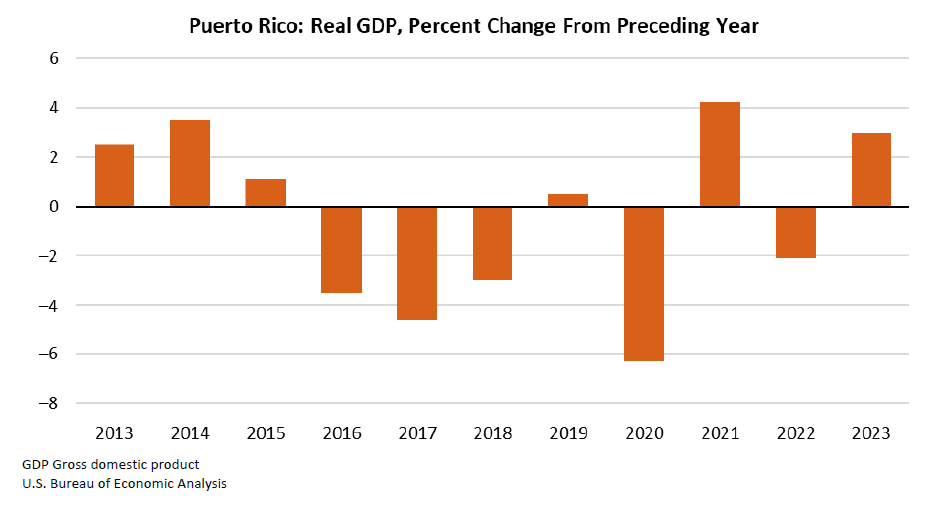
Despite these adversities, the island has demonstrated remarkable resilience. The consistent flow of federal aid, particularly for disaster recovery, has been a crucial lifeline, supporting infrastructure development and economic stabilization. The BEA’s detailed reporting on Puerto Rico’s GDP provides an essential tool for understanding the island’s economic performance and the effectiveness of various recovery and development strategies.
The BEA’s commitment to producing these statistics, even as they announce the discontinuation of future releases, underscores the importance of data-driven policy-making for Puerto Rico. The acknowledgments within the report highlight the critical support received from the government of Puerto Rico and various organizations, emphasizing the collaborative nature of economic data production in this unique context.
Revisions and Data Integrity
The BEA also reported revisions to its real GDP estimates for Puerto Rico covering the period from 2018 to 2022. These revisions, incorporated to reflect updated source data, show a pattern of inflation-adjusted GDP growth similar to previously published estimates. The largest revision in any single year was 0.4 percentage point in 2022. This meticulous process of data revision is standard practice in economic statistics to ensure the highest degree of accuracy and reliability. The table provided shows a minor positive revision to real GDP in millions of chained (2012) dollars for 2022, moving from a slight contraction to a larger one based on revised data, while the percentage change from the preceding period in real GDP for 2022 was revised from -2.1% to -2.1% with a revision of 0.4 percentage points. For 2021, the revision to real GDP was 115 million dollars, contributing to a slight increase in the percentage change from 4.2% to 4.2% with a 0.1 percentage point revision. These minor adjustments reflect the dynamic nature of economic data collection and analysis.
Implications and Future Outlook
The positive GDP growth in 2023 is a welcome development for Puerto Rico. It signals a potential turning point, suggesting that the island’s economy is on a path toward sustained recovery and growth. The strong performance in exports indicates a competitive position in the global market, while the increase in domestic demand, particularly in consumption and investment, points to growing confidence and economic activity within the island.
The continued investment in infrastructure, driven by federal disaster recovery funds, is crucial for enhancing the island’s resilience and attractiveness for both domestic and foreign investment. However, the decrease in private inventory investment, particularly in manufacturing, warrants further attention. Understanding the specific reasons behind this decline, whether it’s due to supply chain adjustments, changes in demand, or other factors, will be important for future economic planning.
The BEA’s announcement that it will no longer produce Puerto Rico GDP statistics after this release is a significant development. This discontinuation raises questions about the future availability of comprehensive economic data for the island and the potential impact on policy-making and research. The BEA has indicated that previously published vintages of the data will be accessible through its Data Archive, but the absence of ongoing official GDP estimates could present challenges for tracking economic progress.
The economic trajectory of Puerto Rico remains closely tied to its ability to attract investment, foster innovation, and effectively manage its resources. The performance in 2023 provides a positive foundation, but sustained growth will depend on continued strategic initiatives, effective governance, and a favorable global economic environment. The island’s ability to leverage its strengths, address its challenges, and adapt to evolving economic conditions will be paramount in shaping its future economic landscape.
Acknowledgments and Data Accessibility
The production of these vital economic statistics for Puerto Rico relies heavily on the cooperation and support of various entities. The BEA explicitly acknowledges the critical assistance provided by the government of Puerto Rico, as well as numerous organizations and individuals across the island. This collaborative effort underscores the unique challenges and requirements for producing economic data outside the standard U.S. framework.
For those seeking to delve deeper into the data, the BEA provides access to interactive data tables through its application. These tables offer detailed breakdowns of GDP, personal consumption expenditures, exports and imports, and gross domestic investment, allowing for granular analysis of economic trends. The availability of these historical and detailed datasets is invaluable for researchers, policymakers, and businesses seeking to understand Puerto Rico’s economic dynamics.
The provision of these detailed data tables, covering various facets of the economy, allows for a comprehensive understanding of the drivers behind the 2023 GDP growth and the factors that may have influenced other components of the economy. This commitment to data transparency, even with the cessation of future GDP releases, ensures that the foundational data for economic analysis remains accessible.