Julia Chirkova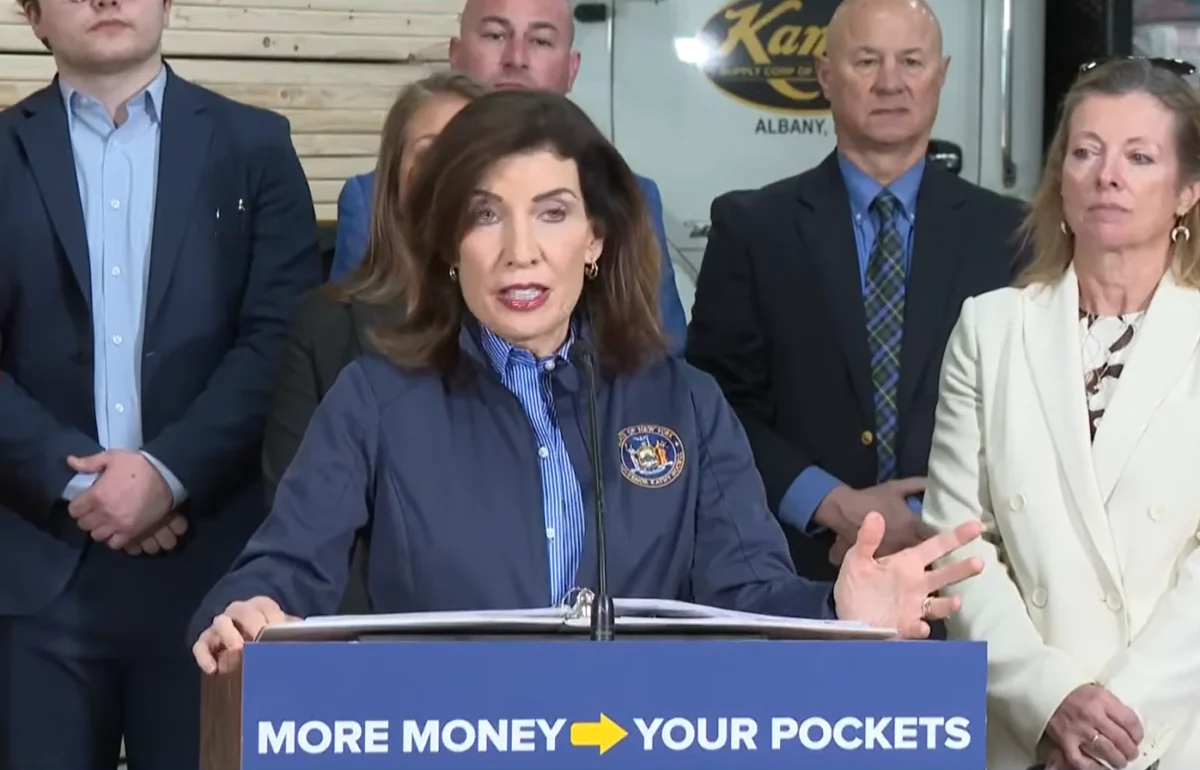
NEW YORK – Governor Kathy Hochul announced on Thursday what she described as a “handshake deal” on a $268 billion state budget, a comprehensive package that includes a controversial “pied-à-terre” tax on luxury second homes in New York City, intended to bolster city coffers amidst a significant multi-billion dollar deficit. The proposed budget, arriving after a five-week delay past the April 1st deadline, also earmarks funding for crucial childcare initiatives within the five boroughs and a series of immigration measures designed to counter policies enacted by the previous Trump administration.
Despite the Governor’s assertion of a broad agreement, Assembly Speaker Carl Heastie swiftly disputed the claim, stating unequivocally to reporters in Albany, “There’s no budget deal.” Heastie articulated significant frustration with the negotiation process, emphasizing the number of unresolved fiscal issues and stating, “We signed off on nothing major.” His remarks highlighted a deep-seated disagreement regarding the progression of budget talks, adding, “This is what I’m telling y’all is wrong with this process. I’m saying this to y’all very clearly: I am never doing this again. Budgets are supposed to be about money, not policy.” This stark divergence in public statements underscores the complex and often fraught nature of state-level budget negotiations, particularly when significant fiscal disparities and policy priorities are at play.
The allocation of state aid to New York City emerged as a central point of contention throughout the budget discussions. Mayor Zohran Mamdani had been actively lobbying state officials for months, seeking substantial assistance to bridge the city’s estimated $5.4 billion budget gap. To exert pressure on Albany, Mayor Mamdani had previously sounded alarms about an impending fiscal crisis and had not shied away from threatening an increase in local property taxes as a last resort. However, the proposed budget, as outlined by Governor Hochul, does not include the corporate or income tax hikes that Mayor Mamdani had championed, a stance that met with firm resistance from the Governor. Similarly, a reduction in the Pass-Through Entity Tax credit, which had garnered support from both Mayor Mamdani and Council Speaker Julie Menin, was also reportedly a non-starter in the negotiations. Governor Hochul maintained her position, stating, “I held through to what I said.”
The precise amount of additional financial support the state will provide to New York City remains unclear, as the final state spending plan is still undergoing detailed development. There was also anticipation that the Governor might announce further financial assistance or a delay in the implementation of the class size mandate for schools, a regulation that budget experts have estimated could cost the city hundreds of millions of dollars. However, neither of these potential measures was explicitly mentioned during Governor Hochul’s announcement on Thursday.
At an unrelated event in Brooklyn on Thursday, Mayor Mamdani expressed cautious optimism regarding the state budget’s potential to provide the necessary aid to New York City, while acknowledging the ongoing need for finalized details. “We are seeing that there are still a few more things to be discussed and agreed to in that state budget negotiation, but we are hopeful as to the direction of that conversation and the progress that we’ve been seeing over the last few days and weeks,” he stated. The prolonged state budget deliberations had prompted city lawmakers to push back their own budget deadline, with the Mayor’s next budget proposal slated for submission on Tuesday.
Mayor Mamdani, a prominent figure within the progressive wing of the Democratic party, had campaigned on a platform that included increasing taxes on the city’s wealthiest residents and corporations. However, Governor Hochul had consistently characterized these proposals as non-starters, advocating instead for the city to identify internal savings within its substantial $127 billion budget. Governor Hochul acknowledged the difficulty of the negotiations, remarking, “I’m not going to mince the words: The negotiations were not easy. They were very substantive disagreements, tough choices and powerful special interests trying to influence the outcome, and the dysfunction out of Washington certainly doesn’t help.”
A significant achievement highlighted by Governor Hochul is the inclusion of $15 billion in state reserves, a move she described as a "pretty impressive" accomplishment, especially in light of what she termed "attacks on federal funding" from the Trump administration. This substantial reserve fund is intended to provide a buffer against unforeseen economic challenges and maintain fiscal stability.
The Contentious Pied-à-Terre Tax
The proposed "pied-à-terre" tax, which would impose a surcharge on high-value second homes in New York City, emerged as one of the most contentious and uncertain elements of the budget negotiations. The tax, designed to generate an estimated $500 million annually for the city, was a key point of discussion in the final weeks leading up to the announcement. However, as of Thursday, Governor Hochul confirmed that the specific details of this tax had not yet been finalized.
A primary obstacle in the deliberations surrounding the pied-à-terre tax centered on the methodology for determining the valuation of the properties that would be subject to the surcharge. The city’s current property assessment process has been described by Hochul as "rather bizarre" and prone to significantly undervaluing luxury residences. This discrepancy in valuation poses a challenge in accurately implementing and enforcing the new tax. The state is exploring various mechanisms to ensure fair and equitable taxation of these high-value assets, a process that requires careful consideration of real estate market dynamics and existing assessment frameworks.
Governor Hochul characterized this year’s budget negotiations as "unusual," noting the unprecedented level of focus on assisting New York City with its fiscal challenges. "This is the first time that we’ve been so immersed in helping them solve their budget problem," she stated, underscoring the unique circumstances that necessitated such direct state intervention in municipal finance.
Broader Budgetary Provisions and Unresolved Issues
While the "general agreement" announced by the Governor did not provide specific figures for new funding allocated to New York City’s K-12 schools, her budget director, Blake Washington, indicated during a press briefing that the state legislature was actively considering various factors impacting such allocations. "We’re very invested in helping particularly the high-needs communities," Hochul emphasized, signaling a commitment to addressing educational disparities.
Beyond the fiscal matters, the budget package reportedly includes significant allocations for childcare, a pledge Governor Hochul had initially made in January. Additionally, new legislative measures aimed at enhancing youth online safety are slated for inclusion. These provisions are designed to protect minors by blocking direct messages from unknown adults, disabling AI chatbots, and restricting location-sharing capabilities for individuals under the age of 18. The budget also proposes an expansion of the Governor’s existing free community college initiative, aiming to broaden access to higher education for more New Yorkers.
Background and Context
The protracted budget negotiations highlight the fiscal pressures facing both the state and its largest city. New York City, in particular, has grappled with the economic fallout from the COVID-19 pandemic, which has impacted tax revenues and increased demand for social services. The city’s substantial budget deficit has necessitated difficult choices and a reliance on state assistance. The proposed pied-à-terre tax, while controversial, represents an attempt to tap into a revenue source associated with the city’s high-value real estate market.
The tension between the Governor’s office and legislative leaders, particularly Assembly Speaker Heastie, reflects the inherent power dynamics and policy disagreements that often characterize budget making. The Assembly, often representing a more progressive constituency, may push for different spending priorities and revenue-raising measures than the executive branch. The delay in reaching a budget agreement underscores the challenge of forging consensus among diverse political interests and stakeholder groups.
The inclusion of immigration measures in the budget signals a political alignment with federal efforts to counteract policies perceived as harmful to immigrant communities. This aspect of the budget reflects a broader national debate about immigration policy and its impact on states and cities.
Analysis of Implications
The eventual finalization of the state budget will have significant ramifications for New York City’s fiscal health and its ability to provide essential services. The success of the pied-à-terre tax in generating revenue, as projected by the Governor, will depend on the clarity and fairness of its implementation, particularly concerning property valuation. Any shortfall in projected revenue could exacerbate the city’s deficit and necessitate further austerity measures or alternative funding solutions.
The allocation of funds for childcare and youth online safety addresses pressing social needs and reflects a commitment to supporting families and protecting vulnerable populations. The expansion of the free community college program aims to enhance educational opportunities and workforce development, potentially yielding long-term economic benefits for the state.
The divergent public statements from Governor Hochul and Assembly Speaker Heastie suggest that while a broad framework for the budget may be in place, numerous details and policy nuances still require resolution. The commitment from Speaker Heastie to avoid similar protracted and contentious negotiation processes in the future indicates a potential shift in how future budgets are approached, though the practical implications of this statement remain to be seen. The ongoing process of budget finalization will be closely watched by residents, businesses, and advocacy groups across New York State, as it will shape the state’s financial trajectory and policy landscape for the upcoming fiscal year.
The ultimate impact of this $268 billion budget will be determined by its final form, the effectiveness of its implemented policies, and the ongoing economic conditions of both the state and the nation. The successful navigation of these complex fiscal and policy challenges will be a testament to the collaborative, albeit at times contentious, efforts of New York’s elected officials.
With additional reporting by Cayla Bamberger.
Photo caption: New York Gov. Kathy Hochul discussed key state budget proposals during a press conference on April 28, 2026. (Kathy Hochul/YouTube)