Julia Chirkova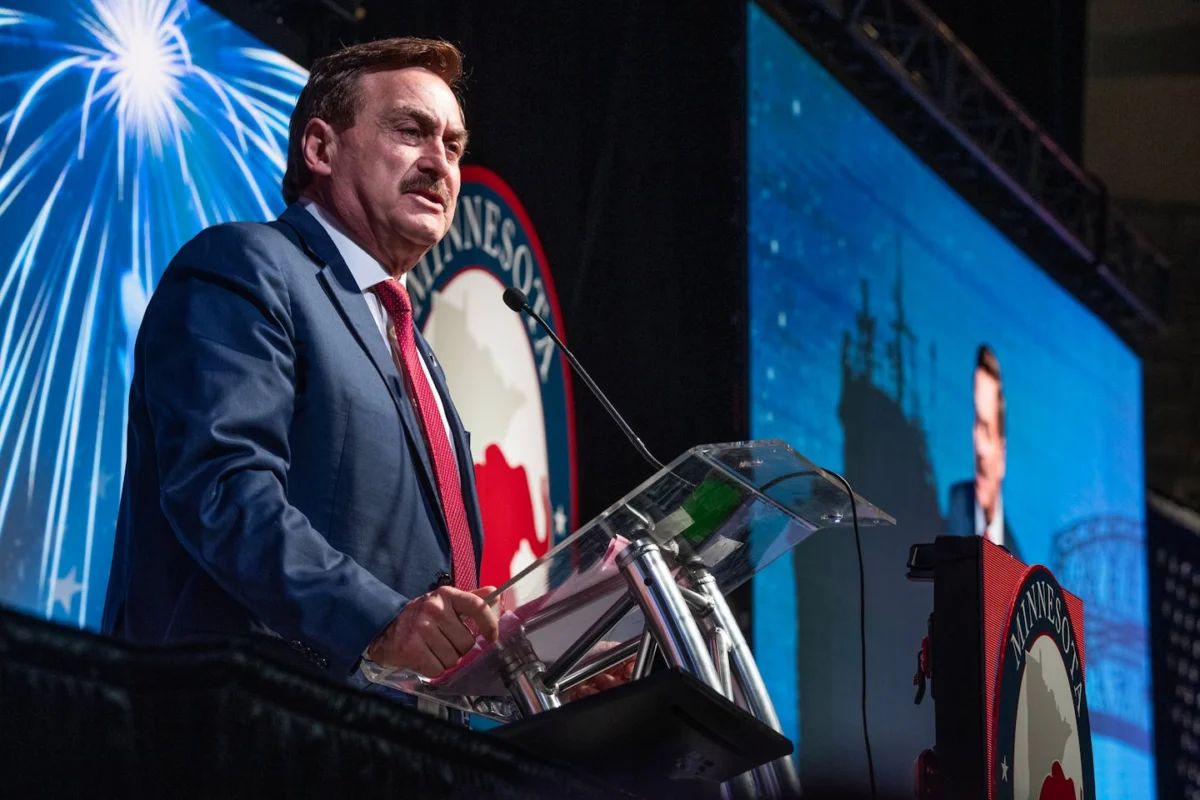
By Emilie Munson
Star Tribune
(TNS)
Mike Lindell, the Republican candidate for Minnesota governor and a prominent supporter of former President Donald Trump, is navigating significant financial challenges, including a substantial debt to the Internal Revenue Service and the fallout from a costly, unapproved COVID-19 treatment investment. A review of Lindell’s sworn depositions from 2024 reveals a protracted battle with the IRS over a $6 million debt, leading to the garnishment of his personal wages from his company, MyPillow. While Lindell has been relatively open about some of his financial struggles, the extent of his liabilities stemming from a failed venture into a COVID-19 supplement has received less public scrutiny.
The Oleandrin Investment: A Ten Million Dollar Gamble
During the height of the COVID-19 pandemic, Mike Lindell invested an estimated $10 million in oleandrin, a substance derived from a toxic plant, with the hope that it would gain U.S. Food and Drug Administration (FDA) approval as a treatment or preventative measure for COVID-19 infections. According to Lindell’s depositions and interviews with the Star Tribune, he sought assistance from President Trump in expediting the FDA approval process. Despite these efforts, the product failed to secure regulatory clearance. Consequently, vast quantities of the oleandrin supplement remained warehoused in Lakeville, Minnesota, until they expired.
Lindell stated in a June 2024 deposition that the IRS disputed his attempt to deduct the $10 million loss in the tax year he desired. This disagreement ultimately led to the IRS placing a $6 million lien on his personal residence in Texas. Furthermore, Lindell testified that the government had garnished half of his MyPillow wages to satisfy the outstanding debt.
In a recent interview, Lindell downplayed the severity of the debt, asserting that the tax deduction he sought was legally permissible. He indicated that he is currently engaged in "productive negotiations" with the IRS, expressing optimism that the issues will be resolved imminently. "All this stuff is getting resolved this summer," Lindell stated. "Everything has been resolved or is getting resolved."
A Pattern of Tax Scrutiny and Allegations of Influence
This latest revelation about Lindell’s tax liabilities emerges a year after reports by The Washington Post and The New York Times detailed concerns raised by a senior Trump administration appointee regarding Lindell’s tax matters. The appointee reportedly contacted the IRS, highlighting Lindell as a "high-profile friend of the president." However, subsequent reporting indicated that the IRS did not act upon the appointee’s email. The IRS has not responded to requests for comment on the matter.
Lindell’s financial situation is a significant backdrop to his campaign for Minnesota governor. He is competing in the August 11 Republican primary against Minnesota House Speaker Lisa Demuth and Kendall Qualls, a retired healthcare executive who secured party backing in May. The eventual Republican nominee will face U.S. Senator Amy Klobuchar, the DFL-endorsed candidate, in the November general election.
Delinquent Property Taxes and Business Woes
Beyond his federal tax issues, records from Hennepin County indicate that a company linked to Lindell owes at least $30,000 in delinquent property taxes on his Tonka Bay residence. Lindell informed the Minnesota Reformer earlier this week that he had been unable to afford the payments last year but intended to settle them promptly. However, as of July 13, a Hennepin County official confirmed that the taxes remained unpaid.
In his 2024 depositions, Lindell painted a stark picture of his company’s financial health, describing MyPillow as "in the hole every day" and lamenting, "I have no assets. There’s nothing left."
The Shadow of Defamation Lawsuits and Retailer Boycotts
Lindell’s financial struggles are amplified by significant losses incurred after he became one of the nation’s most vocal proponents of false claims regarding the 2020 election being rigged. These unsubstantiated allegations led to defamation lawsuits from Dominion Voting Systems and Smartmatic. Lindell’s depositions were taken as part of the Smartmatic lawsuit, where a judge ruled last year that Lindell was liable for defamation. A jury is still to determine the amount of damages.
In June, Dominion Voting Systems settled its defamation lawsuit against Lindell. Additionally, a Dominion executive successfully sued Lindell, and a jury awarded that executive $2.3 million last year. The legal repercussions from these cases prompted numerous retailers to cease stocking Lindell’s products.
Internal Party Concerns and Lindell’s Response
Following President Trump’s endorsement of Lindell, the Minnesota Republican Party has voiced concerns about his financial baggage. Minnesota Republican Party Chair Alex Plechash stated, "Lindell wants Minnesota Republicans to overlook his serious financial baggage, public records showing tens of thousands of dollars in delinquent property taxes, significant electability concerns and unanswered questions surrounding his running mate." Plechash added, "Minnesota cannot afford to nominate a ticket that gives Democrats an easy target."
In his interview, Lindell remained defiant, asserting, "we’re not going anywhere" despite what he characterized as "attacks" on his background. He acknowledged his financial difficulties, attributing them to his company being "the most attacked company in history" by the government and facing lawsuits from voting machine companies he claims sought to suppress the truth. Lindell maintains that these issues are now resolved.
The Genesis of the Oleandrin Venture: A Divine Proposition
The controversial oleandrin investment reportedly began on Easter 2020, when Andrew Whitney approached Mike Lindell with what he described as a business proposition from God. According to text messages presented during Lindell’s deposition, Whitney claimed to have received a divine message about a "cure for the virus" and that "God told him to only trust Mike Lindell." Whitney was an executive on the board of Phoenix Biotechnology, a company involved in the development of oleandrin.
Oleandrin, Lindell explained in his deposition, was presented as being akin to ivermectin or hydroxychloroquine, medications that gained traction among some for COVID-19 treatment despite strong scientific evidence disputing their efficacy. Whitney’s outreach to Lindell followed Lindell’s appearance at the White House in late March 2020, where he joined other CEOs in promoting efforts to combat the pandemic. At that time, Lindell had pivoted his MyPillow operations to produce masks.
Motivated by Whitney’s pitch, Lindell committed $10 million to purchase oleandrin, as stated in his deposition. He also joined the Phoenix Biotechnology board, a position he held from 2020 to 2022. Sarah Duncan, president of Phoenix Biotechnology Inc., confirmed Whitney’s past involvement with the company. Whitney could not be reached for comment.
Allegations of High-Level Involvement and FDA Obstacles
During his deposition, Lindell claimed that then-Housing and Urban Development Secretary Dr. Ben Carson and other medical professionals had "validated" the oleandrin supplement. Text messages from May 2020, sent to a MyPillow shareholder, indicated that Lindell had met with President Trump and Vice President Mike Pence to discuss the supplement for an extended period, suggesting that preparations were underway. "I bought $10 million worth (…) to give away and to save the country, and met with the president," Lindell stated in 2024. "And then we had [it] arranged with the [FDA]. The FDA shut it down. And so to this day, I’m still sitting on it."
The supplements ultimately expired, and Lindell was unsuccessful in his attempts to distribute them to the Philippines, Brazil, and Israel. "Once we couldn’t sell it here, we were giving it away," Lindell told the Star Tribune.
Lindell also alleged in his deposition that MyPillow employees who took the supplement during the pandemic "never got sick." Text messages from 2020 to a shareholder suggested that the supplement was being distributed "under the radar" and could "change history," with Lindell even making a facetious remark about winning the presidency in 2024 (a claim he later described as sarcasm in a subsequent deposition). Lindell confirmed he took the supplement himself, asserting, "I can count at least 10 lives it saved. If it saved one life, to me it was worth it."
Disputed Tax Deductions and Ongoing Audits
In a recent interview, Lindell clarified that a portion of the $6 million IRS debt stemmed from a dispute over the timing of a refundable employee retention tax credit for pandemic-era employees, as well as his attempts to deduct the losses from the expired oleandrin supplement. He also reiterated his 2024 deposition claim that half of his MyPillow wages were being garnished by the government, estimating his weekly MyPillow pay at between $20,000 and $30,000. Lindell concluded his interview with the Star Tribune before further questions about the wage garnishment could be posed and did not respond to follow-up inquiries.
The IRS has been conducting audits of Lindell’s taxes in recent years, according to deposition testimony and his own admissions. While the precise focus of these audits remains unclear, Lindell indicated that the oleandrin deduction and the employee retention tax credit were among the key issues. He described the audit in 2024 as "the biggest audit in history," though he suggested this week that the tax dispute is nearing resolution and that the audit concluded last year. "The IRS told me I couldn’t even do my taxes for the last four years until we resolved all this because there were a couple of big issues," Lindell stated, while maintaining confidence in a settlement.
Lindell denied receiving any special treatment from the IRS during the Trump administration. He confirmed that his Texas property was subject to the IRS lien. His 2024 deposition identified his "only residence" as being in Lufkin, Texas. However, property records reviewed this month reveal that an LLC registered to Lindell has owned a $600,000 home in Texas since 2022 and a $1.6 million home in Tonka Bay, Minnesota, since 2021. Lindell stated he is now living full-time in Minnesota.
Facing Financial Ruin and Expressing Resilience
During a 2025 federal hearing, Lindell famously declared to a judge, "I’m in ruins," and expressed an inability to manage his mounting debts, suggesting he was "trying to avoid" filing for personal bankruptcy. However, in his recent interview, Lindell conveyed a sense of hope as his legal and financial matters appear to be winding down. "We’re still standing here," he stated. "We’re not going anywhere in Minnesota despite all the attacks."
Minnesota Star Tribune staff writer Mike Hughlett contributed to this story.
Photo caption: Minnesota gubernatorial candidate Mike Lindell makes his case for the GOP nomination during the second day of the convention on May 30, in Duluth. (Richard Tsong-Taatarii/The Minnesota Star Tribune/TNS)