Lana Rhoades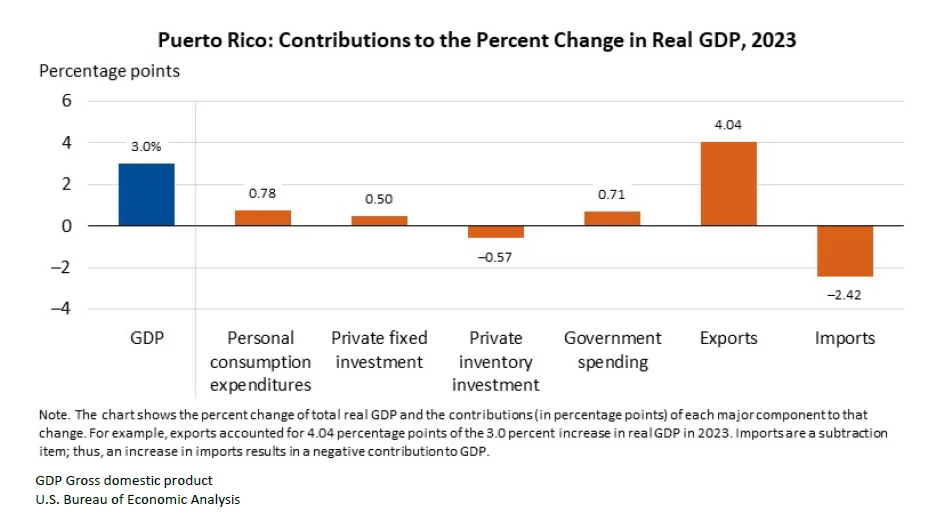
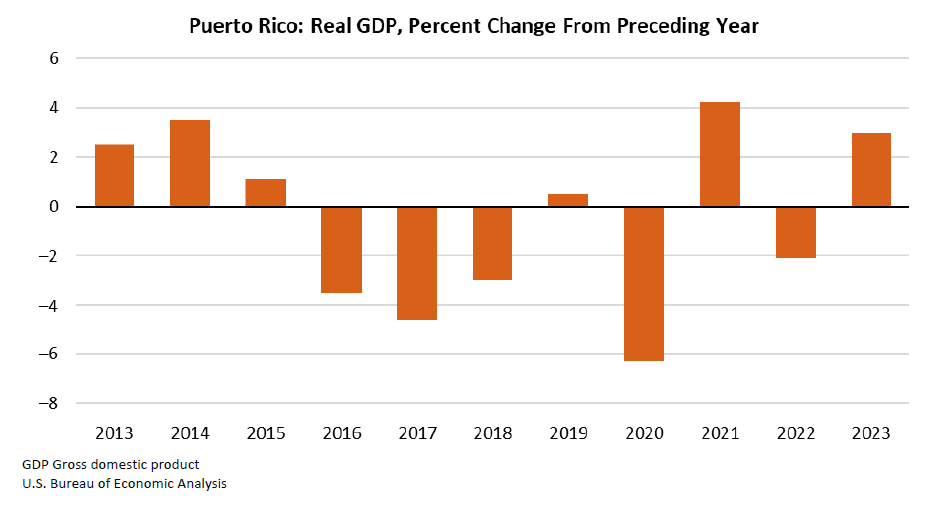
Puerto Rico’s economy demonstrated a significant rebound in 2023, with real gross domestic product (GDP) increasing by 3.0 percent. This marks a notable recovery from the 2.1 percent decrease experienced in 2022, according to the latest statistics released by the U.S. Bureau of Economic Analysis (BEA). The turnaround in economic performance was primarily driven by a robust expansion in exports, complemented by growth in personal consumption, government spending, and private fixed investment.
Economic Rebound Fueled by Strong Export Performance
The 3.0 percent growth in Puerto Rico’s real GDP in 2023 represents a significant positive shift after a challenging year in 2022. The island’s economy has been navigating a complex landscape, including the aftermath of natural disasters, ongoing infrastructure challenges, and shifts in global economic conditions. The positive growth trajectory in 2023 suggests a strengthening economic foundation, with key sectors contributing to the overall expansion.
The primary engine behind this economic revival was a substantial increase in exports. Real exports rose by 6.4 percent, encompassing both goods and services. Exports of goods saw a healthy increase of 6.6 percent, while exports of services grew by 5.6 percent. This surge in external demand indicates improved competitiveness and demand for Puerto Rican products and services in international markets. The pharmaceutical and chemical sectors, often significant contributors to Puerto Rico’s export economy, likely played a crucial role in this expansion.
Key Drivers of GDP Growth
Beyond exports, several other components of GDP contributed positively to the island’s economic performance in 2023:
- Personal Consumption Expenditures (PCE): Real personal consumption expenditures increased by 1.2 percent. Within PCE, spending on services saw a substantial rise of 4.0 percent, indicating increased consumer demand for services. However, spending on goods experienced a slight decrease of 0.8 percent, suggesting a potential shift in consumer preferences or purchasing power dynamics.
- Government Spending: Real government spending recorded a significant increase of 4.8 percent. This growth was observed across all levels of government – federal, central, and municipal. A notable aspect of this increase was the substantial rise in government investment spending. This surge is directly linked to the continued disbursement of federal funds allocated for disaster recovery and infrastructure improvements. The ongoing reconstruction efforts following Hurricanes Irma and Maria in 2017, the 2019 and 2020 earthquakes, and Hurricane Fiona in 2022 are fueling this investment. Specific projects contributing to this growth include critical work on the island’s power grid, the aqueduct system, road and bridge infrastructure, and the National Guard’s Camp Santiago.
- Private Fixed Investment: Real private fixed investment grew by 3.8 percent. This expansion was largely driven by increased investment in equipment, particularly industrial equipment. Businesses are reportedly increasing their purchases of engines, turbines, and electrical equipment, signaling a renewed confidence in the business environment and a commitment to capital expenditure.
Offsetting Factors and Imports
While the growth drivers were strong, certain components acted as partial offsets to the overall GDP increase. Real private inventory investment decreased, with the manufacturing sector being the largest contributor to this decline. This could indicate a strategic adjustment by businesses to manage inventory levels in response to demand forecasts or supply chain considerations.
Imports, which are subtracted in the calculation of GDP, also increased by 4.4 percent. This rise was primarily driven by an increase in imports of goods, with pharmaceuticals and organic chemicals showing a significant 6.0 percent rise. This could reflect an increase in domestic demand for these specific goods or a reliance on imported components for local manufacturing.
Background and Context
Puerto Rico’s economic trajectory has been marked by volatility in recent years. The island has faced significant challenges, including a prolonged recession, substantial public debt, and the devastating impact of natural disasters. The recovery process has been complex, often reliant on external aid and federal funding. The 2023 GDP figures offer a promising sign of economic resilience and the effectiveness of recovery and investment initiatives.
The BEA’s role in tracking Puerto Rico’s economic performance is crucial, especially given that the island is not typically included in the major surveys used to estimate U.S. GDP. The production of these estimates relies heavily on the support and data provided by the government of Puerto Rico and various local organizations. This collaborative effort underscores the unique economic relationship between Puerto Rico and the United States.
Timeline of Recent Economic Performance
- 2017: Hurricanes Irma and Maria cause widespread devastation, significantly impacting the island’s economy and infrastructure.
- 2018-2021: Puerto Rico’s GDP experiences fluctuations, influenced by recovery efforts, ongoing fiscal challenges, and the COVID-19 pandemic.
- 2019-2020: Earthquakes further disrupt economic activity and necessitate additional recovery funding.
- 2022: Real GDP decreases by 2.1 percent, indicating a contraction in economic activity.
- 2023: Real GDP rebounds with a strong increase of 3.0 percent, driven by exports and increased investment.
Data Revisions and Methodologies
The BEA also announced revisions to its previously published GDP estimates for Puerto Rico for the years 2018-2022. These revisions incorporate updated source data and aim to provide a more accurate picture of the island’s economic performance. The largest revision for any single year was 0.4 percentage point in 2022, which still reflects a contraction. These revisions highlight the dynamic nature of economic data and the BEA’s commitment to providing the most up-to-date and precise information. The BEA’s methodology for estimating Puerto Rico’s GDP is detailed in its "Summary of Methodologies: Puerto Rico Gross Domestic Product," which outlines the specific data sources and analytical approaches employed.
Acknowledgments and Future Data Availability
The BEA expressed its gratitude to the government of Puerto Rico and numerous organizations and individuals on the island for their critical support in producing these economic estimates. The collaborative nature of this data collection underscores the unique circumstances of Puerto Rico’s economic reporting.
It is important to note that the BEA will no longer produce Puerto Rico GDP statistics after this release of the 2023 estimates. This marks the end of a significant chapter in economic data collection for the island. Previously published data will remain accessible through the BEA’s Data Archive, allowing for historical analysis and continuity. This decision by the BEA signifies a shift in data reporting, and future economic analyses for Puerto Rico will likely rely on alternative data sources and methodologies.
Analysis of Implications
The robust 3.0 percent GDP growth in 2023 suggests a period of economic recovery and potential expansion for Puerto Rico. The strong performance of exports indicates a growing capacity to compete in global markets, which is vital for long-term economic sustainability. The significant increase in government investment, particularly in infrastructure, is crucial for rebuilding and modernizing essential services, which can attract further private investment and improve the quality of life for residents.
However, the decrease in private inventory investment and the slight dip in consumer spending on goods warrant continued monitoring. These trends could signal underlying economic dynamics that require further analysis. The reliance on federal disaster recovery funds for a significant portion of government investment highlights the ongoing need for sustained federal support while also emphasizing the importance of developing diversified and self-sustaining economic growth engines.
The shift in BEA’s data reporting means that future comprehensive economic assessments of Puerto Rico will require a different approach. This transition may present challenges in maintaining a consistent and detailed historical record of the island’s economic performance. Nonetheless, the 2023 figures provide a positive snapshot of economic activity and a foundation upon which to build future growth. The island’s ability to leverage its export potential, continue infrastructure development, and foster a stable business environment will be key determinants of its economic future. The BEA’s decision to cease production of these specific statistics will undoubtedly shape how economic trends in Puerto Rico are tracked and understood moving forward.