Lana Rhoades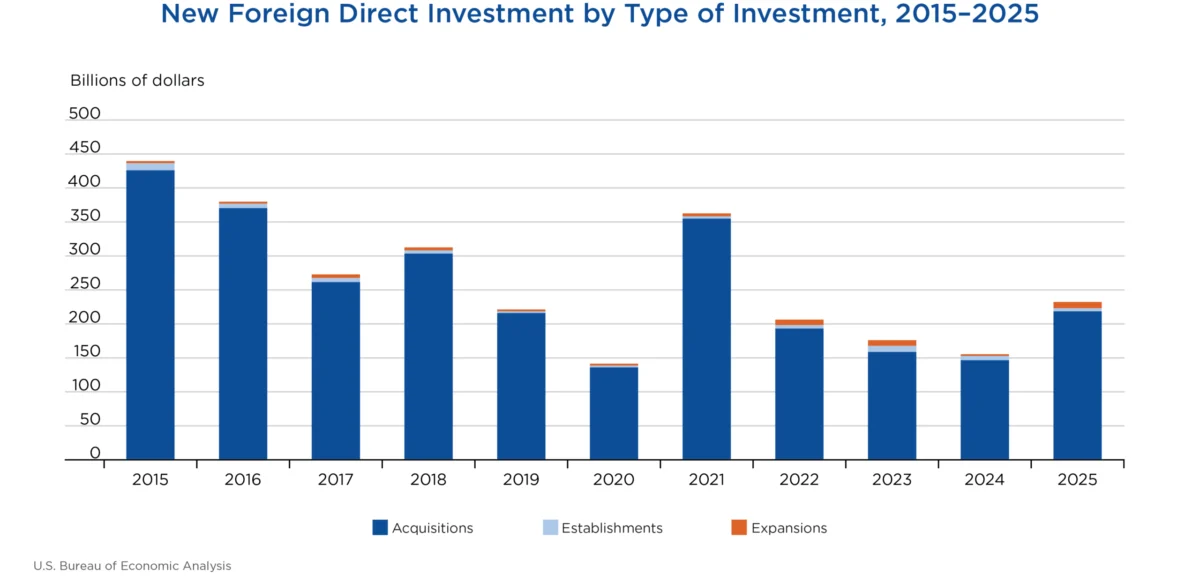
Expenditures by foreign direct investors to acquire, establish, or expand U.S. businesses surged to a remarkable $232.2 billion in 2025, according to preliminary statistics released by the U.S. Bureau of Economic Analysis (BEA). This represents a substantial increase of $76.8 billion, or 49.5 percent, compared to the $155.3 billion recorded in the revised 2024 figures, signaling a robust acceleration in international capital flowing into the American economy. Acquisitions of existing U.S. businesses remained the dominant avenue for foreign investment, underscoring the attractiveness of established companies and their market positions to overseas buyers.
The BEA’s comprehensive report, a key indicator of global economic integration and U.S. competitiveness, detailed a significant uptick across all categories of foreign direct investment (FDI). In 2025, acquisition expenditures alone reached $218.4 billion, a considerable jump from the revised $146.4 billion in 2024. Investment in establishing new U.S. businesses, often referred to as greenfield investments, also saw notable growth, with expenditures totaling $4.6 billion, up from $6.4 billion in 2024. Expansion of existing foreign-owned businesses within the U.S. contributed $9.2 billion, an increase from the revised $2.5 billion in the prior year. These figures reflect a dynamic landscape where foreign entities are not only acquiring established U.S. assets but also actively contributing to the creation and growth of new enterprises.
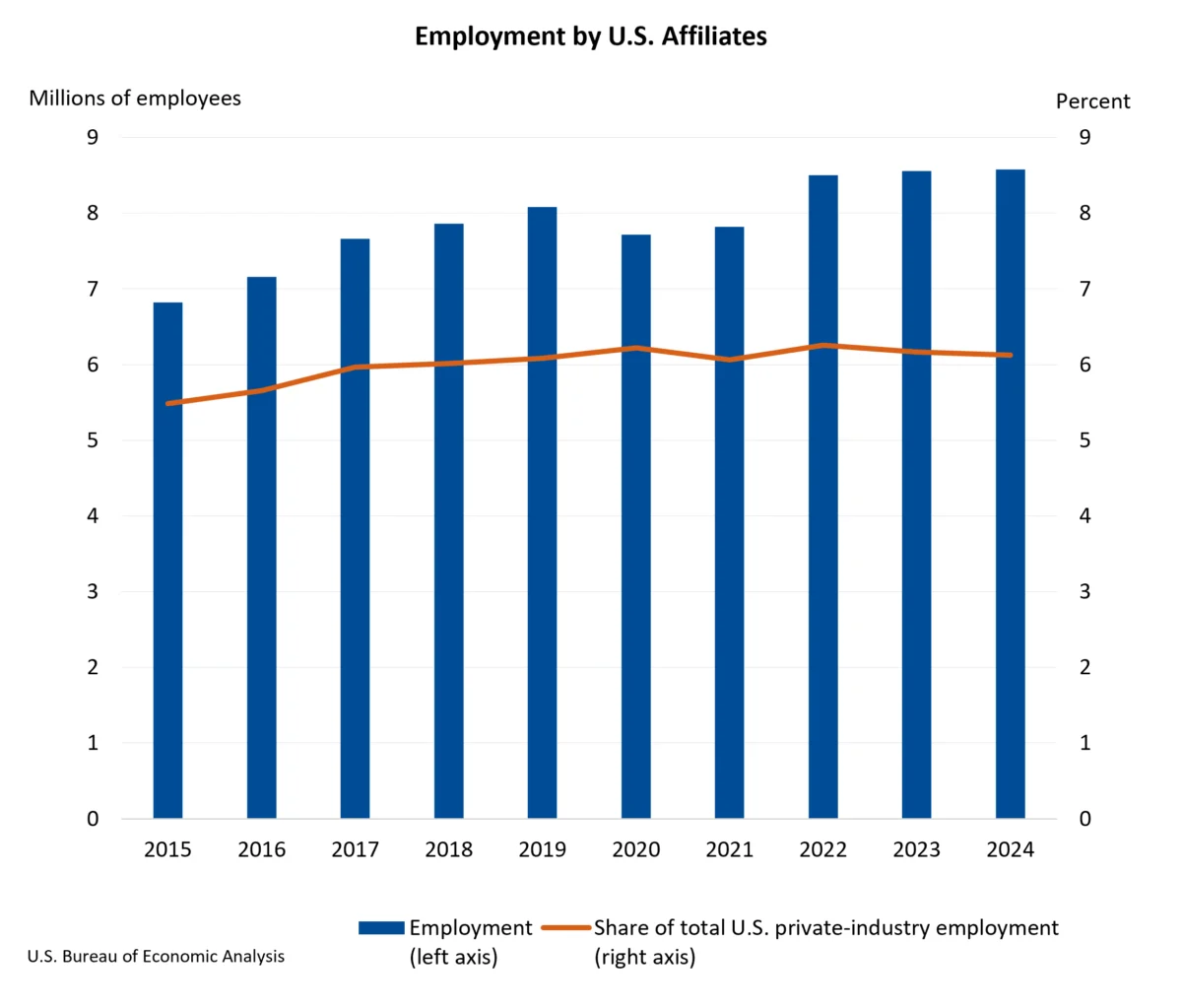
Beyond the immediate first-year expenditures, planned total expenditures, which encompass both initial investments and anticipated future outlays, reached an impressive $284.5 billion. This forward-looking projection suggests a sustained commitment from foreign investors, pointing towards ongoing economic engagement and potential job creation in the years ahead. The BEA’s data also highlights the direct impact on the U.S. workforce, with employment at newly acquired, established, or expanded foreign-owned businesses reaching 213,100 employees in 2025. This figure represents the direct hiring impact of this surge in FDI.
Manufacturing Sector Dominates Investment Landscape
The manufacturing sector emerged as a primary beneficiary of this FDI surge, accounting for a substantial 52.5 percent of total expenditures, or $121.8 billion. This underscores the continued appeal of U.S. manufacturing capabilities and infrastructure to international investors. Within manufacturing, specific sub-sectors attracted significant attention. Publishing industries led the pack with $50.7 billion in new direct investment, followed closely by chemicals manufacturing at $45.4 billion. Plastics and rubber products manufacturing also saw considerable investment, attracting $19.0 billion. The strength in these sectors suggests a strategic focus by foreign investors on areas with established supply chains, technological expertise, and a skilled workforce.
Key Investor Nations and Regional Contributions
Japan stood out as the leading source of foreign direct investment in the U.S. in 2025, injecting $50.5 billion into the American economy. This substantial commitment from Japan reflects a long-standing and deepening economic partnership. Germany followed with $26.7 billion in investments, and Canada contributed $23.5 billion, reinforcing the strong economic ties between North American partners.
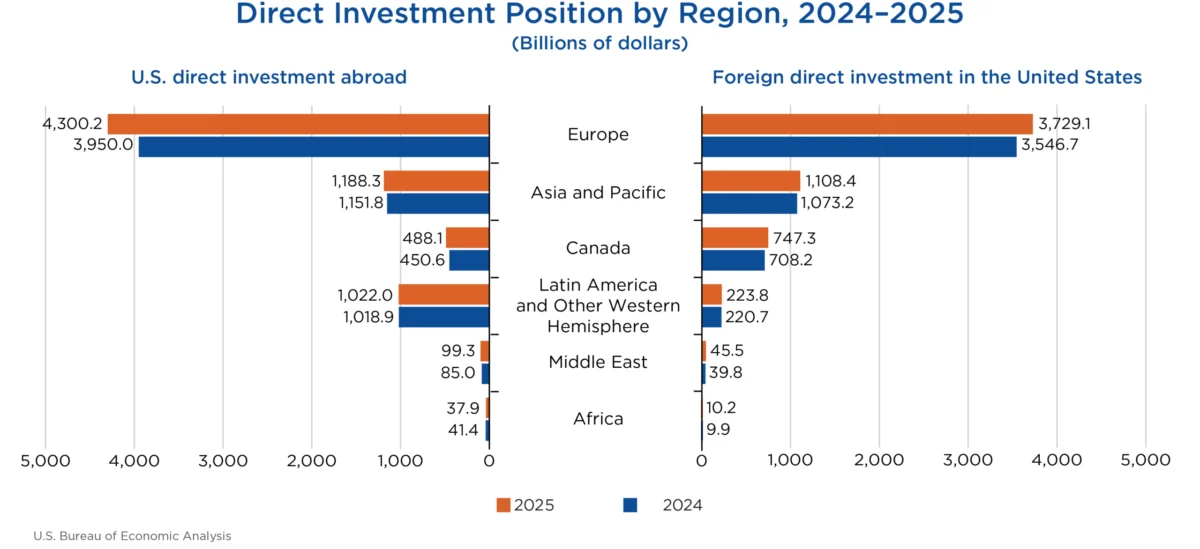
On a regional basis, Europe collectively represented the largest investing bloc, contributing $116.6 billion, or 50.2 percent of all new foreign investment. This highlights Europe’s significant role in fueling U.S. economic expansion. The Asia and Pacific region was the second-largest investor, with expenditures totaling $71.9 billion, demonstrating a growing diversification of investment sources.
State-Level Impact and Economic Distribution
The distribution of this foreign capital across U.S. states reveals significant regional impacts. California attracted the largest share of first-year investment expenditures, with a remarkable $59.7 billion flowing into the state. Texas followed with $21.5 billion, and Pennsylvania secured the third position with $20.9 billion. These leading states often benefit from robust economies, skilled labor pools, and favorable business environments, making them attractive destinations for international capital. The concentration of investment in these states suggests a reinforcing cycle of economic growth and opportunity.
Greenfield Investments: Laying the Foundation for Future Growth
Greenfield investments, which involve establishing new businesses or expanding existing foreign-owned operations, represent a critical component of long-term economic development. In 2025, these expenditures amounted to $13.8 billion. Within this category, the transportation and warehousing sector attracted the largest share of greenfield investment, with $3.6 billion. This indicates a strategic interest in bolstering U.S. logistics and supply chain infrastructure. Computers and electronics products manufacturing followed with $2.0 billion, and chemicals manufacturing with $1.8 billion.
Investors from the Asia and Pacific region were particularly active in greenfield initiatives, contributing $8.3 billion. Australia led this group with $3.0 billion in greenfield expenditures, followed by South Korea with $2.2 billion and Japan with $1.7 billion. At the state level, Louisiana saw significant greenfield investment totaling $3.0 billion, followed by Arizona with $2.7 billion and Texas with $1.9 billion. These investments are often associated with the creation of new manufacturing facilities, research and development centers, and operational hubs, promising substantial long-term employment and economic diversification. Planned total expenditures for greenfield investments initiated in 2025 reached $66.1 billion, signaling a strong pipeline of future growth and job creation.
Employment Dynamics: A Snapshot of Job Creation
The impact of FDI on the U.S. labor market is a critical aspect of its economic contribution. In 2025, current employment in acquired enterprises stood at 211,700. When considering the planned employment for newly established businesses and expansions, the total projected employment rises to 232,400. This comprehensive employment figure provides a more complete picture of the jobs directly and indirectly supported by foreign investment.
By industry, plastics and rubber parts manufacturing accounted for the largest number of current employees, with 21,800. Transportation equipment manufacturing followed with 17,300 employees, and primary and fabricated metals manufacturing with 16,400. These figures highlight the significant role of manufacturing in absorbing foreign investment and creating skilled jobs.
Looking at employment by country of origin, Mexico was the largest contributor to current employment, with 54,600 employees. Canada followed with 29,500, and the United Kingdom with 26,800. These numbers reflect the established presence and operational scale of companies from these nations within the U.S. At the state level, California led in current employment resulting from new investment, with 37,200 employees. Illinois followed with 17,600, and Texas with 16,500.
Revisions to 2024 Data Reflect Evolving Economic Landscape
The BEA’s release also included important revisions to the 2024 FDI statistics, offering a more accurate historical context for the 2025 surge. First-year expenditures for 2024 were revised upward from the previously published $151.0 billion to $155.3 billion. This upward revision was primarily driven by an increase in expenditures for U.S. businesses acquired, revised to $146.4 billion from $143.0 billion, and for U.S. businesses expanded, revised to $2.5 billion from $1.8 billion. Expenditures for U.S. businesses established remained relatively stable, revised to $6.4 billion from $6.3 billion.
Planned total expenditures for 2024 also saw an upward revision, from $157.0 billion to $164.0 billion. The revisions were most pronounced in planned expenditures for U.S. businesses expanded, which were significantly adjusted to $9.4 billion from $6.2 billion. Planned expenditures for acquired and established businesses saw more modest upward revisions. These revisions underscore the dynamic nature of economic data and the BEA’s commitment to providing the most accurate picture of FDI trends.
Analysis and Implications: A Strong Signal of U.S. Economic Vitality
The substantial increase in foreign direct investment in 2025 signals a strong vote of confidence in the U.S. economy by international investors. This influx of capital can have several positive implications. Firstly, it directly contributes to economic growth through increased spending, investment in infrastructure, and the establishment of new facilities. Secondly, it fosters job creation, both directly within the foreign-owned entities and indirectly through supply chains and related industries. The projected employment figures suggest a significant boost to the U.S. labor market.
The dominance of manufacturing in attracting FDI highlights the ongoing strategic importance of this sector. It suggests that despite global shifts, the U.S. remains a competitive location for manufacturing due to its technological capabilities, skilled workforce, and access to markets. The strong performance in publishing and chemicals manufacturing also points to specific areas of innovation and demand that are attractive to foreign capital.
The leading roles of Japan, Germany, and Europe underscore the enduring strength of established economic relationships. However, the significant contributions from the Asia and Pacific region indicate a broadening of international partnerships and a growing reliance on diverse sources of capital. The state-level distribution, with California, Texas, and Pennsylvania leading, reinforces the importance of these states’ economic ecosystems in attracting and retaining foreign investment.
The substantial planned expenditures, particularly in greenfield investments, suggest that the positive impacts of FDI are likely to continue beyond 2025. These long-term investments are crucial for building new industrial capacity, driving innovation, and creating sustainable economic opportunities.
The BEA’s commitment to publishing detailed data, including granular information on industries, countries, and states, is invaluable for policymakers, businesses, and researchers. This transparency allows for a nuanced understanding of FDI trends and their impact on different sectors and regions of the U.S. economy. The ongoing updates and revisions to historical data demonstrate the BEA’s dedication to data integrity and providing the most accurate economic intelligence available. The next release, anticipated in June 2027, will provide insights into the 2026 FDI landscape, offering a continuous stream of vital economic indicators.