Lana Rhoades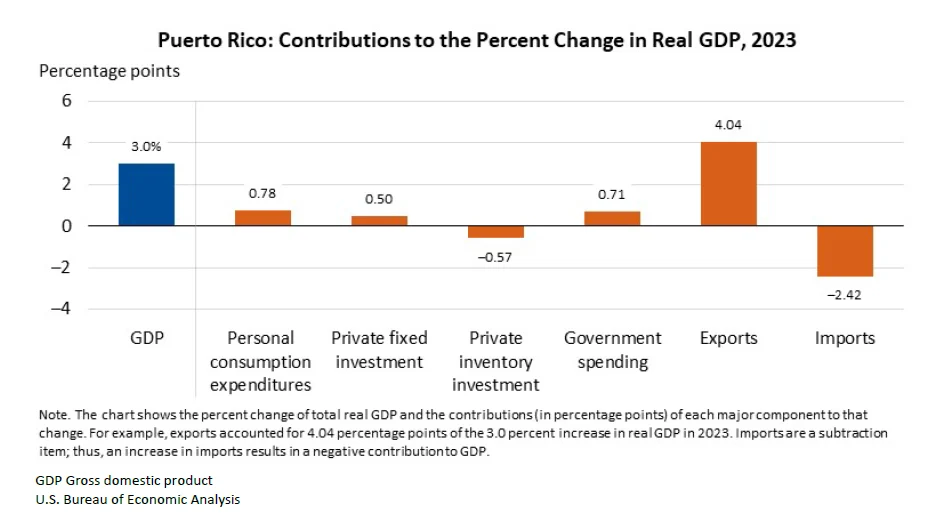
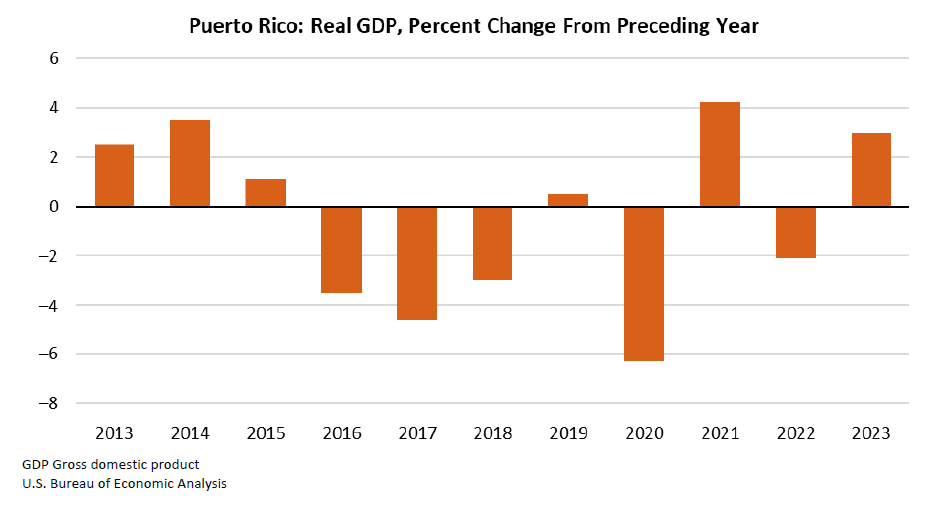
The economic landscape of Puerto Rico experienced a significant upswing in 2023, with its real gross domestic product (GDP) growing by 3.0 percent. This marks a notable recovery from the 2.1 percent contraction observed in the previous year, according to data released by the U.S. Bureau of Economic Analysis (BEA). This turnaround signals a positive shift in the island’s economic trajectory, driven by robust export performance and increased domestic spending.
Economic Recovery Fueled by Strong Export Growth
The rebound in Puerto Rico’s real GDP in 2023 was primarily propelled by a substantial increase in exports. The BEA’s statistics indicate that real exports rose by 6.4 percent, encompassing both goods and services. Exports of goods saw a healthy rise of 6.6 percent, while exports of services experienced a commendable increase of 5.6 percent. This export-led growth is a critical indicator of Puerto Rico’s integration into global markets and its ability to compete internationally.
This surge in exports can be attributed to several factors, including the sustained demand for pharmaceutical products manufactured on the island, a key sector for Puerto Rico’s economy. Additionally, a diversified export portfolio, encompassing various manufactured goods and specialized services, contributed to this positive trend. The ability of Puerto Rican businesses to capitalize on international market opportunities has been instrumental in driving this economic expansion.
Domestic Demand Shows Resilience
Beyond exports, several domestic economic components also contributed to the GDP growth. Personal consumption expenditures (PCE) increased by 1.2 percent, indicating a rise in household spending. Within PCE, spending on services saw a significant jump of 4.0 percent, while spending on goods experienced a slight decrease of 0.8 percent. This shift towards services spending suggests a potential evolution in consumer behavior, possibly reflecting increased confidence or a greater availability of services.
Government spending also played a crucial role in bolstering the economy, with real government spending increasing by 4.8 percent. This rise was observed across all levels of government, with a particular emphasis on investment spending by federal, central, and municipal authorities. This robust government expenditure is directly linked to ongoing federal funding for disaster recovery and infrastructure improvement projects.
Investment and Infrastructure Development
Real private fixed investment also demonstrated a positive trend, growing by 3.8 percent. This increase was largely driven by investments in equipment, with industrial equipment leading the way. Businesses, particularly those in manufacturing, have been actively acquiring engines, turbines, and electrical equipment, signaling a commitment to modernizing operations and enhancing productive capacity.
The significant increase in government investment spending is a direct consequence of continued disbursements of federal funds allocated for the reconstruction and enhancement of critical infrastructure. These funds are being utilized to address the long-term impacts of major natural disasters, including Hurricanes Irma and Maria in 2017, earthquakes in 2019 and 2020, and Hurricane Fiona in 2022. Notable projects underway include extensive work to rebuild and upgrade the island’s power grid, water systems (aqueduct), road networks, and the National Guard’s Camp Santiago. This sustained investment in infrastructure not only creates jobs but also lays the groundwork for future economic resilience and growth.
Sectoral Performance and Inventory Adjustments
While overall economic indicators were positive, certain sectors experienced varied performance. Real private inventory investment decreased, with the manufacturing sector being the largest contributor to this decline. This reduction in inventory investment can be interpreted in several ways, including a more efficient management of stock by businesses or a potential anticipation of future demand patterns.
Imports, which are a subtraction in the calculation of GDP, increased by 4.4 percent. This rise was primarily driven by an increase in the import of goods, with pharmaceuticals and organic chemicals showing the most significant growth at 6.0 percent. The increase in imports, while a subtraction from GDP, can also reflect increased domestic demand and business activity that requires imported raw materials or finished products.
A Look Back: Revisions and Context
The BEA also provided updated historical data, revising real GDP for Puerto Rico from 2018 to 2022. These revisions incorporated updated source data, with the largest revision to any single year being 0.4 percentage points in 2022. The revised estimates generally reflect a similar pattern of inflation-adjusted GDP growth as previously reported. For instance, the real GDP growth for 2022 was revised to a contraction of 2.1 percent, consistent with the initial report. This meticulous revision process underscores the BEA’s commitment to providing the most accurate economic picture of Puerto Rico.
The production of these GDP estimates for Puerto Rico is a collaborative effort. As Puerto Rico is not included in most of the major surveys used by the BEA to estimate U.S. GDP, the agency relies heavily on the support and assistance of the government of Puerto Rico and various local organizations and individuals. This cooperative approach has been crucial in the successful development of these vital economic statistics.
Broader Economic Implications and Future Outlook
The 3.0 percent GDP growth in 2023 represents a significant stride towards economic stability and recovery for Puerto Rico. The multi-faceted drivers of this growth – strong exports, resilient domestic consumption, increased government spending, and private investment – suggest a broad-based economic expansion. The continued federal investment in infrastructure is particularly promising, as it addresses critical needs and fosters long-term economic development.
However, challenges remain. The decrease in private inventory investment in the manufacturing sector warrants further monitoring. Additionally, the island’s ongoing efforts to diversify its economy and attract new industries will be crucial for sustained growth. The reliance on federal disaster recovery funds, while essential, also highlights the need for long-term economic strategies that foster organic growth independent of external aid.
The BEA’s decision to cease the production of Puerto Rico GDP statistics after the 2023 release marks the end of an era for detailed economic reporting by the agency. However, previously published data will remain accessible through the BEA’s Data Archive, ensuring historical continuity for researchers and policymakers. This transition may necessitate increased reliance on other data sources and analytical frameworks for understanding Puerto Rico’s economic performance moving forward.
The economic narrative of Puerto Rico in 2023 is one of resilience and recovery. The 3.0 percent GDP growth is a testament to the island’s capacity to overcome economic headwinds and leverage its strengths in international trade and domestic development. As Puerto Rico continues on its path of economic advancement, sustained investment, strategic policy implementation, and continued collaboration will be key to securing a prosperous future. The BEA’s detailed statistics provide an invaluable snapshot of this progress, offering insights that will inform economic policy and business decisions for years to come.
The comprehensive data released by the BEA, including detailed breakdowns of Personal Consumption Expenditures (PCE), exports and imports of goods and services, and gross domestic investment, provides a granular view of the economic forces at play. For instance, the rise in PCE services suggests a potential shift in consumer priorities, with spending on healthcare, education, or leisure activities potentially increasing. The strong performance of exports, particularly in goods like pharmaceuticals, reinforces Puerto Rico’s position as a significant manufacturing hub in the Caribbean.
The ongoing infrastructure projects, funded by federal allocations, are not merely about reconstruction but also about modernization and building resilience against future natural events. The improvements to the power grid and the aqueduct system are fundamental for attracting and retaining businesses, as reliable utilities are a cornerstone of a stable economic environment. Similarly, investments in roads and bridges facilitate the movement of goods and people, enhancing logistical efficiency and connectivity.
While the BEA’s discontinuation of future Puerto Rico GDP reports is noted, the wealth of data provided in this release offers a robust foundation for understanding the island’s economic health. The interactive data tables available through the BEA’s application allow for deeper dives into specific components of the economy, empowering analysts and stakeholders to conduct more nuanced assessments. The "Summary of Methodologies" document further enhances transparency by detailing the data sources and estimation techniques employed by the BEA, fostering confidence in the reported figures.
In conclusion, Puerto Rico’s economic performance in 2023, characterized by a significant rebound in real GDP, underscores a period of recovery and growth. The interplay of strong export performance, robust domestic demand, and strategic infrastructure investment has laid a positive foundation. While the path ahead may present its own set of challenges, the data released by the U.S. Bureau of Economic Analysis offers a clear and encouraging picture of Puerto Rico’s economic resurgence.