Lana Rhoades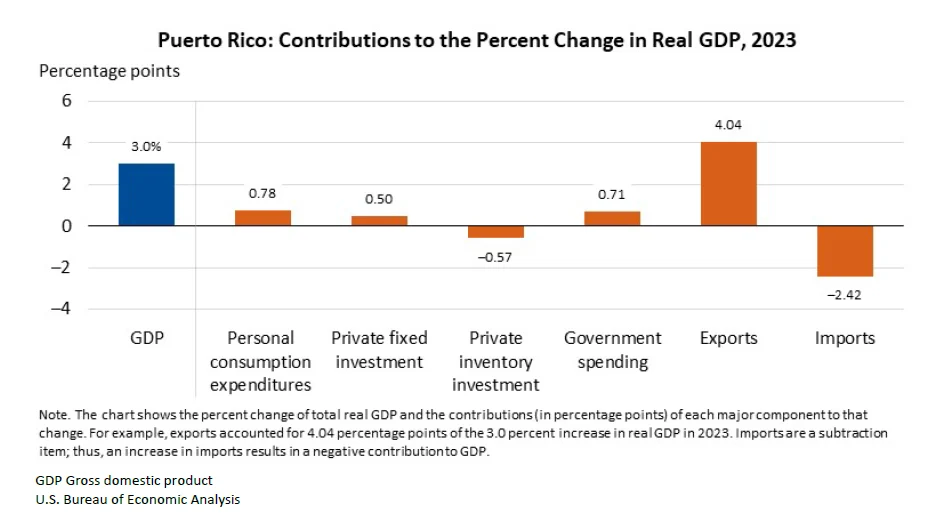
Puerto Rico’s economy demonstrated a significant turnaround in 2023, with its real gross domestic product (GDP) experiencing a robust increase of 3.0 percent. This marks a substantial recovery from the 2.1 percent contraction recorded in the preceding year, 2022, according to the latest statistics released by the U.S. Bureau of Economic Analysis (BEA). The upward trend in economic activity was primarily propelled by a surge in exports, signaling a potential strengthening of Puerto Rico’s position in both domestic and international markets.
Economic Rebound Driven by Export Growth and Increased Spending
The positive economic performance in 2023 was a multifaceted development, with several key components contributing to the overall GDP expansion. Beyond the notable increase in exports, personal consumption expenditures, government spending, and private fixed investment also registered gains. These upward movements, however, were partially counterbalanced by a decline in private inventory investment. Furthermore, imports, which are subtracted in the calculation of GDP, also saw an increase.
Key Drivers of GDP Growth in 2023:
- Exports: Real exports climbed by 6.4 percent, encompassing both goods and services. Exports of goods saw a substantial rise of 6.6 percent, while exports of services increased by 5.6 percent. This robust performance in the export sector underscores Puerto Rico’s growing capacity to engage with global markets and highlights the demand for its products and services.
- Personal Consumption Expenditures (PCE): Real PCE rose by 1.2 percent, indicating increased consumer spending. Within PCE, spending on services grew by a significant 4.0 percent, although spending on goods saw a slight decrease of 0.8 percent. This divergence suggests a shifting consumer preference towards services, a trend observed in many developed economies.
- Government Spending: Real government spending experienced a notable increase of 4.8 percent. This growth was observed across all levels of government, with a particular emphasis on investment spending. A significant portion of this increase is attributed to the ongoing disbursement of federal funds aimed at disaster recovery and infrastructure improvement projects.
- Private Fixed Investment: Real private fixed investment grew by 3.8 percent, driven primarily by increased investment in equipment. Industrial equipment, in particular, saw substantial purchases by businesses, signaling confidence in future economic activity and expansion.
Conversely, real private inventory investment experienced a decrease, with the manufacturing sector being the largest contributor to this decline. This could indicate a strategic adjustment by businesses to align inventory levels with anticipated demand or a response to supply chain dynamics.
A Closer Look at the Components of Growth
The BEA’s detailed analysis provides deeper insights into the forces shaping Puerto Rico’s economic landscape in 2023. The substantial growth in exports, both in goods and services, suggests a successful integration into regional and international supply chains, potentially benefiting from global economic trends or specific trade agreements. The resilience in the services sector, as reflected in PCE, points towards a potential shift in consumer behavior and business offerings.
The significant increase in government spending is intrinsically linked to the ongoing efforts to rebuild and enhance the island’s infrastructure. Federal funding, channeled through various agencies, is playing a crucial role in revitalizing critical sectors such as the power grid, water systems, transportation networks, and military installations. These investments, while contributing to immediate economic activity, also lay the groundwork for long-term economic stability and growth.
The uptick in private fixed investment, especially in industrial equipment, suggests a positive outlook among businesses. This investment is crucial for enhancing productivity, fostering innovation, and creating employment opportunities. The emphasis on equipment purchases points to a focus on modernization and efficiency within various industries.
Historical Context and Recent Trends
The economic trajectory of Puerto Rico has been marked by a series of challenges and opportunities in recent years. The island has faced significant hurdles, including natural disasters, a protracted economic recession, and political instability. The hurricanes of Irma and Maria in 2017, followed by earthquakes in 2019 and 2020, and Hurricane Fiona in 2022, have necessitated substantial recovery and reconstruction efforts. These events have not only caused widespread damage but have also had a profound impact on the island’s economic output and its ability to attract and retain investment.
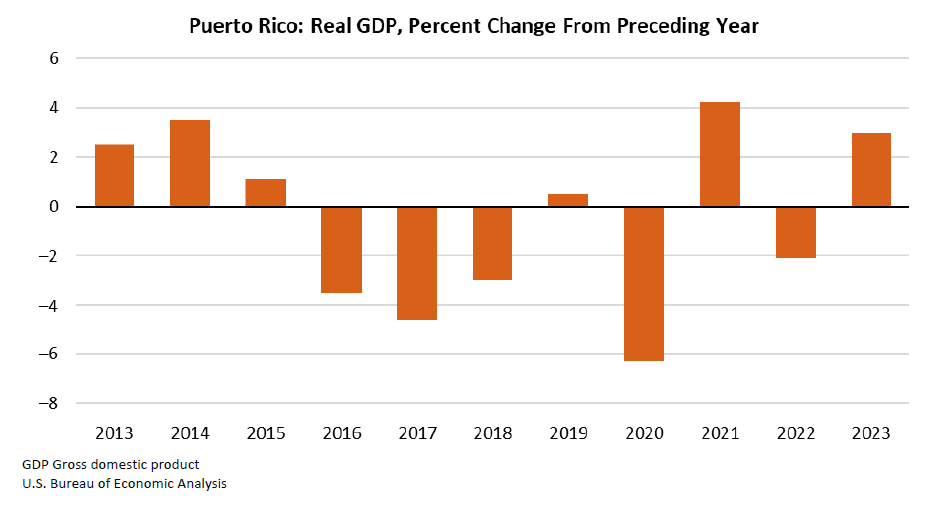
The BEA’s revised estimates for GDP from 2018 to 2022 reflect the incorporation of updated source data. The largest revision in this period was a 0.4 percentage point adjustment in 2022. While the 2022 contraction of 2.1 percent was a setback, the subsequent rebound in 2023 underscores the island’s capacity for recovery and adaptation. The BEA has also acknowledged the critical support and assistance provided by the government of Puerto Rico and various organizations in producing these vital economic statistics, given that Puerto Rico is not included in most of the major surveys used for U.S. GDP estimation.
Federal Funding and Infrastructure Development
The role of federal funding in Puerto Rico’s economic recovery cannot be overstated. The disbursement of federal funds for disaster recovery has been a consistent driver of economic activity, particularly in the realm of government investment. Projects such as the rebuilding and improvement of the power grid, the aqueduct system, roads and bridges, and military installations like Camp Santiago are crucial for enhancing the island’s resilience and its capacity to support economic growth. These investments are not merely about rebuilding what was lost but also about modernizing and strengthening the infrastructure for the future.
The BEA’s analysis highlights the widespread increases in investment spending by federal, central, and municipal governments. This coordinated effort reflects a strategic approach to addressing the long-term developmental needs of the island. The continued flow of federal aid, coupled with effective local governance and private sector engagement, is essential for sustaining the current momentum and fostering a more robust and diversified economy.
Implications for the Future
The positive GDP growth in 2023 offers a beacon of hope for Puerto Rico’s economic future. The rebound suggests that the island’s economy is moving in the right direction, driven by a combination of external demand, domestic consumption, and strategic public investment. The growth in exports, particularly in goods and services, indicates a strengthening of the island’s competitive position in the global marketplace.
The increased government spending, fueled by federal disaster recovery funds, is not only providing immediate economic stimulus but is also creating a more resilient and functional infrastructure. This improved infrastructure is a prerequisite for attracting further private investment and supporting sustainable economic development. The rise in private fixed investment, especially in industrial equipment, signals growing confidence among businesses about the island’s economic prospects.
However, challenges remain. The decrease in private inventory investment warrants monitoring, as it could signal potential shifts in market dynamics or supply chain issues. Furthermore, the island continues to navigate the complexities of its fiscal situation and debt restructuring, which are critical factors influencing long-term economic stability.
A Note on Data Discontinuation
It is important to note that, as indicated in the original report, the U.S. Bureau of Economic Analysis will no longer produce Puerto Rico GDP statistics after the release of the 2023 estimates. This marks the end of an era for official BEA GDP reporting for the island. Previously published data will remain accessible in BEA’s Data Archive, allowing for historical analysis. The discontinuation of these statistics may present challenges for future economic tracking and analysis by various stakeholders. The production of these estimates has relied significantly on the collaboration and data provided by the government of Puerto Rico, highlighting the importance of such partnerships in understanding regional economic performance.
Conclusion
In summary, Puerto Rico’s real GDP growth of 3.0 percent in 2023 represents a significant economic recovery, driven by a robust export sector, increased consumer and government spending, and a rise in private investment. This positive development offers a much-needed boost to the island’s economy, which has faced numerous challenges in recent years. The ongoing infrastructure development, bolstered by federal funding, is crucial for laying a foundation for sustained growth. While the discontinuation of BEA’s GDP statistics for Puerto Rico presents a shift, the data released for 2023 provides valuable insights into the island’s economic resilience and its potential for future prosperity. The ability to maintain this positive trajectory will depend on continued strategic investments, effective governance, and adaptation to evolving economic landscapes.