Nila Kartika Wati
On May 17, 2026, the National Mall in Washington, D.C., became the site of one of the most significant and controversial religious-political gatherings in modern American history. Titled "Rededicate 250," the event was framed as a taxpayer-funded prayer rally, backed by the White House, to commemorate the upcoming 250th anniversary of the United States’ founding. However, for civil rights advocates, constitutional scholars, and many faith leaders, the gathering represented an aggressive and overt display of state-sanctioned Christian Nationalism.
The rally featured a prominent lineup of political and religious figures, including House Speaker Mike Johnson, prominent evangelist Franklin Graham, and Defense Secretary Pete Hegseth. The speakers consistently framed the nation’s 1776 founding not merely as a political revolution, but as an explicitly Christian project. They called for the American people to "recommit" the nation to a specific, narrow interpretation of "One Nation Under God." While critics immediately labeled the event unconstitutional and a dangerous blurring of the lines between church and state, a deeper ideological shift was being observed far from the microphones and the grandeur of the National Mall.
The Chronology of Rededicate 250 and the Semiquincentennial Strategy
The origins of the Rededicate 250 rally can be traced back to a broader administrative strategy aimed at the United States Semiquincentennial. As the nation approached its 250th anniversary, the administration and its allies sought to center the celebration on a narrative of religious exceptionalism. This strategy, often referred to in political circles as the "Freedom 250" or "Bisesquicentennial Strategy," aimed to align the historical memory of the American Revolution with contemporary Christian conservative values.
Throughout early 2026, planning for the National Mall event was characterized by high-level coordination between federal agencies and evangelical organizations. By the time the rally occurred in May, it served as a catalyst for a summer-long series of events intended to culminate on July 4. However, the overt nature of the rally—with high-ranking government officials using their platforms to proselytize—triggered a counter-movement among progressive faith leaders.
In response to this growing trend, the "Voices of Repair" initiative was launched. This movement, spearheaded by Black clergy and narrative strategists, sought to address not just the loud proclamations of Christian Nationalism seen on the National Mall, but the subtle, insidious ways the ideology had begun to permeate Black and brown Christian communities.
Understanding the Spectrum of Christian Nationalism
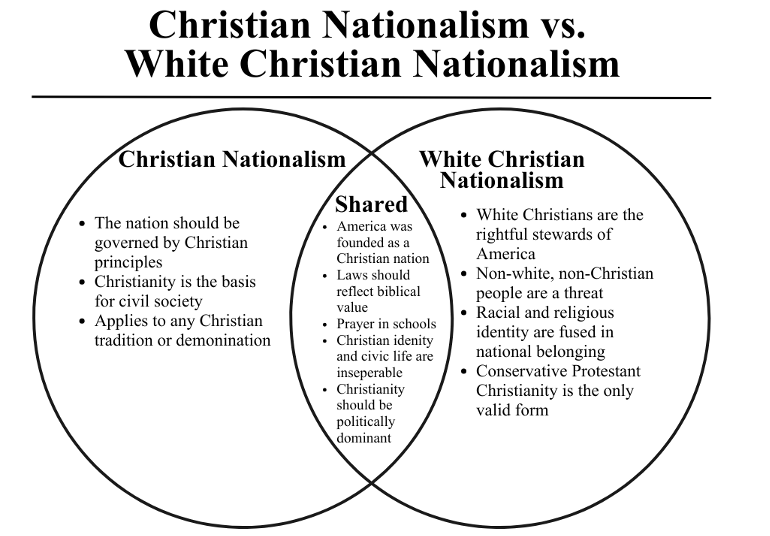
Christian Nationalism is frequently misunderstood as a monolith of extreme rhetoric. In reality, experts and organizers note that the ideology exists on a spectrum. While the most visible and extreme tactics are often deployed by White Christian evangelicals, the underlying logic of the movement is far more pervasive.
For many Americans, Christian Nationalism does not arrive as a political platform, but as a "theological logic"—a way of explaining their personal circumstances through the language of faith. Narrative strategists Chelsea Fuller and Takara Pierce, who helped build the Voices of Repair initiative, argue that this ideology often shows up as a story people tell themselves about why their lives look the way they do.
A poignant example cited by organizers involves a Black deacon in his late 60s. Despite his decades of service in the Black church and his support for social justice reforms, such as "invest-divest" organizing strategies, he simultaneously attributed the systemic killing of Black children by police to the "removal of God from schools." This internal dissonance—holding a belief in systemic reform while also adhering to a theological framework that blames moral failings for systemic harm—is the primary target of the Voices of Repair intervention.
Supporting Data: The PRRI Findings
The belief that Christian Nationalism is exclusively a White evangelical phenomenon is contradicted by recent data from the Public Religion Research Institute (PRRI). According to PRRI research, approximately 34 percent of Black Christians hold beliefs that align with Christian Nationalist frameworks. This rate actually exceeds the percentage found among White Christians by roughly 30 percent in certain metrics.
The data suggests that millions of Black and brown Christians are becoming increasingly susceptible to narratives that rewrite their place in the nation’s history and future. This susceptibility often stems from the internalization of moral frameworks that prioritize individual "sin" or "moral failure" over structural analysis. For example, a single mother struggling with low wages might be conditioned by her church environment to view her hardship as a result of "moral failings"—such as having children out of wedlock—rather than the result of stagnant wages, lack of affordable housing, or systemic economic barriers.
The Strategy of Voices of Repair
The Voices of Repair initiative was born out of the realization that traditional progressive "fact-checking" is often ineffective against deeply held religious narratives. The organizers argue that one cannot argue against a belief system with a better fact; instead, the intervention must occur within the language of faith itself.
The campaign centers on Black clergy across various denominations. Rather than using outside messengers or political talking points, the initiative utilizes:
- Synchronized Sermons: Faith leaders across the country delivering messages that reclaim the "prophetic obligation" of the church to name harm and demand remedy.
- Community Conversations: Facilitated dialogues that allow congregants to interrogate the "theological logic" they use to explain systemic issues.
- Historical Reclamation: Re-examining the role of Christianity in colonization while highlighting the "liberation theology" that has historically fueled Black freedom struggles.
By focusing on the period between Juneteenth (often referred to in this context as #ReparationsJune) and August (#BlackAugust), the initiative seeks to provide a counter-narrative to the July 4th celebrations that may be co-opted by nationalist rhetoric.
Official Responses and Reactions
The Rededicate 250 rally and the subsequent rise of the Voices of Repair movement have sparked a wide range of reactions from across the political and social spectrum.
From the Rally Organizers:
Spokespeople for the Rededicate 250 event defended the taxpayer funding, arguing that the event was a "non-partisan celebration of the nation’s spiritual heritage." They maintained that the presence of government officials like Speaker Mike Johnson was consistent with the long-standing tradition of American leaders acknowledging a higher power.
From Constitutional Advocacy Groups:
Organizations such as the American Civil Liberties Union (ACLU) and Americans United for Separation of Church and State issued stern rebukes. They argued that the rally was a clear violation of the Establishment Clause, as it used government resources to promote a specific religious ideology. They noted that the framing of the nation’s 250th anniversary as a "Christian project" effectively erases the history and contributions of non-Christian and non-religious Americans.
From the Black Clergy:
Leaders within the Voices of Repair movement have emphasized that their work is not about attacking faith, but about protecting it from being weaponized against their own communities. "The Black church carries a prophetic obligation to name harm and demand remedy," the organizers stated. "Faith cannot be treated as a private comfort; it must be a public commitment to justice."

Broader Impact and Implications
The struggle over the narrative of the American 250th anniversary has significant implications for several key areas of American life:
1. Electoral Organizing:
Narrative strategists point out that while voters may publicly align with candidates who look like them, they often vote based on what they believe their faith says about moral issues. In the South, where religious adherence is high, the influence of Christian Nationalist frameworks can shift electoral outcomes even among minority populations. Funders and organizers are increasingly viewing the dismantling of Christian Nationalism as a core component of electoral strategy.
2. Reproductive Justice:
In the realm of reproductive healthcare, Christian Nationalism shapes the sense of bodily autonomy among women of color. By framing reproductive choices as moral failings rather than healthcare decisions, the ideology creates barriers to support for reproductive rights within communities that would otherwise benefit from them.
3. Political Violence and Authoritarianism:
Observers note that Christian Nationalism is often the engine driving political violence and authoritarian tendencies. By framing political opponents not just as rivals but as "enemies of God," the ideology lowers the threshold for acceptable political behavior and justifies the exclusion of marginalized groups from the national story.
Conclusion: A Public Commitment to Repair
As the United States moves toward the height of its 250th-anniversary celebrations, the tension between state-sanctioned Christian Nationalism and the movement for "repair" is likely to intensify. The Voices of Repair initiative represents a shift in strategy for the progressive left—one that moves away from secular arguments and toward a deep engagement with the religious foundations of American identity.
The movement posits that the most effective counter to a false story is a truer one, delivered by trusted community leaders. For the Black church and its allies, the goal is to ensure that the next chapter of the American story is not authored by those who seek to exclude, but by those who have historically labored and sacrificed to make the nation’s ideals a reality. The focus on "repair" and "reparations" as moral obligations, rather than just political demands, signals a new era of public faith—one that seeks to reconcile the nation’s spiritual heritage with its ongoing struggle for liberation.