Candice Horbacz
Vehicle miles traveled (VMT) taxes have emerged as a prominent consideration for governments at all levels grappling with the escalating challenge of funding road infrastructure. While the concept offers a potentially more sustainable and equitable revenue stream than traditional fuel taxes, widespread privacy fears have significantly impeded its widespread implementation. Americans’ concerns about potential unconstitutional surveillance programs under the guise of a VMT tax are not unfounded, yet a meticulously designed VMT tax system can effectively address these privacy apprehensions without compromising its core objectives.
The Pressing Need for a New Funding Model
The current mechanisms for financing road construction and maintenance, primarily through fuel taxes, are increasingly insufficient. Both the federal Highway Trust Fund and state road programs are struggling to provide adequate funding, leading to deteriorating infrastructure and deferred maintenance. The federal Highway Trust Fund, established in 1956, has faced chronic deficits for over a decade, requiring transfers from the general fund to remain solvent. This financial instability is largely due to stagnant fuel tax rates—the federal gas tax has remained at 18.4 cents per gallon since 1993—coupled with rising construction costs, improved vehicle fuel efficiency, and the growing adoption of electric vehicles (EVs).
A VMT tax is posited as a more efficient and direct user fee for the roads compared to the antiquated gas tax and the myriad of other additional taxes and fees currently in place. The fundamental principle is straightforward: drivers are charged a fee per mile driven on government-maintained roads, directly linking usage to contribution. This charge can be adjusted based on vehicle weight, acknowledging that heavier vehicles cause more wear and tear on roadways. Such a system creates a neutral and transparent user fee, ensuring that those who benefit most from the infrastructure contribute proportionally to its upkeep.
Advantages of a VMT Tax System
Beyond its direct user-fee model, a VMT tax offers several distinct advantages. It promises a simpler taxation landscape, potentially replacing a complex web of existing taxes and fees with a single, clear charge. This consolidation would enhance transparency, as the cost per mile would be explicitly established, a stark contrast to the current system that often obfuscates the true cost of roads by spreading the burden across various levies, sometimes even embedding environmental program costs within what users perceive as road funding.
Furthermore, a VMT tax is inherently more neutral than the gas tax. It does not unduly favor one type of engine over another, meaning electric vehicles, which pay no gas tax, would contribute their fair share alongside gasoline-powered vehicles. Nor does it disproportionately burden specific types of driving, unlike retail delivery fees or rental car taxes. This neutrality extends to its future-proof nature; as vehicle technology evolves, from more prevalent EVs to hydrogen or even thorium-powered cars, the VMT tax would remain relevant, requiring no significant updates to ensure all drivers pay for their road usage. This stability offers a reliable funding stream resistant to technological shifts and fluctuating fuel consumption patterns.

The Shadow of Surveillance: A Major Obstacle
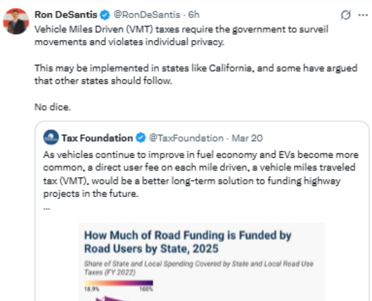
Despite its principled design and demonstrated administrative feasibility in pilot programs, the VMT tax faces significant public and political opposition, primarily centered on concerns about driver privacy. Governor Ron DeSantis (R-Florida) articulated this sentiment clearly in a social media post responding to analyses of VMT viability, highlighting widespread skepticism about government monitoring. His statement underscores a deep-seated apprehension among the public regarding potential surveillance, a concern that policymakers cannot afford to dismiss.
The public’s wariness is not without basis, given the contemporary landscape of escalating transgressions against driver privacy. One of the most notable developments is the proliferation of automated license plate reader (ALPR) cameras. These devices continuously scan every license plate within their field of view, logging vehicle location, date, and time, and creating vast, searchable databases. Projects like DeFlock have documented nearly 100,000 such cameras across the U.S., with agencies like the US Border Patrol reportedly using them for AI-powered "predictive policing." This extensive network of warrantless domestic surveillance has triggered considerable backlash, including legal challenges from groups like the Institute for Justice through its Plate Privacy Project.
Ironically, while Governor DeSantis expressed strong opposition to VMT-related surveillance, Florida itself extensively utilizes ALPR technology. The state’s Toll-By-Plate system, which complements its SunPass program for numerous toll roads, heavily relies on these cameras. DeFlock data indicates over 5,000 ALPR cameras in Florida, ranking it fifth nationally in cameras per road mile. This highlights a perceived double standard where existing surveillance technologies are often overlooked while new proposals, even if designed with privacy in mind, face intense scrutiny.
Further exacerbating privacy concerns is a provision within the 2021 Infrastructure Investment and Jobs Act. This legislation included a mandate for new vehicles to incorporate a "kill switch" surveillance system, designed to "passively monitor the performance of a driver" and prevent operation if impairment is detected. While implementation details and timelines remain unclear—the provision has already been delayed—its existence adds to a growing list of ways modern vehicles can track their drivers, from infotainment systems collecting data to apps monitoring driving habits. Against this backdrop of pervasive vehicle-centered data collection, public skepticism toward any new monitoring program, including a VMT tax, is entirely rational.
Designing a Privacy-Conscious VMT Tax
The critical distinction is that a VMT tax, by its very nature, does not necessitate a surveillance program. A properly designed VMT system does not require tracking drivers’ locations, routes, or driving behaviors. It does not need to know where, when, how, or why driving occurs. The only essential piece of information is the total cumulative miles driven on government roads. This data can be collected and supplied to the government through several privacy-protective mechanisms.
One highly viable method, demonstrated by the Washington state pilot program, involves periodic odometer readings. Drivers could simply report their odometer mileage, perhaps accompanied by a photograph for verification, at designated intervals (e.g., annually during vehicle inspection or registration renewal). To account for miles driven on private roads or outside the applicable jurisdiction, a standard exemption for non-chargeable miles could be provided. Drivers would also have the option to submit documentation for any non-taxable driving exceeding this standard exemption. This system offers maximum privacy as it does not involve real-time tracking or granular location data.
While governments should not mandate location-based reporting, they can offer it as an optional convenience, especially if coupled with robust data anonymization and security policies. Millions of Americans already voluntarily opt into driving monitoring programs offered by their insurance companies. These systems, using in-vehicle devices paired with smartphone applications, track not only miles driven but also detailed driving behaviors like speed, acceleration, deceleration, and adherence to traffic laws. A VMT system could leverage a similar model, employing a third-party commercial account manager (CAM). These CAMs would collect, secure, and aggregate granular driving data, sharing only the total aggregated mileage with the taxing authority, effectively shielding sensitive location or behavioral data from direct government access.
California has successfully piloted programs utilizing multiple CAMs and various location-tracking tools, alongside odometer readings, to measure road usage. The results consistently affirm the viability of VMT implementation across different data collection methods. These pilot programs demonstrate that the technological and administrative frameworks exist to implement VMT taxes without resorting to government surveillance. The key lies in offering choices that prioritize driver privacy while still achieving the primary goal of equitable road funding.
Broader Implications and the Path Forward
The successful implementation of VMT taxes holds significant economic, technological, and political implications. Economically, it promises a stable, inflation-resistant funding source for critical infrastructure, allowing for more predictable long-term planning and investment in road maintenance and expansion. This shift could lead to more efficient resource allocation, reducing the need for ad-hoc funding solutions and general fund transfers.
Technologically, the development of privacy-preserving data collection systems for VMT taxes could spur innovation in secure data management and anonymization, potentially benefiting other sectors dealing with sensitive personal information. The experience gained from VMT pilot programs could inform future public-private partnerships in data management and service delivery.
Politically, the VMT debate highlights the ongoing tension between public service provision and individual privacy rights. Policymakers who genuinely commit to designing VMT systems with explicit privacy safeguards—such as voluntary participation in location-based tracking and robust third-party data management—are far more likely to garner public consent and overcome constitutional challenges. This approach fosters trust and demonstrates a government responsive to citizen concerns, which is crucial for the success of any large-scale policy change.
The alternative—continuing to rely on an eroding gas tax—is a path toward further infrastructure decay, increased economic inefficiency, and a diminished quality of life for commuters and businesses alike. The imperative to find a sustainable funding mechanism for transportation systems is undeniable. By consciously separating the collection of mileage data from any form of government surveillance, policymakers can address the strongest opposition to VMT taxes. This careful balance, respecting individual privacy while securing reliable and principled funding for future transportation systems, is not merely a preference but a necessity for the nation’s infrastructure and its citizens. The lessons from pilot programs and the ongoing public discourse emphasize that the future of road funding depends not just on finding a better tax, but on building public trust through transparent, privacy-conscious design.