Lana Rhoades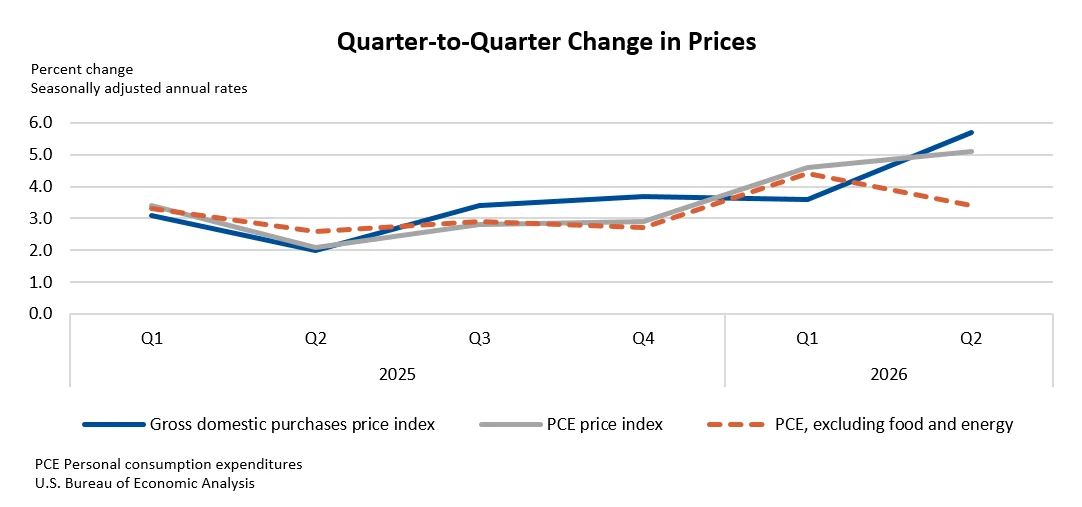
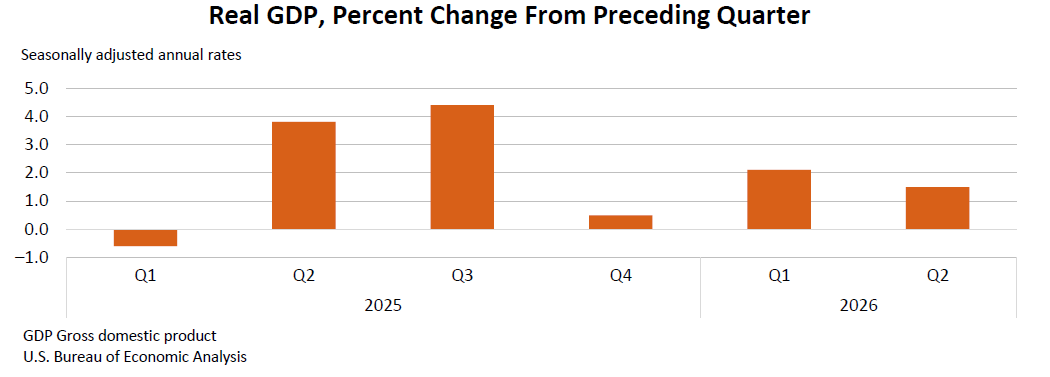
The United States economy experienced a notable deceleration in its growth rate during the second quarter of 2026, with real Gross Domestic Product (GDP) expanding at an annualized rate of 1.5 percent. This figure, released today by the U.S. Bureau of Economic Analysis (BEA) in its advance estimate, marks a significant slowdown from the 2.1 percent growth recorded in the first quarter of the year. The shift in economic momentum is attributed to a complex interplay of factors, including a contraction in government spending, moderated investment and export growth, and an acceleration in consumer spending.
Economic Landscape in Q2 2026: A Detailed Look
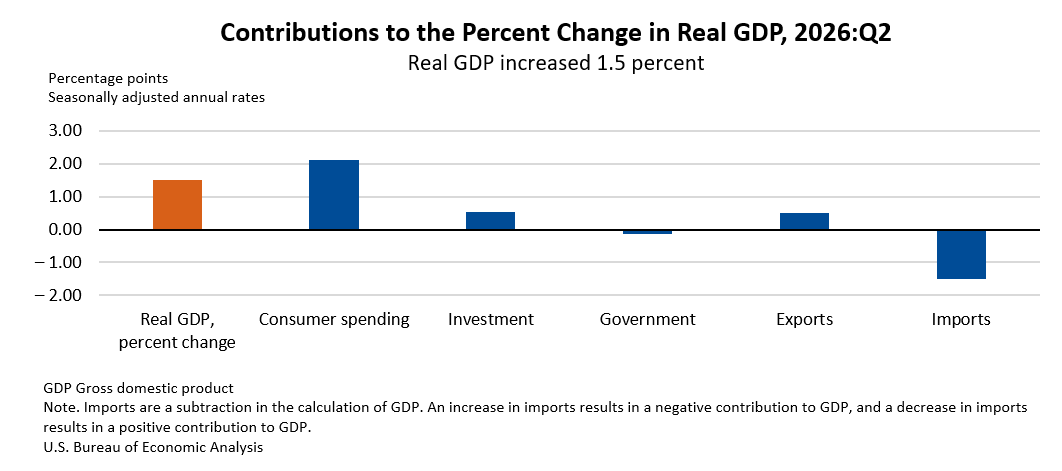
The BEA’s advance estimate provides a comprehensive snapshot of the nation’s economic performance between April and June 2026. The primary drivers contributing to the second-quarter GDP increase were robust consumer spending, a rebound in investment, and a rise in exports. However, these positive contributions were counterbalanced by a decline in government spending, a key factor in the overall deceleration. Furthermore, imports, which are subtracted in GDP calculations, saw an increase, further dampening the net growth figure.
While the overall GDP growth moderated, a deeper analysis reveals diverging trends within the economy. Real final sales to private domestic purchasers, a critical measure of demand from consumers and businesses excluding inventories and government consumption, demonstrated resilience. This aggregate, which comprises consumer spending and gross private fixed investment, surged by 3.9 percent in the second quarter. This represents a substantial acceleration from the 1.7 percent increase observed in the first quarter, indicating underlying strength in private sector activity.
The components of GDP paint a more nuanced picture of the economic transition. Consumer spending, a cornerstone of the U.S. economy, accelerated in the second quarter, providing a crucial boost. This acceleration suggests that households maintained their purchasing power and confidence, despite broader economic shifts. Conversely, investment and exports experienced a deceleration compared to their performance in the first quarter. This slowdown in two key growth engines, coupled with a direct decrease in government spending, created headwinds for the overall GDP expansion. Imports also increased at a faster pace in the second quarter than in the first, acting as a drag on the GDP calculation.
Inflationary Pressures Persist, Influencing Economic Outlook
Beyond the growth figures, the second quarter of 2026 also saw a significant uptick in inflationary pressures. The price index for gross domestic purchases, a broad measure of inflation for goods and services purchased by domestic entities, rose by 5.7 percent. This represents a notable acceleration from the 3.6 percent increase recorded in the first quarter, signaling a widening of price increases across the economy.
Within this broader trend, the Personal Consumption Expenditures (PCE) price index, a closely watched inflation gauge by the Federal Reserve, increased by 5.1 percent. This is up from a 4.6 percent rise in the first quarter. The core PCE price index, which excludes volatile food and energy prices, also saw a notable shift. It increased by 3.4 percent, a deceleration from the 4.4 percent rise in the first quarter. This divergence between the headline and core PCE figures suggests that while overall price pressures intensified, the rate of increase in underlying inflation may be moderating, though still elevated.
Historical Context and Economic Trends
The deceleration in GDP growth in the second quarter of 2026 follows a period of relatively strong economic expansion. The first quarter’s 2.1 percent growth had provided a sense of sustained recovery. However, the current figures suggest a recalibration of economic activity. Factors that may have influenced this shift include evolving global economic conditions, shifts in fiscal policy, and ongoing adjustments in supply chains and consumer behavior post-pandemic.
The BEA’s GDP reports are integral to understanding the health and direction of the U.S. economy. They provide policymakers, businesses, and the public with critical data to make informed decisions. The advance estimate is the first of three estimates for each quarter, offering an early look at the economic performance. The second estimate, typically released about a month later, incorporates more comprehensive data, and the third estimate refines the figures further.
Factors Influencing Government Spending
The decrease in government spending noted in the second quarter could be influenced by a variety of factors. This might include the winding down of certain pandemic-related relief programs, adjustments in defense spending, or shifts in state and local government fiscal priorities. Understanding the precise composition of this decline will be crucial in future analyses. For instance, a reduction in infrastructure spending would have different implications than a decrease in social program outlays.
Investment and Export Dynamics
The moderation in investment growth, despite the strong performance of real final sales to private domestic purchasers, warrants further examination. It could indicate a cautious approach by businesses in certain sectors, perhaps due to uncertainty about future demand, rising input costs, or evolving interest rate environments. Similarly, the deceleration in exports, while still contributing positively to GDP, might reflect slowing global demand or increased competition in international markets.
The Role of Consumer Spending
The acceleration in consumer spending remains a bright spot in the economic narrative. This robust performance could be attributed to several factors, including accumulated savings, wage growth, and a continued desire for goods and services. However, the sustainability of this accelerated spending will depend on factors such as inflation, employment trends, and consumer confidence levels in the coming quarters.
Insights from BEA Data and Analysis
The Bureau of Economic Analysis provides extensive data and analysis to support its GDP releases. The "Technical Notes" section of the BEA’s reports offers detailed explanations of the sources and methods used in the calculations. For the second quarter of 2026, the BEA highlighted that the 1.5 percent annual rate of real GDP growth translates to a 0.4 percent quarterly rate, underscoring the quarter-over-quarter slowdown. The agency also provides "key source data and assumptions" tables, offering transparency into the underlying data and the assumptions made in generating the estimates.
Future Economic Outlook and Data Releases
The BEA’s release schedule is crucial for tracking economic progress. The next major release will be the second estimate of GDP for the second quarter of 2026, along with corporate profits, scheduled for August 26, 2026. This release will offer a more refined view of the economic performance.
Annual Updates to National Economic Accounts
A significant event on the BEA’s calendar is the annual update of the National and Regional Economic Accounts, slated for September 30, 2026. For the first time, this year’s updates for national, industry, and regional data will commence on the same day, signifying improvements in the concurrent production of BEA statistics. This comprehensive update will encompass GDP, gross domestic income, GDP by industry, monthly personal income and outlays, and related statistics within the National Income and Product Accounts and the Industry Economic Accounts. The Regional Economic Accounts will also see updates to GDP by state and county, and personal income by state and county. Detailed information regarding these updates can be found in the BEA’s "Information on 2026 Annual Updates to the National, Industry, State, and County Statistics."
Broader Implications and Market Reactions
The moderation in GDP growth, coupled with rising inflation, presents a complex scenario for policymakers and market participants. The Federal Reserve will likely be closely monitoring these trends to inform its monetary policy decisions. A slower growth environment might suggest a need for a more accommodative stance, but persistent inflation could necessitate continued monetary tightening. Businesses will need to navigate this environment by carefully managing costs, adjusting pricing strategies, and assessing consumer demand.
The BEA’s data serves as a vital barometer for the U.S. economy, providing essential insights into its trajectory. The 1.5 percent growth in the second quarter of 2026, while slower than the preceding quarter, is part of a dynamic economic landscape influenced by a multitude of interconnected factors. The interplay of consumer resilience, government fiscal adjustments, investment trends, and inflationary pressures will continue to shape the economic narrative in the coming months.
For those seeking deeper dives into the data, the BEA offers access to historical time series and detailed breakdowns through its Interactive Data Application. Key tables, such as "Percent Change From Preceding Period in Real Gross Domestic Product" and "Contributions to Percent Change in Real Gross Domestic Product," provide granular detail for researchers and analysts. These resources are invaluable for understanding the nuances of the U.S. economic performance and its underlying drivers. The BEA also provides access to archived data for historical reference, ensuring that past economic performance can be analyzed alongside current trends.
The next GDP release will supersede the data presented today, with links to historical data being updated accordingly. The BEA’s commitment to transparency and accessibility ensures that stakeholders have the necessary tools to interpret and utilize economic data effectively.