Layla Zulfa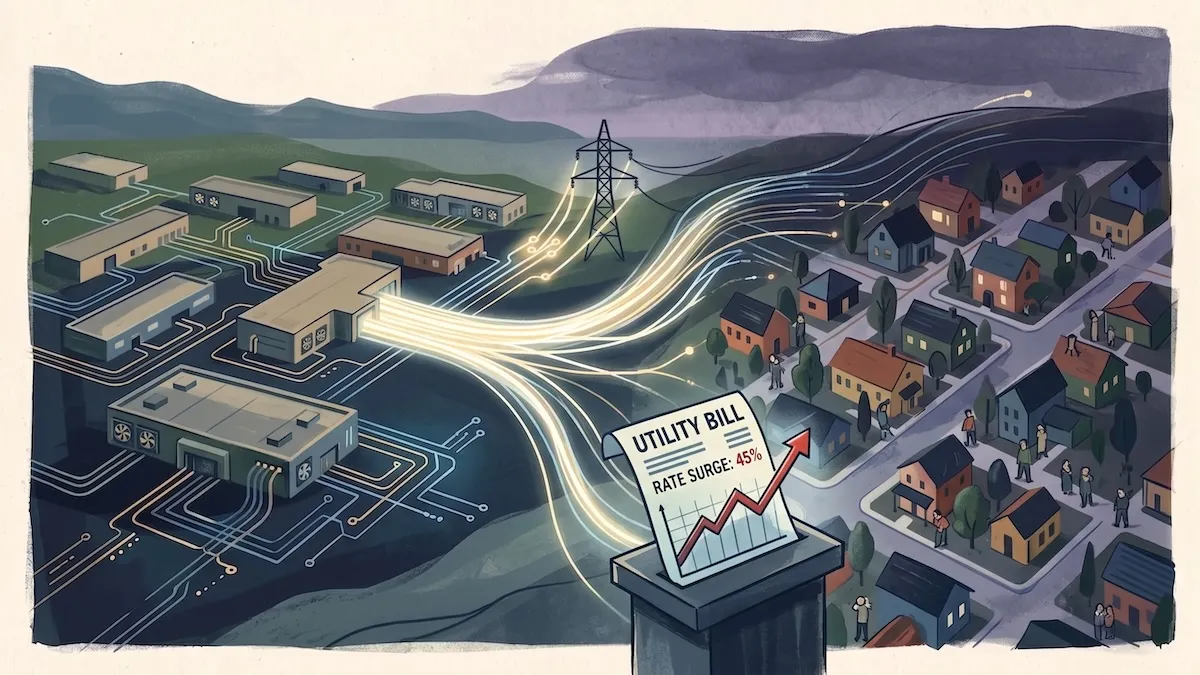
For real estate agents, data centers are increasingly part of conversations about nearby development, noise, views, water use, and potential effects on property values. But another question may be just as relevant to a client’s decision to buy, sell, or remain in a home – whether the enormous amount of electricity required by data centers could eventually affect the monthly cost of powering that home. The answer is complicated. Data centers do not automatically raise residential utility bills, and electricity prices are affected by many factors. However, Ari Peskoe, director of the Electricity Law Initiative at the Harvard Law School Environmental and Energy Law Program, states that the unprecedented scale of data-center development has created a fundamental question about who pays when utilities build new power plants, transmission lines, and other infrastructure to serve them.
Peskoe, co-author of the 2025 report "Extracting Profits from the Public: How Utility Ratepayers Are Paying for Big Tech’s Power," along with Harvard Legal Fellow Eliza Martin, highlights a critical issue for consumers and the real estate market. Their research reviewed nearly 50 regulatory proceedings involving utility rates for data centers, examining how rate structures, infrastructure spending, and confidential agreements could shift some costs associated with serving large technology companies to other customers. "We’re talking about homeowners and renters, as well," Peskoe told HousingWire. "That’s because most people pay their own electric bill, and the basic gist of it is that the business model of the electric utility is to build new infrastructure like power lines and power plants, and to socialize the cost among all consumers within its monopoly service territory."
This traditional utility model is now colliding with an extraordinary source of new demand. "Right now, the biggest driver of new infrastructure is new data centers, and these data centers can use as much electricity as large cities," Peskoe explained. "So, the tech industry is trying to just basically drop these cities all over the country. It’s causing utilities to spend billions of dollars, and again, the classic business model here is to spread those costs to everyone." For real estate professionals, the potential consequence is another variable in the affordability equation. Buyers routinely compare principal and interest payments, property taxes, homeowners insurance, and association fees. Electricity is also a recurring cost of occupying a home – and one that can rise as utilities invest in generation, transmission, and distribution systems. Whether data-center growth affects that cost depends heavily on the utility serving the property, the regional electricity market, and the rules established by regulators for assigning new infrastructure costs.
The Shifting Landscape of Utility Infrastructure Costs
Peskoe’s research delves into how utilities can negotiate arrangements with major electricity users outside the standard rate structures that apply to residential customers. "Very large users of energy have had sort of a side door to making a separate deal with the utility," he said. "They don’t necessarily pay a standard rate; they can cut a separate deal. There’s a long history of these side deals, and the basic premise is that historically, with large users of energy like a factory – engines of economic development – there was a public benefit to attract and keep those energy users in the service territory. What’s changed here is just the scale of this issue, and utilities are competing with each other to attract new data centers because that’s how utilities make money, by building infrastructure."
The Harvard report argues that determining whether data centers are actually paying their full share can be difficult because some agreements and pricing arrangements are not publicly disclosed. "They claim that the terms of their deal are commercially sensitive, therefore confidential, and they, in general, do not disclose the prices that data centers pay for energy," said Peskoe. For a real estate agent, that means the potential affordability impact may not be immediately obvious from a property’s listing or a current utility bill.
Peskoe also cautioned against blaming data centers for every increase in electricity costs. "I don’t want to overstate the impact because there are a number of factors driving up energy prices around the country," he said. "Data centers are just one factor, and one real unknown here is the future of this data center industry. There’s just so much investment – more than a trillion dollars a year – projected for next year going into new data centers. Is this the beginning of an extended investment era? Is the bubble going to pop? We just have no idea."
Water Concerns Compound Utility Costs
In addition to higher utility costs, data centers’ strain on local water supplies has also been a main point of ire for residents nationwide. Bernadine Anderson, a Realtor and licensed appraiser working near the data center project hotspot Granbury, Texas, noted that water has become a central issue in real estate transactions, with new statewide disclosure requirements coming into effect. "Now we have water disclosures, which we didn’t have before," Anderson said. "It asks what kind of water do you have? Where are you pulling it from? Are you on a well? It became effective July 1." The concern is not unfounded, she added. "It’s a huge issue in some counties. In Parker County, you have to have a minimum of two acres before you can put in a water well. For lots under two acres, you’re going to have to find a co-op or do a water system. I’ve been doing this for 25 years. We weren’t even worried about water issues, as Realtors. But now, everybody’s going, ‘Oh, yeah, we need to start looking at that.’"
Jerry Allen, a Realtor with eXp Realty and a member of the Granbury, Texas, planning and zoning commission, stated that the sheer number of proposed data center facilities is alarming residents, as well as potential buyers looking to move to the area. "It’s a big drain on your power grid, so that’s going to raise your power prices, and it’s a big drain on your water supply, which is the bigger concern," he said. "Also, nothing is like what’s been promised. They’ll say, ‘Oh, we’re bringing a bunch of jobs.’ It’s true, they do bring in a bunch of jobs while it’s being constructed. After it’s constructed, the jobs go away. It doesn’t take very many people to babysit a bunch of servers."
Anderson cited that multiple data centers in her area are planned within a relatively small radius. "Somebody said nine, but I’ve only heard about four or five," she said. "They’re all within five miles of each other, and it’s all rural, because that’s where you have all the land. Everybody’s wondering, ‘Why all of a sudden? Why so many? Why do we need them right next to each other?’" Public meetings have become heated, Anderson said. "City council meetings and town council meetings are overflowing because of all the issues. Some local governments are putting a moratorium on them and saying no to data centers."
How Costs Can Reach a Homeowner
J.P. Blackwood, public affairs liaison and media spokesperson for the Ohio Consumers’ Counsel (OCC), explained the basic mechanics of an electric bill and how massive new electricity demand can affect ordinary customers. "There are three key components of an Ohio electric bill: generation – making the electricity; transmission – moving it long distances; and distribution – delivering it locally to homes and businesses," he said. "The recent, wholly unprecedented surge in electricity demand from data centers in Ohio is a key factor in rising bills."
"Generation prices are affected by supply and demand, and today, data centers are adding enormous amounts of new demand to the regional power grid." At the local level, distribution utilities can face costs for new or upgraded substations, transformers, and power lines needed to connect massive new customers. The OCC cannot identify a specific dollar amount that data centers alone are currently adding to every Ohio household’s monthly bill. "Too many factors affect residential bills – including generation prices, [PJM Interconnection] capacity costs, transmission and distribution investments, and the utility serving the customer," Blackwood said. "There are too many to say data centers will add a specific amount per month to every Ohio household."
However, the agency points to evidence that the broader impact of data-center demand is already material in the regional electricity market. Blackwood cited PJM’s independent market monitor concluding that data-center load growth is a primary reason for recent and expected tight capacity-market conditions and high prices. Data center load reportedly drove up revenue in the PJM Interconnection’s last capacity auction by $7.3 billion, or 82%, to $16.1 billion. The OCC has taken the issue directly to the Ohio Legislature, advocating that customers creating extraordinary new demand should bear the extraordinary costs of serving that demand.
One significant Ohio protection is AEP Ohio’s data-center tariff. The tariff requires qualifying new, large data centers to pay for at least 85% of their contracted electric capacity for up to 12 years, even if their actual electricity usage falls below that amount. "The tariff protects consumers against AEP building infrastructure based on speculative data center demand forecasts," said Blackwood. "Only data center demand based on actual contracts, subject to the tariff, will be submitted by AEP to PJM for consideration about infrastructure building decisions."
The tariff is also designed to address what consumer advocates call the "stranded-investment problem." "Under AEP’s tariff, if the customer cancels or delays the project before the target energization date, the customer is responsible for 100% of the associated buildout costs," said Blackwood. "Once the project is energized, the minimum demand requirements, contract term, collateral, and exit provisions are intended to keep the data center financially responsible if its actual electricity use falls short of what it originally requested. Without such protections, a utility could build a substation, distribution and transmission lines, or other facilities based on an anticipated enormous new customer; the customer could disappear or use a fraction of its projected load, and the utility could subsequently seek to recover the investment from its remaining customers."
The OCC has nonetheless warned that an individual utility tariff does not solve every problem associated with regional data-center growth. "Residential consumers can still be affected by regional transmission costs and wholesale generation (energy) and capacity prices," said Blackwood. "If thousands of megawatts of new data center demand cause PJM to procure more generation or require major transmission projects, some of those costs can be allocated much more broadly."
Virginia regulators have adopted one of the country’s most explicit frameworks for limiting cost shifting. The Virginia State Corporation Commission created a separate GS-5 rate class for qualifying very large electricity users, including hyperscale data centers, with the purpose of minimizing cost shifting to other customer classes. New qualifying large-load customers contracting for service on or after January 1, 2027, generally must commit to at least 14 years of service. Large-load customers also must pay at least 85% of the transmission and distribution costs incurred to serve them each month, regardless of how much electricity they actually consume.
The Flip Side of the Equation: Economic Benefits and Transparency Concerns
Harvard’s Peskoe pointed to Loudoun County, Virginia, where the concentration of data centers has generated substantial tax revenue for the county. "We should present the flip side of this, as well," he said. "There was just an article yesterday in The New York Times about Loudoun County, the data center capital of the world, and that county has been able to reduce property taxes because of the tax revenue from data centers. So, if you’re just concerned about the cost of living in a particular community, you also have to consider that potential."
Georgia Power states that large energy users such as data centers are required to pay for the infrastructure needed to serve them through upfront payments, long-term contracts, collateral requirements, minimum bills, and termination payments. The company has frozen its base rates through at least 2028 and also argues that data center growth can produce a financial benefit for existing customers by spreading fixed costs across a larger base of electricity sales. Peskoe remains skeptical of claims that large customers are fully covering their costs when the underlying financial arrangements are not transparent. "[Georgia Power] says they’re doing that, but there’s just zero transparency in the data," he said. "They just don’t provide the numbers publicly, so you have to take their word on it, and I generally don’t take the word of a monopoly." Georgia Power’s position, meanwhile, is that its approved large-load framework is specifically designed to ensure that new large-energy users pay their way and protect other customers from subsidizing them.
What Real Estate Agents Should Watch
For real estate professionals, the most responsible message is not that a proposed data center will inevitably raise a client’s utility bill. Instead, agents can help clients understand that data-center growth is becoming one more factor in the broader monthly cost of housing. Blackwood put the connection plainly: "Electric bills are recurring housing costs just like insurance and property taxes. A $25 monthly increase is $300 a year, and $50 a month is $600 a year. For a household already stretched by mortgage payments, insurance, taxes, and other necessities, utility increases of that magnitude plainly affect the cost of remaining in the home – even if we cannot say that data centers alone are currently producing increases that large."
Peskoe expects any rate effects to develop over time rather than necessarily appearing as a sudden increase. "Utility rate increases tend to be gradual, and so that’s what I would expect here," he said. "Again, a number of factors can drive electricity prices higher and are driving them higher, and this is one of them. There are steps being taken around the country to mitigate the effects of data centers. My view is that they are incomplete, but there have been some positive steps taken in many states."
A buyer may still want to know whether a data center affects noise, views, water resources, or future resale demand. But in markets experiencing extraordinary growth in electricity demand, there is another question worth asking – what will it cost to power the home, and who is ultimately paying for the infrastructure required to power everything around it?
This is the third of a three-part series on data centers.
Part 1: Data centers emerge as real estate’s newest pricing wildcard.
Part 2: Are data centers the next constraint on affordable housing supply?