Candice Horbacz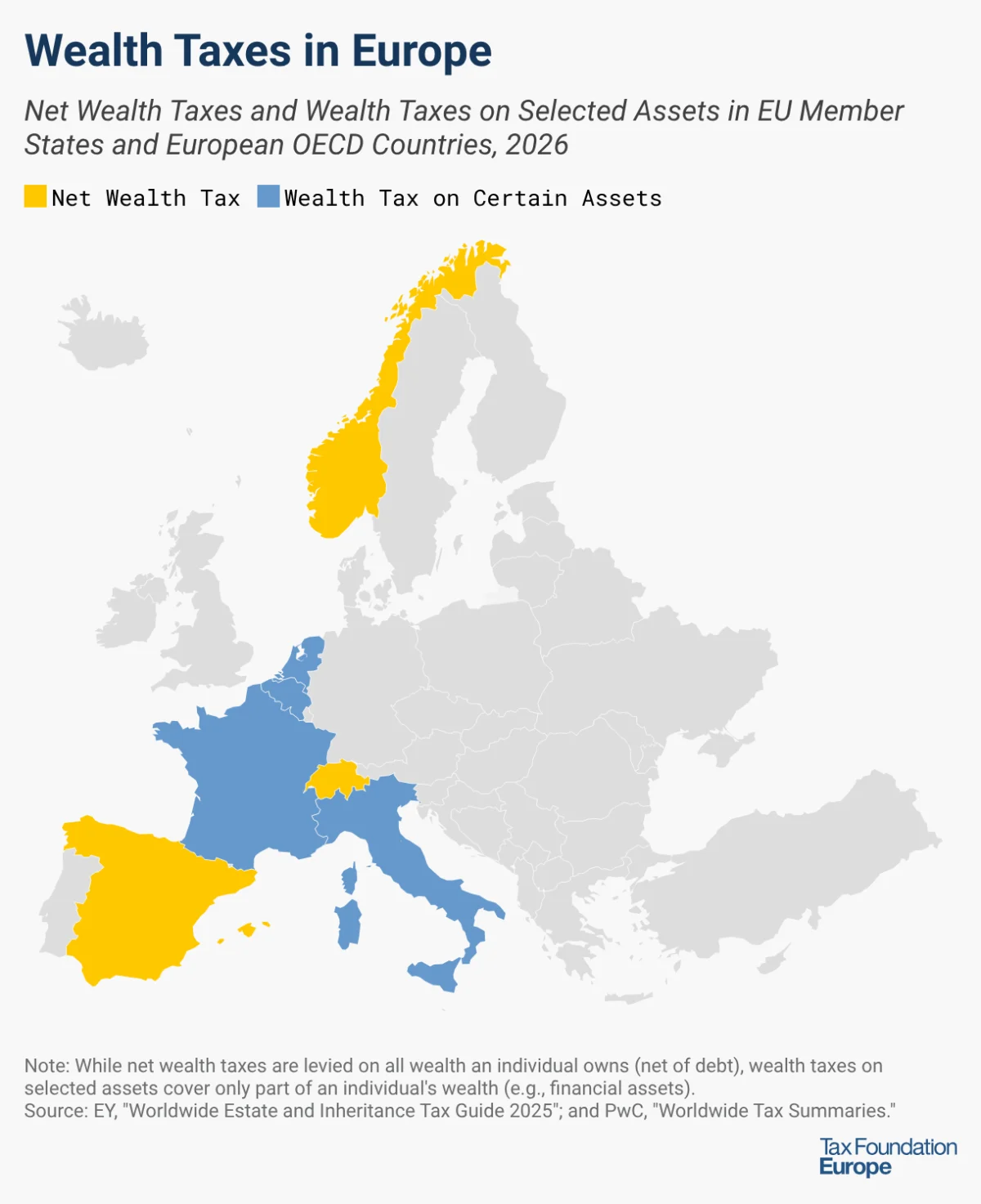
Net wealth taxes, defined as recurrent levies on an individual’s total assets minus liabilities, represent a distinct approach to public finance, extending beyond the scope of traditional real property taxes to encompass all forms of personal wealth. While similar in principle to property taxes, their broader base covering financial assets, movable property, and other forms of wealth presents unique opportunities and challenges for national treasuries and individual taxpayers alike. Currently, only three European nations — Norway, Spain, and Switzerland — maintain a comprehensive net wealth tax system. This contrasts with a growing trend among other European economies, such as France, Italy, Belgium, and the Netherlands, which have either abolished broad wealth taxes in favor of more narrowly defined levies on specific assets or are in the process of reforming their existing systems. The diverse landscape of wealth taxation across Europe reflects an ongoing, often contentious, debate about economic equity, fiscal sustainability, and the potential impact on national competitiveness and investment.
The Landscape of Comprehensive Net Wealth Taxation
The concept of a net wealth tax, though debated globally, finds its most comprehensive application in a select few European states. These nations employ systems that aim to capture a broader slice of an individual’s financial standing, reflecting a historical or philosophical commitment to wealth redistribution and public revenue generation.
Norway: A Long-Standing Tradition
Norway stands out for its deep-rooted commitment to a net wealth tax, which dates back to 1892. This enduring levy underscores a consistent policy approach towards wealth distribution and fiscal contribution. The Norwegian system imposes a 1 percent tax on individual wealth exceeding NOK 1.9 million (approximately EUR 172,710 or USD 198,996). This rate is bifurcated, with 0.35 percent allocated to municipalities for local services and 0.65 percent directed to the central government, highlighting a shared responsibility in revenue utilization. For the wealthiest individuals, those whose net assets surpass NOK 21.5 million (roughly USD 2.2 million), a slightly higher rate of 1.1 percent applies, signifying a progressive element within its structure. The longevity of Norway’s wealth tax suggests a societal acceptance and integration into its economic fabric, often framed within the context of its robust social welfare model and high public trust. However, even in Norway, the tax is not without its critics, who occasionally raise concerns about its potential impact on entrepreneurship and capital formation, particularly in a globalized economy where capital can be highly mobile.
Spain: A Shifting and Fragmented Approach
Spain’s net wealth tax presents a more complex and dynamic picture, characterized by significant regional autonomy and recent central government interventions. The tax operates as a progressive levy, with rates ranging from 0.16 percent in regions like Navarra to a substantial 3.5 percent on wealth stocks exceeding EUR 700,000 (approximately USD 805,330), though this threshold can vary by autonomous community. This regional variation is a hallmark of Spain’s decentralized fiscal system, allowing regions to tailor tax policies to their specific economic and social conditions. For instance, several regions, including Andalusia, Cantabria, La Rioja, Madrid, and Murcia, have historically offered 100 percent relief for individuals with net wealth below EUR 3 million, with Extremadura providing blanket 100 percent relief. This regional divergence has often led to accusations of fiscal dumping and unequal treatment of taxpayers across the country.
A significant development occurred in 2022 when the Spanish central government introduced a "solidarity wealth tax." This new levy, designed to ensure a minimum contribution from high-net-worth individuals across all regions, applies to net assets exceeding EUR 3 million, with rates ranging from 1.7 percent to 3.5 percent. The central government’s rationale was to capture revenue that might otherwise be foregone due to regional tax breaks, ensuring a more uniform approach to wealth taxation for the wealthiest. This solidarity tax was initially temporary but was extended indefinitely in December 2023. In a notable reaction to this central imposition, regions like Madrid and Andalusia, which had previously offered significant wealth tax relief, subsequently restored their regional wealth taxes. This strategic move aimed to allow the regional governments to retain the revenues that the central government’s solidarity tax would otherwise collect, transforming a centralizing measure into a mechanism for regional fiscal capture. This ongoing interplay between central and regional authorities illustrates the political complexities and constitutional tensions inherent in implementing national fiscal policies within a highly autonomous regional framework. Spanish residents are subject to the tax on a worldwide basis, while non-residents are taxed only on assets located within Spain, a common distinction in international tax law.
Switzerland: Cantonal Autonomy at its Core
Switzerland’s net wealth tax, first implemented in 1840, is unique due to its highly decentralized nature. It is levied primarily at the cantonal level, meaning that tax rates, allowances, and exemptions vary significantly across the 26 cantons and even within municipalities. This cantonal autonomy is a defining feature of the Swiss federal system, allowing for a diverse range of fiscal policies tailored to local preferences and economic realities. The tax generally covers worldwide assets, with the notable exception of real estate and permanent establishments located abroad, which are typically taxed where they are situated. This fragmented approach, while reflecting Switzerland’s deep-seated federalist principles, also creates a complex tax landscape for individuals and businesses, often requiring specialized advice to navigate. Proponents argue that cantonal competition fosters efficiency and responsiveness, while critics point to potential inequities and administrative burdens arising from such diverse regulations. The stability of the Swiss system, despite its complexity, suggests a strong cultural and political commitment to local self-determination in fiscal matters.
The Shift Towards Selected Asset Taxation
While a few nations maintain broad net wealth taxes, a more common trend in Europe has been the abolition of comprehensive wealth taxes in favor of levies targeting specific asset classes. This shift often reflects a pragmatic response to challenges associated with administering broad wealth taxes, such as capital flight, valuation difficulties, and concerns about economic disincentives.
France: From ISF to IFI
France provides a prominent example of this strategic pivot. In 2018, the government of President Emmanuel Macron abolished the controversial Impôt de Solidarité sur la Fortune (ISF), a broad net wealth tax that had been in place since 1982 (and its predecessor since 1989). The ISF had been widely criticized for allegedly encouraging capital flight, deterring investment, and creating administrative complexities. In its place, France introduced the Impôt sur la Fortune Immobilière (IFI), a real estate wealth tax. This targeted levy applies to French tax residents whose net worldwide real estate assets exceed EUR 1.3 million (approximately USD 1.5 million). Non-French tax residents are also subject to the IFI if their net real estate assets located in France surpass the same threshold. Depending on the net value of the real estate assets, the tax rate can reach up to 1.5 percent. The rationale behind this reform was to streamline the tax system, encourage investment in productive assets, and reduce the incentive for wealthy individuals to relocate their capital or residency. While the IFI still generates significant revenue, it represents a narrower application of wealth taxation, focusing specifically on immovable property rather than an individual’s entire net worth.
Italy: Targeting Foreign-Held Assets and Emerging Categories
Italy employs a distinct approach by focusing on specific categories of assets, particularly those held abroad by resident taxpayers. The country levies a tax of 0.2 percent on financial assets held abroad without Italian intermediaries, with a higher rate of 0.4 percent for assets held in certain specific countries, reflecting efforts to manage capital flows and ensure fiscal compliance. In a move reflecting the evolving digital economy, Italy introduced a new tax in 2023: a 0.2 percent annual levy on crypto assets held with a non-resident intermediary or stored on personal devices like USB sticks or smartphones. This demonstrates a proactive stance in adapting tax policy to new forms of wealth. Furthermore, real estate properties held abroad by Italian tax residents are subject to a tax rate of 1.06 percent. These measures collectively aim to capture revenue from wealth that might otherwise escape the domestic tax net, particularly in an increasingly globalized financial landscape.
Belgium: A Solidarity Tax on Securities Accounts
Since 2021, Belgium has implemented a "solidarity tax," officially known as the tax on securities accounts (TSA). This levy imposes a 0.15 percent tax on securities accounts with an average value exceeding EUR 1 million (approximately USD 1.15 million). The TSA was introduced as a measure to increase fiscal fairness and contribute to public finances, particularly in the wake of economic challenges. It targets significant financial holdings in the form of securities, rather than an individual’s entire net wealth. The design of the TSA reflects an attempt to create a more politically palatable and administratively simpler form of wealth taxation compared to a broad-based levy, focusing on a liquid and more easily quantifiable asset class.
The Netherlands: Navigating Legal Challenges and Reform
The Netherlands presents a fascinating case study in the complexities of wealth taxation, particularly concerning legal challenges and ongoing reform efforts. Historically, the Dutch system included the value of net wealth (excluding primary residence and substantial interests in companies) within its income tax framework, applying a deemed return on these assets. However, in 2021, the Dutch Supreme Court ruled that this system violated European law regarding property rights and non-discrimination, arguing that the deemed return often did not reflect the actual returns generated by taxpayers, leading to an unfair tax burden.
In response to this landmark ruling, the Dutch government proposed a new temporary alternative system for the years 2023 to 2027. Under this interim model, each asset category (e.g., savings, debts, other investments) would have its own deemed return, attempting to better reflect market realities. For 2026, the plan involves applying a weighted average yield over all categories to the total assets above a personal exemption of EUR 59,357 (approximately USD 68,373) to determine the taxable benefit, which will then be subject to a flat tax rate of 36 percent. Looking further ahead, the government is aiming to introduce a more fundamental and permanent system based on actual returns by 2028. This ambitious reform seeks to address the Supreme Court’s concerns by aligning tax liabilities more closely with real economic gains, while simultaneously grappling with the significant administrative challenges of valuing and taxing actual returns across diverse asset portfolios. The Dutch experience highlights the intricate legal and practical hurdles in designing and implementing wealth tax systems that are both fair and effective.
Broader Context: The Enduring Debate and Economic Implications
The global and European experience with wealth taxes reveals a persistent and often polarized debate. Proponents of wealth taxes typically emphasize their potential to address escalating wealth inequality, generate substantial public revenue, and enhance the perceived fairness of the tax system. They argue that wealth, particularly inherited wealth, contributes disproportionately to societal disparities and that a tax on accumulated assets can help rebalance economic opportunities and fund essential public services like healthcare, education, and infrastructure. From this perspective, wealth taxes are seen as a mechanism for social solidarity and economic justice.
Conversely, critics raise a litany of concerns, many of which have contributed to the abolition of comprehensive wealth taxes in numerous European countries over the past few decades. A key argument revolves around the administrative complexity and practical difficulties of valuation, particularly for illiquid assets like private businesses, art collections, or specialized real estate. Determining market value annually for a diverse range of assets can be an expensive and contentious process, leading to disputes and high compliance costs for both taxpayers and tax authorities.
Moreover, economic analysis, including reports from organizations like the OECD, frequently highlights potential negative impacts on entrepreneurship, innovation, and long-term economic growth. Critics contend that wealth taxes can disincentivize savings and investment, as accumulated capital is repeatedly taxed. This can encourage capital flight, where wealthy individuals and their assets relocate to jurisdictions with more favorable tax regimes, thereby eroding the tax base and diminishing domestic investment. The argument posits that such taxes can penalize successful wealth creation, rather than just consumption or income, thereby stifling the very economic dynamism necessary for prosperity. The "lock-in effect," where individuals avoid selling assets to defer tax liabilities, can also reduce market liquidity and efficient capital allocation.
Timeline and Chronology of European Wealth Tax Evolution:
- 1840: Switzerland first implements its cantonal net wealth tax, a system that has largely endured due to its decentralized nature.
- 1892: Norway establishes its national net wealth tax, marking over a century of continuous application.
- Late 20th Century: A period where many European countries, facing challenges like capital flight and administrative burden, begin to repeal their comprehensive wealth taxes. Countries like Germany, Sweden, Denmark, and Austria are among those that phased out their wealth taxes.
- 1982 (predecessor from 1989): France introduces the Impôt de Solidarité sur la Fortune (ISF), a broad wealth tax that would become a central point of political contention.
- 2018: France abolishes the ISF, replacing it with the real estate-focused IFI, signaling a major policy shift under President Macron to encourage investment and curb capital flight.
- 2021: The Dutch Supreme Court rules against the Netherlands’ deemed return system for wealth taxation, citing violations of property rights and non-discrimination, triggering a need for comprehensive reform.
- 2021: Belgium introduces its "solidarity tax" on securities accounts, a targeted wealth levy.
- 2022: Spain’s central government introduces the "solidarity wealth tax" to address regional wealth tax reliefs and ensure contributions from high-net-worth individuals. The Netherlands proposes a temporary alternative wealth tax system for 2023-2027.
- 2023: Italy expands its asset-specific taxes to include crypto assets. Spain’s central government extends its "solidarity wealth tax" indefinitely, leading Madrid and Andalusia to restore their regional wealth taxes.
- 2028 (Target): The Netherlands aims to implement a new, permanent wealth tax system based on actual returns, following the Supreme Court’s ruling.
Official Responses and Stakeholder Perspectives:
Government decisions regarding wealth taxes are typically driven by a mix of fiscal necessity, ideological conviction, and public pressure. For nations like Norway, the consistent application of a wealth tax is often framed as an integral part of their social contract, ensuring that those who have accumulated significant wealth contribute proportionately to the collective good. In Spain, the introduction of the solidarity tax by the central government was explicitly justified as a measure to enhance fiscal equity and revenue generation, especially in light of the economic pressures exacerbated by recent crises. The subsequent reaction from regional governments, restoring their own wealth taxes, highlights a complex interplay of fiscal autonomy and a desire to control local revenue streams.
Conversely, the French government’s decision to abolish the ISF was rooted in an economic rationale: to boost investment, stimulate entrepreneurship, and prevent the exodus of capital and talent. Policymakers argued that the ISF had become a drag on the economy, and its replacement with a narrower real estate tax was intended to alleviate these disincentives while still capturing wealth held in immovable property.
Economists and think tanks often contribute significantly to the debate. Organizations like the Tax Foundation, referenced in the original article, and the OECD frequently publish research evaluating the effectiveness and economic consequences of wealth taxes. Their findings often underscore the administrative complexities, the potential for capital flight, and the disincentivizing effects on entrepreneurship and long-term growth. These analyses frequently advocate for broader-based, lower-rate taxes on consumption or income, arguing they are more efficient and less distortive than wealth taxes. However, other economic analyses, particularly those focused on inequality, often present counter-arguments, suggesting that the benefits of addressing extreme wealth concentration through taxation could outweigh some of the efficiency costs.
Future Outlook and Ongoing Debates:
The future of wealth taxation in Europe remains a subject of intense scrutiny and potential change. While a return to widespread, comprehensive net wealth taxes across the continent seems unlikely given past experiences and current trends, the targeted taxation of specific assets, as seen in France, Italy, and Belgium, may become more prevalent. The Netherlands’ ambitious reform journey towards an actual-return-based system will be closely watched as a potential model for reconciling legal requirements with practical implementation.
The fundamental tension between revenue generation, wealth redistribution, and economic competitiveness will continue to shape policy decisions. As societies grapple with persistent wealth inequality and the fiscal demands of aging populations and climate change, the idea of taxing wealth will undoubtedly resurface in various forms. However, the lessons learned from decades of experimentation with wealth taxes across Europe — particularly regarding administrative feasibility, economic impact, and political viability — suggest that any future initiatives will likely be more nuanced, targeted, and rigorously evaluated than their predecessors. The ongoing debate underscores that while the principle of taxing wealth holds appeal for many, its practical implementation remains one of the most challenging frontiers in modern fiscal policy.