Nila Kartika Wati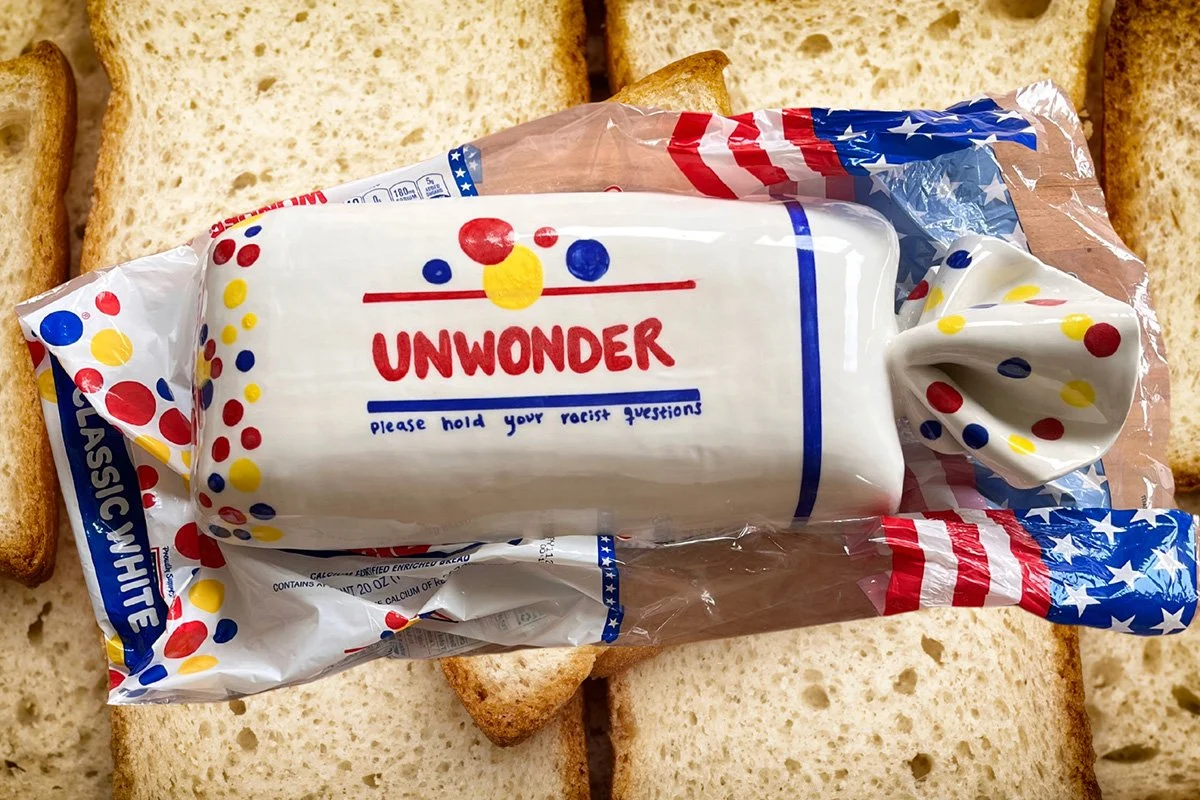
The Intersection of Brand Iconography and Racial Identity
The choice of Wonder Bread as the central motif for Whitebread’s sculpture is a deliberate engagement with American cultural history. Introduced in 1921 by the Taggart Baking Company, Wonder Bread became one of the first nationally distributed sliced breads, eventually becoming synonymous with the post-war American middle class and a specific ideal of "whiteness" characterized by homogeneity and mass production. By utilizing this imagery, Whitebread highlights the dissonance of the mixed-race experience within a society that has historically valued "purity" and clear-cut categorization.
For the artist, the connection is personal and literal. Growing up on the East Coast with the surname "Whitebread," the artist navigated a predominantly White environment where her Asian American heritage was frequently met with skepticism. The sculpture reflects a specific type of cognitive dissonance: the experience of occupying a visibly racialized body while bearing a name that serves as a linguistic marker of Whiteness. This tension was further complicated by geographical relocation; upon moving to the West Coast, the artist noted that public assumptions shifted from questioning her Asian identity to assuming an Indigenous background, illustrating how racial perception is often a projection of local colonial histories and regional demographics.
Demographic Shifts and the Rise of the Multiracial Population
The themes explored in Unwonder: Please Hold Your Racist Questions are increasingly relevant as the United States undergoes a significant demographic transformation. According to the 2020 U.S. Census, the population identifying as multiracial—or "Two or More Races"—increased by 276 percent over the previous decade, growing from 9 million people in 2010 to 33.8 million in 2020. This shift represents one of the most dramatic changes in the nation’s self-reported racial composition in history.
Despite this growth, the social infrastructure for understanding multiracial identity remains rooted in binary frameworks. Sociological research suggests that mixed-race individuals frequently experience "identity denial," a phenomenon where others question or refuse to acknowledge an individual’s self-identified racial background. Whitebread’s sculpture addresses the psychological toll of this denial, characterizing it as a form of "curiosity masquerading as offense." The artwork functions as a rejection of the "magical racial bridge" expectation—the idea that multiracial people exist primarily to facilitate understanding between different racial groups or to serve as proof of a "post-racial" society.

Chronology of the Artwork and the Artist’s Evolution
The development of Unwonder is the culmination of Whitebread’s multi-faceted career as an educator, community builder, and consultant. Her background as a middle school science teacher and a master composter program manager informs her approach to "unlearning" social norms, while her current role as a Senior Consultant at Healing Equity United allows her to address systemic inequities within the nonprofit sector.
- Early Life (East Coast): Formation of identity amidst the paradox of her surname and her Asian American heritage in a predominantly White setting.
- Relocation (West Coast): Exposure to different racial hierarchies and the persistence of Indigenous erasure, leading to new forms of misidentification.
- Professional Development: Transitioning into radical education and coaching, focusing on dismantling White-supremacy culture in professional and creative spaces.
- Artistic Maturity: The creation of ceramic works that move beyond aesthetics to serve as tools for social commentary, specifically targeting the entitlement of the "White gaze."
- Current Context: The debut of Unwonder as a response to the upcoming U.S. Semiquincentennial, framing the 250th anniversary as a moment to demand racial legibility on one’s own terms.
The Burden of Legibility and the "What Are You?" Phenomenon
A central theme of Whitebread’s work is the rejection of "legibility"—the demand that an individual be easily categorized and understood by outside observers. In the American context, the obsession with categorization is a legacy of historical legal structures, such as the "one-drop rule" and the racial integrity acts of the early 20th century, which sought to maintain rigid boundaries between racial groups.
The "What are you?" question, which Whitebread cites as a primary inspiration for the sculpture, is identified by psychologists as a common microaggression. While often framed by the inquisitor as a sign of interest, it serves to "other" the individual, signaling that they do not fit into the observer’s preconceived notions of what a member of a specific race should look like. Whitebread’s sculpture, with its firm directive to "Hold Your Racist Questions," acts as a boundary-setting mechanism. It asserts that mixed-race people are not obligated to make themselves "uncomplicated" or "readable" to be worthy of belonging to their respective communities or to the broader American identity.
Implications for Multiracial Democracy and the Nonprofit Sector
As a leader at Healing Equity United and a board member of City Fruit, Whitebread’s artistic output is inextricably linked to her work in the nonprofit sector. The themes of Unwonder mirror the challenges faced by many mission-driven organizations as they struggle to move beyond performative diversity toward genuine equity.
Nonprofit leaders have noted that the "magical racial bridge" expectation often manifests in the workplace, where staff members of color—particularly those who are mixed-race—are expected to perform emotional labor to bridge cultural gaps or resolve internal racial tensions. Whitebread’s work suggests that true liberation requires interrupting the entitlement of those in power to "know, pigeonhole, and define" others. This has significant implications for how organizations approach leadership development, community engagement, and the creation of "liberatory spaces" where individuals can work and create without the burden of constant self-explanation.

Analysis: The Role of Art in the 250th Anniversary of the United States
As the United States prepares for its 250th anniversary in 2026, the narrative of the "melting pot" is being increasingly scrutinized. Artworks like Unwonder: Please Hold Your Racist Questions provide a counter-narrative to traditional patriotic celebrations that often gloss over the complexities of racial identity and the ongoing reality of exclusion.
The sculpture serves as a reminder that the American identity is not a monolith, nor is it a finished product. By using a staple of the American pantry—bread—to critique the American social fabric, Whitebread places the mixed-race experience at the center of the national conversation. The work suggests that the next century of American life must involve a fundamental shift in how the nation views its citizens: not as data points to be categorized, but as individuals who contain "multitudes" and whose identities are not subject to public debate or interrogation.
Conclusion: A Call for Radical Belonging
Unwonder: Please Hold Your Racist Questions is more than a piece of ceramic art; it is a manifesto for a more nuanced understanding of identity in the 21st century. Through the subversion of commercial branding and the assertion of personal boundaries, Cassie Whitebread highlights the necessity of "sitting with complexity" and "holding space for multiple truths."
In a society deeply obsessed with restrictive boxes, the sculpture asks a vital question: What would it mean to allow people to exist without the requirement of being "legible"? As the multiracial population continues to grow, the demand for this type of radical belonging will only increase. Whitebread’s work stands as a testament to the power of art to facilitate unlearning and to pave the way for a future where identity is defined by the individual, not by the questions of the curious. The piece remains a poignant reminder that while curiosity can be a virtue, it becomes a tool of marginalization when it serves to reinforce the boundaries of an exclusionary culture.