Lana Rhoades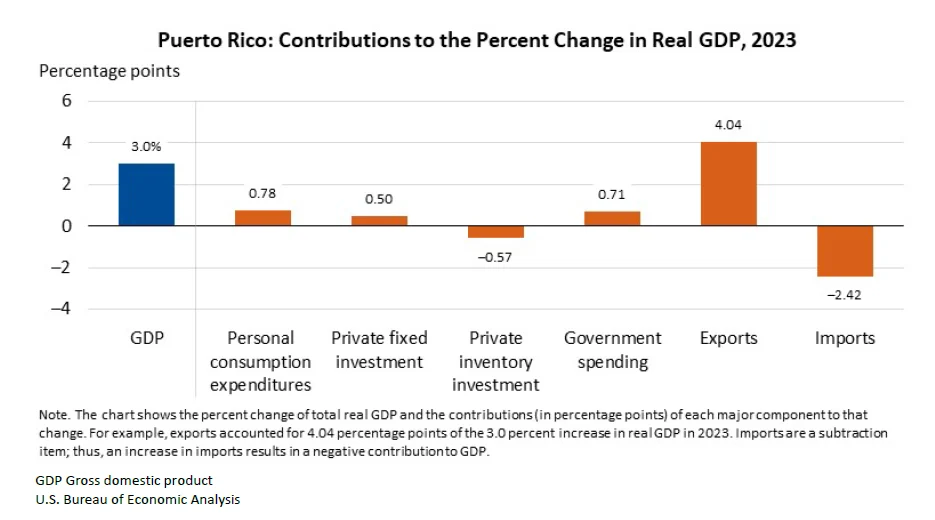
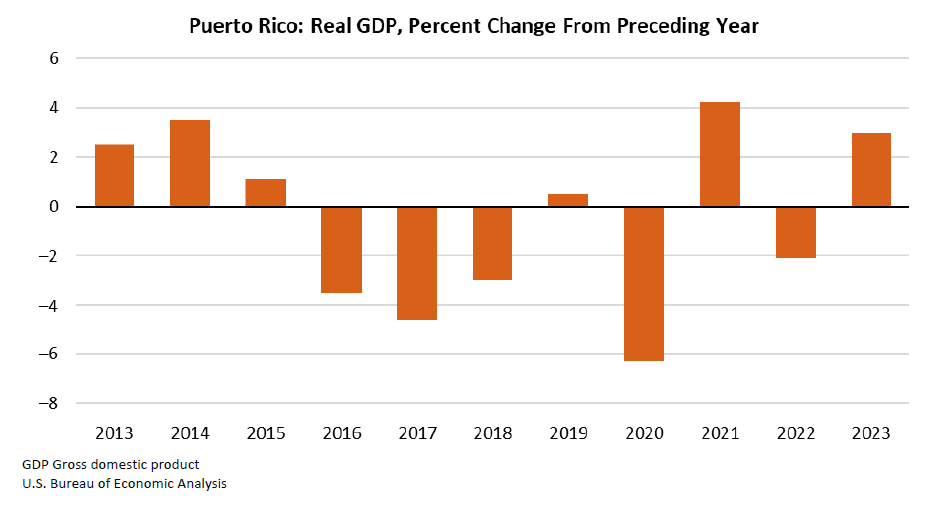
The economy of Puerto Rico experienced a significant rebound in 2023, with its real gross domestic product (GDP) growing by 3.0 percent. This marks a notable recovery after a contraction of 2.1 percent in the preceding year, according to the latest statistics released by the U.S. Bureau of Economic Analysis (BEA). This positive shift in economic performance is attributed to a broad-based expansion across several key sectors, most notably a substantial increase in exports, alongside gains in personal consumption, government spending, and private investment.
Economic Rebound Driven by Robust Exports and Domestic Demand
The turnaround in Puerto Rico’s economic fortunes in 2023 was primarily fueled by a surge in exports, which saw a robust increase of 6.4 percent. This growth encompassed both goods and services, with exports of goods rising by 6.6 percent and services by 5.6 percent. This expansion in external demand indicates a strengthening of Puerto Rico’s position in international markets and highlights the importance of its export-oriented industries in driving overall economic activity.
Beyond exports, domestic demand also played a crucial role in the island’s economic resurgence. Real personal consumption expenditures (PCE), a key indicator of household spending, increased by 1.2 percent. While spending on goods within PCE saw a slight decrease of 0.8 percent, this was more than offset by a significant 4.0 percent rise in PCE services, suggesting a shift towards service-based consumption patterns.
Government spending also demonstrated considerable strength, growing by 4.8 percent. This expansion was observed across all levels of government and was particularly driven by increased investment spending at the federal, central, and municipal levels. A significant portion of this investment is directly linked to ongoing federal funding for disaster recovery efforts. The continued disbursement of these funds is crucial for rebuilding and enhancing critical infrastructure, including the island’s power grid, water systems, transportation networks, and military facilities such as Camp Santiago. The sustained influx of federal aid underscores the long-term commitment to restoring and improving the island’s resilience in the face of recurring natural disasters.
Furthermore, real private fixed investment saw a healthy increase of 3.8 percent. This growth was predominantly driven by investments in equipment, with a particular surge in industrial equipment purchases by businesses. This suggests a renewed confidence in the business environment and an expansion of productive capacity across various industries.
These positive contributions to GDP growth were partially tempered by a decrease in private inventory investment, which saw its largest decline in the manufacturing sector. While inventory drawdowns can sometimes signal anticipated sales or a move towards leaner operational models, in this context, it suggests that businesses may be optimizing their stock levels in response to increased demand and production.
Imports, which are subtracted in the calculation of GDP, also increased by 4.4 percent. This rise was largely attributed to an increase in imported goods, with pharmaceuticals and organic chemicals leading the way with a 6.0 percent increase. This suggests a growing demand for essential goods and potentially a reliance on external supply chains for certain key industries.
Historical Context and Recent Trends
The economic landscape of Puerto Rico has been marked by significant challenges in recent years, including the impact of Hurricanes Irma and Maria in 2017, a series of earthquakes in 2019 and 2020, and Hurricane Fiona in 2022. These events have necessitated substantial recovery and reconstruction efforts, heavily supported by federal funding. The BEA’s GDP statistics provide a crucial measure of the island’s economic health and its ability to rebound from these adversities.
The 3.0 percent growth in 2023 stands in stark contrast to the 2.1 percent contraction observed in 2022. This shift highlights a turning point in Puerto Rico’s economic trajectory, moving from a period of stagnation or decline to one of expansion. The BEA’s data also reveals that the real GDP for the period 2018-2022 has been revised to incorporate updated source data. The largest revision in any single year was a 0.4 percentage point adjustment in 2022, indicating the dynamic nature of economic data collection and refinement.
Key Drivers of 2023 Growth: A Deeper Dive
Exports: A Global Demand Surge
The significant increase in real exports by 6.4 percent signals a robust demand for Puerto Rican goods and services in the international market. This growth is a testament to the competitiveness of the island’s export sector, which includes a strong presence in the pharmaceutical and medical device industries, as well as growing contributions from services. The BEA’s detailed breakdown shows that both goods and services exports contributed to this positive trend, with goods exports growing by 6.6% and services by 5.6%. This diversification in export performance suggests a broad-based strength in the island’s external trade relationships.
Personal Consumption Expenditures: Shifting Spending Habits
The 1.2 percent increase in real personal consumption expenditures reflects continued consumer confidence and spending power within Puerto Rico. The divergence between spending on goods (down 0.8 percent) and services (up 4.0 percent) is a noteworthy trend. This pattern is observed globally and suggests a post-pandemic shift in consumer priorities, with greater emphasis on experiences, travel, and other service-based consumption. This trend could indicate a maturing economy with a growing middle class and an increasing demand for higher-value services.
Government Spending: Infrastructure and Resilience
The 4.8 percent rise in real government spending underscores the critical role of public investment, particularly in infrastructure development and disaster recovery. The continued disbursement of federal funds for rebuilding efforts related to hurricanes and earthquakes is a major catalyst. The specific mention of investments in the power grid, aqueduct system, roads, and Camp Santiago highlights a strategic focus on enhancing the island’s fundamental infrastructure, which is essential for long-term economic stability and growth. This sustained government investment not only creates jobs in the short term but also lays the groundwork for future private sector investment and improved quality of life for residents.
Private Fixed Investment: Business Confidence and Expansion
The 3.8 percent increase in real private fixed investment indicates a positive outlook among businesses operating in Puerto Rico. The emphasis on equipment investment, particularly in industrial machinery, suggests that companies are expanding their productive capacity and investing in modernization. This can lead to increased efficiency, higher output, and ultimately, job creation. The growth in industrial equipment purchases signifies a commitment to long-term growth and a belief in the island’s economic potential.
Challenges and Offsetting Factors
While the overall economic picture is positive, certain components of GDP growth experienced declines. The decrease in private inventory investment, especially within the manufacturing sector, warrants attention. This could be indicative of a strategic effort by manufacturers to streamline their supply chains and reduce holding costs, or it could reflect a cautious approach to future production in anticipation of potential market fluctuations.
The increase in imports, while reflecting demand, also means that a portion of the economic activity is directed towards external economies. The specific mention of pharmaceuticals and organic chemicals as leading import categories suggests a reliance on global supply chains for critical goods, which can expose the economy to price volatility and supply disruptions.
Acknowledging Collaboration and Future Outlook
The BEA explicitly acknowledges the crucial support and assistance provided by the government of Puerto Rico in the production of these economic estimates. Because Puerto Rico is not integrated into the same broad survey framework as the U.S. mainland, collaboration with local entities is vital for accurate data collection. This recognition highlights the unique nature of economic data production for the island and the importance of ongoing partnerships.
The BEA has also noted that it will no longer produce Puerto Rico GDP statistics after this release. Previously published data will remain accessible through the BEA’s Data Archive. This marks the end of an era for detailed quarterly and annual GDP reporting for Puerto Rico by the BEA, shifting the focus to other forms of economic analysis.
Broader Implications and Analysis
The positive GDP growth in 2023 signifies a period of economic recovery and resilience for Puerto Rico. The substantial increase in exports suggests a strengthening of the island’s role in global trade, while domestic demand components indicate a healthy and growing internal economy. The sustained government investment in infrastructure is a critical factor, not only for recovery but also for building a more robust and sustainable economic future.
The shift in personal consumption towards services could signal a maturing economy and a growing middle class. The increase in private fixed investment reflects business confidence, which is essential for long-term job creation and economic development.
However, the reliance on federal disaster recovery funds, while crucial for immediate rebuilding, also highlights the vulnerability of the island’s economy to external shocks. Long-term economic sustainability will depend on fostering private sector growth that is less dependent on external aid.
The decision by the BEA to cease publishing detailed GDP statistics for Puerto Rico after this release may have implications for the availability of granular economic data for policymakers, researchers, and the public. While historical data will remain accessible, the discontinuation of future releases could impact the ongoing monitoring of the island’s economic health.
In conclusion, Puerto Rico’s economy in 2023 demonstrated a significant and welcome rebound, characterized by strong export performance, growing domestic consumption, and substantial government and private investment. This positive trajectory offers a hopeful outlook, underscoring the island’s capacity for recovery and growth, even in the face of historical challenges. The coming years will be critical in assessing the sustainability of this growth and the island’s ability to diversify its economic drivers further.