Julia Chirkova
Accounting, tax, and financial professionals have transitioned from the initial exploration of artificial intelligence (AI) to a more strategic and operational phase, according to a groundbreaking study by Gartner. This shift, termed the "tactical phase," signifies a mature integration of AI into core financial processes. However, the research underscores a critical imperative for Chief Financial Officers (CFOs) to cultivate a more disciplined and strategic approach to managing their AI investments, moving beyond mere adoption to optimized value realization.
The findings, derived from a comprehensive survey of 160 senior finance function leaders conducted between January and April 2026, reveal a nuanced landscape of AI implementation within finance departments. While initial investments have largely focused on applications delivering rapid productivity gains, such as data extraction, accounts payable and receivable automation, and report generation, the study emphasizes the need for a balanced strategy that incorporates longer-term, high-impact use cases.
"AI adoption has reached a point where CFOs must adopt more deliberate portfolio management," stated Marco Steecker, Senior Director Analyst in the Gartner Finance practice. "The goal is not to stifle experimentation, but to know where to invest, when to cut underperforming initiatives, and which foundational capabilities to accelerate, especially as AI technology becomes more user-friendly and barriers to experimentation diminish."
Navigating the Tactical Phase: Time-to-Value and Strategic Investment
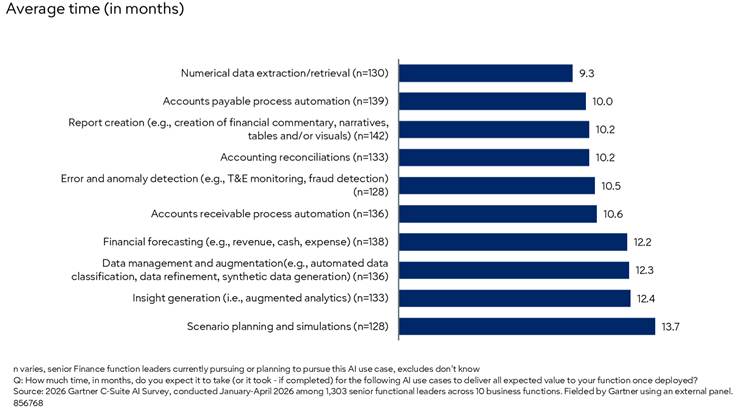
The Gartner survey meticulously maps the average time-to-value for various AI use cases within the finance function. For tasks like data extraction, automating accounts payable and receivable processes, and streamlining report creation, organizations generally observe returns within a nine to ten-month timeframe. These represent the "quick wins" that have likely fueled the initial adoption surge.
However, the study also highlights that more sophisticated AI applications, including advanced data management, complex insight generation, and predictive forecasting, necessitate a more extended development and integration period before tangible value is realized. This distinction is crucial for CFOs aiming to build a robust and sustainable AI strategy.
"Finance AI investments tend to be focused on lower time-to-value use cases that boost productivity, like report creation and process automation," Steecker elaborated. "However, CFOs should not let the appeal of quick returns crowd out more complex use cases that take longer to mature but can improve decision making, manage risk, and support revenue growth."

This insight suggests a potential pitfall: an overemphasis on short-term efficiencies could inadvertently divert resources and attention from AI initiatives with the potential for more transformative, long-term strategic advantages. The balanced approach advocated by Gartner implies a dual focus: maximizing immediate productivity gains while simultaneously investing in and nurturing AI capabilities that can enhance strategic decision-making, fortify risk management frameworks, and ultimately drive top-line growth.
Evolving Barriers: From Talent Acquisition to AI Literacy
Historically, the scarcity of specialized talent has been a significant impediment to the successful implementation of AI initiatives within finance departments. However, the landscape of AI adoption challenges has evolved. The increasing sophistication and accessibility of agentic coding tools, which can automate large portions of software development and AI model creation, have significantly lowered the technical barrier to entry.
Consequently, Gartner’s research identifies AI literacy as the paramount obstacle that finance leaders must now address. This shift signifies a move from a skills gap in AI development to a broader need for understanding, utilizing, and integrating AI across the entire finance workforce.
"Low AI literacy is now the most significant barrier finance leaders must address," Steecker emphasized. "CFOs should give employees practical opportunities to use AI through project assignments, sandbox experimentation, and short, on-the-job activities. This will help finance teams build the skills and confidence needed to get more value from AI."
This observation points to a fundamental requirement: upskilling and reskilling the existing finance workforce. Instead of solely relying on hiring new AI specialists, organizations must empower their current employees to become proficient users and collaborators with AI technologies. This can be achieved through targeted training programs, hands-on project experience, and the creation of safe, experimental environments where employees can explore AI’s capabilities without fear of failure.
Strategic Imperatives for CFOs in the Tactical AI Phase
The transition into the tactical phase of AI adoption presents several key strategic imperatives for CFOs:
1. Disciplined Portfolio Management:
CFOs must move beyond ad-hoc AI deployments and establish a structured framework for managing their AI initiatives. This involves:
- Prioritization: Clearly defining criteria for selecting AI projects based on strategic alignment, potential ROI, and risk.
- Resource Allocation: Strategically allocating budget, talent, and technological resources to initiatives that offer the greatest potential value.
- Performance Monitoring: Implementing robust metrics to track the progress and performance of AI initiatives against defined objectives.
- Portfolio Balancing: Ensuring a healthy mix of short-term productivity enhancements and long-term strategic AI investments.
2. Realistic Time-to-Value Expectations:
As highlighted by the Gartner survey, different AI use cases have varying timelines for delivering value. CFOs must set and communicate realistic expectations to stakeholders, fostering patience and understanding for initiatives that require longer development cycles. This also means recognizing when an initiative is not meeting its projected value and making the difficult decision to divest or pivot.
3. Balancing Productivity Gains with Broader Business Outcomes:
While quick productivity wins are valuable, CFOs should not allow them to overshadow the potential of AI to drive more significant business outcomes. This includes leveraging AI for:
- Enhanced Decision-Making: Utilizing AI-driven insights to inform strategic planning, investment decisions, and operational adjustments.
- Improved Risk Management: Employing AI to identify, assess, and mitigate financial and operational risks more effectively.
- Revenue Growth: Exploring AI applications that can optimize pricing, personalize customer experiences, and identify new market opportunities.
4. Strengthening AI Literacy Across Finance Teams:
Investing in the AI literacy of the entire finance function is paramount. This involves:
- Training and Development: Implementing comprehensive training programs that cover AI fundamentals, specific tools, and ethical considerations.
- Experiential Learning: Providing employees with opportunities to work with AI through pilot projects, sandbox environments, and collaborative AI initiatives.
- Change Management: Fostering a culture that embraces AI as a tool for augmentation rather than a replacement for human expertise.
5. Leveraging User-Friendly AI Tools:
The increasing user-friendliness of AI technologies, driven by advancements in natural language processing and low-code/no-code platforms, is lowering the barrier to experimentation. CFOs should encourage the adoption of these tools to empower a wider range of finance professionals to engage with and benefit from AI.
Broader Impact and Implications for the Finance Function
The findings from Gartner’s study have significant implications for the future of the finance function. As AI becomes more deeply embedded, the role of finance professionals will evolve. The emphasis will shift from routine transactional tasks to more analytical, strategic, and advisory responsibilities.
Organizations that successfully navigate this tactical phase of AI adoption will likely gain a competitive advantage through:
- Increased Efficiency and Accuracy: Automating repetitive tasks reduces errors and frees up valuable human capital.
- Deeper Insights and Foresight: AI can uncover patterns and trends in vast datasets that humans might miss, leading to more informed strategic decisions.
- Enhanced Agility: The ability to rapidly analyze data and adapt to changing market conditions becomes a critical differentiator.
- Improved Risk Mitigation: Proactive identification and management of risks can prevent significant financial losses.
- Innovation and Growth: AI can unlock new avenues for product development, market expansion, and customer engagement.
The study by Gartner serves as a critical roadmap for CFOs and finance leaders as they mature their AI strategies. By adopting a disciplined, data-driven approach to portfolio management, prioritizing AI literacy, and balancing short-term gains with long-term strategic objectives, finance functions can unlock the full transformative potential of artificial intelligence. The era of tactical AI adoption demands a thoughtful, deliberate, and people-centric strategy to ensure sustained value creation and competitive advantage in the evolving business landscape. The call to action is clear: move beyond simply adopting AI to strategically mastering its integration for enduring success.