
 Lana Rhoades
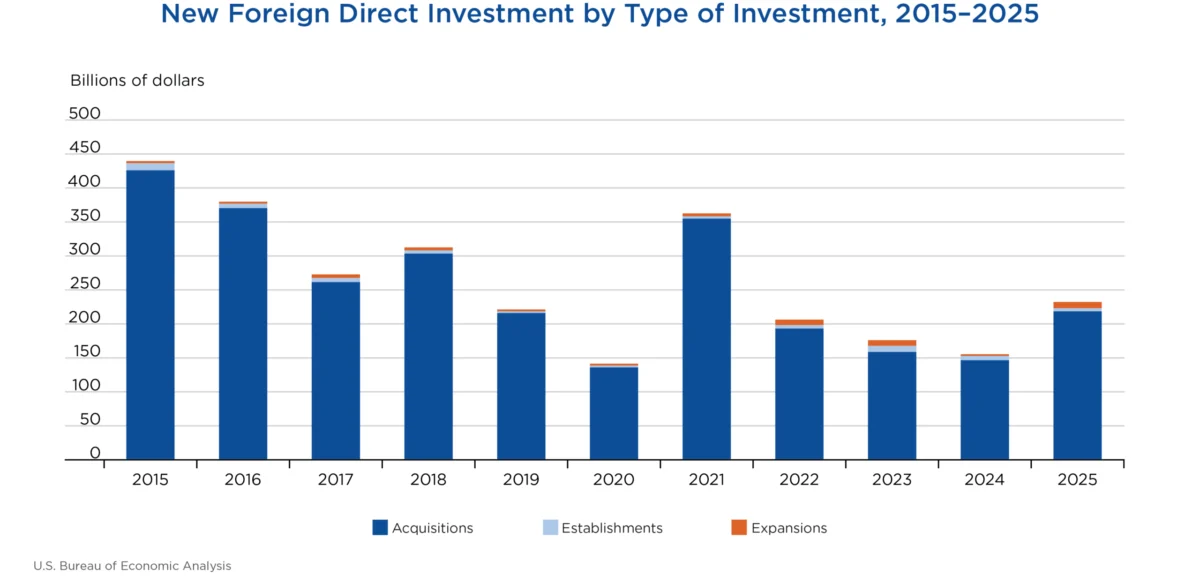
Expenditures by foreign direct investors to acquire, establish, or expand U.S. businesses surged to $232.2 billion in 2025, marking a substantial increase of $76.8 billion, or 49.5 percent, from the previous year’s figures. These preliminary statistics, released today by the U.S. Bureau of Economic Analysis (BEA), underscore a robust and dynamic period for international investment in the American economy. Acquisitions of existing U.S. businesses continued to dominate these expenditures, reflecting a prevailing strategy among foreign investors seeking to integrate into established markets and leverage existing operational frameworks.
The breakdown of these significant investments reveals that $218.4 billion was allocated to the acquisition of U.S. businesses. A smaller but still notable portion, $4.6 billion, was directed towards establishing entirely new U.S. business enterprises, a key indicator of long-term commitment and expansion of the U.S. economic footprint. Furthermore, $9.2 billion was invested in expanding existing foreign-owned businesses within the United States, signaling growth and reinvestment by established international players. The total planned expenditures, encompassing both initial first-year outlays and commitments for future investment, reached an impressive $284.5 billion, suggesting sustained investor confidence and ambitious growth projections for the coming years. This influx of capital is expected to translate into significant job creation and economic activity across various sectors.
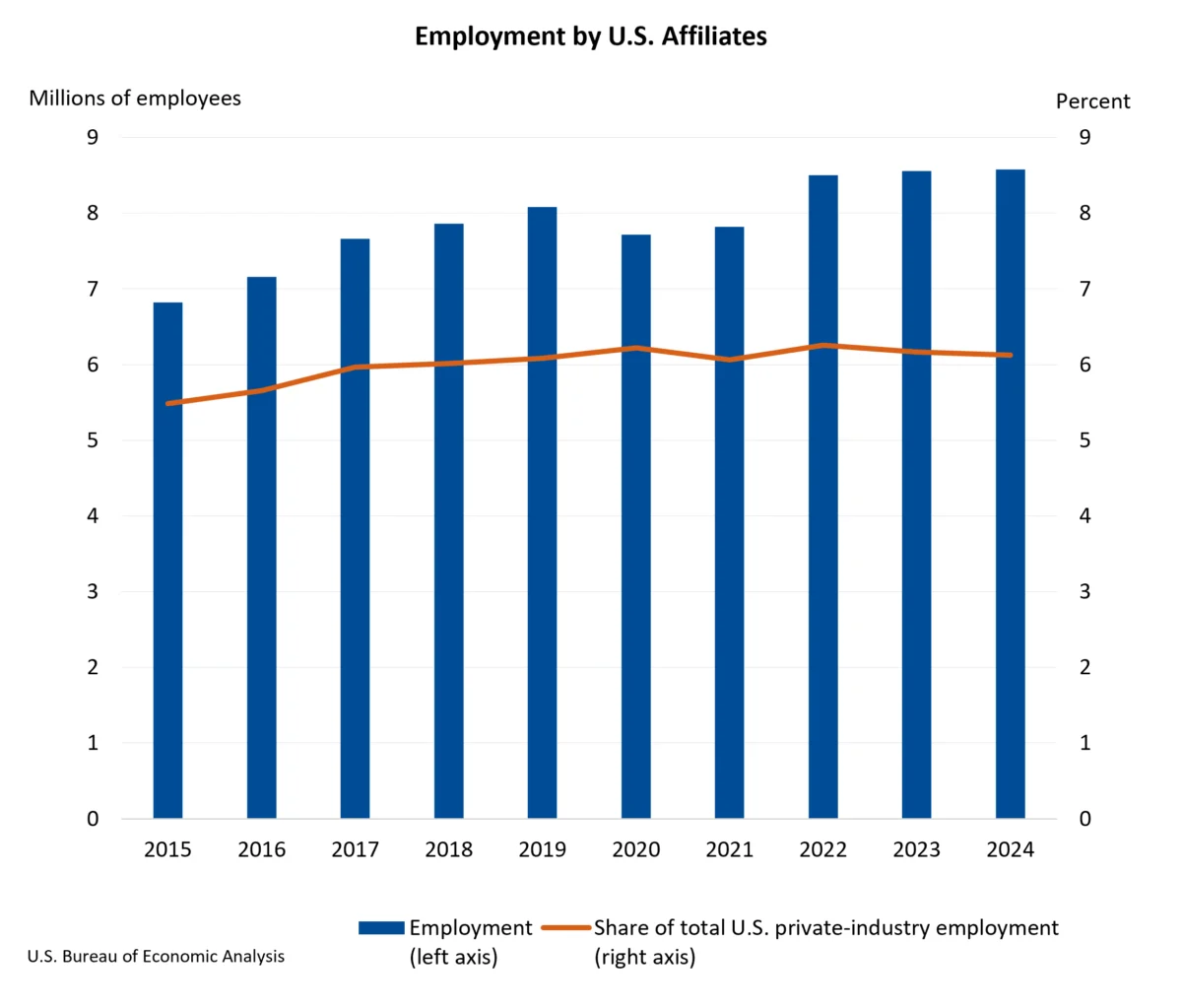
Employment within newly acquired, established, or expanded foreign-owned businesses in the United States reached an estimated 213,100 employees in 2025. This figure represents the direct impact of foreign direct investment (FDI) on the U.S. labor market, highlighting the role of international capital in bolstering domestic employment opportunities.
Investment Trends by Industry, Country, and State
The distribution of foreign investment across various industries provides a granular view of where international capital is flowing. Publishing industries attracted the largest share of new direct investment in 2025, with expenditures totaling $50.7 billion. This sector’s appeal may be linked to the continued evolution of media and content delivery, with foreign investors potentially seeking to capitalize on new digital platforms and established market positions. Following closely, chemicals manufacturing secured $45.4 billion, underscoring the enduring importance of this foundational industrial sector for global supply chains and innovation. Plastics and rubber products manufacturing also saw significant investment, accounting for $19.0 billion. Collectively, the manufacturing sector emerged as a dominant recipient, attracting $121.8 billion, which represented a substantial 52.5 percent of all new direct investment expenditures. This strong performance in manufacturing indicates a renewed global interest in U.S. production capabilities and a recognition of the sector’s strategic importance.
On a country-by-country basis, Japan led the pack in terms of investment volume, committing $50.5 billion to U.S. businesses. This substantial investment reflects long-standing economic ties and strategic diversification efforts by Japanese corporations. Germany followed with $26.7 billion in expenditures, highlighting its continued role as a major European investor in the U.S. market. Canada also demonstrated significant commitment, investing $23.5 billion, reinforcing the deep economic integration between the two North American neighbors. From a regional perspective, Europe as a whole contributed the largest portion of new investment, totaling $116.6 billion, or 50.2 percent of all new investment in 2025. This significant European engagement points to a broader trend of international capital seeking stable and growth-oriented markets. The Asia and Pacific region ranked as the second-largest investing region, with expenditures amounting to $71.9 billion, showcasing the growing economic influence and investment capacity of Asian economies.
Geographically within the United States, California once again proved to be a prime destination for foreign direct investment, attracting $59.7 billion in first-year investment expenditures. Its robust economy, technological innovation hubs, and large consumer market continue to make it a magnet for global capital. Texas followed with $21.5 billion, benefiting from its strong energy sector, growing tech scene, and business-friendly environment. Pennsylvania secured the third-highest level of investment, with $20.9 billion, likely driven by its industrial base, growing logistics sector, and strategic location.
Greenfield Investments: Building the Future
Greenfield investments, which involve establishing new businesses or expanding existing foreign-owned operations, represent a direct commitment to building new economic capacity within the U.S. In 2025, these expenditures totaled $13.8 billion. Within this category, the transportation and warehousing sector attracted the largest share of greenfield investment at $3.6 billion, signaling potential growth in logistics and supply chain infrastructure. The manufacturing of computers and electronic products followed with $2.0 billion, indicating foreign investment in high-tech production facilities. Chemicals manufacturing also saw significant greenfield investment, with $1.8 billion allocated to new or expanded operations.
Looking at the origins of greenfield investment, investors from the Asia and Pacific region were the most significant contributors, with $8.3 billion in expenditures. Australia led this group with $3.0 billion in greenfield investments, followed by South Korea with $2.2 billion, and Japan with $1.7 billion. This suggests a strong preference among these nations for creating new operational bases in the U.S. By state, Louisiana emerged as a key recipient of greenfield investment, attracting $3.0 billion, potentially linked to its port infrastructure and chemical industry. Arizona followed with $2.7 billion, and Texas with $1.9 billion, indicating continued investment in expanding manufacturing and industrial capabilities. The planned total expenditures for greenfield investments initiated in 2025, including future commitments, reached $66.1 billion, a substantial figure that points to significant future job creation and economic development.
Employment Dynamics: A Growing Workforce
The impact of foreign direct investment on employment is a critical measure of its contribution to the U.S. economy. In 2025, the current employment in newly acquired enterprises stood at 211,700. When considering the planned employment for newly established businesses upon full operation and anticipated expansions, the total planned employment figure rose to 232,400. This indicates a net positive outlook for job growth directly attributable to foreign investment.
By industry, plastics and rubber parts manufacturing accounted for the largest number of current employees at 21,800, reflecting the labor-intensive nature of this sector. Transportation equipment manufacturing followed with 17,300 employees, and the primary and fabricated metals manufacturing sector employed 16,400 individuals. These figures underscore the significant role of manufacturing in absorbing foreign-invested labor.
Examining employment by country of origin, Mexico contributed the largest number of current employees with 54,600, highlighting the deep employment ties between the U.S. and its southern neighbor. Canada followed with 29,500 employees, and the United Kingdom with 26,800, demonstrating continued reliance on established trading partners for workforce needs. Within the United States, California led in current employment resulting from new investment, with 37,200 jobs. Illinois followed with 17,600 employees, and Texas with 16,500, indicating that states attracting significant capital also tend to see corresponding increases in employment.
Revisions to 2024 Data Signal Upward Trend
The Bureau of Economic Analysis also provided updated figures for 2024, indicating a positive revision to previous estimates. First-year expenditures for new foreign direct investment in the United States in 2024 were revised upward to $155.3 billion from a previously published $151.0 billion. This revision was driven by increases in acquisitions of U.S. businesses ($146.4 billion from $143.0 billion), establishments ($6.4 billion from $6.3 billion), and expansions ($2.5 billion from $1.8 billion). Similarly, planned total expenditures for 2024 were revised to $164.0 billion from $157.0 billion, with upward adjustments across all categories of investment. These revisions suggest that the robust growth observed in 2025 may be part of a sustained, upward trajectory in foreign direct investment, building upon a stronger-than-initially-reported foundation in 2024.
Broader Context and Implications
The substantial surge in foreign direct investment in 2025 occurs against a backdrop of evolving global economic dynamics. The United States continues to be perceived as a stable and attractive market for international investors, bolstered by its large consumer base, technological innovation, and relatively predictable regulatory environment. The significant increase in acquisitions suggests that foreign entities are increasingly opting for quicker market entry and leveraging existing operational efficiencies and market share rather than solely focusing on greenfield development.
The strong performance in manufacturing and key industrial sectors indicates that despite ongoing discussions about reshoring and supply chain resilience, foreign investment remains a critical component in bolstering U.S. production capabilities. The emphasis on publishing and technology-related manufacturing also points to a forward-looking investment strategy, aligning with global trends in digitalization and advanced manufacturing.
The notable contribution of European and Asian investors underscores the interconnectedness of the global economy and the strategic importance of the U.S. market for these economic powerhouses. The focus on specific states like California, Texas, and Pennsylvania highlights the concentrated impact of FDI, driving regional economic growth and job creation.
The BEA’s updated disclosure avoidance method, which employs coarsening techniques like rounding and aggregation, allows for the publication of more detailed data while ensuring the confidentiality of survey respondents. This approach is crucial for maintaining the integrity of economic statistics and fostering continued participation in data collection.
Looking ahead, the BEA’s next release, scheduled for June 2027, will provide statistics for 2026, offering further insights into the trajectory of foreign direct investment and its ongoing impact on the U.S. economy. The continued flow of foreign capital is expected to play a vital role in innovation, job creation, and overall economic prosperity, making these statistics essential for policymakers, businesses, and investors alike. The robust performance in 2025, marked by significant increases across all investment types and sectors, signals a promising period of international economic engagement with the United States.