Lana Rhoades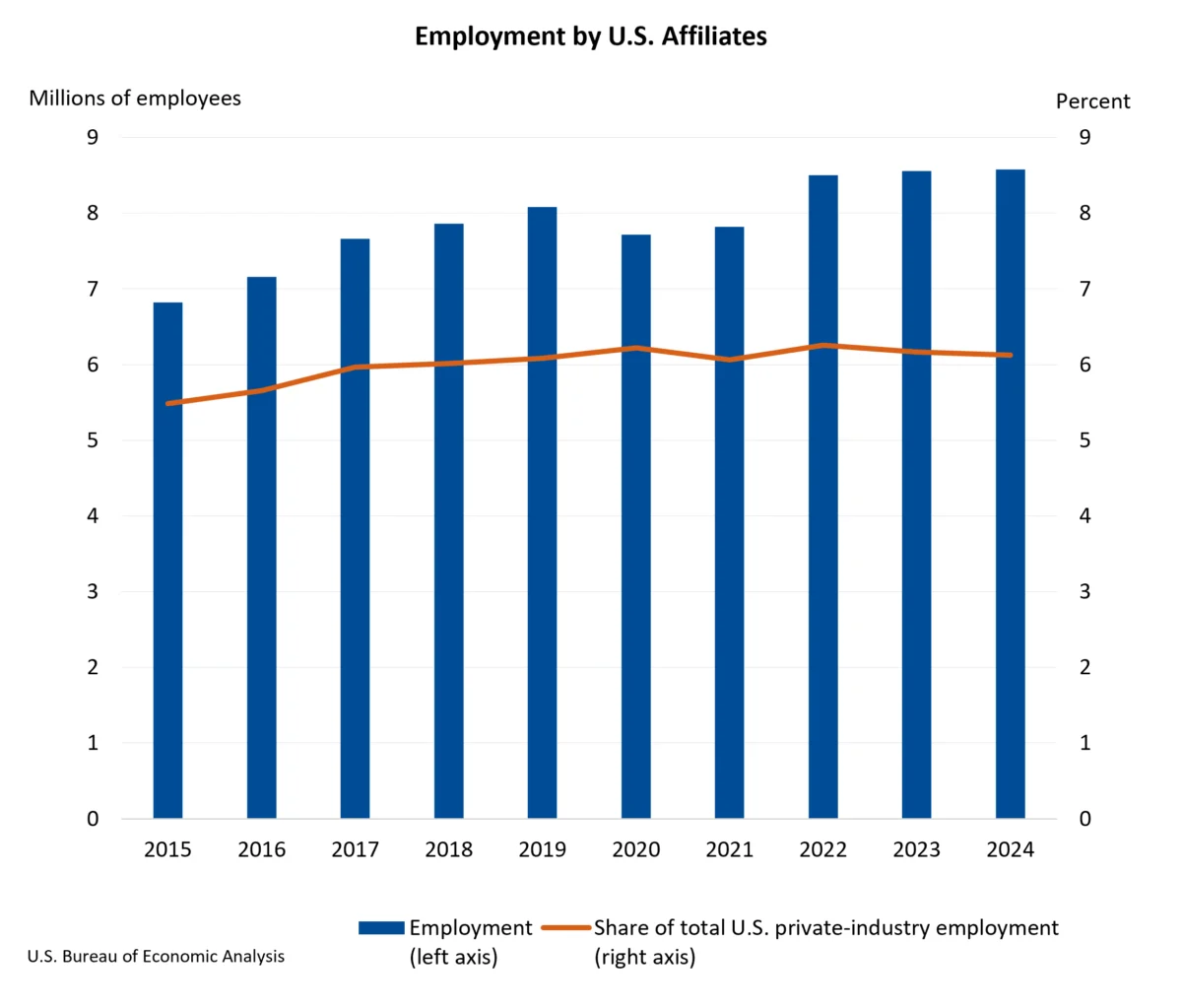
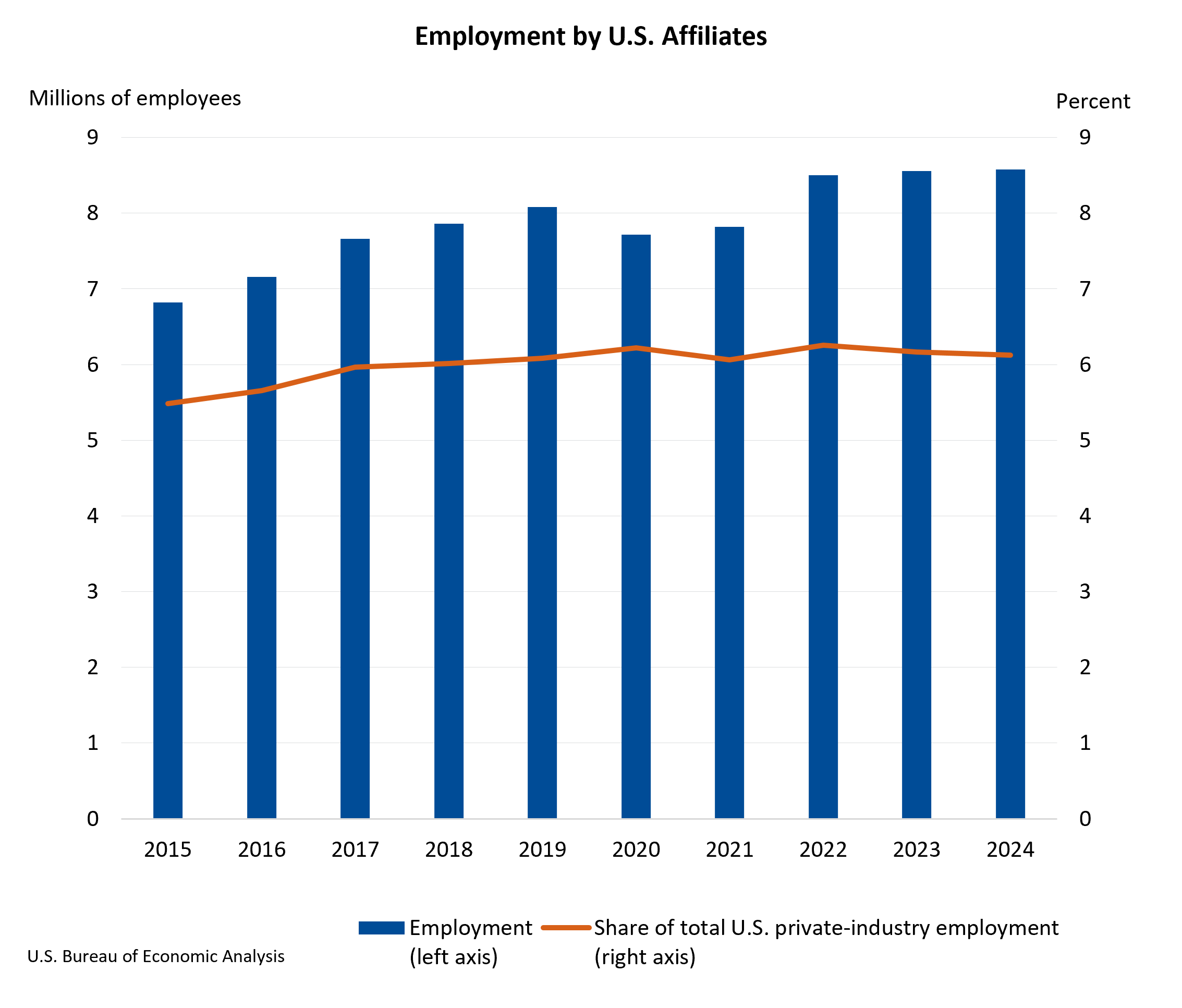
Majority-owned U.S. affiliates of foreign multinational enterprises (MNEs) employed 8.57 million workers in the United States in 2024, representing a marginal 0.2 percent increase from 8.56 million workers in 2023. This finding, released today by the U.S. Bureau of Economic Analysis (BEA), underscores the sustained and significant role these foreign-owned entities play in the American labor market. While the raw number of jobs grew, the share of total private-industry employment attributed to these affiliates saw a slight decrease, falling to 6.1 percent in 2024 from 6.2 percent in the preceding year.
These statistics, derived from the BEA’s comprehensive survey of U.S. affiliate operations and finances, provide a detailed snapshot of the economic contributions of foreign investment in the United States. The slight uptick in employment figures, though modest, signals continued confidence and investment from international businesses operating on American soil. This growth, even when tempered by a marginal decrease in overall share, highlights the resilience of these enterprises in a dynamic economic landscape.
The manufacturing and retail trade sectors continue to be the primary engines of employment for these U.S. affiliates. Within these sectors, the United Kingdom, Japan, and Germany emerged as the largest contributors to job creation, reflecting long-standing trade and investment relationships between these nations and the United States. The concentration of employment in these key industries suggests a strategic focus by foreign MNEs on sectors with established consumer bases and robust supply chains within the U.S. economy.
Beyond employment, the economic footprint of these foreign-owned entities extends significantly to their direct contribution to the U.S. gross domestic product (GDP). The current-dollar value added by U.S. affiliates, a key metric for measuring their economic impact, surged by 4.3 percent to reach an impressive $1.52 trillion in 2024. This represents 6.7 percent of total U.S. business-sector value added, a slight decrease from 6.8 percent in 2023, indicating that while the absolute value added by foreign affiliates grew, the overall U.S. economy expanded at a slightly faster pace in relative terms.
Investment in the future productive capacity of the U.S. economy is also a hallmark of these foreign operations. Expenditures for property, plant, and equipment by U.S. affiliates saw a robust increase of 3.3 percent, totaling $328.0 billion. This substantial investment signals a commitment to expanding operations, upgrading facilities, and enhancing the long-term infrastructure of their U.S.-based businesses. Such capital expenditures are crucial for job growth, innovation, and overall economic dynamism.
Furthermore, the commitment to innovation is evident in the significant rise in research and development (R&D) performed by U.S. affiliates. These activities increased by 5.3 percent, reaching $95.5 billion. Notably, these foreign-owned entities accounted for a substantial 12.4 percent of all U.S. business R&D in 2024. This high level of R&D investment underscores the strategic importance of the U.S. as a hub for innovation and technological advancement for these global companies, contributing to the nation’s scientific and technological progress.
Geographical Distribution of Employment
The impact of these foreign-owned businesses is not evenly distributed across the nation. California continued to lead in U.S. affiliate employment, with 885,200 workers. Texas followed closely with 717,400 employees, and New York secured the third position with 556,700 workers. In all three of these leading states, the manufacturing sector employed the largest number of workers within the U.S. affiliate landscape, reinforcing the sector’s significance in driving job creation for foreign-owned companies. This geographical concentration highlights the economic advantages and strategic locations that attract significant foreign direct investment, often tied to access to skilled labor, established industries, and major consumer markets.
Background and Chronology of Data Collection
The statistics released by the BEA are the result of an ongoing, rigorous data collection and analysis process. The BEA conducts annual surveys of U.S. affiliates of foreign MNEs, gathering detailed financial and operational data. These surveys are essential for understanding the impact of foreign direct investment (FDI) on the U.S. economy, providing insights into employment, output, investment, and innovation.
The data released today for 2024 is based on preliminary estimates, with subsequent revisions expected as more comprehensive source data becomes available. The BEA also utilizes this opportunity to release revised statistics for the preceding year, 2023. The preliminary estimates for 2023, released in December 2025, have now been updated with more complete information. These revisions are a critical part of the statistical process, ensuring the accuracy and reliability of the data over time.
Key Revisions for 2023 Data:
- Number of Employees (thousands): The preliminary estimate of 8,661.8 thousand employees has been revised to 8,556.9 thousand. This represents a downward revision, indicating that the initial count may have slightly overestimated the final employee numbers for 2023.
- Value Added: The preliminary estimate for value added was $1,469.1 billion, which has been revised to $1,456.3 billion. This slight downward revision suggests that the initial assessment of the contribution to GDP was marginally higher.
- Expenditures for Property, Plant, and Equipment: Preliminary estimates of $322.7 billion have been revised to $317.6 billion. This indicates a slight adjustment downward in the reported capital expenditures for 2023.
- Research and Development Expenditures: In contrast to the other metrics, R&D expenditures saw an upward revision. The preliminary estimate of $87.8 billion has been revised to $90.6 billion, suggesting that foreign affiliates invested more in R&D in 2023 than initially reported.
These revisions highlight the dynamic nature of economic data and the BEA’s commitment to providing the most accurate picture possible. The process involves integrating data from various sources, including surveys, administrative records, and other statistical programs.
Analysis of Trends and Implications
The slight increase in employment, coupled with a marginal decrease in the percentage share of total private-industry employment, suggests a complex interplay of factors. On one hand, foreign direct investment continues to be a net positive for U.S. job creation. On the other hand, the overall U.S. economy, encompassing domestic businesses and other forms of investment, is also growing, leading to a relative dilution of the foreign-owned sector’s share.
The continued dominance of manufacturing and retail trade in employment figures points to the enduring importance of these sectors in absorbing labor from foreign MNEs. This also suggests that strategies for attracting and retaining foreign investment may need to consider the specific needs and growth potential of these key industries.
The significant contribution to GDP and R&D spending underscores the qualitative impact of foreign affiliates. They are not merely employers but also drivers of economic value and innovation. The BEA’s data serves as a crucial tool for policymakers to understand the benefits of FDI, to formulate policies that encourage further investment, and to address any potential challenges that may arise.
The geographical concentration of employment in states like California, Texas, and New York indicates that investment is often drawn to established economic hubs. This raises questions about how to encourage FDI in other regions and foster more equitable distribution of the economic benefits derived from foreign investment. Strategies could include targeted investment promotion initiatives, infrastructure development in less-developed regions, and workforce training programs tailored to attract specific types of foreign investment.
Official Statements and Context
While the provided text does not include direct quotes from officials, the release of these statistics by the U.S. Bureau of Economic Analysis itself serves as an official communication of key economic trends. The BEA’s mission is to provide the economic statistics and information that enable sound public and private decision-making. The detailed nature of these reports allows for a nuanced understanding of the U.S. economy and its global connections.
The data on U.S. affiliates of foreign MNEs is a critical component of the BEA’s international economic accounts. It provides essential insights into how foreign investment impacts U.S. employment, output, trade, and investment flows. This information is vital for assessing the overall health and competitiveness of the U.S. economy and for informing U.S. trade and investment policy.
Broader Impact and Future Outlook
The sustained presence and growth of foreign-owned businesses in the U.S. have far-reaching implications. They contribute to competition, which can drive innovation and lower prices for consumers. They bring new technologies, management practices, and access to global markets. Moreover, they are significant contributors to the U.S. tax base, generating revenue that supports public services.
Looking ahead, the BEA anticipates releasing data for 2025 in the Spring of 2027. This forward-looking schedule allows for the continuous monitoring of trends and the adaptation of economic policies. The BEA’s ongoing efforts to refine its data collection methods, including the implementation of updated disclosure avoidance techniques such as rounding and aggregation, aim to enhance the usability and confidentiality of the published statistics. This ensures that valuable economic insights can be shared more broadly while safeguarding the proprietary information of survey respondents.
The comprehensive data tables and interactive applications provided by the BEA on its website offer a wealth of detailed information for researchers, businesses, and policymakers. These resources enable in-depth analysis of specific industries, countries of origin, and sub-national regions, providing a granular understanding of the complex dynamics of foreign investment in the United States. As the global economic landscape continues to evolve, the accurate and timely reporting of data on U.S. affiliates of foreign MNEs will remain indispensable for navigating the opportunities and challenges of international economic integration.