
 Lana Rhoades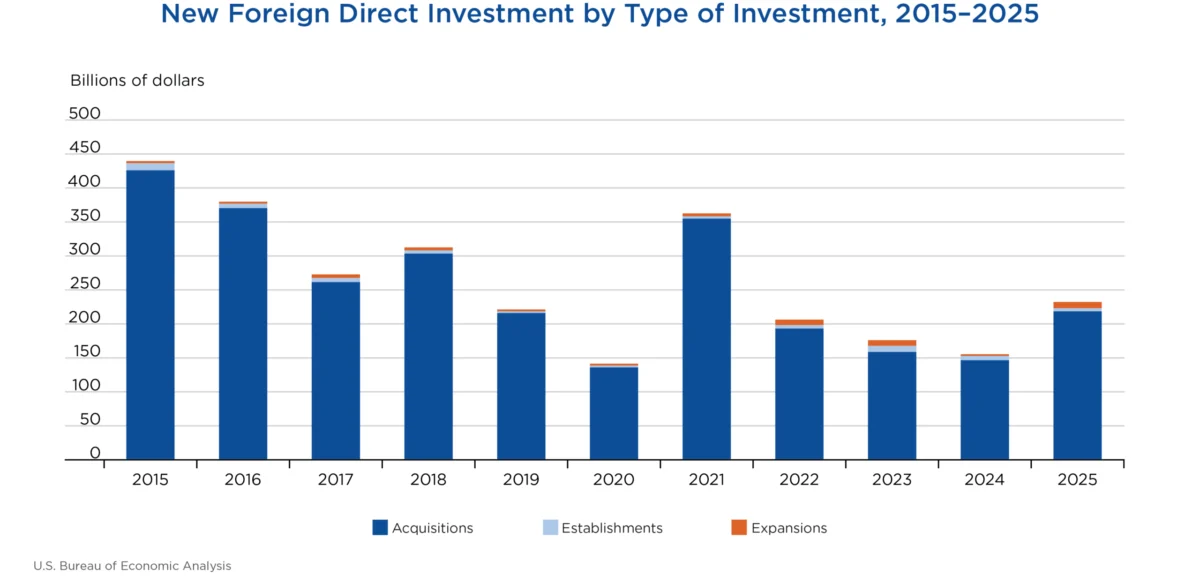
Expenditures by foreign direct investors to acquire, establish, or expand U.S. businesses surged to $232.2 billion in 2025, marking a substantial 49.5 percent increase from the previous year, according to preliminary statistics released by the U.S. Bureau of Economic Analysis (BEA). This robust growth underscores the continued attractiveness of the American market for international capital, with acquisitions of existing U.S. businesses remaining the dominant form of investment. The data highlights a dynamic period of international economic engagement, with significant implications for employment, industrial output, and regional development across the United States.
The BEA’s findings reveal that the lion’s share of foreign investment in 2025 was directed towards acquiring established U.S. companies, totaling $218.4 billion. This figure reflects a strong appetite among foreign entities to integrate into the U.S. economic landscape through mergers and acquisitions. In contrast, expenditures aimed at establishing new U.S. businesses amounted to $4.6 billion, while expansions of existing foreign-owned operations contributed $9.2 billion. Beyond the initial outlay, planned total expenditures, encompassing both first-year commitments and projected future investments, reached an impressive $284.5 billion, signaling sustained long-term engagement. This significant inflow of capital is expected to foster job creation and economic activity. In 2025, newly acquired, established, or expanded foreign-owned businesses in the United States provided employment for an estimated 213,100 individuals.
A Deeper Dive into Investment Trends
The BEA’s detailed breakdown of foreign direct investment (FDI) reveals distinct patterns across various industries, countries of origin, and U.S. states.
Investment by Industry: Manufacturing Dominance and Emerging Sectors
The manufacturing sector emerged as a primary beneficiary of foreign investment in 2025, accounting for a significant 52.5 percent of total expenditures, or $121.8 billion. Within this broad sector, specific industries attracted substantial capital. Publishing industries led the pack with $50.7 billion in new direct investment. This surge in publishing investment may indicate foreign confidence in the U.S. media and content creation landscape, potentially driven by digital transformation trends and evolving consumer habits.
Following closely was the chemicals manufacturing industry, which secured $45.4 billion in foreign investment. This substantial inflow suggests a robust demand for chemical products and a belief in the long-term growth potential of U.S.-based chemical production, possibly linked to advancements in material science and industrial applications. The plastics and rubber products manufacturing sector also saw considerable investment, attracting $19.0 billion. This highlights the ongoing importance of these materials across a wide array of consumer and industrial goods.
Beyond manufacturing, other sectors also experienced notable FDI. While not detailed in the provided summary, the BEA’s full dataset likely includes investment in services, technology, and other vital economic areas, painting a more comprehensive picture of the U.S. economy’s appeal. The BEA’s methodology for tracking FDI categorizes investments based on the industry of the acquired or established U.S. affiliate, providing a granular view of where foreign capital is making its most significant impact.
Global Investors: Japan Leads the Pack, Europe and Asia Show Strong Presence
The geographical origins of foreign investment in the U.S. economy in 2025 were diverse, with Japan leading the charge as the largest investing country, contributing $50.5 billion. This substantial investment from Japan underscores its long-standing economic ties with the United States and its continued strategic interest in the U.S. market. Germany followed with $26.7 billion in investment, reflecting its significant industrial base and its established presence in key U.S. sectors. Canada also demonstrated strong investment activity, with $23.5 billion directed towards U.S. businesses.
On a regional level, Europe as a whole was the most significant contributor, injecting $116.6 billion, or 50.2 percent of all new foreign investment in 2025. This broad European investment highlights the interconnectedness of the transatlantic economies and the strategic importance of the U.S. market for European corporations. The Asia and Pacific region was the second-largest investing bloc, with expenditures totaling $71.9 billion. This demonstrates the growing economic influence of Asian economies and their increasing commitment to U.S. business ventures.
The BEA’s reporting on the "country of ultimate beneficial owner (UBO)" provides a deeper insight into the true origins of capital, ensuring that investment flows are accurately attributed even when routed through intermediaries. This detailed classification is crucial for understanding global investment dynamics and their impact on U.S. economic policy.
State-Level Impact: California and Texas Draw Major Investments
At the sub-national level, U.S. states competed to attract foreign capital, with California emerging as the top destination in 2025. The Golden State received a remarkable $59.7 billion in first-year investment expenditures, underscoring its status as a global hub for innovation, technology, and diverse industries. Texas followed with $21.5 billion in investment, reflecting its strength in energy, manufacturing, and its growing technological sector. Pennsylvania secured the third-highest level of investment, with $20.9 billion, indicating its diversified industrial base and strategic location.
These state-level figures highlight the uneven distribution of FDI across the country, with certain states acting as magnets for international capital. The concentration of investment in these states can lead to significant regional economic development, job growth, and technological advancement, while also presenting challenges in ensuring equitable distribution of benefits nationwide.
Greenfield Investments: Building for the Future
Greenfield investments, which involve establishing new businesses or expanding existing foreign-owned operations from the ground up, represent a critical component of long-term economic development. In 2025, greenfield expenditures totaled $13.8 billion. These investments are particularly important as they often involve the creation of new facilities, the adoption of new technologies, and the hiring of new workforces, driving innovation and competition.
By industry, greenfield investments were most prominent in transportation and warehousing ($3.6 billion), signaling foreign confidence in the U.S. logistics and supply chain infrastructure. This is particularly relevant in an era of increasing e-commerce and global trade. Computers and electronics products manufacturing attracted $2.0 billion, indicating continued foreign investment in the U.S. technology sector’s future. Chemicals manufacturing also saw significant greenfield investment, with $1.8 billion, suggesting expansion of production capacity in this vital industrial segment.
Investors from the Asia and Pacific region led in greenfield expenditures, contributing $8.3 billion. Australia was a notable investor within this region, with $3.0 billion, followed by South Korea ($2.2 billion) and Japan ($1.7 billion). This trend suggests a strategic focus by Asian companies on building new operational bases in the United States.
At the state level, Louisiana received the highest level of greenfield investment ($3.0 billion), potentially driven by its strong industrial infrastructure and port facilities. Arizona ($2.7 billion) and Texas ($1.9 billion) also attracted significant greenfield capital, indicating their appeal for new business establishment and expansion. Planned total expenditures for greenfield investment initiated in 2025 were substantial, reaching $66.1 billion, which includes both initial outlays and projected future investments, pointing to a long-term commitment to building and expanding operations in the U.S.
Employment Dynamics: Job Creation and Workforce Development
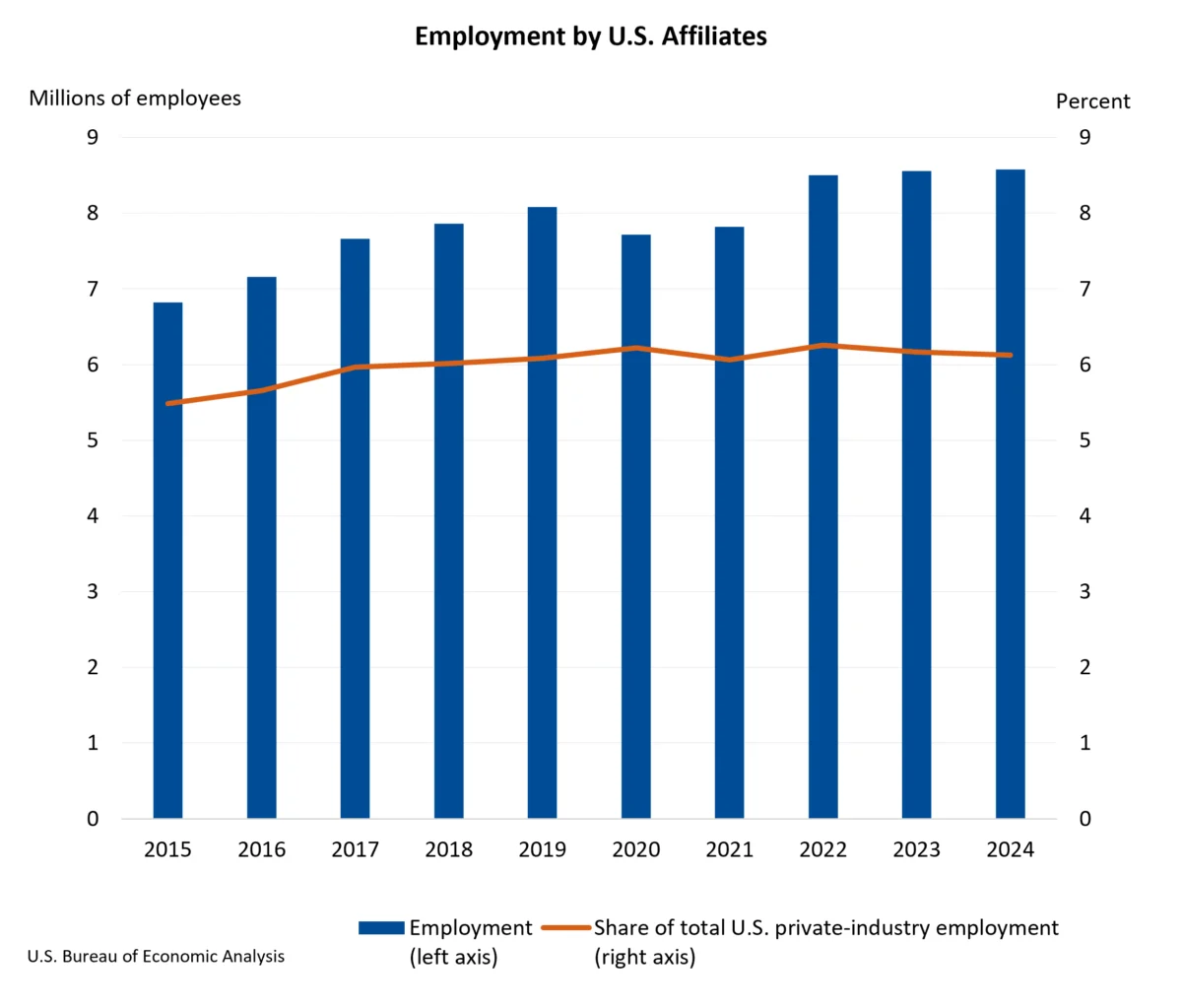
The influx of foreign direct investment in 2025 translated directly into job creation and workforce development. Current employment at acquired enterprises stood at 211,700. When factoring in the planned employment for newly established businesses and expansions, the total projected employment associated with these new FDI initiatives reached 232,400. This represents a significant boost to the U.S. labor market.
Analyzing employment by industry, the plastics and rubber parts manufacturing sector accounted for the largest number of current employees, with 21,800. This highlights the labor-intensive nature of certain manufacturing processes and the substantial workforce required to support them. Transportation equipment manufacturing followed with 17,300 employees, and primary and fabricated metals manufacturing employed 16,400 individuals. These figures underscore the ongoing importance of traditional manufacturing industries in providing stable employment opportunities.
By country of origin, Mexico contributed the largest number of current employees through its investments, with 54,600. Canada followed with 29,500 employees, and the United Kingdom with 26,800. These figures reflect the significant presence of companies from these nations in the U.S. economy.
California once again demonstrated its employment-generating power, with 37,200 current employees resulting from new foreign investment. Illinois followed with 17,600 employees, and Texas with 16,500. These states not only attract substantial capital but also serve as significant job creators, contributing to economic prosperity for their residents.
Revisions to Previous Year’s Data: A Refined Economic Picture
The BEA also provided updated figures for 2024, indicating a refinement of previous estimates. First-year expenditures for new foreign direct investment in 2024 were revised upward to $155.3 billion from a previously published $151.0 billion. This revision suggests that the U.S. economy was already experiencing robust FDI activity in the prior year, with the current year’s surge building upon a strong foundation.
Within the 2024 revisions, acquisitions of U.S. businesses were adjusted to $146.4 billion, establishments to $6.4 billion, and expansions to $2.5 billion. Planned total expenditures for 2024 were also revised upward to $164.0 billion from $157.0 billion. These adjustments reflect the dynamic nature of economic data collection and the BEA’s commitment to providing the most accurate picture of economic activity.
The revisions to planned expenditures for establishments and expansions indicate a greater long-term commitment to U.S. operations than initially reported for 2024. This suggests that foreign investors were not only actively engaged in the U.S. market but were also projecting sustained future growth and investment.
Context and Implications: A Strong Signal for U.S. Economic Resilience
The surge in foreign direct investment in 2025 arrives at a time when the global economic landscape is marked by both opportunities and uncertainties. The robust growth in FDI signals a strong vote of confidence from international investors in the stability, innovation capacity, and long-term growth prospects of the U.S. economy. This influx of capital can serve as a crucial catalyst for economic expansion, supporting job creation, technological advancement, and increased productivity.
The dominance of acquisitions in FDI flows indicates a strategic approach by foreign investors to leverage existing U.S. infrastructure, market access, and talent pools. This can lead to enhanced competitiveness for acquired companies and the transfer of best practices. Simultaneously, the continued investment in greenfield projects demonstrates a commitment to building new capacities and fostering long-term economic development within the U.S.
The BEA’s ongoing efforts to enhance its disclosure avoidance methods, such as employing coarsening techniques including rounding, aggregation, and the use of ranges, are vital for publishing more comprehensive data while safeguarding the confidentiality of survey respondents. This balance is crucial for maintaining the integrity and utility of economic statistics.
Looking ahead, the BEA’s schedule for the next release in June 2027, covering 2026 data, will provide further insights into the trajectory of foreign direct investment in the United States. As the U.S. economy navigates evolving global dynamics, the patterns and trends in foreign direct investment will remain a critical indicator of its international standing and economic vitality. The BEA’s comprehensive data reporting, supported by detailed tables and supplemental information, provides policymakers, businesses, and researchers with the essential tools to understand and respond to these important economic developments.