Lana Rhoades
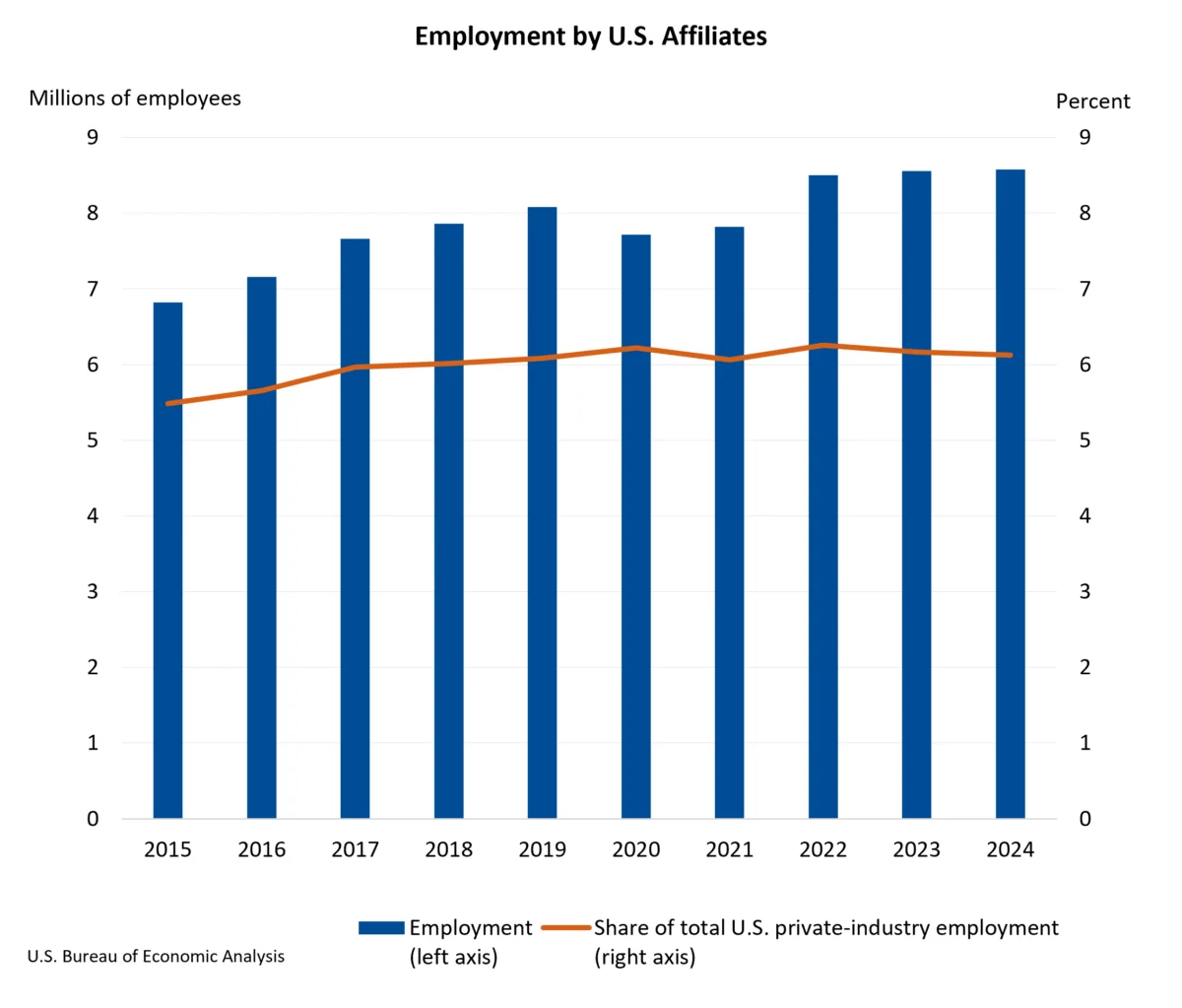
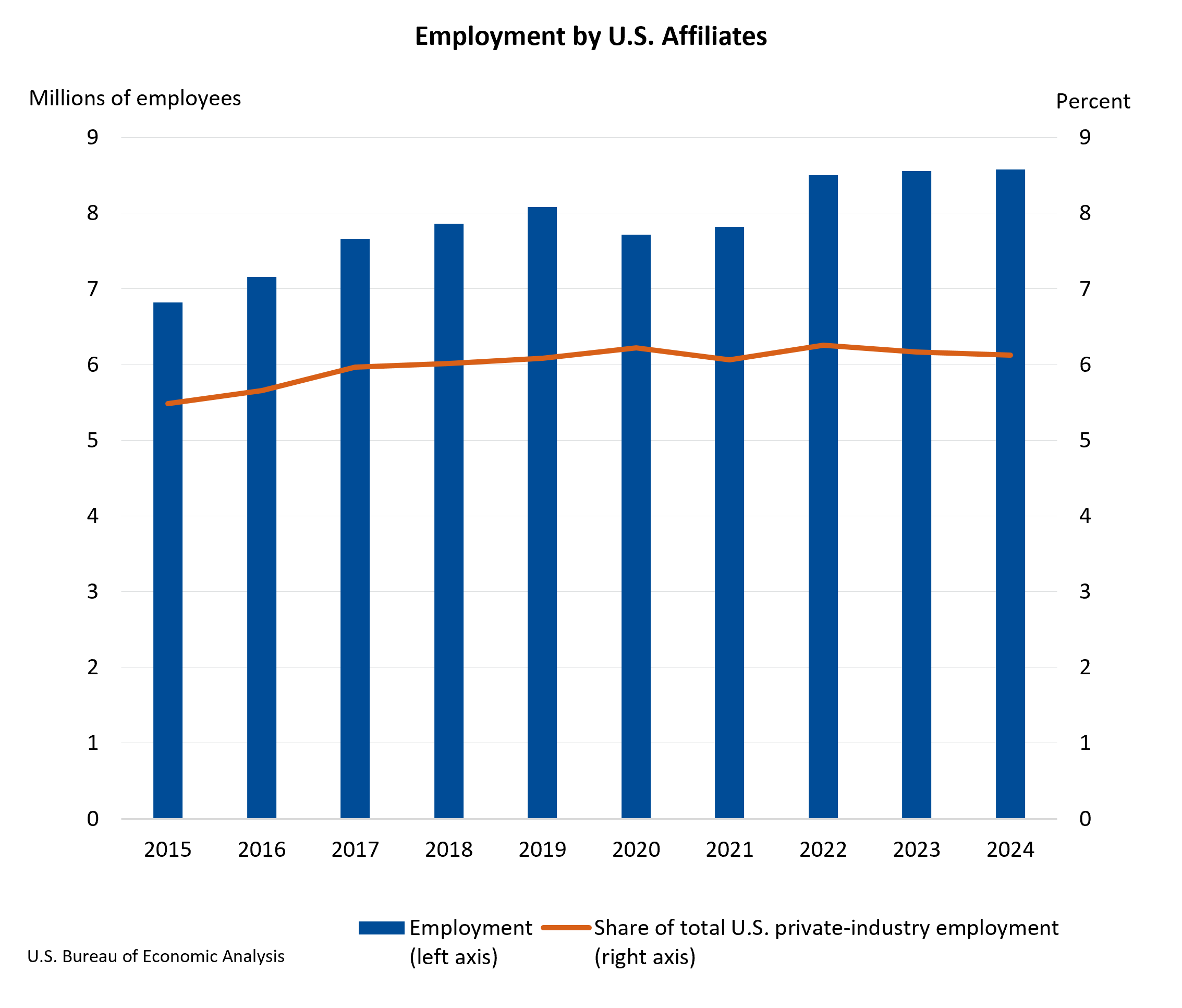
Washington D.C. – Majority-owned U.S. affiliates of foreign multinational enterprises (MNEs) provided employment for 8.57 million individuals across the United States in 2024, marking a modest 0.2 percent increase from the 8.56 million workers recorded in the preceding year. This data, released by the U.S. Bureau of Economic Analysis (BEA), offers a snapshot of the significant role foreign investment plays in the American labor market and broader economy. While the overall employment figure saw a slight uptick, its proportional share of total private-industry employment in the U.S. experienced a marginal decline, moving from 6.2 percent in 2023 to 6.1 percent in 2024.
The manufacturing and retail trade sectors continued to be the primary engines of employment for these U.S. affiliates, underscoring their foundational importance to the nation’s industrial and commercial landscape. Geographically, the United Kingdom, Japan, and Germany emerged as the leading contributors to employment through their U.S. subsidiaries, reflecting deep-seated economic ties and substantial investment flows from these key global economic partners.
Beyond employment figures, the economic footprint of these foreign-owned entities is substantial. Their current-dollar value added, a key metric of their direct contribution to the U.S. gross domestic product (GDP), surged by 4.3 percent to reach an impressive $1.52 trillion in 2024. This figure represents 6.7 percent of total U.S. business-sector value added, a slight decrease from 6.8 percent in 2023, indicating that while the absolute contribution grew, other sectors of the U.S. economy also expanded.
Investment in the nation’s future productive capacity also saw a notable increase. Expenditures on property, plant, and equipment by these U.S. affiliates rose by 3.3 percent, totaling $328.0 billion. This investment signals a commitment to expanding operational capabilities, modernizing infrastructure, and potentially increasing output and employment in the long term.
Furthermore, the commitment to innovation and future-oriented development is evident in research and development (R&D) activities. U.S. affiliates significantly increased their R&D expenditures by 5.3 percent, reaching $95.5 billion. This substantial investment accounted for 12.4 percent of total U.S. business R&D in 2024, highlighting the critical role foreign-owned entities play in driving technological advancement and scientific discovery within the United States.
On a state-by-state basis, California, Texas, and New York led the nation in employment generated by U.S. affiliates of foreign MNEs. California reported the highest number of jobs, with 885,200 positions, followed by Texas with 717,400, and New York with 556,700. In all three of these economic powerhouses, the manufacturing sector was the largest employer among foreign-affiliated companies, demonstrating the sector’s enduring significance.
Historical Context and Trends
The data released by the BEA reflects a consistent trend of foreign direct investment (FDI) into the United States, a phenomenon that has been a cornerstone of the American economy for decades. Foreign MNEs have historically sought to establish a presence in the U.S. market due to its large consumer base, stable regulatory environment, skilled workforce, and access to global markets. The establishment of U.S. affiliates—subsidiaries or branches that are at least 10 percent foreign-owned, with the data specifically focusing on majority-owned entities—represents a tangible manifestation of this investment.
The BEA’s statistics provide an annual account of the economic activities of these affiliates, offering insights into employment, output, investment, and R&D. This consistent tracking allows for the identification of trends and the assessment of the impact of global economic shifts, trade policies, and domestic economic conditions on foreign investment.
In recent years, the landscape of global investment has been influenced by factors such as geopolitical tensions, evolving trade agreements, and shifts in global supply chains. Despite these complexities, the U.S. has remained an attractive destination for foreign investment, as evidenced by the continued growth in employment and value added by U.S. affiliates. The slight increase in employment in 2024, while marginal, indicates resilience in the face of potential global headwinds.
Key Sectors and Contributors
The concentration of employment in manufacturing and retail trade is not a new development. These sectors have historically been major recipients of foreign investment due to their broad reach and substantial labor requirements. The manufacturing sector, in particular, benefits from access to U.S. innovation, a skilled workforce, and a robust domestic market, enabling foreign firms to produce goods for both domestic consumption and export. Retail trade, on the other hand, directly taps into the vast American consumer market, with foreign retailers establishing a strong presence through various store formats and e-commerce platforms.
The dominance of U.K., Japanese, and German investment is a long-standing characteristic of U.S. affiliate operations. These nations have historically been major trading partners and sources of FDI for the United States. For instance, Japanese automakers have established significant manufacturing operations in the U.S. South and Midwest, while German companies have a strong presence in the automotive, chemical, and pharmaceutical sectors. U.K. companies have diversified investments across various industries, including finance, technology, and life sciences. The continued strength of these relationships underscores the strategic importance of the U.S. market for these economies.
Economic Contributions and Implications
The value-added metric, representing the affiliate’s direct contribution to U.S. GDP, is a crucial indicator of the economic significance of these foreign-owned enterprises. The $1.52 trillion in value added in 2024 signifies that these companies are not merely present but are actively contributing to the nation’s economic output, generating wealth, and supporting a wide array of ancillary businesses and services.
The investment in property, plant, and equipment is a forward-looking indicator. An increase in these expenditures suggests that foreign-owned companies are anticipating future demand and are committing capital to expand their capacity, upgrade their facilities, and enhance their operational efficiency. This investment can lead to job creation, increased productivity, and the introduction of new technologies, all of which benefit the U.S. economy.
The substantial investment in R&D is particularly noteworthy. In an increasingly knowledge-based global economy, R&D is a critical driver of innovation, competitiveness, and long-term economic growth. The fact that U.S. affiliates account for over 12 percent of total U.S. business R&D underscores their role as innovation hubs, contributing to the development of new products, processes, and technologies that can have spillover effects across the entire U.S. economy. This investment also helps to solidify the U.S.’s position as a global leader in scientific and technological advancement.
State-Level Impact
The concentration of employment in California, Texas, and New York reflects the economic gravity of these states. California’s diverse economy, encompassing technology, manufacturing, and services, provides fertile ground for foreign investment. Texas, with its robust energy sector, growing manufacturing base, and strategic location, also attracts significant foreign capital. New York, as a global financial center and a hub for various industries, continues to be a prime destination for foreign enterprises. The fact that manufacturing is the leading sector in these states, despite their diverse economic profiles, highlights the enduring strength and adaptability of this industry.
Revisions and Data Updates
The BEA’s release also included revisions to the 2023 statistics, incorporating newly available and revised source data. These revisions are a standard part of the statistical process, aimed at improving the accuracy and comprehensiveness of economic reporting. For instance, the number of employees for 2023 was revised downward from a preliminary estimate of 8,661.8 thousand to 8,556.9 thousand. Similarly, value added, capital expenditures, and R&D expenditures for 2023 were also subject to revisions, reflecting the dynamic nature of economic data collection and analysis. These updates are crucial for providing policymakers, businesses, and researchers with the most accurate picture of economic activity.
Broader Economic Significance and Analysis
The consistent presence and growth of U.S. affiliates of foreign MNEs offer several key benefits to the U.S. economy. They contribute significantly to job creation, provide access to capital and technology, foster competition which can lead to lower prices and better quality for consumers, and enhance U.S. exports through their global supply chains. Moreover, these affiliates often bring advanced management practices and technological expertise that can diffuse throughout the broader U.S. business community.
However, the slight decrease in the proportional share of total private-industry employment, even as absolute numbers grew, suggests that the U.S. private sector as a whole might be growing at a faster pace than employment within foreign-affiliated companies, or that certain domestic sectors are experiencing particularly robust job growth. This nuance is important for understanding the evolving dynamics of the U.S. labor market.
The BEA’s ongoing commitment to refining its data collection and disclosure methods, such as the updated disclosure avoidance method using coarsening techniques, is essential for providing more granular and timely data while safeguarding the confidentiality of survey respondents. This allows for a more comprehensive understanding of economic activities at various levels, including industry and state.
Future Outlook
The BEA’s announcement of the next release in Spring 2027, focusing on the 2025 activities of U.S. affiliates of foreign MNEs, indicates a continued commitment to monitoring and reporting on this vital aspect of the U.S. economy. As global economic conditions continue to evolve, the trends observed in the BEA’s data will provide crucial insights into the resilience and adaptability of foreign investment in the United States. The performance of these affiliates will be closely watched as indicators of international business confidence and the ongoing attractiveness of the U.S. as a destination for global capital. The data serves as a vital resource for policymakers seeking to foster economic growth, attract investment, and maintain the nation’s competitive edge in the global marketplace.