Candice Horbacz
In recent years, the international community has grappled with the imperative to modernize global tax rules, particularly those affecting multinational corporations (MNCs) in an increasingly digitalized economy. This culminated in October 2021, following extensive negotiations spearheaded by the Organisation for Economic Co-Operation and Development (OECD), when more than 130 member jurisdictions of the Inclusive Framework on Base Erosion and Profit Shifting (BEPS) agreed to a landmark two-pillar solution. At the heart of this agreement is Pillar Two, which introduces a global minimum corporate tax rate of 15 percent. This transformative initiative is projected to significantly bolster global tax revenues, with estimates ranging from $91 billion to $155 billion annually, representing an increase of 6.5 to 8.1 percent of global corporate income tax revenue. The implementation of Pillar Two marks a pivotal shift in international tax policy, aiming to curb profit shifting and the "race to the bottom" in corporate tax rates that has long characterized the global economic landscape.
The Genesis of Global Tax Reform: Addressing BEPS and Digitalization
The journey towards Pillar Two is rooted in a decade-long international effort to address the challenges posed by base erosion and profit shifting (BEPS). For years, multinational corporations leveraged disparities and loopholes in national tax systems to shift profits to low-tax jurisdictions, effectively minimizing their global tax liabilities. This practice led to significant revenue losses for governments worldwide, distorted competition, and eroded public trust. The rise of the digital economy further exacerbated these issues, as traditional tax nexus rules struggled to capture the value generated by highly digitalized businesses operating without significant physical presence in many markets.
Recognizing the urgency, the G20 tasked the OECD with developing solutions. The initial BEPS project, launched in 2013, delivered 15 actions to tackle aggressive tax planning. However, it became clear that a more fundamental reform was needed to address the tax challenges arising from digitalization and to ensure that large MNEs pay a fair share of tax wherever they operate. This led to the establishment of the Inclusive Framework on BEPS in 2016, bringing together over 140 countries and jurisdictions to work on a consensus-based solution. The two-pillar approach emerged from these discussions, with Pillar One focusing on reallocating taxing rights to market jurisdictions and Pillar Two establishing a global minimum effective tax rate. The agreement in October 2021 was hailed by OECD Secretary-General Mathias Cormann as a "game-changer" that would "ensure that multinational enterprises pay a fair share of tax wherever they operate and earn profits."
The Architectural Framework of Pillar Two: The GloBE Rules
Pillar Two, formally known as the Global Anti-Base Erosion (GloBE) Rules, is designed to ensure that large multinational enterprise (MNE) groups, those with annual consolidated revenues of €750 million or more, pay an effective tax rate of at least 15 percent on their profits in each jurisdiction where they operate. The framework comprises three interconnected rules intended to achieve this minimum taxation:
-
Qualified Domestic Minimum Top-up Tax (QDMTT): This is the first line of defense. It allows a country to impose a top-up tax on the profits of MNE entities located within its own borders if their effective tax rate falls below 15 percent. This gives the source jurisdiction the primary right to tax any undertaxed profits, ensuring that the additional revenue remains within the country where the profits are generated. This mechanism is crucial as it incentivizes countries to collect the top-up tax themselves rather than having it collected by another jurisdiction under the IIR or UTPR.
-
Income Inclusion Rule (IIR): If a jurisdiction does not implement a QDMTT, or if its QDMTT does not fully bring the effective tax rate up to 15 percent, the IIR comes into play. The IIR dictates that the ultimate parent entity of an MNE group will be required to pay a top-up tax on the undertaxed profits of its foreign subsidiaries. This means that if a subsidiary in a low-tax jurisdiction pays less than 15 percent, the parent company in its home country will have to pay the difference, thereby ensuring the minimum tax is met at the group level.
-
Undertaxed Profits Rule (UTPR): The UTPR serves as a backstop to the IIR. It applies when the parent entity’s jurisdiction has not implemented an IIR, or if the IIR has not fully applied to all undertaxed profits. In such cases, the UTPR allows other jurisdictions where the MNE group operates to deny deductions or require an equivalent adjustment, thereby increasing the tax liability of the MNE group in those jurisdictions until the minimum 15 percent effective rate is met. If multiple countries apply a similar top-up tax, the taxable profit would be divided based on the location of tangible assets and employees, aiming for a fair allocation.
Together, these rules create a comprehensive global safety net, ensuring that profits of large MNEs are taxed at a minimum effective rate of 15 percent, regardless of where they are generated or where the parent company is located.
Global Implementation Landscape: The European Union’s Path
The European Union has been a strong proponent of the global minimum tax and has moved swiftly towards its implementation. The EU Directive on Pillar Two (Council Directive (EU) 2022/2523) formally obliges Member States to transpose the GloBE rules into national law. Specifically, the Directive mandated the implementation of the Income Inclusion Rule (IIR) starting from December 31, 2023, and the Undertaxed Profits Rule (UTPR) from December 31, 2024, for Member States with more than 12 in-scope multinational groups.
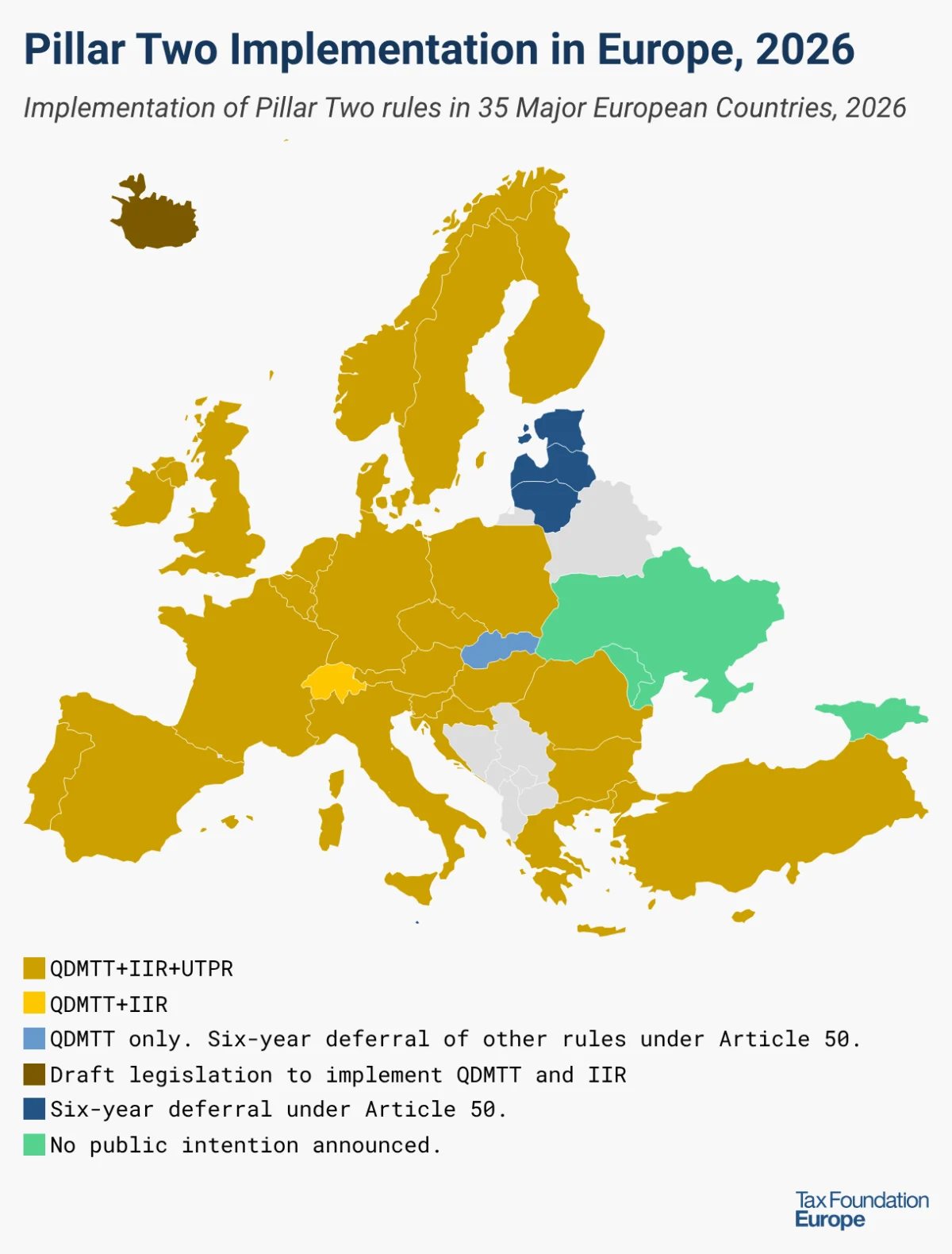
As of early 2024, a significant majority of the 27 EU Member States have either fully implemented or are in the advanced stages of implementing the Pillar Two rules, including the QDMTT, IIR, and UTPR. Twenty-two of the 27 Member States have integrated these provisions into their national legal frameworks by 2026, demonstrating a broad commitment to the OECD agreement.
However, the implementation journey has not been uniform. Five EU Member States – Estonia, Latvia, Lithuania, Malta, and Slovakia – have exercised an option under Article 50 of the Directive to defer the implementation of both the IIR and UTPR for six years. This deferral option is available to Member States with no more than 12 in-scope multinational groups headquartered within their borders. Estonia, Latvia, Lithuania, and Malta have chosen to defer all rules until 2029. Slovakia, while also exercising the deferral, has selectively implemented a domestic top-up tax in 2024, indicating a hybrid approach. These deferrals are often rooted in concerns about the potential impact on their unique domestic tax systems, such as Estonia and Latvia’s distribution-based corporate tax systems, which tax profits only when distributed. By 2030, the full implementation of the Pillar Two Directive would necessitate changes to these systems, obliging in-scope companies to distribute sufficient earnings to meet the 15 percent minimum effective tax rate, thereby compromising a key design feature.
Furthermore, four EU Member States—Cyprus, Poland, Portugal, and Spain—faced delays in implementation despite their obligations under the EU Directive. The European Commission has initiated legal proceedings against these countries for failing to meet the specified deadlines. To address these delays and avoid further penalties, these countries have committed to implementing the Pillar Two rules retroactively for 2024, ensuring compliance with the spirit and letter of the Directive, albeit with a temporal lag.
Beyond the EU: Broader European Adoption and Hesitations
The adoption of Pillar Two extends beyond the European Union, with various other European nations navigating their own implementation timelines and strategies. Among eight major European countries outside the EU, only Norway, Turkey, and the United Kingdom have implemented the full suite of Pillar Two rules—the QDMTT, IIR, and UTPR—by 2025. This demonstrates a strong alignment with the OECD framework in these significant economies.
Switzerland, a key global financial hub, has also moved forward, implementing a QDMTT in 2024 and an IIR in 2025. However, it has not yet outlined any plans to implement a UTPR, signaling a cautious, phased approach that prioritizes domestic revenue collection and primary taxation rights. Iceland is currently undergoing public consultation processes to implement a QDMTT and an IIR by 2026, with no definitive statements regarding a UTPR at this stage. These consultations reflect a deliberate process to assess the domestic economic impact and tailor implementation to national contexts.
Conversely, some countries aspiring for closer ties with the EU have yet to formally commit. Georgia, Moldova, and Ukraine, all recent candidates for EU accession, have not publicly announced their intentions to implement any Pillar Two rules. For these nations, the focus remains on broader economic reforms and aligning with EU standards, and the complex undertaking of Pillar Two implementation may be a subsequent step. The absence of immediate plans highlights the varied capacities and priorities across different European states, particularly those undergoing significant geopolitical and economic transitions.
The United States’ Distinct Approach: A ‘Side-by-Side’ Solution
In contrast to many European countries and the broader OECD consensus, the United States has chosen a distinct path, opting not to directly implement the Pillar Two framework. While participating in the initial G7 and OECD negotiations, the US has expressed reservations about certain aspects of the GloBE rules and has instead focused on strengthening its own cross-border tax framework.
In June 2025, the G7 announced a political agreement on a global minimum tax "side-by-side" solution. This agreement aims to reconcile the US’s existing tax regime with Pillar Two, specifically by excluding US-parented groups from the application of Pillar Two’s Income Inclusion Rule (IIR) and Undertaxed Profits Rule (UTPR. This approach seeks to acknowledge the equivalency of the US system without requiring direct adoption of the GloBE rules.
The US argument is that its existing and recently updated international tax rules already achieve an outcome similar to, and in some cases more stringent than, Pillar Two. Recent changes introduced by the "One Big Beautiful Bill Act" (OBBBA), for instance, include the newly introduced net CFC tested income (NCTI) provisions. The NCTI acts as a minimum tax on all foreign income of US companies, imposing an effective rate of between 12.6 and 14 percent. Crucially, the US system uses a blended formula across jurisdictions rather than a country-by-country approach, which is a key divergence from Pillar Two.
Furthermore, several features of the US system, such as less generous foreign tax crediting rules, the removal of the substance exclusion (which allows for a carve-out for routine profits related to tangible assets and payroll), the lack of loss carryovers, and restrictive interest deductibility rules, contribute to a potentially higher effective tax burden for US multinationals compared to what they might face under the standard Pillar Two rules. This makes the US system arguably more stringent in certain respects, providing the basis for the "side-by-side" equivalency argument and its unique position in the global tax reform landscape.
Economic Impact and Corporate Implications
The implementation of Pillar Two carries profound economic implications and necessitates significant adjustments for multinational corporations. The estimated revenue increase of $91 billion to $155 billion globally underscores the potential for governments to recoup substantial tax revenues previously lost to profit shifting. This additional revenue could be channeled into public services, infrastructure, or deficit reduction, providing fiscal stability in an era of increasing economic uncertainty.
For corporations, the impact is multi-faceted. The immediate challenge lies in navigating the increased complexity and compliance burden. MNEs must now meticulously track their effective tax rates on a jurisdiction-by-jurisdiction basis, requiring enhanced data collection, advanced tax accounting systems, and significant investment in specialized personnel or advisory services. The varying implementation timelines and interpretations across countries further complicate this, creating a patchwork of rules that demand careful management.
Beyond compliance, Pillar Two is expected to influence corporate strategic decisions. Companies may reassess their supply chain structures, investment locations, and legal entity footprints. The incentive to locate intellectual property or highly mobile assets in zero or low-tax jurisdictions will diminish considerably. While the primary goal is not to force companies to relocate, it aims to neutralize the tax advantages of such moves. This could lead to a more economically driven allocation of investments, rather than purely tax-driven ones.
However, concerns remain regarding potential distortions. Some fear that the uniform 15 percent rate might disproportionately affect developing countries that have historically used lower tax rates as an incentive for foreign direct investment. While the QDMTT aims to capture revenue locally, the overall attractiveness of a low headline rate as a competitive advantage may be eroded. Moreover, the "side-by-side" approach of the US introduces another layer of complexity, potentially leading to competitive imbalances between US-parented MNEs and those headquartered in Pillar Two-compliant jurisdictions.
Challenges and Future Outlook
Despite the significant progress, the full realization of Pillar Two’s objectives faces ongoing challenges. The staggered implementation, the existence of deferral options, and the distinct approach adopted by the United States create a complex and evolving global tax environment. The potential for tax disputes between jurisdictions over the application of the UTPR, or over the interpretation of specific GloBE rules, remains a concern. The OECD is continuously working on guidance and administrative frameworks to minimize such conflicts.
The long-term effectiveness of Pillar Two will depend on broad and consistent implementation across jurisdictions. As more countries bring the rules into force, the "race to the bottom" in corporate tax rates is expected to slow, fostering greater tax certainty and fairness. However, the international tax landscape is dynamic, and continuous adaptation will be necessary. Future discussions may focus on the interaction of Pillar Two with other tax policies, its impact on specific industries, and potential adjustments to the rules based on real-world experience.
Ultimately, Pillar Two represents a monumental step towards a more coherent and equitable international tax system. While its implementation journey is intricate and ongoing, the global commitment to a minimum corporate tax rate signals a new era of multilateral cooperation aimed at ensuring that multinational enterprises contribute their fair share to the public good, wherever their profits are earned. The coming years will be crucial in observing how these ambitious reforms reshape global commerce and governmental revenues.