Lana Rhoades
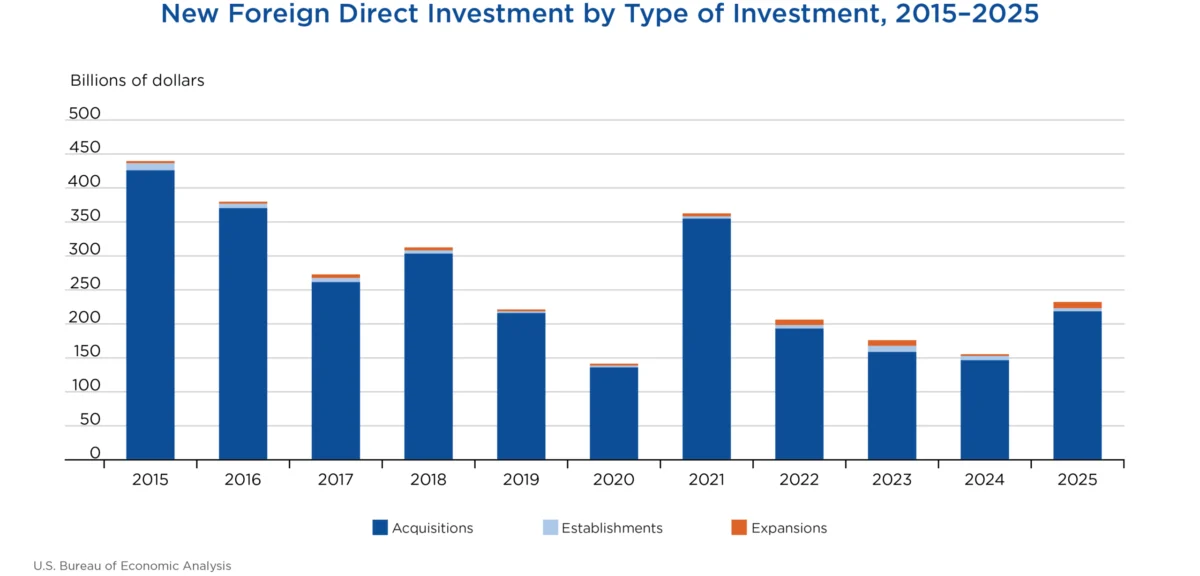
Expenditures by foreign direct investors to acquire, establish, or expand U.S. businesses reached a robust $232.2 billion in 2025, marking a significant 49.5 percent increase from the previous year, according to preliminary statistics released by the U.S. Bureau of Economic Analysis (BEA). This substantial growth underscores a dynamic period for international capital flowing into the American economy, with acquisitions of existing U.S. businesses continuing to dominate the landscape of foreign investment. The surge in FDI signals renewed confidence in the U.S. market and a strategic interest from global players in establishing or reinforcing their presence within the nation’s diverse economic sectors.
The BEA’s comprehensive report details that out of the total $232.2 billion in expenditures, a commanding $218.4 billion was allocated to the acquisition of existing U.S. businesses. This segment alone saw a considerable uptick, reflecting a strong appetite for integrating established operations and market share. The establishment of new U.S. businesses attracted $4.6 billion in investment, while the expansion of existing foreign-owned businesses accounted for $9.2 billion. Beyond the initial outlay, planned total expenditures, encompassing both first-year commitments and anticipated future investments, projected a substantial $284.5 billion, indicating a long-term strategic vision by foreign investors. These investments, in turn, created employment opportunities for an estimated 213,100 individuals in newly acquired, established, or expanded foreign-owned businesses across the United States in 2025.
A Deeper Dive into Investment Trends
The distribution of foreign direct investment in 2025 reveals key areas of focus across various industries, originating countries, and U.S. states. By industry, the publishing sector emerged as a significant recipient, attracting $50.7 billion in new direct investment. The chemicals manufacturing sector followed closely with $45.4 billion, and the plastics and rubber products manufacturing industry garnered $19.0 billion. Collectively, the manufacturing sector represented a substantial portion of the total investment, accounting for $121.8 billion, or 52.5 percent of all expenditures. This dominance highlights the continued importance of manufacturing as a cornerstone of the U.S. economy and a prime target for foreign capital seeking production capabilities and market access.
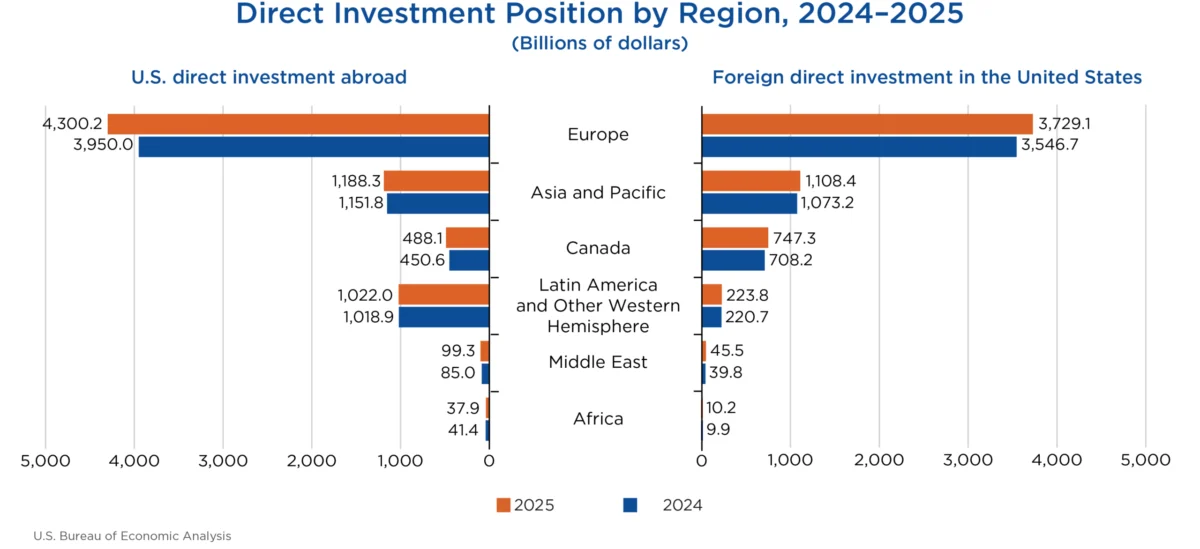
From a geographical perspective, Japan led the pack as the largest investing country, contributing $50.5 billion to the U.S. economy. Germany followed with an investment of $26.7 billion, and Canada was the third-largest investor, injecting $23.5 billion into U.S. enterprises. Regionally, Europe demonstrated its significant economic ties to the U.S., providing the largest share of new investment at $116.6 billion, representing 50.2 percent of the total. The Asia and Pacific region also played a crucial role, ranking as the second-largest investing region with $71.9 billion in expenditures.
At the state level, California once again proved to be a magnet for foreign investment, receiving the highest amount of first-year investment expenditures, totaling $59.7 billion. Texas followed with $21.5 billion, and Pennsylvania secured the third position with $20.9 billion. These states, known for their diverse economies, technological hubs, and strategic locations, continue to attract a disproportionate share of global capital.
Greenfield Investments: Building the Future
Beyond the acquisition of existing entities, greenfield investments – those focused on establishing new businesses or expanding existing foreign-owned ones – also played a vital role in the 2025 FDI landscape. These investments totaled $13.8 billion. Within the greenfield category, the transportation and warehousing sector attracted the largest share, with $3.6 billion in expenditures. The manufacturing of computers and electronic products followed with $2.0 billion, and chemicals manufacturing received $1.8 billion.
Geographically, investors from the Asia and Pacific region were the primary drivers of greenfield investments, contributing $8.3 billion. Notably, Australia led this group with $3.0 billion, followed by South Korea ($2.2 billion) and Japan ($1.7 billion). On the U.S. state level, Louisiana attracted the highest greenfield investment, with $3.0 billion, followed by Arizona ($2.7 billion) and Texas ($1.9 billion). The planned total expenditures for these greenfield initiatives initiated in 2025, encompassing both immediate and future outlays, were projected at $66.1 billion, indicating a sustained commitment to building new operational capacities within the U.S.
Employment Implications of Foreign Investment
The influx of foreign direct investment in 2025 had a tangible impact on U.S. employment. At newly acquired, established, or expanded foreign-owned businesses, a total of 213,100 employees were engaged. Of these, current employment in acquired enterprises stood at 211,700. The broader picture of planned employment, which includes the full operational capacity of newly established businesses and projected expansions, reached an impressive 232,400 individuals.
By industry, plastics and rubber parts manufacturing accounted for the largest number of current employees, with 21,800 workers. Transportation equipment manufacturing followed with 17,300 employees, and primary and fabricated metals manufacturing employed 16,400. Looking at the origin of the investment, Mexico contributed the most current employees, with 54,600, followed by Canada (29,500) and the United Kingdom (26,800). California led the states in terms of current employment generated by new foreign investment, with 37,200 jobs, followed by Illinois (17,600) and Texas (16,500).
Revisions to 2024 FDI Data
The BEA also provided updated figures for 2024 expenditures on new foreign direct investment in the United States, highlighting revisions to previously published data. First-year expenditures were revised upward to $155.3 billion from an earlier estimate of $151.0 billion. This revision was driven by an increase in acquisitions of U.S. businesses, which were revised to $146.4 billion from $143.0 billion. Expenditures for establishing new businesses saw a slight upward revision to $6.4 billion from $6.3 billion, and expansions of existing businesses were revised to $2.5 billion from $1.8 billion. Planned total expenditures for 2024 were also adjusted upward to $164.0 billion from $157.0 billion, reflecting similar trends in acquisitions, establishments, and expansions. These revisions provide a more accurate picture of the investment landscape in the preceding year, reinforcing the upward trajectory observed in 2025.
Context and Analysis of FDI Trends
The substantial increase in foreign direct investment in 2025 can be attributed to a confluence of factors, including a stable U.S. economic environment, favorable regulatory conditions, and strategic global economic realignments. The strong performance of the U.S. economy, characterized by steady growth and a robust consumer market, continues to make it an attractive destination for international capital. Furthermore, the trend of acquisitions suggests that foreign investors are increasingly looking to leverage existing U.S. market presence and infrastructure rather than starting entirely from scratch, a strategy that can offer quicker market penetration and integration.
The dominance of the manufacturing sector in receiving investment signals a potential reshoring or nearshoring trend, where foreign companies are investing in U.S.-based production facilities to serve the North American market, possibly driven by supply chain resilience considerations and evolving trade dynamics. The leading role of countries like Japan, Germany, and Canada in FDI flows underscores their deep-seated economic relationships with the United States and their long-term strategic interests in the American market.
The significant greenfield investments, particularly in sectors like transportation and warehousing, point towards investments in logistical infrastructure and capacity building, which are crucial for the efficient functioning of a large economy. The focus on the Asia and Pacific region in greenfield investments might reflect strategic diversification efforts or investments aimed at capitalizing on specific technological advancements or market demands originating from these regions.
Broader Economic Implications and Outlook
The surge in foreign direct investment has several positive implications for the U.S. economy. It not only brings substantial capital infusion but also contributes to job creation, technological transfer, and enhanced competition within various sectors. The BEA’s detailed data on industry, country, and state-level investments provides valuable insights for policymakers, businesses, and economic development organizations, allowing for targeted strategies to attract and retain foreign investment.
The upward revisions to 2024 data suggest that the growth in FDI observed in 2025 is part of a broader, sustained trend rather than an isolated event. This continued influx of foreign capital is likely to bolster economic activity, support innovation, and contribute to the overall competitiveness of the U.S. economy on the global stage. As the BEA prepares to release its 2026 data in June of next year, stakeholders will be closely watching to see if this robust investment momentum continues, further solidifying the United States’ position as a prime destination for international business and investment. The BEA’s commitment to publishing more granular data, aided by updated disclosure avoidance methods, will continue to be instrumental in understanding these complex economic interactions.