Pevita Pearce
The established system that has guided tax professionals and businesses through electronic information return filings since the 1990s is no more. What replaces it is not merely a new login, but a fundamental shift involving a different application, a new file format, and in some instances, a revised certification process. This seismic change, affecting how millions of information returns are processed annually, demands careful navigation and a clear understanding of the new landscape.
The transition from the Filing Information Returns Electronically (FIRE) system to the Information Returns Intake System (IRIS) represents a significant undertaking for firms that have relied on FIRE for decades. While much of the public discourse has framed this as a simple "migration"—akin to moving to a new address with the same belongings—this perspective is potentially misleading and could lead to costly delays, particularly as the January tax season approaches. The reality is that four out of the five critical changes associated with this transition do not occur at the submission step itself, but rather earlier in the process. Understanding this sequence is paramount for any firm filing on behalf of clients.
The Phased Sunset of the FIRE System
The closure of the FIRE system was not a singular event, but a carefully orchestrated series of deadlines throughout the autumn of 2026. Firms that focused solely on the final closure date likely missed crucial earlier deadlines, thereby limiting their options for a smooth transition. The sequence of events was as follows:
- July 21, 2026: The IR Application for TCC, the primary interface for the FIRE system, ceased accepting new applications. This marked the initial step in phasing out access for new filers.
- November 1, 2026: The test system for FIRE was decommissioned. This removed the ability for filers to conduct pre-submission testing, a vital step for ensuring compliance with submission requirements.
- November 9, 2026: Changes to the Transmitter Control Code (TCC) system, a critical component for identifying and authorizing filers, were halted. This signaled the finalization of existing TCCs and the cessation of modifications.
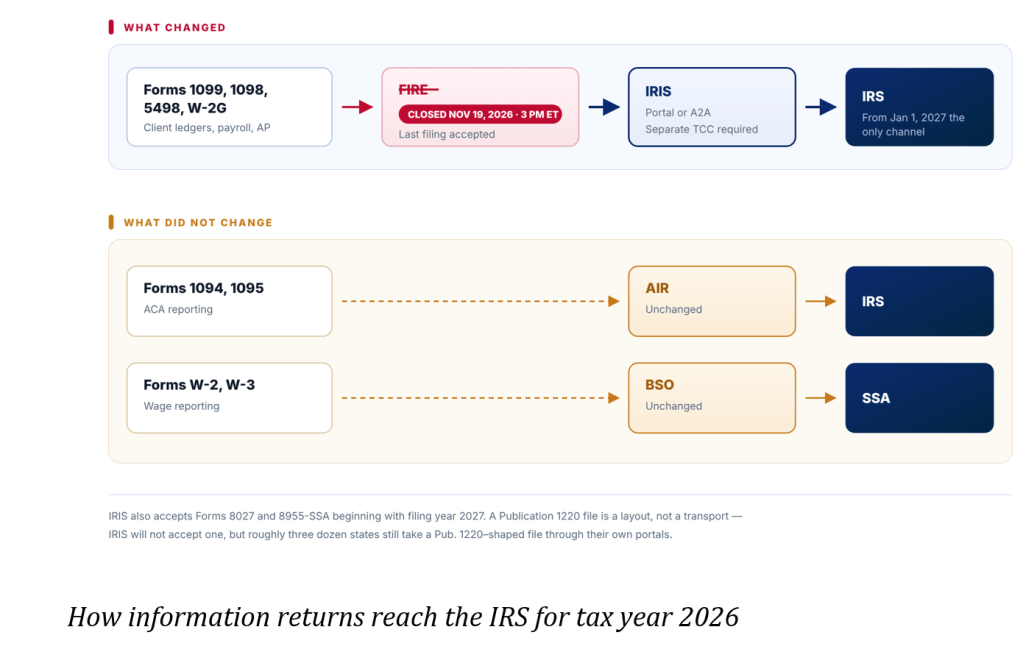
- November 19, 2026, 3 p.m. Eastern Time: The production system for FIRE accepted its final tax return. This marked the definitive end of FIRE’s operational capacity for submitting new filings.
The Internal Revenue Service (IRS) has been unequivocal in its communication regarding the future. The mandate is clear: "IRIS will be the only information returns electronic filing system, including current year, prior year, or corrections, after January 1, 2027." This statement carries significant weight, as it encompasses not only the tax year 2026 returns filed during the upcoming season but also any necessary corrections to prior-year returns submitted in March 2027 or later. Any firm holding open corrections, regardless of whether they file a single current-year return through IRIS, will be required to utilize the new system.
The Transmitter Control Code (TCC): The Critical Path
Of all the components involved in this transition, the Transmitter Control Code (TCC) emerges as the most critical bottleneck. While other aspects of the change can be addressed within an afternoon, securing a TCC requires a more extended timeline.
According to IRS Publication 5903, the processing time for a typical TCC application is approximately 45 business days. For firms applying in late November, this timeline could easily extend beyond the February 1, 2027, deadline for crucial forms such as the Form 1099-NEC and Form W-2. Firms that initiated their TCC applications in September or October have afforded themselves a more comfortable buffer. However, those applying now must factor in this significant processing window and proactively develop a fallback filing strategy.
There are essentially two viable responses to this situation: either secure the TCC well in advance of critical deadlines, understanding the inherent processing delays, or have a robust alternative filing method in place. The option of paper filing, while technically available, is largely impractical for most firms. The IRS electronic filing threshold mandates electronic submission for any entity filing 10 or more information returns of any type, aggregated across all forms (1099s, W-2s, 1095s, etc.). Given this threshold, almost every firm will exceed the limit for the majority of their clients.
Small businesses, accountants, and tax professionals have the option to file 1099 forms directly through the IRS’s free IRIS Taxpayer Portal or via an authorized e-filing provider. It is crucial to note that federal filing does not automatically satisfy state reporting requirements; therefore, filers must verify any separate state submission mandates. A significant advantage of using third-party providers is that they typically do not require the firm to obtain its own TCC, streamlining the process considerably.
Understanding Roles: Issuer vs. Transmitter
A prevalent error during the TCC application process stems from a fundamental misunderstanding of the roles involved. This is not a mere typo but a structural misunderstanding that can have significant repercussions.
| Role | Who it is for | Can it file for clients? |
|---|---|---|
| Issuer | A business transmitting information returns only for the company named on the application | No |
| Transmitter | A third-party business transmitting on behalf of its own company and/or other businesses | Yes |
| Software Developer | A business writing software that transmits through A2A | n/a (can be held alongside Transmitter) |
IRS Publication 5903 explicitly states that an applicant "must select one or more roles but cannot select both ‘Issuer’ and ‘Transmitter’." A firm that files returns on behalf of its clients inherently acts as a Transmitter. Selecting "Issuer" because the firm is, in essence, "issuing" returns, is a misapplication of the role and will likely lead to rejection at the most inopportune time.
Further complications can arise from the authorized user requirements. Part 3.5 of Publication 5903 mandates at least two responsible officials unless the applicant is a sole proprietor or single-member LLC. It also permits zero to two authorized delegates and requires at least two contacts. Each responsible official must sign the submission using a five-digit PIN. Until all required signatures are obtained, the application remains in "Signature Required" status, and no TCC is issued.
A practical warning that cannot be overstated: a P.O. box is not accepted as a business address. Additionally, government agencies or divisions sharing a single Employer Identification Number (EIN) may only hold one IRIS Application for TCC between them.
It is important to note a discrepancy within the IRS publications themselves. Part 1 of Pub. 5903 outlines different minimum requirements than Part 3.5 (e.g., one responsible official versus two for sole proprietorships, S corporations, and single-member LLCs). In cases of disagreement, it is advisable to adhere to the stricter requirement and document the reasoning for compliance.
Choosing the Right Transmission Method: Portal or A2A
The IRIS system offers two primary methods for electronic filing: the IRIS Taxpayer Portal and Application-to-Application (A2A).
The IRIS Taxpayer Portal is a web-based application where users can log in, input or upload return data, and transmit the information.
Application-to-Application (A2A) is a machine-to-machine interface designed for direct data exchange between authorized third-party software and the IRS. It accepts XML files formatted according to specific IRS schemas.
Crucially, each distinct role and transmission method is issued a separate TCC. A firm intending to utilize both the portal and A2A will need to apply for and obtain a TCC for each. Selecting a method that will not be used is counterproductive and can introduce unnecessary complexity.
A2A transmission introduces an additional layer of compliance: the IRIS Technical Conformance Certification. This certification must be obtained before the schema package can be released through the Secure Object Repository. For firms planning to transmit their own XML files, both the TCC and this technical certification should be considered separate, critical path items, not a single entity.
For the majority of tax practices, the IRIS Taxpayer Portal is likely to be sufficient. For others, particularly those with a high volume of filings, leveraging the A2A connection of a trusted third-party provider is often a more practical and efficient solution than developing and maintaining an in-house A2A integration.
What Remains Unchanged: Important Distinctions
A significant portion of the anxiety surrounding this transition arises from the assumption that IRIS has absorbed all prior filing systems. This is not the case. Certain returns continue to be filed through established, separate channels.
| Return | Channel for the 2027 Season | Changed by the FIRE Closure? |
|---|---|---|
| Forms 1099 series, 1098 series, 5498, W-2G | IRIS | Yes – this is the primary migration |
| Forms 1094-B/C and 1095-B/C (ACA) | AIR (Affordable Care Act Information Returns) | No |
| Forms W-2 and W-3 | SSA (Social Security Administration), via Business Services Online | No |
| Forms 8027 and 8955-SSA | IRIS, beginning with filing year 2027 | New to IRIS |
The handling of Form W-2 presents a common point of confusion, as it surprises many practitioners each January. W-2s have never been filed directly with the IRS for electronic processing; instead, they are submitted to the Social Security Administration (SSA) through a distinct system requiring a separate credential. The closure of FIRE does not alter this process. Firms that allow their SSA Business Services Online access to lapse while solely focusing on IRIS are, in effect, addressing the wrong problem.
Publication 1220: A File Layout, Not a Transport
It is crucial to distinguish between Publication 1220 and the FIRE system. While they have historically been closely associated, they are fundamentally different entities.
FIRE was a transport mechanism – the system used to transmit data. Publication 1220, on the other hand, is a file layout – a documented specification for fixed-width records of 750 characters, categorized into types T, A, B, C, and F. For years, these two traveled in tandem, leading to their frequent conflation.
IRIS does not accept files formatted according to Publication 1220. This is a genuine change that renders export-and-upload routines developed over years of FIRE seasons obsolete for federal filings.
However, this does not render the Publication 1220 file format entirely useless. Approximately three dozen states continue to accept files structured according to Pub. 1220 through their own state portals. These state filing channels are independent of FIRE and remain operational. Firms that have concluded their Pub. 1220 export tooling is now worthless have, in fact, discarded a highly reusable asset for state-level compliance.
The same principle applies to historical data. A FIRE file from a previous filing season is still a documented and parseable record of submitted information, including payer and payee details, and state totals. This data can be imported into spreadsheets for review rather than requiring manual re-entry. Tools are available to facilitate this conversion, aiding firms in retrieving and reviewing past filings. Care should be taken to monitor leading zeros in taxpayer identification numbers and ZIP codes when migrating data to spreadsheet formats.
The 2027 Tax Calendar: Key Dates and Shifts
Several filing deadlines have been adjusted for the 2027 tax season due to their placement on weekends or holidays.
| What | Date | Why it Moved |
|---|---|---|
| Forms 1099-NEC – recipient and IRS | February 1, 2027 | January 31, 2027, falls on a Sunday. |
| Forms W-2 – employee and SSA | February 1, 2027 | January 31, 2027, falls on a Sunday. |
| Forms 1099-MISC – recipient, with box 8 or 10 | February 16, 2027 | February 15, 2027, is Washington’s Birthday. |
| Information returns – IRS, on paper | March 1, 2027 | February 28, 2027, falls on a Sunday. |
| Information returns – IRS, electronically | March 31, 2027 | No shift. |
The Form 1099-NEC continues to present a specific challenge: unlike most other information returns in the series, electronic filing does not grant an extension. Both the recipient copy and the IRS copy share the same deadline, which is the first day of February.
It is also important to note a change in reporting thresholds for payments made during 2026. The reporting threshold for nonemployee compensation has increased from $600 to $2,000, and this figure will be indexed for inflation in subsequent years. The prior $600 threshold remains in effect for tax year 2025 forms, which are filed in January 2026. This means two different thresholds will be relevant within a short period, depending on the year the payment was made.
A Readiness Checklist for Firms
To ensure a smooth transition and avoid the pitfalls associated with the FIRE to IRIS change, firms should consider the following checklist:
- TCC Application: Have you applied for your IRIS TCC? If not, do so immediately and factor in the 45-business-day processing time.
- Role Selection: Did you correctly identify your role as a "Transmitter" if you file for clients?
- Authorized Users: Have you designated the required number of responsible officials and contacts, ensuring they have their PINs?
- Business Address: Is your business address a physical location, not a P.O. box?
- Transmission Method: Have you decided on your filing method (IRIS Portal, A2A, or third-party provider)?
- Technical Conformance (A2A): If using A2A, have you initiated or completed the IRIS Technical Conformance Certification process?
- Prior Year Data: Have you devised a plan for accessing and utilizing historical FIRE data if needed?
- State Filings: Are you aware of any specific state filing requirements and their compatibility with Pub. 1220 or other formats?
- W-2 and ACA Filings: Have you confirmed that your SSA Business Services Online and AIR access are current and functional?
- Client Communication: Have you informed your clients about the changes and any new requirements on their end?
The firms that anticipate an uneventful January are those that treated the TCC acquisition as a procurement item in September. For all others, the critical question is no longer if they will migrate, but how they will navigate the new system. Proactive decision-making this month, rather than a panicked response in the third week of January, will be the key to success.
Frequently Asked Questions
Q: Can I still file through FIRE for tax year 2026?
A: No. FIRE accepted its final information return at 3 p.m. ET on November 19, 2026. Tax year 2026 returns are filed during the 2027 season entirely through IRIS.
Q: Does my FIRE TCC work for IRIS?
A: No. A separate IRIS Application for TCC is required, and each role and transmission method receives its own TCC.
Q: How long does an IRIS TCC take?
A: The IRS states that a typical application is processed within 45 business days. Applications submitted in late November are unlikely to clear before the February 1 deadline.
Q: Do W-2s go through IRIS now?
A: No. Forms W-2 go to the Social Security Administration through Business Services Online, as they always have. The FIRE closure does not affect them.
Q: What about ACA forms?
A: Forms 1094 and 1095 continue to go through AIR. IRIS does not accept them.
Q: Can I file prior-year returns and corrections through IRIS?
A: Yes—and after January 1, 2027, only through IRIS. The IRS’s wording covers current year, prior year, and corrections.
Q: Is my old Pub. 1220 export tooling now useless?
A: No. Publication 1220 is a file layout rather than a transport. IRIS will not take such a file, but around three dozen states still accept one through their own portals.
Q: Do I need an IRIS TCC if I file through a provider?
A: No. A provider transmitting under its own TCC removes the application from your critical path entirely.
IRS Sources for Further Information:
- IRS.gov/Businesses/Corporations/Filing-Information-Returns-Electronically-FIRE
- IRS Publication 5903, IRIS General Instructions
- IRS Publication 1220, Specifications for ElectronicFiling Information Returns
- IRS.gov/Forms-Publication/Publication-1179
- IRS.gov/Businesses/Small-Businesses-Self-Employed/Electronic-Filing-Information-Returns-E-filing-of-Tax-Professionals
Disclaimer: This article provides general information and is not intended as tax advice. Filing requirements are subject to the specific return, tax year, and jurisdiction.