Lana Rhoades

The United States witnessed a significant surge in foreign direct investment (FDI) in 2025, with expenditures by foreign investors to acquire, establish, or expand U.S. businesses reaching a robust $232.2 billion. This figure represents a substantial increase of $76.8 billion, or 49.5 percent, compared to the $155.3 billion recorded in 2024, according to preliminary statistics released by the U.S. Bureau of Economic Analysis (BEA). Acquisitions of existing U.S. businesses remained the dominant driver of this investment activity, underscoring a continued trend of foreign entities seeking to integrate with or take control of established American enterprises.
Record Investment Driven by Acquisitions and Manufacturing Sector
The headline figure of $232.2 billion in first-year expenditures reflects a dynamic investment landscape. Of this total, acquisitions of existing U.S. businesses accounted for the lion’s share, totaling $218.4 billion. The establishment of new U.S. businesses attracted $4.6 billion in investment, while the expansion of existing foreign-owned businesses saw $9.2 billion. Beyond immediate outlays, planned total expenditures, which encompass both first-year commitments and anticipated future investments, were projected to reach an impressive $284.5 billion. This forward-looking figure suggests a sustained commitment to U.S. operations and growth by foreign investors.
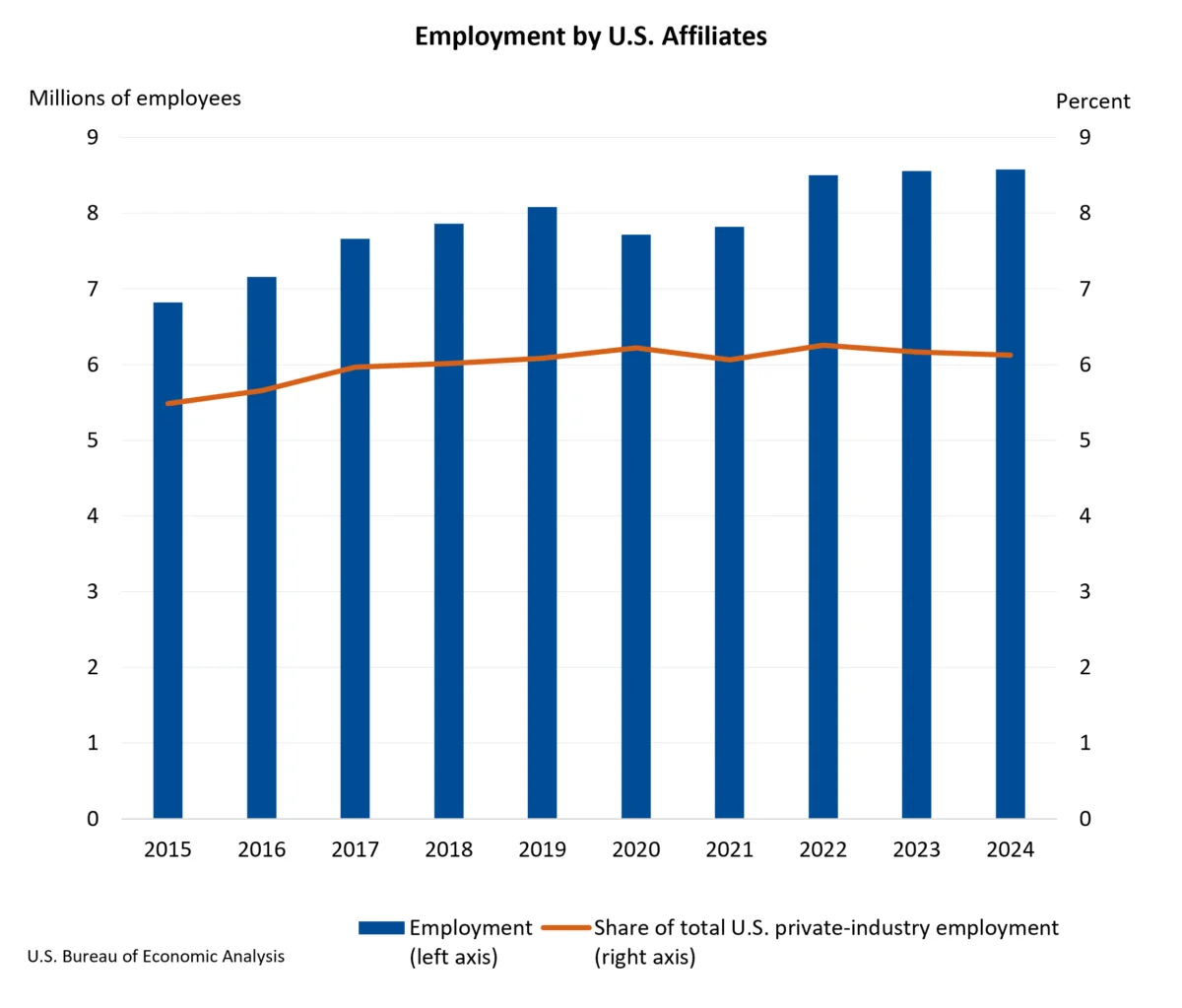
The influx of capital translated into significant job creation, with 213,100 employees engaged at newly acquired, established, or expanded foreign-owned businesses in 2025. This metric highlights the tangible economic impact of FDI on the U.S. labor market.
Industry Breakdown: Manufacturing Takes the Lead
Analysis of investment by industry reveals a strong preference for the manufacturing sector, which collectively attracted $121.8 billion, representing a substantial 52.5 percent of total expenditures. Within manufacturing, specific sub-sectors demonstrated exceptional strength. Publishing industries led the charge with $50.7 billion in new direct investment, followed closely by chemicals manufacturing ($45.4 billion) and plastics and rubber products manufacturing ($19.0 billion). The dominance of manufacturing suggests a continued global demand for American industrial capacity and innovation, potentially driven by factors such as skilled labor, advanced technology, and favorable market access.
Global Investors Focus on Key Nations and Regions
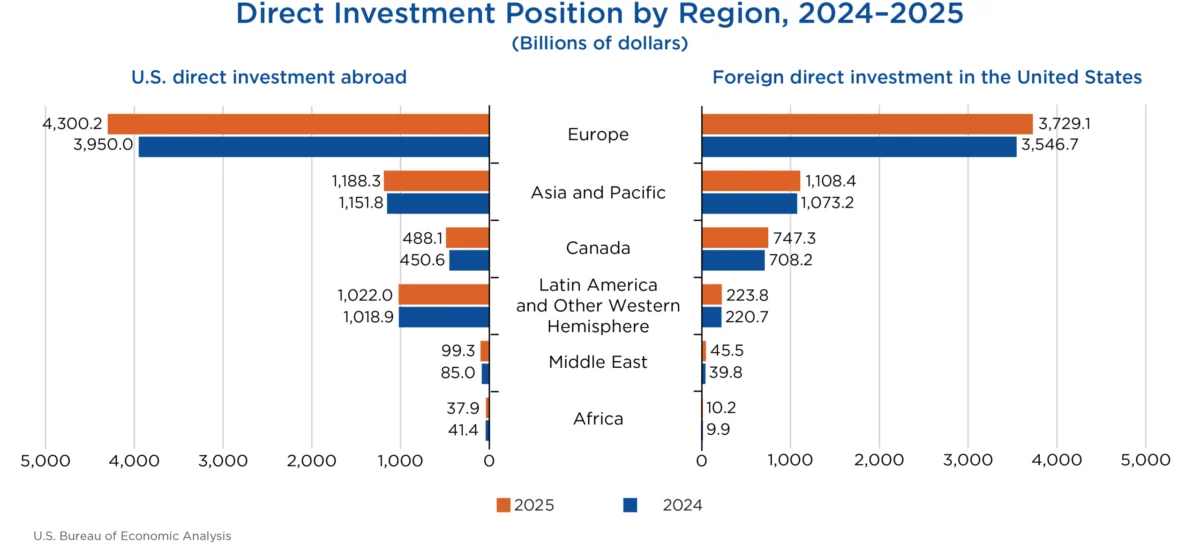
Geographically, Japan emerged as the leading investor nation in 2025, committing $50.5 billion to U.S. businesses. Germany followed with $26.7 billion, and Canada with $23.5 billion. These consistent top investors underscore the enduring appeal of the U.S. market for established economic powers. On a regional basis, Europe contributed the most significant portion of new investment, accounting for $116.6 billion, or 50.2 percent of all new FDI. The Asia and Pacific region was the second-largest investing region, with expenditures totaling $71.9 billion, indicating a diversified global interest in U.S. opportunities.
State-Level Impact: California and Texas Lead the Pack
At the state level, California secured the largest share of first-year investment expenditures, attracting $59.7 billion. Texas followed with $21.5 billion, and Pennsylvania with $20.9 billion. These states, known for their diverse economies, technological hubs, and significant manufacturing bases, continue to be magnets for foreign capital. The distribution of investment across states suggests a pattern of targeting regions with established infrastructure, skilled workforces, and supportive business environments.
Greenfield Investment: A Focus on New Ventures and Expansion
Beyond acquisitions, greenfield investments—expenditures aimed at establishing new U.S. businesses or expanding existing foreign-owned ones—totaled $13.8 billion in 2025. This segment, while smaller than acquisitions, represents a direct injection of new capital and job creation. Key industries for greenfield investment included transportation and warehousing ($3.6 billion), computers and electronics products manufacturing ($2.0 billion), and chemicals manufacturing ($1.8 billion). Investors from the Asia and Pacific region were particularly active in greenfield ventures, contributing $8.3 billion, with notable investments from Australia ($3.0 billion), South Korea ($2.2 billion), and Japan ($1.7 billion). Louisiana ($3.0 billion), Arizona ($2.7 billion), and Texas ($1.9 billion) emerged as leading states for greenfield investment. Planned total expenditures for greenfield initiatives initiated in 2025 reached $66.1 billion, signaling a robust pipeline of future growth.
Employment Dynamics: A Detailed Look
The employment impact of FDI is multifaceted. In 2025, current employment at acquired enterprises stood at 211,700. The total planned employment, encompassing current roles at acquired firms, anticipated positions at newly established businesses once fully operational, and planned expansions, was projected at 232,400. This comprehensive employment figure underscores the long-term job growth potential associated with FDI.
By industry, plastics and rubber parts manufacturing provided employment for the largest number of current employees (21,800), followed by transportation equipment manufacturing (17,300) and primary and fabricated metals manufacturing (16,400). This aligns with the industrial breakdown of investment, highlighting sectors that are both attracting capital and generating significant employment.
On a country-of-origin basis, Mexico contributed the largest number of current employees (54,600), followed by Canada (29,500) and the United Kingdom (26,800). This data point reflects the employment footprint of foreign-owned companies already operating in the U.S. California led states in current employment resulting from new investment, with 37,200 employees, followed by Illinois (17,600) and Texas (16,500).
Revisions to 2024 Data Reflect Underlying Strength
The BEA also provided updated figures for 2024, indicating that previously published expenditure data has been revised. First-year expenditures for new FDI in 2024 were revised upward from $151.0 billion to $155.3 billion. This revision was primarily driven by an increase in expenditures for U.S. businesses acquired, revised to $146.4 billion from $143.0 billion. Planned total expenditures for 2024 also saw an upward revision, from $157.0 billion to $164.0 billion. These revisions suggest that the underlying strength and momentum in FDI may have been underestimated in initial reports, further contextualizing the substantial growth observed in 2025.
Context and Implications of the FDI Surge
The significant increase in FDI in 2025 occurs against a backdrop of evolving global economic dynamics. Factors such as geopolitical stability, trade relations, technological advancements, and the pursuit of market access likely influenced the investment decisions of foreign entities. The preference for acquisitions suggests that many foreign investors are seeking to leverage existing U.S. infrastructure, market share, and established customer bases, rather than building from the ground up. This can lead to faster integration and quicker realization of investment returns.
The strong performance in the manufacturing sector, particularly in chemicals and plastics, could be indicative of reshoring trends or a strategic positioning of U.S. production to serve domestic and international markets. The U.S. remains an attractive destination due to its large consumer market, relatively stable regulatory environment, and access to innovation.
However, the concentration of investment in specific industries and states also raises questions about regional economic disparities and the potential for concentrated job growth. While the overall numbers are positive, understanding the distribution of these benefits is crucial for comprehensive economic analysis.
Official Responses and Future Outlook
The Bureau of Economic Analysis, as the primary source of this data, plays a critical role in providing timely and accurate economic indicators. While direct statements from government officials or industry leaders were not provided in the initial data release, the BEA’s role is to furnish the factual basis for policy discussions and economic forecasting. The release of these preliminary statistics is a crucial step in the annual FDI reporting cycle, with more detailed data typically following.
The BEA’s commitment to enhancing data disclosure through methods like coarsening, which involves rounding and aggregation, allows for the publication of more comprehensive information while safeguarding respondent confidentiality. This approach ensures that valuable economic insights are made available to researchers, policymakers, and the public.
Looking ahead, the BEA has scheduled its next release for June 2027, which will cover new foreign direct investment in the United States for 2026. This consistent reporting schedule provides a vital timeline for tracking the ongoing evolution of global investment flows into the U.S. economy. The robust performance in 2025 sets a high benchmark and suggests that the U.S. remains a prime destination for international capital, with ongoing implications for economic growth, employment, and industrial development. The detailed data tables accompanying the release offer further granular insights for those seeking to conduct in-depth analysis of specific investment trends across industries, countries, and states.