Lana Rhoades
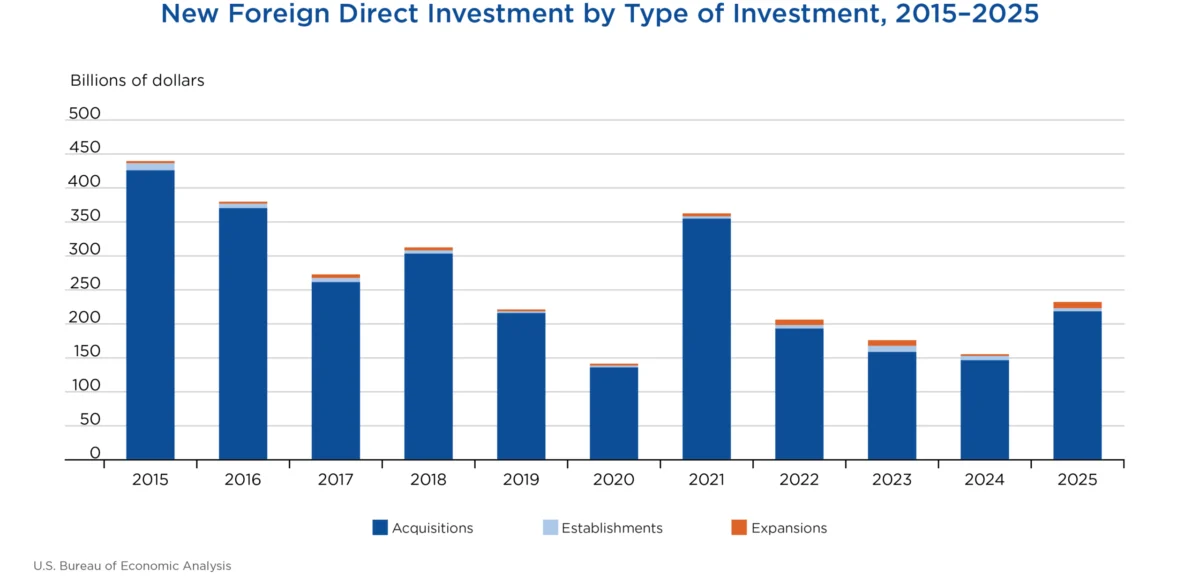
Expenditures by foreign direct investors to acquire, establish, or expand U.S. businesses surged to $232.2 billion in 2025, marking a substantial 49.5 percent increase from the previous year, according to preliminary statistics released by the U.S. Bureau of Economic Analysis (BEA). This robust growth underscores a renewed confidence in the U.S. market among international investors, with acquisitions of existing American companies continuing to be the dominant form of investment. The BEA’s latest figures paint a picture of a dynamic economic landscape shaped by global capital flows, with significant implications for employment, industry development, and regional economies across the nation.
The substantial influx of foreign capital in 2025 represents a significant acceleration from 2024 levels, when expenditures totaled $155.3 billion (revised figure). The increase of $76.8 billion highlights a potent rebound or intensification of investment activity. Acquisitions of established U.S. businesses were the primary driver of this growth, accounting for $218.4 billion of the total expenditures. This suggests that foreign investors are actively seeking to integrate into the U.S. market by leveraging existing infrastructure, market share, and brand recognition.
In addition to acquisitions, foreign investors also committed $4.6 billion to establish new U.S. businesses and $9.2 billion to expand existing foreign-owned enterprises. These figures, while smaller than acquisition figures, represent crucial investments in job creation and future economic capacity. The BEA also reported that planned total expenditures, which encompass both initial outlays and projected future investments, reached an impressive $284.5 billion, indicating a strong pipeline of anticipated foreign direct investment (FDI) in the coming years.
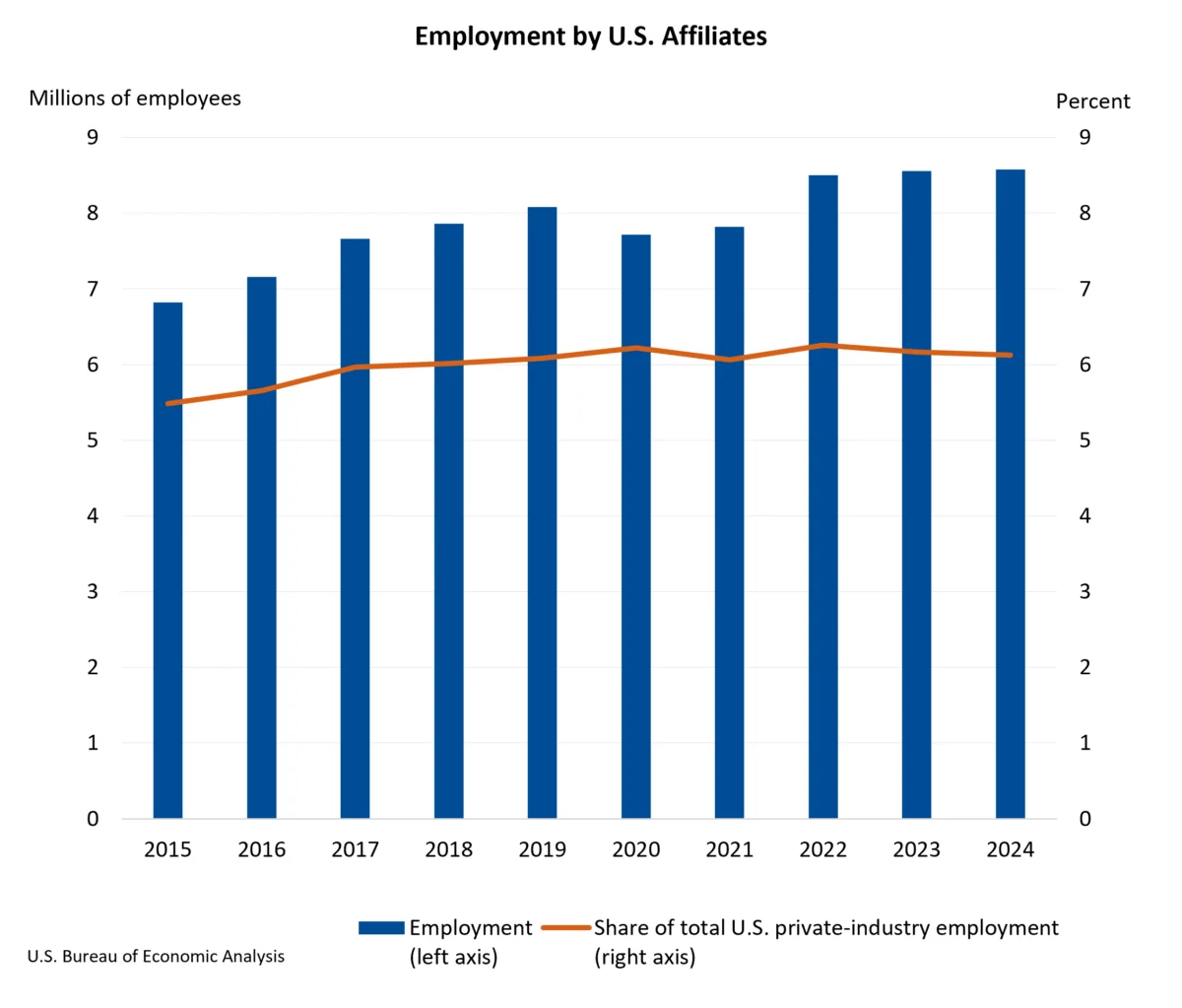
The economic impact of this surge in FDI is further evidenced by the employment figures. In 2025, newly acquired, established, or expanded foreign-owned businesses in the United States provided employment for 213,100 individuals. This significant job creation is a direct benefit of foreign investment, bolstering the U.S. workforce and contributing to economic stability and growth.
Industry Sector Dominance and Key Investing Nations
The BEA’s detailed breakdown by industry reveals a strong leaning towards specific sectors, indicating where foreign investors see the greatest opportunities and strategic advantages. Publishing industries attracted the largest share of new direct investment, with $50.7 billion. This could reflect a growing demand for content across various media platforms or strategic investments in intellectual property. Chemicals manufacturing followed closely, securing $45.4 billion in investment, a sector often characterized by its capital-intensive nature and global supply chain importance. Plastics and rubber products manufacturing also saw substantial investment, with $19.0 billion. Collectively, the manufacturing sector accounted for a significant 52.5 percent of total expenditures, totaling $121.8 billion, underscoring its continued importance as a magnet for global capital.
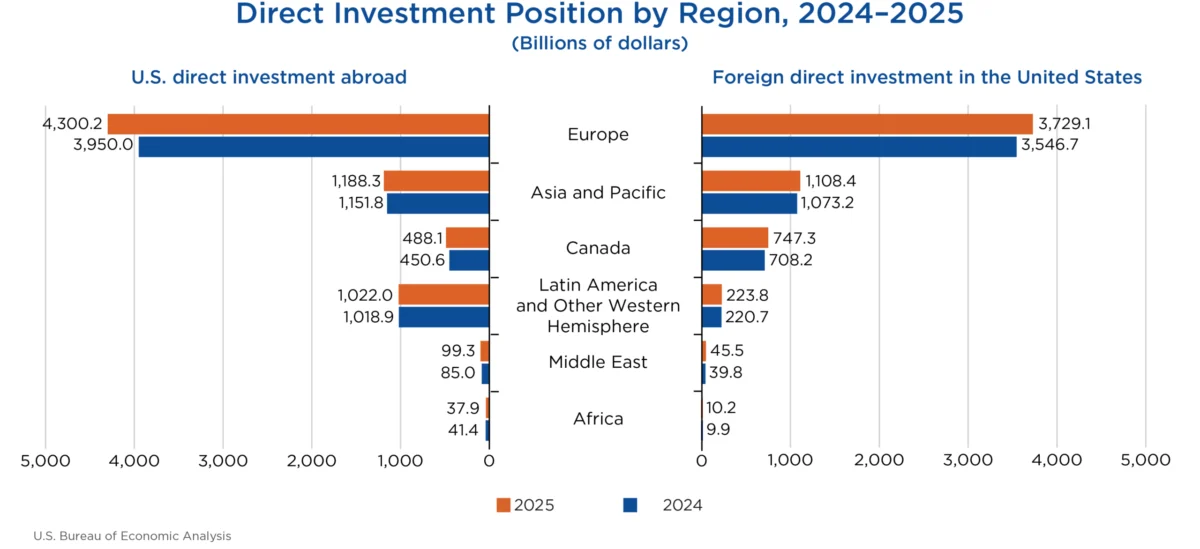
On a national level, Japan emerged as the leading source of FDI in 2025, injecting $50.5 billion into the U.S. economy. This marks a notable resurgence of Japanese investment, building on a long-standing history of significant capital flows into the United States. Germany followed with $26.7 billion, and Canada with $23.5 billion, underscoring the strong economic ties and investor confidence from North America and Europe. Geographically, Europe as a whole contributed the most new investment, accounting for $116.6 billion, or 50.2 percent of all new investment. The Asia and Pacific region was the second-largest investing bloc, with $71.9 billion in expenditures, demonstrating the increasingly interconnected nature of global investment.
Regional Impact and State-Level Investment Trends
The distribution of FDI across U.S. states highlights key economic hubs attracting foreign capital. California once again led the nation in receiving first-year investment expenditures, with a substantial $59.7 billion. Its robust economy, technological innovation, and large consumer market continue to make it an attractive destination for foreign investors. Texas followed with $21.5 billion, solidifying its position as a major economic powerhouse, particularly in energy and technology sectors. Pennsylvania secured the third spot with $20.9 billion, indicating a broad-based appeal for investment across different states.
Greenfield Investment: Cultivating New Opportunities
Beyond the acquisition of existing businesses, the BEA also tracks "greenfield" investments, which involve establishing new businesses or expanding existing foreign-owned ones. These investments are crucial for creating new jobs and fostering innovation from the ground up. In 2025, greenfield expenditures totaled $13.8 billion. The largest beneficiaries within this category were transportation and warehousing, which received $3.6 billion, signaling growth in logistics and supply chain infrastructure. Computers and electronics products manufacturing attracted $2.0 billion, and chemicals manufacturing garnered $1.8 billion.
Regionally, investors from the Asia and Pacific bloc led in greenfield expenditures, contributing $8.3 billion. Australia was a significant player within this region, investing $3.0 billion, followed by South Korea ($2.2 billion) and Japan ($1.7 billion). At the state level, Louisiana emerged as a key recipient of greenfield investment, attracting $3.0 billion, potentially linked to its port infrastructure and manufacturing capabilities. Arizona received $2.7 billion, and Texas garnered $1.9 billion, indicating a diverse geographical spread for new business development. The planned total expenditures for greenfield investments initiated in 2025 reached $66.1 billion, suggesting a sustained commitment to building new enterprises in the U.S.
Employment Landscape and Sectoral Contributions
The employment impact of FDI extends beyond initial job creation. In 2025, current employment in acquired enterprises stood at 211,700. When factoring in the planned employment for newly established businesses and expansions, the total planned employment associated with new FDI reached 232,400. This forward-looking metric underscores the long-term job creation potential of these investments.
By industry, plastics and rubber parts manufacturing provided the largest number of current employees, with 21,800. Transportation equipment manufacturing followed with 17,300, and primary and fabricated metals manufacturing with 16,400. These figures highlight the significant contribution of these manufacturing sub-sectors to the U.S. employment base through foreign investment.
On a country-of-origin basis for current employees, Mexico accounted for the largest share with 54,600 employees, followed by Canada with 29,500 and the United Kingdom with 26,800. This reflects the significant presence of companies from these nations within the U.S. industrial landscape. California once again led the states in terms of current employment resulting from new FDI, with 37,200 jobs, followed by Illinois with 17,600 and Texas with 16,500.
Revisions to 2024 Data and Forward-Looking Trends
The BEA’s release also included important revisions to its 2024 data for new foreign direct investment. These revisions provide a more accurate historical context for the 2025 surge. First-year expenditures for 2024 were revised upward to $155.3 billion from a previous estimate of $151.0 billion. This upward revision was driven by increased figures for acquisitions of U.S. businesses ($146.4 billion revised from $143.0 billion), establishments ($6.4 billion revised from $6.3 billion), and expansions ($2.5 billion revised from $1.8 billion). Similarly, planned total expenditures for 2024 were revised to $164.0 billion from $157.0 billion, reflecting updated projections for future investment commitments. These revisions suggest that the U.S. economy was already on a stronger trajectory of foreign investment than initially reported.
Analysis and Implications
The substantial increase in foreign direct investment in 2025 signals a robust recovery and expansion of global economic engagement with the United States. Several factors likely contributed to this surge, including a stable regulatory environment, a large and growing consumer market, access to skilled labor, and potential strategic advantages offered by U.S. industries in a globalized economy.
The dominance of acquisitions suggests that foreign investors are strategically integrating into existing U.S. industries, potentially acquiring market share, technology, or established brands. This can lead to increased efficiency, competition, and innovation within those sectors. The significant investment in manufacturing, particularly in chemicals, plastics, and metals, indicates a continued reliance on U.S. industrial capacity and a potential re-shoring or near-shoring trend for certain production activities.
Greenfield investments, while smaller in absolute terms, are critical for long-term economic development. The growth in transportation and warehousing greenfield investments points to an expanding e-commerce sector and the need for robust logistics networks. Investment in computers and electronics manufacturing suggests continued global interest in U.S. technological capabilities.
The leading roles of Japan, Germany, and Canada, along with Europe and the Asia-Pacific region as major investing blocs, highlight the interconnectedness of the global economy and the strategic importance of the U.S. market. The concentration of investment in states like California, Texas, and Pennsylvania underscores the importance of economic infrastructure, talent pools, and market access in attracting foreign capital.
The upward revision of 2024 data suggests that the strong performance in 2025 is not an isolated event but rather a continuation of a positive trend. This sustained influx of foreign capital is likely to have a ripple effect throughout the U.S. economy, boosting GDP, supporting employment, and fostering technological advancements. Policymakers and business leaders will undoubtedly be closely monitoring these trends to understand their full impact and to develop strategies that leverage FDI for continued national prosperity. The BEA’s commitment to providing detailed and timely statistics on foreign direct investment remains crucial for informed economic analysis and decision-making. The next release, scheduled for June 2027, will provide insights into the 2026 FDI landscape, offering further evidence of the ongoing trajectory of global investment in the United States.