Lana Rhoades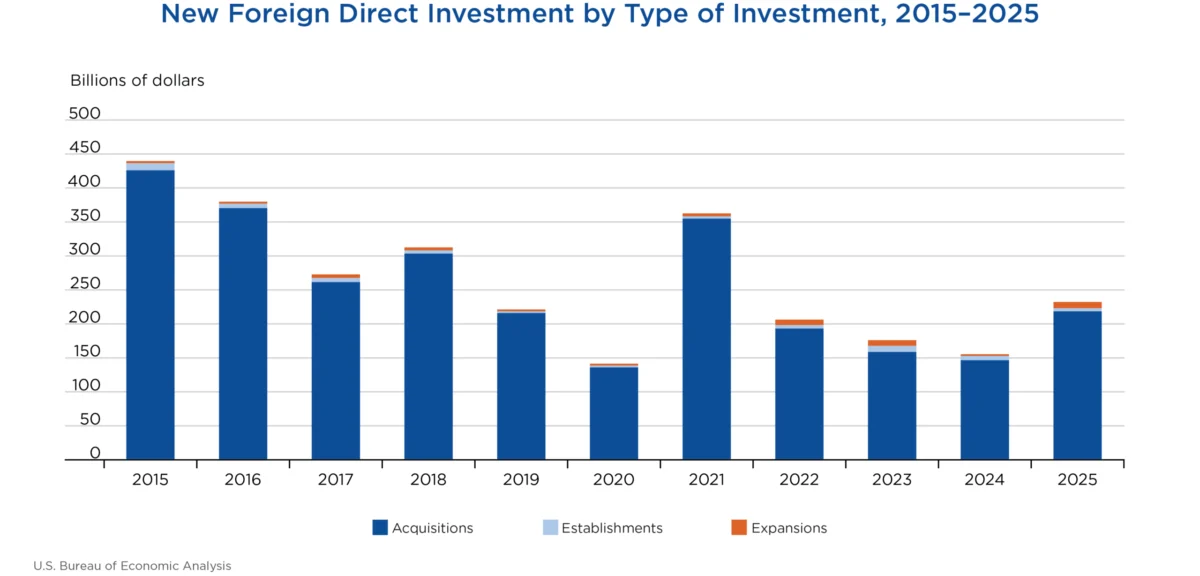
Expenditures by foreign direct investors to acquire, establish, or expand U.S. businesses surged to a remarkable $232.2 billion in 2025, marking a substantial 49.5 percent increase, or an additional $76.8 billion, from the previous year’s levels. These preliminary statistics, released today by the U.S. Bureau of Economic Analysis (BEA), underscore a robust year for international investment in the American economy. As has been the consistent trend in recent years, the acquisition of existing U.S. businesses represented the dominant channel for these significant capital inflows.
The breakdown of these expenditures reveals that acquisitions of U.S. businesses accounted for the vast majority of the investment, totaling $218.4 billion. In contrast, the establishment of new U.S. businesses by foreign entities attracted $4.6 billion, and the expansion of existing foreign-owned businesses saw an investment of $9.2 billion. Looking ahead, planned total expenditures, which encompass both the initial first-year outlays and projected future investments, were estimated at a substantial $284.5 billion, indicating sustained investor interest and commitment to the U.S. market. This significant influx of capital is expected to translate into considerable job creation and economic growth across various sectors.
Job Creation and Employment Impact
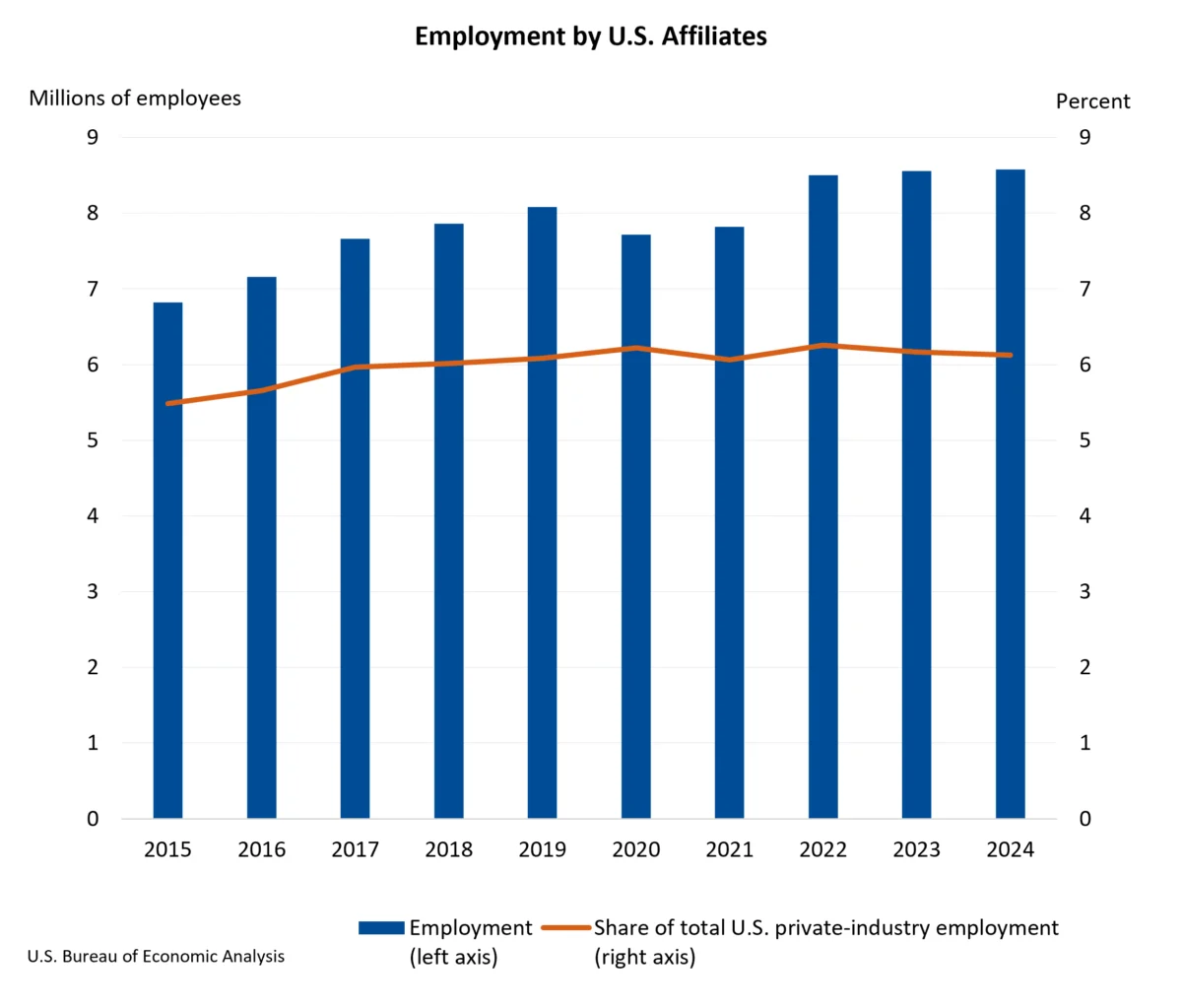
The impact of this foreign direct investment extends beyond financial figures, directly influencing the U.S. labor market. In 2025, newly acquired, established, or expanded foreign-owned businesses in the United States provided employment for an estimated 213,100 individuals. This figure highlights the direct job-creation capacity of FDI. Furthermore, the BEA’s data indicates that current employment within acquired enterprises stood at 211,700. When considering the planned employment for newly established businesses once fully operational, and the projected job growth associated with expansions, the total planned employment across these foreign-invested entities is estimated to reach 232,400. This forward-looking projection suggests a continued positive trajectory for job growth fueled by foreign investment.
Key Investment Trends by Sector, Origin, and Geography
Analyzing the investment landscape by industry reveals a strong preference for certain sectors. Publishing industries led the pack in new direct investment expenditures, attracting $50.7 billion. This was closely followed by chemicals manufacturing, which garnered $45.4 billion, and plastics and rubber products manufacturing, with $19.0 billion in investment. The manufacturing sector as a whole proved to be a major draw for foreign capital, accounting for $121.8 billion, or a significant 52.5 percent, of the total expenditures. This dominance of manufacturing underscores its continued importance to the U.S. industrial base and its attractiveness to international investors seeking production capabilities and market access.
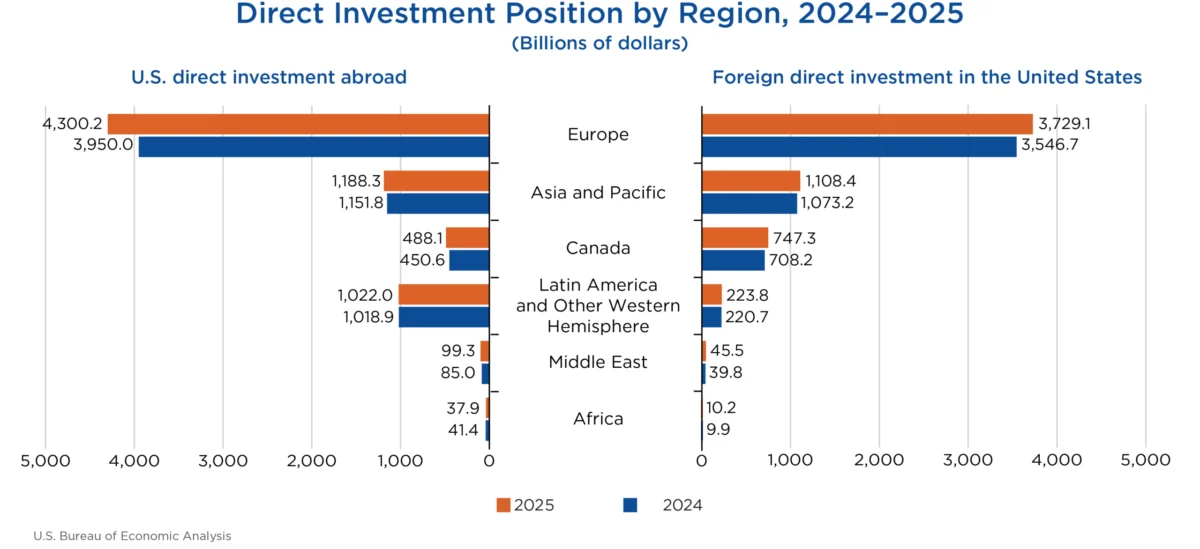
The geographic origin of this substantial investment also paints a clear picture. Japan emerged as the leading investing country in 2025, contributing $50.5 billion. Germany followed with $26.7 billion, and Canada with $23.5 billion. On a regional level, Europe was the largest contributor, injecting $116.6 billion, representing 50.2 percent of all new investment. The Asia and Pacific region followed as the second-largest investing bloc, with expenditures totaling $71.9 billion. This diverse geographical spread of investment indicates broad international confidence in the U.S. economy.
Geographically within the United States, California once again proved to be a prime destination for foreign investment, receiving the largest share of first-year investment expenditures at $59.7 billion. Texas followed with $21.5 billion, and Pennsylvania secured the third position with $20.9 billion. These states, known for their robust economies, skilled workforces, and favorable business environments, continue to attract substantial foreign capital.
Focus on Greenfield Investments: Building New Capacity
Beyond acquisitions, "greenfield" investments – those focused on establishing new U.S. businesses or expanding existing foreign-owned ones – also played a crucial role in the overall investment picture. Greenfield expenditures totaled $13.8 billion in 2025. Within this category, the transportation and warehousing sector saw the largest share of greenfield investment, with $3.6 billion. This was followed by computers and electronics products manufacturing ($2.0 billion) and chemicals manufacturing ($1.8 billion).
The Asia and Pacific region was the leading contributor to greenfield expenditures, with investors from this region committing $8.3 billion. Australia led the way within this region, investing $3.0 billion, followed by South Korea with $2.2 billion and Japan with $1.7 billion. At the state level, Louisiana attracted the highest volume of greenfield investment, with $3.0 billion, followed by Arizona ($2.7 billion) and Texas ($1.9 billion). Planned total expenditures for greenfield investments initiated in 2025, including future commitments, were substantial at $66.1 billion, signaling a strong pipeline of new business creation and expansion projects.
Employment Dynamics by Industry, Country, and State
Delving deeper into the employment figures reveals specific sectoral and geographical concentrations. In 2025, the plastics and rubber parts manufacturing sector reported the highest number of current employees within acquired enterprises, totaling 21,800. This was followed by transportation equipment manufacturing with 17,300 employees, and primary and fabricated metals manufacturing with 16,400 employees.
Examining employment by the country of the foreign investor, Mexico accounted for the largest number of current employees in foreign-owned enterprises, with 54,600 individuals. Canada followed with 29,500 employees, and the United Kingdom with 26,800. Within the United States, California once again led in terms of current employment generated by new foreign investment, with 37,200 jobs. Illinois was second with 17,600 employees, and Texas ranked third with 16,500 employees. These figures underscore the significant contribution of foreign direct investment to job creation and economic vitality across various U.S. states and industries.
Revisions to 2024 Data Highlight Growth Trajectory
The BEA also released revised figures for 2024, indicating that the previously reported investment levels were somewhat understated. First-year expenditures for new foreign direct investment in the United States in 2024 were revised upward from $151.0 billion to $155.3 billion. This revision was primarily driven by an increase in the acquisition of U.S. businesses, which rose from $143.0 billion to $146.4 billion. Similarly, planned total expenditures for 2024 were also revised upward from $157.0 billion to $164.0 billion. These revisions suggest a consistently strong and perhaps underestimated upward trend in foreign direct investment leading into 2025.
Context and Analysis of the Investment Surge
The substantial increase in foreign direct investment in 2025 can be attributed to a confluence of factors. The U.S. economy, despite facing global headwinds, has demonstrated resilience, offering a stable and attractive market for international businesses. Favorable corporate tax policies, a highly skilled workforce, robust intellectual property protections, and access to a large consumer base continue to make the United States a premier destination for foreign capital. The strong performance of the manufacturing sector, particularly in areas like chemicals and advanced materials, indicates a strategic focus by foreign investors on bolstering supply chains and production capabilities within the U.S.
The dominance of acquisitions suggests that foreign companies are leveraging existing infrastructure, market share, and established brands to expand their footprint in the U.S. This strategy often allows for quicker market penetration and immediate access to skilled labor and customer bases, compared to the longer lead times associated with establishing entirely new operations. However, the significant planned expenditures for greenfield investments also signal a commitment to building new capacity and creating new jobs, indicating a dual strategy of both acquiring existing assets and fostering organic growth.
The leading roles of Japan, Germany, and Canada in investment highlight long-standing economic ties and strategic partnerships between these nations and the United States. The significant contribution from Europe and Asia reflects the global nature of FDI and the broad appeal of the U.S. market to investors worldwide. The concentration of investment in states like California, Texas, and Pennsylvania is consistent with their status as economic powerhouses, offering critical infrastructure, technological innovation, and large consumer markets.
Implications for the U.S. Economy
The surge in foreign direct investment carries significant implications for the U.S. economy. The direct job creation of over 213,000 employees in 2025 is a tangible benefit, boosting household incomes and consumer spending. Furthermore, the inflow of capital can lead to increased productivity, technological advancements through knowledge transfer, and enhanced competitiveness in global markets. The investment in manufacturing, in particular, can help to revitalize industrial regions, strengthen domestic supply chains, and reduce reliance on foreign production for critical goods.
The BEA’s commitment to enhancing data disclosure through methods like coarsening, which involves rounding and aggregation, allows for the publication of more granular data while maintaining confidentiality for survey respondents. This transparency is crucial for policymakers, businesses, and researchers seeking to understand and leverage FDI trends.
Looking ahead, the BEA has scheduled its next release of new foreign direct investment statistics for June 2027, which will cover data for 2026. This ongoing monitoring of FDI provides a vital barometer of the U.S. economy’s attractiveness to international investors and its ongoing role in the global economic landscape. The trends observed in 2025 suggest a continued robust inflow of foreign capital, poised to contribute significantly to economic growth, innovation, and employment in the years to come.
Note: The data presented in this article are based on preliminary statistics released by the U.S. Bureau of Economic Analysis. Final figures may be subject to revision.