admin
In a significant strategic pivot reflecting the dynamic evolution of digital technology, LimeWire, a name historically synonymous with peer-to-peer file-sharing, has officially relaunched as a cutting-edge generative AI content publishing platform. This transformation positions LimeWire at the intersection of artificial intelligence, the burgeoning creator economy, and Web3 technologies, offering a novel ecosystem for digital artists and content creators to generate, share, and monetize their work. The platform aims to distinguish itself in a crowded AI tools market by integrating advanced content generation capabilities with robust blockchain-based monetization models, providing creators with a comprehensive toolkit that includes AI image creation, NFT minting, and a unique ad revenue sharing system.
From File-Sharing Legacy to AI Innovation: A Strategic Rebrand
The re-emergence of LimeWire marks one of the most unexpected yet compelling rebranding narratives in recent digital history. For over a decade, the LimeWire name was inextricably linked to the early 2000s era of digital music piracy, operating as a popular peer-to-peer file-sharing client. Its original incarnation facilitated the sharing of music, movies, and software, often without proper licensing, leading to high-profile legal battles with the recording industry. After years of litigation, a U.S. federal court injunction in 2010 ultimately forced its shutdown, concluding a chapter that profoundly influenced the development of digital rights management and content distribution.
The current iteration of LimeWire, however, bears no operational resemblance to its predecessor. Its relaunch in 2022 was meticulously planned to capitalize on emerging technological trends, particularly the explosive growth of generative AI and the increasing mainstream adoption of Web3 principles like decentralization and digital ownership. This strategic shift underscores a broader industry movement where established brands, or their intellectual property, are revitalized to address contemporary market demands and technological capabilities. The decision to retain the "LimeWire" name, despite its controversial past, is a calculated move to leverage brand recognition, albeit with the challenge of redefining its public perception entirely. This new entity is wholly separate from the original company and its legal entanglements, representing a fresh start with a forward-looking vision.
The AI Studio: A Hub for Generative Creativity
At the core of LimeWire’s new offering is its AI Studio, designed as a versatile platform for content creation. Currently, the studio primarily focuses on AI Image Generation, providing users with a sophisticated suite of tools to transform textual prompts into visual art. The platform supports several leading generative AI models, including Stable Diffusion 2.1, Stable Diffusion XL, and DALL-E 2. These models represent the vanguard of AI art generation, renowned for their ability to produce high-quality, diverse, and imaginative imagery from simple or complex text descriptions. The integration of multiple advanced models offers creators flexibility and access to different artistic styles and technical capabilities, catering to a broad spectrum of creative visions.
Users can initiate the creative process with prompts ranging from a few descriptive words to intricate, detailed instructions. This accessibility democratizes the creation of digital art, allowing individuals without traditional artistic training to produce professional-grade visuals. A key differentiator for LimeWire’s AI Studio is its seamless integration of various AI models and an extensive library of design styles. Creators can effortlessly switch between options such as cinematic, digital art, pixel art, anime, and analog film, each imparting a distinct aesthetic to the generated images. This stylistic versatility empowers users to explore a vast creative landscape, from photorealistic renditions to highly stylized illustrations, all within a single interface.
Beyond fundamental image generation, the platform incorporates advanced features like samplers, which allow users to fine-tune the quality, detail, and specific characteristics of their creations. Customization options and prompt guidance further enhance the user experience, making the platform intuitive for novices while offering depth for experienced digital artists. The commitment to innovation is further underscored by LimeWire’s ongoing development of its proprietary AI model. This future addition signals the platform’s dedication to continuously expanding its creative horizons, promising unique capabilities and enhanced performance tailored to its user base.
Empowering Creators Through Web3 Monetization
One of LimeWire’s most compelling features is its integrated Web3 monetization framework, designed to empower creators to earn revenue directly from their digital assets. This approach addresses a long-standing challenge in the creator economy: fair compensation and genuine ownership for digital content.
Automatic NFT Minting: Upon completing a creative endeavor within the LimeWire Studio, users are given the option to publish their content. A standout feature is the platform’s automated process of minting each creation as a Non-Fungible Token (NFT). This is facilitated on either the Polygon or Algorand blockchains, both chosen for their efficiency, lower transaction costs, and scalability compared to other networks. This transformative step imbues each artwork with a unique digital signature, securing its authenticity, verifiable ownership, and provenance on a decentralized ledger. NFTs have revolutionized digital ownership, allowing creators to establish scarcity and track the lineage of their work, fundamentally changing how digital art is valued and traded.
Creators maintain significant control over the accessibility of their NFT creations. They can opt for a public release, making the content discoverable by anyone within the LimeWire community and fostering broader engagement. This public visibility also opens avenues for enthusiasts and collectors to trade these NFTs on secondary markets, creating a dynamic layer of community involvement and potential financial appreciation for the original creator. Alternatively, for content intended for a more exclusive audience, creators can choose to share their posts solely with their premium subscribers. This option cultivates an intimate and personalized experience, offering dedicated fans exclusive access to specialized content. This flexibility in distribution options underscores LimeWire’s commitment to providing creators with agency over how they connect with their audience and distribute their digital creations, catering to diverse monetization strategies.
Ad Revenue Sharing: Beyond NFTs, LimeWire introduces a direct ad revenue sharing model. Creators who publish content on the platform are eligible to receive 70% of all ad revenue generated from other users viewing their images, music, and future video content. This revenue model is particularly beneficial for designers and artists who generate a high volume of engaging content. It provides a consistent, passive income stream, encouraging experimentation with AI generation tools and fostering a vibrant content ecosystem. This aligns with the broader trend of platforms seeking to offer creators more direct financial incentives, moving beyond traditional models where platforms retain the vast majority of advertising profits.
LMWR Tokens and Ecosystem: The revenue earned by creators is distributed in the form of LMWR tokens, LimeWire’s native cryptocurrency. Earnings are paid out monthly, and creators can then trade their LMWR tokens on various popular crypto exchange platforms such as Kraken, ByBit, and UniSwap. This integration into the wider cryptocurrency ecosystem provides liquidity and utility for the tokens. Furthermore, LMWR tokens can be used within the LimeWire platform to pay for prompts when utilizing its generative AI tools, creating a circular economy that incentivizes both creation and engagement. The use of a native token reinforces the platform’s Web3 ethos, providing a decentralized medium of exchange and value transfer.
Artist Endorsements and Future Expansion:
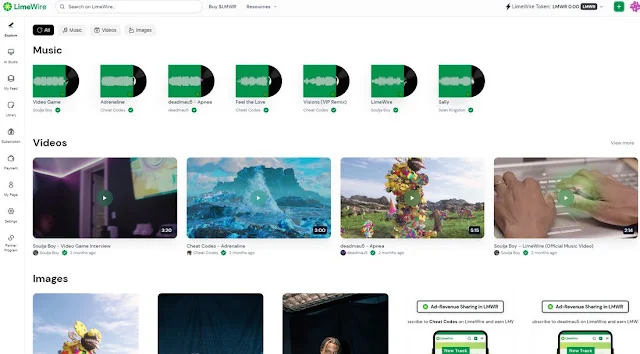
The appeal of LimeWire’s new model has already attracted significant attention from established figures in the music industry. Acclaimed artists and musicians, including Deadmau5, Soulja Boy, and Sean Kingston, have embraced the platform to publish their content, notably in the form of NFT music, videos, and images. Their involvement serves as a powerful endorsement, lending credibility to LimeWire’s Web3 ambitions and demonstrating the potential for mainstream artist adoption of blockchain-based content distribution.
Looking ahead, LimeWire has ambitious plans to broaden its offerings beyond AI image generation. The platform intends to introduce AI music and video generation tools in the near future. This strategic expansion is poised to unlock even more avenues for creative expression and audience engagement, positioning LimeWire Studio as a dynamic and evolving platform within the rapidly expanding realm of AI-powered content creation. The market for AI-generated music and video is nascent but growing rapidly, with projections indicating significant disruption across media industries. By integrating these capabilities, LimeWire aims to become a comprehensive multimedia AI creation hub.
Pricing Structure and Accessibility
LimeWire adopts a tiered pricing model designed to cater to a broad spectrum of users, from casual experimenters to professional creators, while also offering a free entry point.
Free Tier: Users can sign up for free and receive 10 credits, allowing them to generate up to 20 AI images per day. This tier also grants a 50% share of ad revenue, providing a tangible incentive for new users to explore the platform’s capabilities and begin monetizing their early creations. The free tier serves as an excellent onboarding mechanism, lowering the barrier to entry for generative AI art and Web3 monetization.
Premium Plans: For creators seeking more extensive capabilities and enhanced benefits, LimeWire offers several premium subscription tiers:
- Basic Plan ($9.99/month): Includes 1,000 credits per month, allowing for up to 2,000 image generations, early access to new AI models, and a 50% ad revenue share.
- Pro Plan ($29/month): Provides 3,750 credits per month, up to 7,500 image generations, early access to new AI models, and a 60% ad revenue share.
- Elite Plan ($49/month): Offers 5,000 credits per month, up to 10,000 image generations, early access to new AI models, and a 70% ad revenue share.
- Ultimate Plan ($99/month): The highest tier, offering 11,250 credits per month, up to 22,500 image generations, early access to new AI models, and a 70% ad revenue share.
All premium plans come with additional benefits designed to enhance the professional creator experience, including a Pro profile badge, full creation history access, faster image generation speeds, and an ad-free experience. This structured pricing strategy balances accessibility with the provision of advanced features and higher earning potential for dedicated users, aligning with typical SaaS models in the creative software space.
Broader Implications and Market Context
LimeWire’s strategic pivot and integrated model carry significant implications for the creator economy, the generative AI market, and the broader adoption of Web3 technologies.
Democratization of Creativity: By combining user-friendly AI tools with straightforward monetization mechanisms, LimeWire is poised to further democratize the creative process. It removes traditional barriers to entry for artists, designers, and musicians, enabling individuals without extensive technical skills or resources to produce, publish, and potentially profit from high-quality digital content. This aligns with the overarching goal of the creator economy to empower individual talent.
Shifting Creator Economy Paradigms: The platform represents a tangible example of how the creator economy is evolving beyond traditional advertising and subscription models. By integrating NFTs and direct ad revenue sharing, LimeWire offers a more robust and equitable value proposition for creators, allowing them to truly own their creations and participate more directly in the value generated by their content. This could inspire other platforms to adopt similar Web3-centric models.
Challenges and Opportunities: Despite its innovative approach, LimeWire faces several challenges. The generative AI market is intensely competitive, with numerous established and emerging players. Differentiating itself and attracting a critical mass of users will be crucial. Furthermore, the ethical and legal landscape surrounding AI-generated content, particularly concerning copyright, intellectual property, and data provenance, remains complex and evolving. LimeWire, like all platforms operating in this space, will need to navigate these issues carefully. The inherent volatility and regulatory uncertainty of the cryptocurrency market also present risks for the LMWR token and NFT ecosystem, although the choice of established blockchains like Polygon and Algorand mitigates some of these concerns.
However, the opportunities are substantial. The market for generative AI is projected to grow exponentially, with significant investment flowing into tools that automate and enhance creative processes. The global creator economy is valued in the hundreds of billions of dollars, continually seeking new avenues for growth and monetization. By combining these powerful trends, LimeWire has positioned itself to capture a significant share of this evolving digital landscape. The endorsement of celebrity artists further validates its potential to bridge the gap between mainstream content creation and Web3 innovation.
Conclusion
LimeWire’s re-emergence as a generative AI content publishing platform represents a bold and calculated move into the future of digital creation and ownership. By shedding its controversial past and embracing the transformative power of artificial intelligence and Web3 technologies, the platform is poised to become a significant player in the evolving creator economy. Its integrated approach, offering sophisticated AI image generation, automated NFT minting, a compelling ad revenue sharing model, and a native cryptocurrency, provides a comprehensive and attractive ecosystem for digital artists and content creators.
As LimeWire continues to innovate with the development of its proprietary AI model and the planned expansion into AI music and video generation, it stands as a testament to the dynamic nature of the digital realm. It offers a glimpse into a future where anyone can unleash their artistic potential, own their creations, and earn revenue with unprecedented ease. For creators eager to explore the frontiers of generative art and Web3 monetization, LimeWire provides an accessible and forward-thinking platform, promising a future brimming with creative potential and endless artistic exploration.