
 Layla Zulfa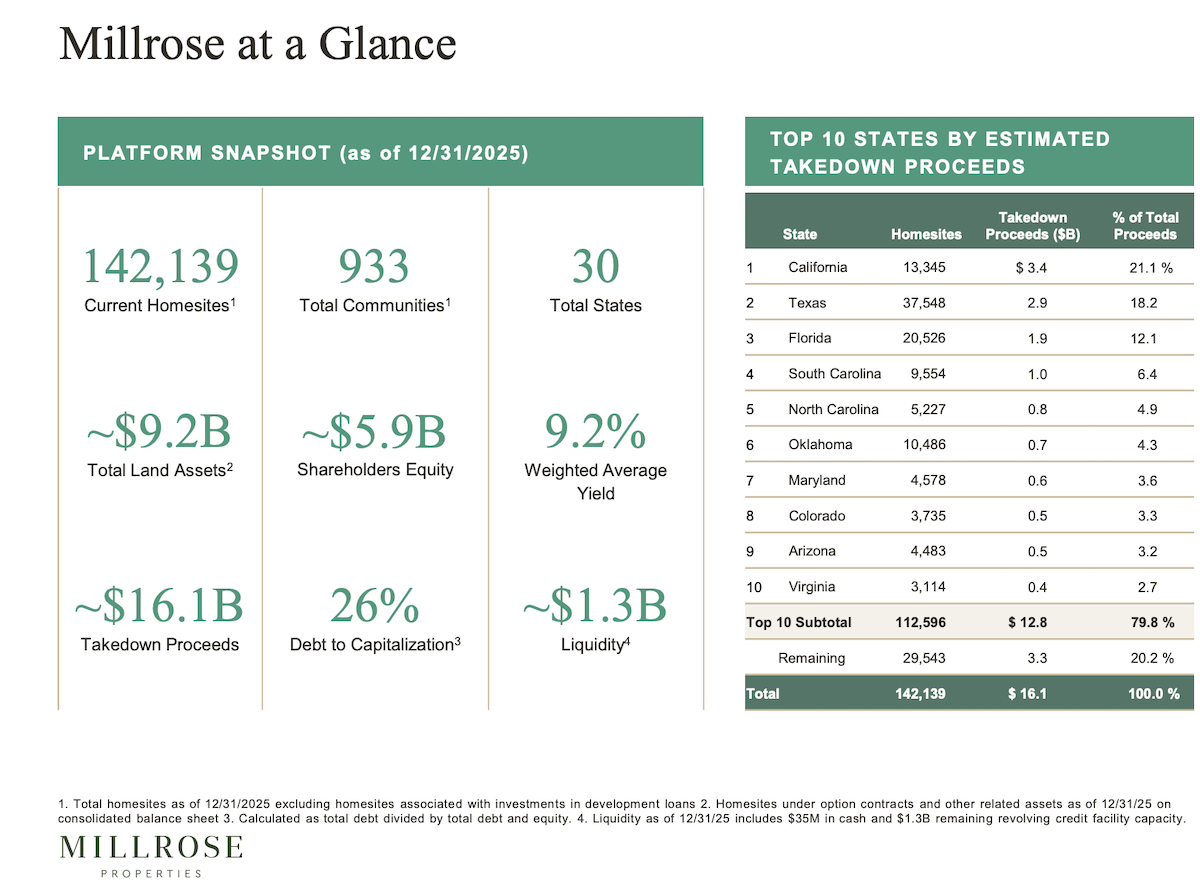
The 2025 homebuilding market, characterized by a pronounced slowdown in new construction, led to a wave of contract cancellations and diminished takedown activity across the industry. In stark contrast to this prevailing trend, Millrose Properties, a firm that redefined land banking and asset-light homebuilding development with its ambitious launch in early 2025, not only weathered the storm but also demonstrated robust growth. Emerging from its spin-off from Lennar in December 2024, Millrose has consistently expanded its revenue, a testament to its strategic deployment of capital and the cultivation of a diverse network of homebuilder partnerships that extend well beyond its foundational relationship with Lennar.
Despite facing significant headwinds, including a national decline in new home starts estimated at approximately 7.0% for the preceding year, Millrose reported an unblemished record in 2025: not a single builder terminated a contract. This achievement stands out against a backdrop where many developers opted to reduce their lot exposure to bolster margins and enhance liquidity. Millrose, in its inaugural year as an independent entity, attributed its success to a combination of sophisticated risk management strategies and a deliberate, yet consistent, expansion of its partnership base.
"2025 was not an easy year for the home building industry, and that is precisely what made it such a meaningful proof point for Millrose," stated CEO and President Darren Richman during a Q4 2025 earnings call. "2025 proved the model. 2026 is where we intend to begin showing its full potential." This sentiment underscores the company’s confidence in its innovative approach, which it believes is poised for even greater impact in the coming year.
The Millrose Model: A Strategic Approach to Land Banking and Risk Mitigation
At its core, Millrose Properties operates on a model that involves acquiring, retaining, and developing residential land. This approach allows homebuilders to secure the rights to develop homesites through option agreements, a departure from the traditional method of outright land purchase. This "land-light" strategy empowers builders with greater flexibility and a more capital-efficient operational framework. Under these agreements, builders pay option fees to reserve the right to acquire completed homesites according to a predetermined schedule. This structure enables them to strategically expand their land positions while simultaneously managing their debt and capital expenditure commitments.
A cornerstone of Millrose’s resilience in the face of market volatility lies in its sophisticated risk mitigation techniques. The company structures its agreements with substantial deposits and implements a unique "cross-termination pooling mechanism." This mechanism aggregates multiple land agreements with a builder into a single pool. Consequently, if a builder opts to cancel an agreement for one property, it can trigger penalties or forfeiture of deposits across the entire pool of associated properties. This integrated risk management framework, which effectively covers nearly all of Millrose’s investment balance, has been instrumental in preventing partner defaults, even within a challenging market environment.
"It does not prevent a builder from walking away from an option contract," explained Robert Nitkin, Millrose’s COO. "What it does is raise the cost of doing so, creating a meaningful economic disincentive that protects the integrity of the relationship without eliminating the builder’s optionality." This approach balances the need for partner flexibility with robust financial safeguards.
Furthermore, Millrose emphasizes the strategic geographic diversification of its portfolio. With a presence spanning 30 states and encompassing 933 communities, the company mitigates dependency on the performance of any single market or region. This widespread footprint ensures that fluctuations in one area are less likely to have a disproportionate impact on the overall business.
Complementing its diverse portfolio, Millrose maintains a proprietary data set derived from its extensive deal flow, transaction history, and builder sales reports. This data-driven approach enhances due diligence processes and informs strategic decision-making. The confluence of speed in execution, reliable capital provision, and close collaboration with builders provides Millrose with a distinct advantage in closing and executing deals, according to company executives.
Cultivating Strategic Partnerships: Beyond the Lennar Foundation
Following its separation from Lennar, Millrose established the Lennar Master Program. This foundational agreement allows Millrose to acquire land and subsequently grant Lennar options to purchase homesites on these acquired properties. As of December 2025, the Lennar Master Program represented a significant asset base for Millrose, with $6.5 billion in homesite inventory and a capital balance of $6.1 billion. However, the company has proactively pursued further diversification.
Beyond the Lennar Master Program, Millrose’s "Invested Capital" segment, operating separately, concluded 2025 with approximately $2.4 billion. The company has projected a substantial increase in this figure, anticipating an additional $2 billion in deployment during 2026. This strategic expansion has fueled a growth in the number of Millrose’s homebuilding counterparties. Between the third and fourth quarters of 2025, the number of partnerships increased from 12 to 15. Despite this expansion, Millrose maintains a highly selective approach to onboarding new partners.

Nitkin elaborated on the criteria for partnership: "We partner with homebuilders seeking capital efficiency, not risk mitigation. This is because Millrose’s business model is built to optimize capital deployment, not to insulate builders from market risk." By aligning with builders whose strategic objectives mirror Millrose’s focus on capital efficiency, the company increases the likelihood of stable, long-term relationships where partners are less inclined to withdraw from contractual obligations.
The cross-termination pooling structure also serves as a crucial mechanism for identifying and vetting potential partners. Nitkin described this protocol as a "relationship-defining mechanism," capable of identifying builders who are genuinely aligned with Millrose’s operational philosophy. "These are builders who understand our model, embrace the off-balance sheet structure and are committed to a long-term programmatic relationship," he added.
In the past, executives have highlighted collaborations with entities like Taylor Morrison’s Yardly BTR brand as exemplary of the type of builder Millrose seeks to partner with, underscoring a preference for innovative and forward-thinking homebuilding operations.
A Vision for Future Growth: Strategic Expansion and Financial Prudence
Millrose’s projected $2 billion investment outside the Lennar Master Program in 2026 is set to elevate the company’s total invested capital to over $10 billion. Notably, approximately 40% of this capital will be dedicated to partnerships outside of the Lennar agreement. This strategic growth, however, is being pursued with a deliberate and selective approach.
"We are being selective, but the pipeline gives us the luxury of that selectivity, and we are confident in the quality of what we are choosing to pursue," Nitkin affirmed. This disciplined growth strategy aims to ensure that every new partnership and investment contributes meaningfully to the company’s long-term objectives.
Financially, Millrose maintains a conservative leverage profile. Its current debt-to-capitalization ratio stands at approximately 26%. While this ratio may increase as the company expands, executives have set a clear target to maintain debt levels within a maximum debt-to-capitalization ratio of 33%.
"The reason why we set it at that conservative level is that these are still volatile assets," Richman explained. "The reality is that we cycle through about a third of our balance sheet in the ordinary course of business every year. Having that visibility and that cash in the ordinary course to be able to pay down our debt or neutralize the debt with cash on the balance sheet is just a very important asset for this company." This prudent financial management is designed to provide stability and flexibility, even amidst market fluctuations.
Millrose’s forward-flow agreements with homebuilders, currently totaling around $9 billion, offer significant pipeline visibility and facilitate recurring land purchases rather than relying on ad-hoc transactions. Over the next year, approximately $3 billion of this portfolio is slated to cycle out. These existing forward-flow commitments are crucial for replacing those assets and supporting the company’s $2 billion growth projection for 2026, even in the absence of securing new homebuilding partners. This demonstrates a built-in growth mechanism that provides a degree of predictability.
A Testament to Resilience in a Shifting Market
The macroeconomic shifts experienced throughout 2025 undoubtedly impacted all participants in the homebuilding sector. Nevertheless, Millrose Properties concluded the year on a notably strong note, reporting another positive quarter in Q4. The company’s ability to maintain contractual integrity with its builder partners—evidenced by zero contract terminations in 2025—coupled with its ongoing capital deployment and diversification beyond its initial Lennar partnership, highlights a remarkable level of operational resilience.
The financial and operational performance of Millrose in Q4 and throughout 2025 serves as a compelling case study in how disciplined capital allocation, astute underwriting, and carefully selected partnerships can yield significant rewards, even in a volatile market. At its core, Millrose’s success appears to be driven by an unwavering belief in the value proposition it offers to homebuilders and a commitment to delivering that service with unparalleled precision and efficiency. This strategic focus positions Millrose as a key player in navigating the complexities of the modern homebuilding landscape, demonstrating that innovation and strategic foresight can indeed chart a path to success even when market conditions prove challenging.