Candice Horbacz
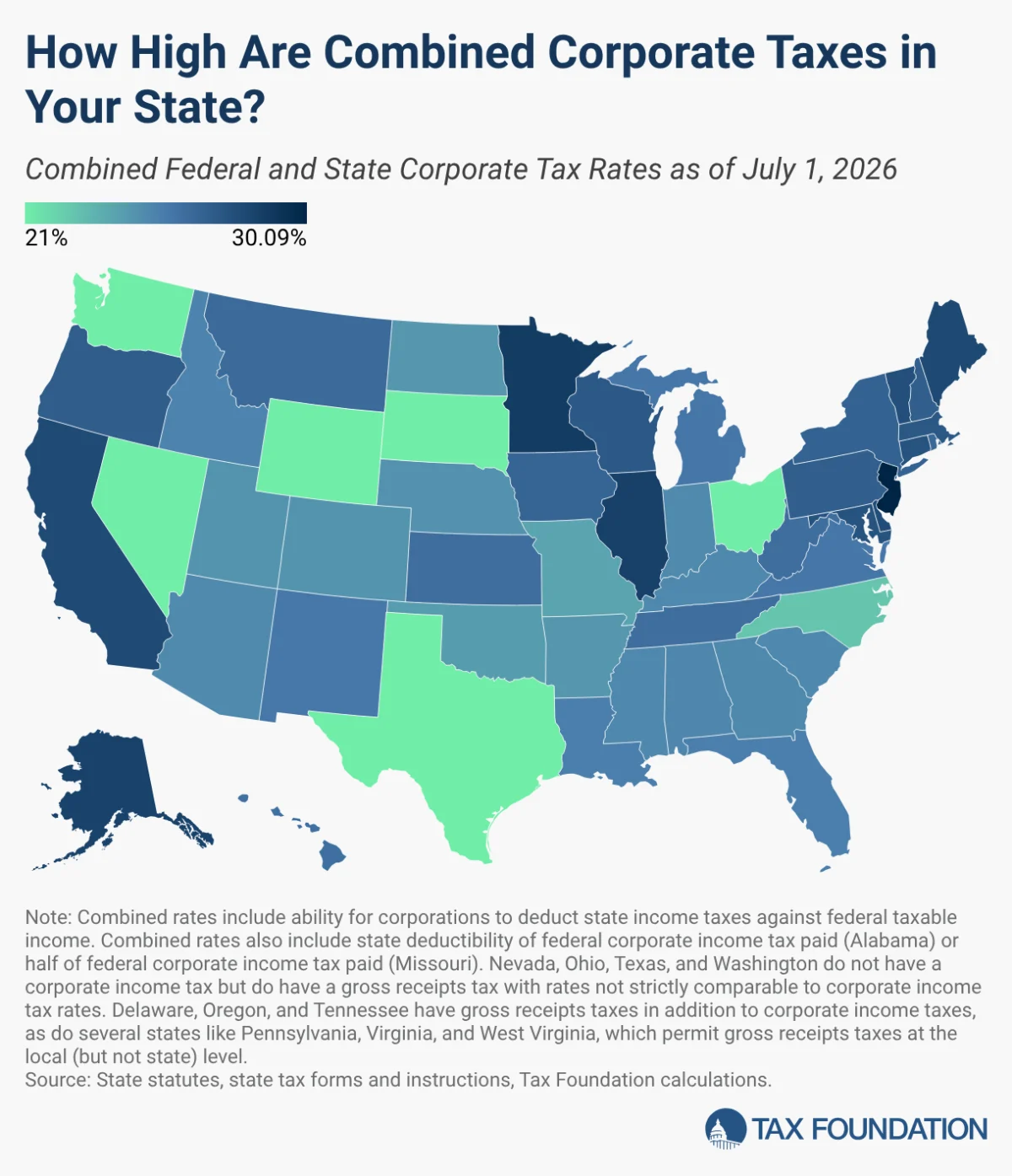
Corporations operating within the United States confront a multi-layered tax system, comprising both a federal corporate income tax and a diverse array of state-level levies. At the federal level, businesses are subject to a statutory corporate income tax rate of 21 percent, a rate established by the Tax Cuts and Jobs Act (TCJA) of 2017. However, this federal rate represents only a portion of the total tax burden, as 44 states and the District of Columbia impose their own taxes on corporate income, leading to a complex and often varied fiscal environment for businesses across the nation.
The landscape of state corporate income taxation is characterized by significant divergence in rates and structures. Top marginal rates among these states span a wide spectrum, from a low of 2.0 percent in North Carolina to a high of 11.5 percent in New Jersey. This disparity is further complicated by the different approaches states take to calculating corporate tax liability. Thirteen states employ graduated corporate income tax rates, meaning the tax rate increases as a corporation’s income rises, a system often designed to introduce an element of progressivity or to ease the burden on smaller businesses. In contrast, 31 states and the District of Columbia opt for a flat rate on corporate income, providing a more predictable and uniform tax calculation for all corporations within their borders, regardless of their profit levels.
The Foundation: Federal Corporate Income Tax
The federal corporate income tax is a cornerstone of the U.S. revenue system, levied on the profits of corporations. Prior to the TCJA of 2017, the federal corporate tax rate stood at 35 percent, one of the highest among developed nations. The significant reduction to 21 percent was enacted with the stated goals of enhancing American corporate competitiveness on the global stage, encouraging domestic investment, and simplifying the tax code. This reduction was a pivotal moment in U.S. tax policy, intended to incentivize businesses to retain profits and operations within the country, rather than seeking lower tax jurisdictions abroad. The tax is applied to a corporation’s "taxable income," which is calculated after accounting for various deductions and exemptions from its gross income. The revenue generated from this tax contributes substantially to federal programs and services, playing a critical role in the nation’s fiscal health.
State-Level Variations: A Mosaic of Rates and Structures
The variability in state corporate tax policies creates a dynamic environment for businesses, influencing location decisions and investment strategies. States like North Carolina, with its 2.0 percent top marginal rate, present a relatively low-tax environment for corporate income, aiming to attract businesses and stimulate economic growth. This contrasts sharply with states such as New Jersey, which imposes an 11.5 percent top marginal rate, making it one of the highest state corporate income tax jurisdictions. The rationale behind these differing approaches often reflects a state’s unique economic priorities, revenue needs, and political philosophies.
Beyond the numerical rates, the structure of these taxes also varies significantly. States employing graduated rates, such as Iowa, Kentucky, and Louisiana, typically segment corporate profits into different brackets, applying progressively higher rates as income increases. For example, a corporation might pay 2% on its first $50,000 of profit, 4% on the next $100,000, and so on, up to a maximum rate. This approach is often championed as a way to ensure that larger, more profitable corporations contribute a proportionally greater share to state revenues, while potentially offering a break to smaller enterprises.
Conversely, the majority of states, including populous ones like California, Florida, and New York, opt for a flat rate system. In these states, all corporate profits exceeding certain thresholds are taxed at a single, uniform rate. This method is often favored for its simplicity and predictability, allowing businesses to more easily forecast their tax liabilities. Proponents argue that flat rates reduce administrative burdens for both taxpayers and tax authorities and can create a more neutral tax environment that doesn’t inadvertently penalize growth.
Alternative Taxation: The Role of Gross Receipts Taxes
In addition to traditional corporate income taxes, several states employ alternative or supplementary forms of business taxation, most notably gross receipts taxes (GRTs). Unlike a corporate income tax, which targets net profits after expenses, a gross receipts tax is levied on a company’s total sales or revenue, without deductions for business expenses such as compensation, costs of goods sold, or overhead. This fundamental difference has profound implications for businesses, as it means a company can owe GRT even if it is operating at a loss.
Four states—Nevada, Ohio, Texas, and Washington—have entirely eschewed corporate income taxes in favor of statewide gross receipts taxes. For instance, Washington State’s Business & Occupation (B&O) tax is a prominent example of a GRT, applied at varying rates depending on the business activity. These states often justify their reliance on GRTs by citing their stability and broad base, making them less susceptible to economic downturns that might reduce corporate profits. However, economists widely criticize GRTs due to a phenomenon known as "tax pyramiding." This occurs because the tax is assessed at every stage of the production process, from raw materials to manufacturing to wholesale and retail. Each time a good or service is sold, the GRT is applied, and these accumulated taxes are often passed on to the final consumer in the form of higher prices. This lack of transparency and distortion of economic activity makes GRTs generally less favored by tax policy experts compared to income-based taxes.
Adding another layer of complexity, three states—Delaware, Oregon, and Tennessee—impose both a corporate income tax and a separate levy on gross receipts. For example, Tennessee has both a corporate excise tax (an income tax) and a franchise tax (based on net worth or property), while also imposing a business license tax which functions similarly to a gross receipts tax at the local level. These hybrid systems aim to diversify revenue streams, ensuring a broader base for taxation. Furthermore, Pennsylvania, Virginia, and West Virginia levy gross receipts taxes specifically at the local level, adding a municipal or county layer of taxation that can vary significantly even within a single state. This localized approach can create additional administrative burdens for businesses operating across different jurisdictions within these states.
States Offering a Tax Haven: No Corporate Income or Gross Receipts Tax
A select few states stand out by imposing neither a corporate income tax nor a statewide gross receipts tax. South Dakota and Wyoming are unique in this regard, offering businesses a significant advantage by not levying either of these major corporate taxes. These states typically rely on other revenue sources, such as sales taxes, property taxes, severance taxes (on natural resources), and individual income taxes (where applicable, though Wyoming has none and South Dakota only on interest and dividends), to fund public services. This approach positions them as highly attractive destinations for businesses seeking to minimize their state-level tax burden, potentially fostering a more robust business climate and attracting capital investment. The absence of these taxes can be a powerful incentive for corporate relocation and expansion, driving economic development in these states.
The True Cost: Combined Federal and State Tax Rates
Understanding the full tax burden on a corporation requires considering the combined effect of federal and state taxes. New Jersey, with its high state corporate income tax rate, also holds the distinction of having the highest combined corporate income tax rate in the nation, reaching an estimated 30.1 percent. This figure includes the federal 21 percent rate, highlighting the significant impact state policies can have on a company’s overall tax liability.
Other states where corporations face substantial combined rates at or above 28 percent include Alaska, Illinois, Maine, and Minnesota. For instance, Illinois imposes a corporate income tax rate of 9.5 percent (7% corporate income tax + 2.5% personal property replacement tax), which, when combined with the federal rate, places it among the highest taxing states. These higher combined rates can potentially influence businesses to seek opportunities in lower-tax states, impacting economic development and employment.
Conversely, six states—Ohio, Nevada, South Dakota, Texas, Washington, and Wyoming—effectively levy no state corporate income tax. Consequently, corporations in these states are subject only to the federal tax rate of 21 percent on their income. It is crucial to remember, however, that four of these states (Ohio, Nevada, Texas, Washington) impose statewide gross receipts taxes, meaning businesses in these locations still face a significant state-level tax burden, albeit one structured differently than an income tax. South Dakota and Wyoming remain the only two states that truly levy neither a corporate income tax nor a statewide gross receipts tax, offering the lowest income-based tax burden for corporations.
The Nuances of Deductibility: Lowering Effective Rates
The interaction between federal and state tax systems is further complicated by various deductibility provisions, which can significantly alter a corporation’s effective tax rate. One of the most common and impactful mechanisms is the deductibility of state corporate income taxes paid against federal taxable income. This provision allows corporations to subtract the amount of state corporate income tax they paid from their income before calculating their federal tax liability.
For example, consider a corporation operating in Rhode Island, which levies a flat corporate income tax rate of 7 percent. If this corporation pays $70,000 in state taxes on $1,000,000 of state taxable income, it can deduct this $70,000 from its federal taxable income. This reduces the base on which the 21 percent federal tax is applied. Assuming the same $1,000,000 federal taxable income before state tax deduction, the corporation would effectively pay federal tax on $930,000 ($1,000,000 – $70,000). The federal tax would then be $930,000 0.21 = $195,300. This translates to an effective* federal rate of 19.53 percent ($195,300 / $1,000,000), rather than the statutory 21 percent. When combined with the 7 percent state rate, the total effective combined rate becomes 26.53 percent ($70,000 state tax + $195,300 federal tax / $1,000,000 initial taxable income). This mechanism effectively shares a portion of the state tax burden with the federal government, lowering the net cost for businesses.
Adding another layer of complexity, two states allow corporations to deduct federal corporate income tax against some portion of their state corporate income tax liability. Alabama permits full deductibility of federal corporate income tax liability against its state liability. This means that if an Alabama corporation owes $210,000 in federal tax on $1,000,000 of income, it can deduct this $210,000 from its income before calculating its Alabama state tax. This significantly reduces the effective state tax rate. Similarly, Missouri permits a 50 percent deduction of federal corporate income tax liability against its state tax. These provisions aim to mitigate the effect of "double taxation" (taxation by both federal and state governments on the same income) and can provide a substantial benefit to corporations operating in these states, further lowering their overall effective tax rates.
Considering all these factors, including the states that impose no corporate income taxes, the average combined state and federal corporate income tax rate across the U.S. stands at approximately 25.5 percent. This average, however, masks the significant variations and complexities that individual businesses face depending on their specific location and operational structure.
Economic Implications and the Drive for Reform
The structure and level of corporate taxes are not merely accounting exercises; they carry significant economic implications. Economists widely consider corporate income taxes to be among the most economically damaging ways to raise government revenue. This assessment stems from several factors:
- Discouragement of Investment: High corporate tax rates can reduce the after-tax return on investment, making it less attractive for businesses to invest in new equipment, research and development, or expansion projects. This can slow down capital formation and innovation.
- Impact on Job Creation: Reduced investment often translates into slower job growth, as businesses are less inclined to expand their workforce when profit margins are squeezed by taxation.
- Capital Flight and Business Relocation: Companies may choose to relocate or expand in states or even countries with lower corporate tax burdens, leading to a loss of economic activity and jobs in higher-tax jurisdictions.
- Burden on Workers and Consumers: While levied on corporations, the economic incidence of corporate taxes can fall on workers (through lower wages), consumers (through higher prices for goods and services), and shareholders (through lower dividends or stock values). This "shifting" of the tax burden means the true cost is often borne by individuals rather than just the corporate entity itself.
Given these economic effects, corporate tax reform remains a promising area for states to enhance their competitiveness and foster economic growth. Simplifying tax codes, lowering statutory rates, and reconsidering the reliance on economically distorting taxes like gross receipts taxes can create a more favorable environment for businesses. Such reforms can attract new companies, encourage existing ones to expand, and ultimately lead to job creation and increased prosperity for residents. The ongoing debate around corporate taxation reflects a continuous effort to balance the need for government revenue with the imperative to promote a robust and dynamic economy.
As organizations like the Tax Foundation continue to analyze and publish data on these complex systems, policymakers are better equipped to make informed decisions that shape the future of business and economic development across the United States. The intricate web of federal and state corporate taxes underscores the importance of a comprehensive understanding for businesses, investors, and citizens alike.