Candice Horbacz
The intricate relationship between escalating tax rates and the proliferation of illicit markets continues to shape the landscape of cigarette consumption across the United States. A recent comprehensive report for 2024, compiled in partnership with scholars at the Mackinac Center for Public Policy, underscores a persistent trend: higher cigarette taxes strongly incentivize tax avoidance, leading to a surge in cross-border shopping and the expansion of black and gray markets. This phenomenon, where consumers and suppliers actively seek avenues to circumvent steep costs, has transformed cigarette smuggling into both a pervasive national challenge and a highly profitable criminal enterprise. The report highlights that growing disparities in state-level cigarette taxes are a primary driver of this illicit trade, costing states billions in foregone revenue annually.
Key Findings from the 2024 Report
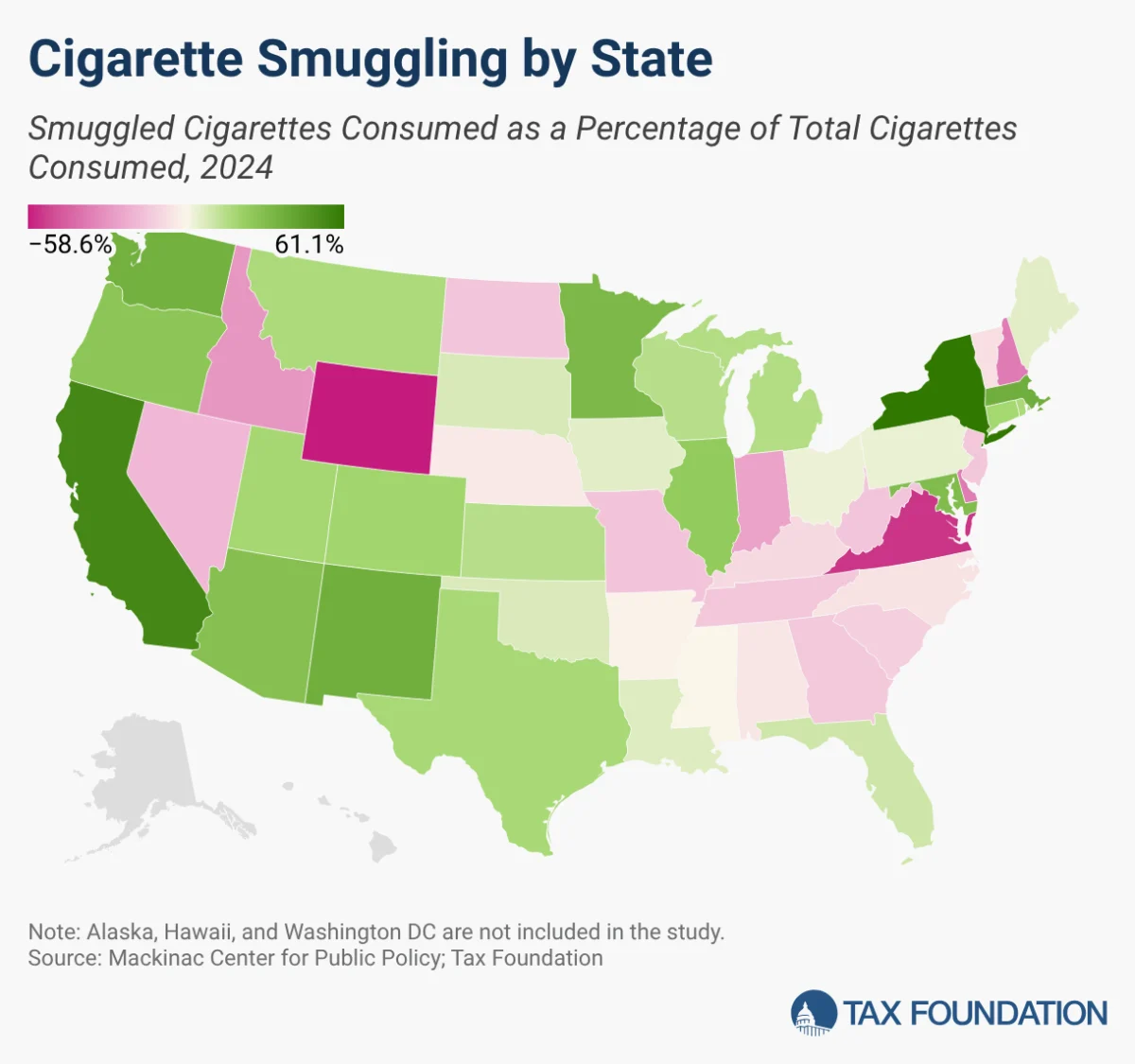
For the current reporting period, New York has re-established its position as the undisputed leader in cigarette smuggling nationwide, reclaiming the top spot after briefly being surpassed by California in the previous year. A staggering 61.1 percent of all cigarettes consumed within New York State are estimated to have been acquired through illegal channels, meaning they were not purchased legally within the state’s taxed market. This figure represents a critical concern for New York’s fiscal health and public safety. California closely follows, with an estimated smuggling rate of 54.4 percent, indicating that over half of its cigarette consumption also bypasses legal purchasing channels. These high rates in densely populated states with some of the nation’s highest excise taxes underscore the significant economic incentives driving illicit trade.
Conversely, states with significantly lower tax rates experience what is termed "net outbound smuggling." These are jurisdictions where cigarettes are purchased legally within the state and subsequently transported for consumption elsewhere, primarily in neighboring states with higher taxes. Wyoming leads this category, with an estimated 58.6 percent net outbound smuggling rate, effectively acting as a net exporter of legal cigarettes. Virginia ranks second, with a 54.4 percent net outbound rate. Both Wyoming and Virginia are strategically positioned to attract cross-border shoppers from nearby states and metropolitan areas, such as Colorado and Washington D.C., which impose much higher cigarette taxes. This dynamic creates a complex web of interstate commerce, both legal and illicit, driven by tax differentials.
The Economic Drivers of Illicit Trade: A Chronology of Policy and Consequence
The economic principle at play is straightforward: as the price of a good increases due to taxation, consumers become more sensitive to price differences and seek cheaper alternatives. For cigarettes, this often means purchasing from states with lower taxes or turning to unregulated illicit markets. This dynamic is not new; it mirrors historical patterns seen during Prohibition, where attempts to ban alcohol led directly to the rise of sophisticated criminal organizations and widespread illicit production and distribution. Over the past few decades, as states increasingly turned to tobacco excise taxes as a means of both revenue generation and public health deterrence, the problem of smuggling has steadily intensified.
Annual reports, like those produced in collaboration with the Mackinac Center for Public Policy, have consistently tracked this trend. Data from previous years, including the 2022 report, have demonstrated a robust positive correlation between rising cigarette tax rates and corresponding increases in smuggling activity. When states like New York or California implement significant tax hikes, the immediate and foreseeable consequence is an expansion of both cross-border legal purchases and outright illicit trade. This consistent trend forms a critical feedback loop: higher taxes aim to reduce smoking and generate revenue, but they also inadvertently create a lucrative environment for criminal enterprises, thereby undermining the very goals they seek to achieve.
State-Specific Data and Revenue Implications
The financial toll of cigarette smuggling on state treasuries is substantial. The 2024 estimates indicate that the total forgone revenue from smuggled cigarettes across the continental U.S. exceeded $4.6 billion. This staggering sum represents a significant loss of potential funding for public services and programs. California, with its high tax rate of $2.87 per pack, faced the largest financial hit, losing nearly $1.4 billion in cigarette excise tax collections due to illicit trade. New York, with a tax rate of $5.35 per pack – one of the highest in the nation – was not far behind, missing out on over $1.2 billion in revenue. These figures highlight the immense fiscal pressure high-tax states face from smuggling.
Conversely, states like Virginia and Indiana are significant beneficiaries of the tax differential phenomenon. Virginia, with its comparatively low tax of $0.60 per pack, netted over $61 million in smuggling-related cigarette tax revenue, primarily from sales to out-of-state consumers. Indiana, with a tax rate of $0.995 per pack, was the second-largest beneficiary, generating nearly $57 million from net inbound smuggling. These states, often strategically located near high-tax jurisdictions, effectively capitalize on the price sensitivity of consumers seeking to avoid higher costs elsewhere.
Beyond the top and bottom states, the report provides a detailed breakdown of smuggling rates and foregone revenues for each continental U.S. state. For example:
- Massachusetts ($3.51 tax) experienced a 37.86% smuggling rate, losing over $190 million.
- Maryland ($3.75 tax) saw a 31.69% smuggling rate, with $160 million in forgone revenue.
- Minnesota ($3.779 tax) had a 33.34% smuggling rate, losing over $195 million.
- Texas ($1.41 tax) registered a 19.10% smuggling rate, resulting in over $211 million in lost revenue.
- Illinois ($2.98 tax) had a 25.20% smuggling rate, losing over $220 million.
These figures underscore that while New York and California lead, many other states are also grappling with substantial revenue losses due to illicit cigarette trade. States with negative smuggling rates, such as Delaware (-35.66%), New Hampshire (-35.89%), and Missouri (-14.13%), indicate a net inflow of legally purchased cigarettes, contributing positively to their tax coffers.
Broader Implications: Public Health and Law Enforcement Challenges
The ramifications of widespread cigarette smuggling extend far beyond lost tax revenue. Public health officials consistently raise concerns about the unregulated nature of illicit tobacco products. Counterfeit cigarettes, often sourced internationally from countries like China where an estimated 400 billion units are produced annually, frequently contain toxic heavy metals, pesticides, and other harmful contaminants not found in legally regulated products. These substances pose additional, severe health risks to consumers who are often unaware of the provenance or contents of what they are smoking. The proliferation of such dangerous products undermines public health efforts aimed at reducing tobacco-related illnesses, as consumers are exposed to even less safe alternatives.
Law enforcement agencies also face immense challenges in combating sophisticated, large-scale smuggling operations. These illicit networks are often highly organized, leveraging complex supply chains to transport vast quantities of untaxed cigarettes across state and international borders. Many of the billions of dollars generated by international cigarette smuggling have been linked to broader criminal activities, including terrorism financing, adding a critical national security dimension to the problem. Anti-smuggling task forces, comprising state and federal agents, routinely seize millions of dollars worth of contraband cigarettes. However, these seizures often represent a mere fraction of the overall market. For instance, a recent multi-agency investigation in New York led to the seizure of approximately 43,700 packs of untaxed cigarettes, a significant bust in its own right, yet this amounted to only 0.019 percent of the state’s estimated annual smuggling activity. This stark disparity illustrates the monumental task facing law enforcement in curtailing these operations.
The Impact of Regulatory Bans: Menthol and Flavor Restrictions
Beyond excise taxes, excessive regulations, particularly flavor bans, have emerged as another significant driver of illicit cigarette trade. States like California and Massachusetts, which have implemented menthol and other flavored tobacco product bans, tend to exhibit particularly high rates of smuggling. The rationale behind these bans is typically to reduce youth initiation and promote public health. However, evidence suggests that these bans do not necessarily reduce overall tobacco consumption but instead push consumers to seek prohibited products in neighboring states or through illicit channels.
Massachusetts’s flavor ban, for example, has been extensively analyzed for its impact on state tobacco revenue and smuggling rates. Similarly, California’s flavor ban continues to cost the state hundreds of millions of dollars annually in lost tax revenue, a consequence that was predicted by analysts. Despite these significant financial losses, smoking behavior in these states has largely remained unchanged, with the void in legal sales being filled by illicit, untaxed products. This mirrors the lessons learned from alcohol Prohibition in the 1920s: consumers who desire prohibited products will find ways to acquire them, often at greater risk to their health and with financial benefits accruing to organized crime. Flavor bans, nicotine bans, or effective bans resulting from FDA inaction collectively burden consumers with fewer safe choices, harm legitimate domestic businesses, and deplete state tax revenues while simultaneously increasing enforcement costs.
Emerging Challenges in the Vaping Market
The lessons learned from cigarette taxation and prohibition are now increasingly relevant to the evolving vaping market. Illicit markets for tax avoidance and smuggling are becoming a prominent issue in the vaping sector as well. As states and the federal government grapple with how to regulate e-cigarettes and other nicotine delivery systems, many are falling into the same pitfalls that have plagued cigarette markets. High taxes, flavor bans, and overly restrictive regulations on vaping products risk replicating the very problems seen with traditional cigarettes: driving consumers to untaxed, unregulated, and potentially more dangerous illicit products, while undermining legal businesses and revenue streams.
Policy Considerations and Recommendations
The data consistently demonstrates that legal markets suffer when untaxed and unregulated products gain significant competitive advantages from high taxes and outright prohibitions. Illicit markets introduce additional dangers for consumers due to a lack of quality control and ingredient transparency, subsequently placing additional burdens on public health systems. They also undermine both legitimate domestic businesses, which cannot compete with untaxed goods, and state revenue generation efforts.
Policymakers across the nation face a complex challenge. While the goals of reducing tobacco use and generating revenue are laudable, the methods employed must carefully consider their unintended, yet foreseeable, consequences. A balanced approach that evaluates the elasticity of demand, the potential for cross-border arbitrage, and the capacity of illicit markets to fill supply voids is crucial. Instead of exacerbating the problem through ever-increasing tax rates and blanket prohibitions, a more holistic strategy might involve harmonizing tax rates with neighboring states, rigorously enforcing existing laws against illicit trade, and carefully designing regulations that do not inadvertently empower criminal enterprises. Without such careful consideration, states will continue to see billions in lost revenue, public health compromised by unregulated products, and law enforcement stretched thin by an ever-expanding illicit market.