Dwi Wanna
The transition from a sole proprietorship to an employer marks a critical milestone in the lifecycle of a small business, shifting the founder’s role from a singular visionary to a steward of human capital and regulatory compliance. While the expansion of a workforce is often a sign of healthy growth, it introduces a complex array of administrative burdens, most notably the management of payroll. In the United States, payroll is not merely a financial transaction between employer and employee; it is a highly regulated process involving federal, state, and local tax authorities. Failure to adhere to these standards can result in severe financial penalties, legal disputes, and the potential dissolution of the enterprise. As the economic landscape evolves with new digital tools and shifting tax codes, understanding the intricacies of payroll management has become a fundamental requirement for business sustainability.
The Foundational Requirements for New Employers
Before the first paycheck can be issued, a business must establish a legal infrastructure to interact with the Internal Revenue Service (IRS) and state agencies. The primary identifier for this purpose is the Employer Identification Number (EIN). Often referred to as a social security number for businesses, the EIN is required for reporting taxes and other documents to the IRS. Simultaneously, employers must register for the Electronic Federal Tax Payment System (EFTPS), which serves as the primary portal for the online remittance of federal tax obligations.
At the state level, requirements vary significantly but generally include registering for state and local employer identification numbers and setting up accounts for new hire reporting. This reporting is a federal mandate that requires employers to provide information on newly hired and re-hired employees to a state directory within a specific timeframe—usually 20 days. This system is primarily used to facilitate child support withholding and to detect fraudulent unemployment insurance or welfare claims.
The classification of workers is perhaps the most scrutinized aspect of the setup phase. Business owners must distinguish between employees (W-2) and independent contractors (1099). Furthermore, within the employee category, workers must be classified as either exempt or non-exempt under the Fair Labor Standards Act (FLSA). Non-exempt employees are entitled to overtime pay—typically 1.5 times the regular rate—for any hours worked over 40 in a workweek, whereas exempt employees are not. Misclassification in this area is a leading cause of Department of Labor (DOL) audits and back-pay settlements.
The Chronology of Payroll Implementation
The process of managing payroll follows a distinct chronological path that begins during the onboarding of a new hire and continues through annual tax reconciliations.
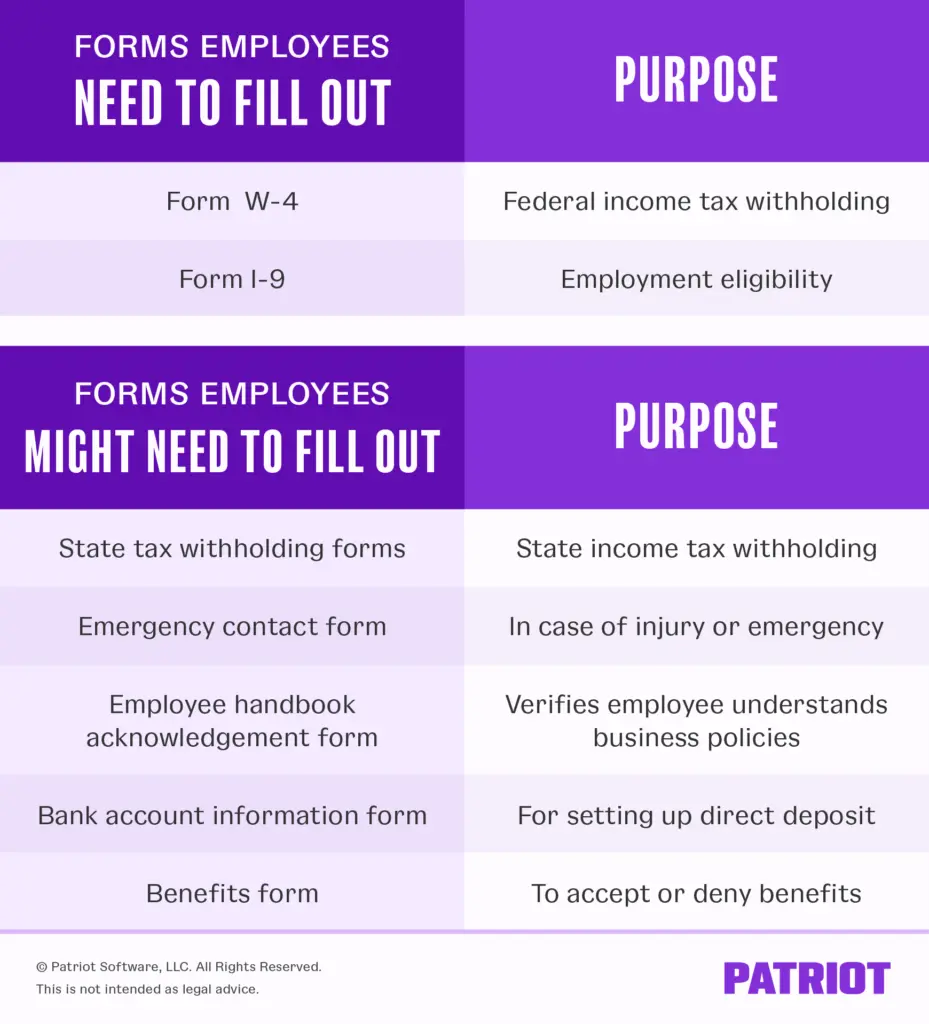
1. Documentation and Onboarding: Upon hiring, every employee must complete Form W-4 (Employee’s Withholding Certificate) to determine the amount of federal income tax to be withheld from their pay. Additionally, the Form I-9 (Employment Eligibility Verification) must be completed to confirm the individual’s legal authorization to work in the United States. While the I-9 is not used for tax calculations, it is a mandatory record that must be retained by the employer for inspection by U.S. Citizenship and Immigration Services (USCIS).
2. Determining Pay Frequency and Methods: Employers must establish a consistent pay schedule—weekly, biweekly, semimonthly, or monthly. According to the Bureau of Labor Statistics, biweekly is the most common pay frequency in the private sector, utilized by approximately 43% of businesses. The method of payment—whether via physical check, direct deposit, payroll card, or cash—must also comply with state laws, some of which require employers to offer at least one method that does not incur fees for the employee.
3. The Payroll Run: Each pay period requires the meticulous tracking of hours worked for non-exempt staff. This includes accounting for paid time off (PTO), sick leave, and any bonuses or commissions. Gross wages are calculated, and then "statutory deductions" (taxes) and "voluntary deductions" (health insurance, retirement contributions) are subtracted to arrive at the net pay, or "take-home" pay.
4. Tax Deposition and Reporting: After paychecks are distributed, the employer’s responsibility shifts to the government. Federal and FICA taxes must be deposited on either a monthly or semi-weekly schedule, depending on the size of the business’s tax liability during a designated "lookback period." Reports, such as Form 941, are filed quarterly to reconcile the amounts withheld with the amounts deposited.
Comparative Analysis of Payroll Management Systems
Small businesses generally choose between four primary methods of managing payroll, each with distinct trade-offs regarding cost, control, and risk.
- Manual Processing: Historically the default for very small operations, manual payroll involves calculating taxes using IRS Publication 15 (Circular E). While this method eliminates software costs, it is highly susceptible to human error. With the increasing complexity of local tax jurisdictions, manual processing is now considered a high-risk strategy.
- Spreadsheet-Based Systems: Using Excel or Google Sheets provides a digital framework but still requires manual data entry and formula updates. This method lacks the "automaticity" of specialized software and does not provide built-in compliance alerts for changing tax rates.
- Payroll Software (SaaS): Cloud-based payroll platforms have become the industry standard for small to medium-sized enterprises (SMEs). These tools automate calculations, handle direct deposits, and often file tax forms automatically. Data from the Small Business Administration (SBA) suggests that automation can reduce payroll processing time by up to 80%.
- Outsourcing and PEOs: Hiring an accounting firm or a Professional Employer Organization (PEO) represents the highest level of delegation. In a PEO arrangement, the business enters a co-employment contract where the PEO handles all HR, benefits, and payroll functions. While the most expensive option, it offers the greatest protection against compliance errors.
Supporting Data: The Cost of Non-Compliance
The necessity of rigorous payroll management is underscored by the scale of penalties issued by the IRS. Recent data indicates that the IRS assesses billions of dollars in civil penalties annually related to employment taxes. These penalties are often triggered by "failure to deposit" (FTD) errors, where a business misses a deadline or underpays its tax liability.
Furthermore, the Social Security Administration (SSA) and the IRS track the "tax gap"—the difference between taxes owed and taxes paid. Employment taxes represent a significant portion of this gap. Consequently, the IRS has increased its focus on "trust fund" taxes. Because the money withheld from an employee’s paycheck is held "in trust" by the employer for the government, the IRS can hold business owners personally liable for unpaid payroll taxes, regardless of the business’s corporate structure. This "Trust Fund Recovery Penalty" is one of the most potent enforcement tools in the agency’s arsenal.
Statutory Tax Obligations and Employer Contributions
Understanding the breakdown of payroll taxes is essential for accurate financial forecasting. Taxes are generally divided into employee-paid and employer-paid categories.
Employee-Paid Taxes (Withheld by Employer):
- Federal Income Tax: Based on W-4 selections and IRS tax tables.
- State and Local Income Tax: Varies by geography; some states, like Florida and Texas, have no state income tax.
- FICA (Social Security): 6.2% of gross wages up to the annual wage base ($168,600 for 2024).
- FICA (Medicare): 1.45% of all gross wages, with an additional 0.9% for high-earners.
Employer-Paid Taxes (Added Cost to the Business):
- FICA Match: The employer must match the 6.2% for Social Security and 1.45% for Medicare.
- FUTA (Federal Unemployment Tax): 6.0% on the first $7,000 of each employee’s wages, though most employers receive a credit of 5.4%, resulting in an effective rate of 0.6%.
- SUTA (State Unemployment Tax): Rates are determined by the state based on the employer’s "experience rating" (the history of unemployment claims filed against the business).
Record Retention and Audit Preparedness
The Department of Labor and the IRS have strict requirements for record retention. Employers are generally required to keep payroll records for at least three years and records of time cards or work schedules for at least two years. These records must be available for inspection and should include names, addresses, occupations, pay rates, and total weekly earnings. In the event of a DOL audit, the inability to produce these records can lead to the assumption of guilt in wage-and-hour disputes, often resulting in maximum penalty assessments.
Broader Impact and Economic Implications
The efficiency of payroll management has broader implications for the national economy. Small businesses employ nearly 50% of the American workforce. When these businesses struggle with payroll compliance, it creates a ripple effect of financial instability for workers and lost revenue for the public sector.
The rise of "fintech" in the payroll space has democratized access to sophisticated financial tools, allowing a business with a single employee to access the same level of accuracy as a Fortune 500 company. This technological shift is narrowing the "compliance gap" and allowing small business owners to focus more on innovation and less on administrative bureaucracy. However, the human element remains vital. Experts suggest that even with automated systems, business owners must conduct periodic "payroll audits" to ensure that the software is correctly interpreting local laws and that employee data remains current.
In conclusion, managing payroll for a small business is a multifaceted discipline that requires a blend of legal knowledge, mathematical precision, and disciplined record-keeping. By establishing a robust system early—whether through advanced software or professional outsourcing—business owners protect their most valuable assets: their time, their reputation, and their workforce. As the regulatory environment grows increasingly complex, the role of payroll management will continue to be a defining factor in the longevity and success of the small business sector.