Candice Horbacz
Early property taxes, a fiscal instrument with roots stretching back to feudal times, were initially conceived as levies primarily on land, with farmers bearing the brunt of these obligations. In an agrarian economy where land represented the principal form of wealth and productive capacity, such taxation was a logical, albeit often burdensome, mechanism for sovereigns to extract resources. Over centuries, as economies diversified and societies urbanized, the concept of property taxation evolved significantly. Today, these taxes extend beyond mere land, encompassing assets like real estate—including buildings and structures—and are paid on a recurrent basis by individuals, households, and legal entities, forming a critical cornerstone of local government finance across much of the globe.
The Dual Nature of Property Taxes: Incentives and Disincentives
Ideally, a well-structured property tax system can serve as a powerful fiscal incentive for local governments. By tying local revenues directly to the value of immovable assets, it encourages municipalities to permit and even actively promote new development. The logic is straightforward: more development typically translates into a larger tax base, generating increased revenue streams that can be reinvested into local public services. These services—ranging from schools and libraries to roads, parks, and public safety—in turn enhance the desirability and value of properties within the jurisdiction, creating a virtuous cycle where the value of public amenities is capitalized into property prices. This localized funding model fosters a direct connection between local governance, community investment, and resident benefits.
However, the efficacy of property taxes is not without its complexities and potential drawbacks. When these taxes are levied not only on the intrinsic value of land but also on the improvements made to it, such as buildings and structures, they can inadvertently create a disincentive for investment. Businesses contemplating expansion, construction of new facilities, or significant upgrades to existing properties must factor in not only the initial capital outlay but also the recurrent tax burden on these new assets. This additional cost can diminish the prospective returns on investment, making certain projects less attractive. For this reason, businesses, particularly those with significant physical footprints or high capital intensity, may strategically choose to locate their operations away from jurisdictions perceived to have high or inefficient property tax regimes, leading to potential economic stagnation or decline in affected areas.
A Comparative Look at European Property Tax Regimes
The landscape of property taxation across Europe reveals a diverse array of approaches, reflecting different historical trajectories, economic priorities, and fiscal philosophies. Of the 34 European countries under review, two outliers stand out for their complete absence of recurrent property taxes: Liechtenstein and Malta. These small, distinct economies likely rely on alternative revenue streams, such as corporate taxes, consumption taxes, or financial services, to fund public services, or their unique geographical and economic structures render such a tax less relevant or administratively complex.
In stark contrast, Estonia represents a unique model, distinguishing itself as the sole country within this comparative framework that taxes only land. This "land value tax" approach is often lauded by economists for its efficiency. By taxing only the unimproved value of land, Estonia’s system avoids penalizing investment in buildings, renovations, or other structural improvements. The rationale is that land value is largely determined by public investments (infrastructure, services) and broader economic growth, rather than by individual effort. Therefore, taxing land captures this publicly generated value without discouraging productive private activity. This makes Estonia’s real property tax system arguably one of the most efficient, as it does not distort investment decisions concerning capital improvements.
Deductibility and Double Taxation: Impacts on Business Investment
Further nuances emerge when examining how property taxes interact with corporate income tax. Among the 32 countries that do levy property taxes, a significant majority—28—permit businesses to deduct property or land taxes from their corporate income. This mechanism is crucial for mitigating the overall tax burden on businesses. By allowing these deductions, governments effectively reduce the net cost of property taxes, thereby encouraging businesses to invest in fixed assets and expand their operations. It acknowledges property taxes as a legitimate cost of doing business, preventing a portion of the tax from being levied twice.
However, a quartet of European nations—Austria, Iceland, Italy, and Slovenia—stand apart by prohibiting the deduction of property taxes from business income. This policy leads to a form of "double taxation" on business properties. In these countries, a company’s profits are first subjected to corporate income tax, and then the assets (land and buildings) that were instrumental in generating those profits are taxed again through property levies, without the ability to offset the latter against the former. This effectively increases the overall tax burden on capital-intensive businesses, potentially disincentivizing investment, hindering economic growth, and making these nations less attractive for businesses seeking to establish or expand their physical presence. The inability to deduct such a significant operational cost can materially impact a company’s profitability and capital allocation decisions.
Revenue Generation: A Spectrum of Reliance
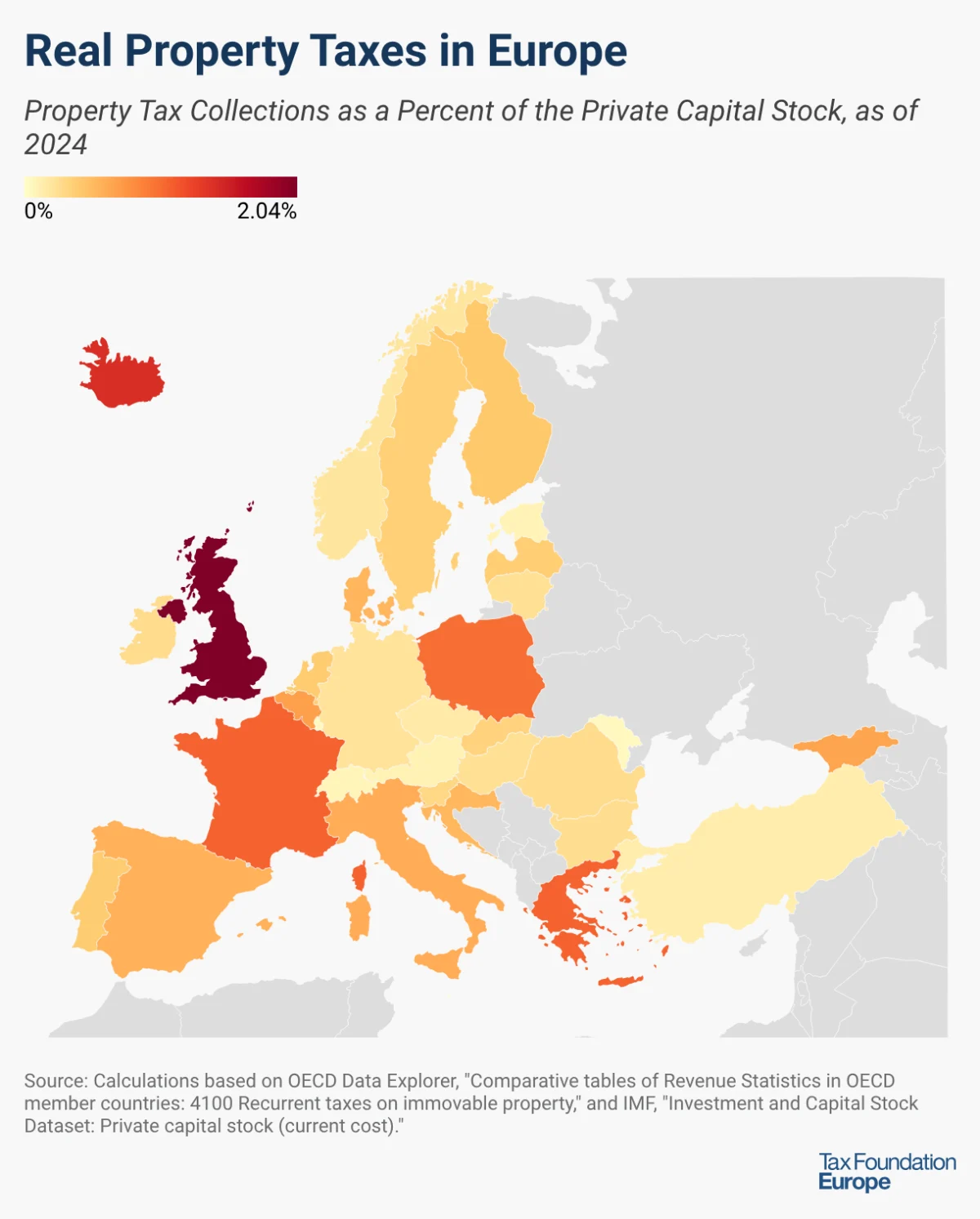
The extent to which countries rely on recurrent property taxes as a share of their private capital stock also varies dramatically, highlighting diverse fiscal strategies and economic structures. At the lower end of the spectrum, Luxembourg and Moldova raise the lowest property tax revenues, at approximately 0.05 percent of their private capital stock. Switzerland and Estonia follow closely, with 0.08 percent and 0.09 percent respectively. These low figures could be indicative of relatively low tax rates, high reliance on other tax forms (e.g., income or consumption taxes), or smaller private capital bases. Luxembourg, for instance, is known for its strong financial sector and a tax system that historically prioritized corporate attractiveness over property levies.
Conversely, some nations lean heavily on property taxes. The United Kingdom leads this group, extracting 2.04 percent of its private capital stock through property taxes. This high figure is attributable to its robust system of council tax (for residential properties) and business rates (for commercial properties), both of which are significant revenue generators for local authorities. Iceland follows with 1.43 percent, and France with 1.08 percent. These higher rates often reflect a greater fiscal decentralization, where local governments are tasked with funding a broader range of public services primarily through local property levies. For instance, France’s ‘taxe foncière’ and ‘taxe d’habitation’ (though the latter is being phased out for primary residences) have historically been substantial contributors to municipal budgets.
On average, the 32 European countries that implement a recurrent property tax collect approximately 0.45 percent of their private capital stocks from these levies. This figure, however, pales in comparison to the United States, which raises a substantial 1.88 percent of its private capital stock through property taxes. This significant disparity underscores a fundamental difference in fiscal architecture. In the U.S., property taxes are overwhelmingly the largest source of local government revenue, funding critical services such as public education, local infrastructure, police, and fire departments. This high reliance often results from a greater degree of fiscal autonomy for local jurisdictions and less direct financial support from central or state governments for core local services compared to many European counterparts. The U.S. system places a heavier burden and greater responsibility on local property owners to fund community services.
The Division of Burden: Households vs. Businesses
Understanding who pays property taxes is as important as knowing how much is collected. For the 16 European countries that provide a breakdown of property tax revenues between businesses and households, the data indicates that households, on average, remit around 60 percent of the total property tax revenue. This general trend suggests that residential property owners bear a larger share of the direct property tax burden across much of Europe.
However, this average masks considerable national variations. At one extreme, the Slovak Republic sees households contributing a mere 7.4 percent of receipts, implying that businesses shoulder the vast majority of the property tax burden in that nation. This could be a deliberate policy choice to keep housing costs lower for residents or a reflection of a predominantly industrial or commercial property base relative to residential. At the other end, France stands out with households contributing 71.4 percent of property tax revenue. This high share for French households aligns with its historical property tax structure, where homeowners and tenants (until recently) were significant contributors to local budgets. These variations highlight distinct national policy priorities regarding the allocation of the tax burden between residential property owners and commercial enterprises, influencing housing affordability, business competitiveness, and local economic development strategies.
Recent Reforms and Future Directions in Property Taxation
The landscape of property taxation is not static; it is subject to ongoing reforms driven by economic shifts, political priorities, and the need to modernize outdated systems. The year 2025 marks a significant shift in Germany, where the authority over the property tax base is being devolved to the individual state (Länder) level. This decentralization was prompted by a 2018 ruling by Germany’s Constitutional Court, which deemed the existing property valuation system unconstitutional due to its reliance on outdated property values (some dating back to 1964 in West Germany and 1935 in East Germany), leading to unfair and unequal taxation.
This devolution grants states the flexibility to design their own property tax models. The state of Baden-Württemberg has seized this opportunity to implement a system that taxes only the value of land, moving towards a land value tax model similar to Estonia’s. This decision is significant as it signals a potential trend towards more efficient property tax systems within Germany, aiming to reduce disincentives for investment in buildings and promote more rational land use. Other German states are exploring different models, including those incorporating both land and building values, but Baden-Württemberg’s move could influence future reforms across the federation. The implications of this reform are profound, potentially leading to a fairer distribution of the tax burden, more predictable revenues for municipalities, and a modernized approach to property valuation that reflects current economic realities. Business associations and property owner groups across Germany have been actively engaged in discussions, with many advocating for simpler, more transparent, and investment-friendly systems.
In another significant development, Croatia introduced a recurrent property tax in 2025, marking a new chapter in its fiscal policy. Previously, Croatia primarily relied on non-recurrent property taxes or utility fees linked to property. The new tax is levied on the square meters of land and floor area, signifying a move towards a more conventional European property tax model. This introduction is likely aimed at diversifying local government revenue sources, enhancing fiscal stability for municipalities, and potentially bringing Croatia more in line with EU fiscal norms. The implementation of this new tax will require robust valuation systems and administrative capacity, and its impact on the housing market, property owners, and local businesses will be closely watched. Homeowners and real estate developers in Croatia have expressed a mix of concern over new costs and hope for improved local services.
Broader Implications and Ongoing Debates
The intricate world of property taxation carries profound implications for economic development, fiscal sustainability, and social equity. Property taxes are a primary tool for financing the essential local services that underpin daily life, from education and public health to infrastructure maintenance and emergency services. Their structure directly influences investment decisions, shaping urban development patterns, affecting housing affordability, and impacting the competitiveness of local businesses.
The ongoing global debate often centers on how to design property tax systems that are not only revenue-genergenerating but also economically efficient and socially equitable. The concept of land value taxation, as exemplified by Estonia and now partially adopted by Baden-Württemberg, continues to gain traction among economists who argue it minimizes economic distortion and encourages optimal land use. Conversely, systems that heavily tax improvements can deter construction and maintenance, potentially contributing to urban decay or housing shortages.
Moreover, property tax systems face challenges from demographic shifts, urbanization, and the increasing demand for high-quality public services. As populations grow and age, the pressure on local budgets intensifies, making a stable and robust property tax base more critical than ever. Debates also persist around the fairness of property taxes, particularly concerning their potential regressive impact on lower-income households or the elderly on fixed incomes, leading to calls for circuit breakers, exemptions, or deferral programs.
Ultimately, the varied approaches to property taxation across Europe and compared to the United States underscore a constant balancing act between revenue generation, economic efficiency, and social equity. As economies continue to evolve, so too will the mechanisms by which governments tap into the wealth represented by immovable property, shaping the fiscal health of communities and the economic choices of their residents and businesses. The reforms in Germany and Croatia are just recent examples of this continuous adaptation, reflecting a broader trend towards modernizing, refining, and optimizing one of the oldest forms of taxation known to humanity.