Julia Chirkova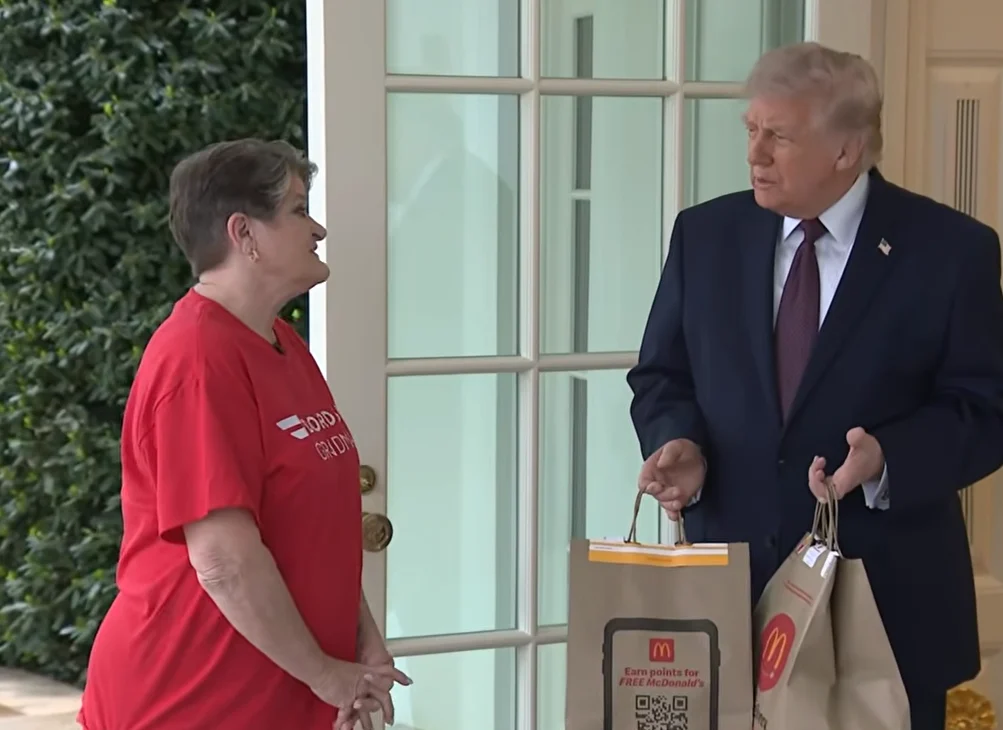
President Donald Trump found himself in a series of somewhat awkward moments on Monday during an event at the White House designed to highlight his administration’s "no tax on tips" policy. The President, who had ordered McDonald’s for the White House, personally accepted the delivery from Sharon Simmons, a DoorDash driver from Arkansas. The encounter, intended to showcase the benefits of his tax initiative, was punctuated by an unexpected exchange about voter support and a redirection from a reporter’s question to a more politically charged topic.
The scene unfolded outside the Oval Office, where President Trump greeted Ms. Simmons, whom the White House had identified as a beneficiary of his tax policy. Ms. Simmons, a self-described "DoorDash Grandma," reportedly saved approximately $11,000 due to the elimination of federal income tax on tips. This saving, she later explained to Fox News, was crucial for her family’s financial well-being, particularly for her husband’s cancer treatments.
"It’s such an honor to meet you. And I think you voted for me. You think?" President Trump asked Ms. Simmons, extending a handshake with one hand while holding the McDonald’s bags in the other.
Ms. Simmons, appearing somewhat taken aback, responded with a hesitant, "Uh, maybe?" accompanied by a laugh. This exchange, captured by White House press pool cameras, highlighted the informal and at times improvisational nature of such presidential events.
The President continued, expressing his appreciation for her perceived support. "I heard you’re a great supporter, and we appreciate it," Trump stated, further shaking her hand.
The delivery itself then took a backseat as President Trump, still holding the McDonald’s bags, turned his attention to the assembled reporters. He then placed the bags down, initiating a brief press gaggle. As reporters began to pose questions on various topics, Ms. Simmons stood nearby, an observer to the unfolding press scrum.
Attempting to ease Ms. Simmons’s apparent discomfort, President Trump remarked, "You don’t have to say too much, I think." He then pivoted to the reporters’ inquiries, suggesting they were more interested in geopolitical matters, specifically mentioning "the Hormuz Strait and various other things."
This redirection from the intended focus on tax policy to broader international affairs, while Ms. Simmons remained present, contributed to the perceived awkwardness of the situation. The contrast between the personal story of financial relief and the President’s immediate engagement with national security issues was notable.
Background and Context of the "No Tax on Tips" Policy
The "no tax on tips" policy, a key component of President Trump’s economic agenda, aimed to provide relief to service industry workers who rely heavily on gratuities. The Tax Cuts and Jobs Act of 2017, signed into law by President Trump, included provisions that effectively eliminated federal income tax on tips for employees who report their tips accurately.
Prior to this legislation, tips were generally considered taxable income. While employees did not pay Social Security and Medicare taxes on tips, they were subject to federal income tax. The argument for eliminating this tax was that it would increase the take-home pay of millions of workers, thereby stimulating consumer spending and providing direct financial relief. The administration frequently highlighted success stories of individuals who benefited from this policy.
The White House’s choice to feature Ms. Simmons, a DoorDash driver, was strategically significant. The gig economy, encompassing delivery services and other flexible work arrangements, has grown substantially in recent years. Workers in these sectors often rely on a combination of hourly wages and tips, making them directly impacted by tax policies affecting gratuities. By selecting a DoorDash driver, the administration sought to demonstrate the policy’s reach across diverse segments of the workforce.
Chronology of the Event
The events of Monday, April 13, 2026, unfolded as follows:
- Morning/Early Afternoon: President Trump places a McDonald’s order for the White House.
- Mid-Afternoon: Sharon Simmons, a DoorDash driver from Arkansas, is dispatched to deliver the order. Ms. Simmons has been identified by the White House as a recipient of significant savings due to the "no tax on tips" policy.
- Late Afternoon: Ms. Simmons arrives at the White House and proceeds to the designated delivery area, where she meets President Trump outside the Oval Office.
- Encounter with President Trump: The President personally accepts the delivery, engages Ms. Simmons in conversation about her perceived political support, and holds the McDonald’s bags.
- Press Gaggle Commences: President Trump sets down the food bags and addresses the press pool, with Ms. Simmons standing nearby.
- Diversion to Other Topics: The President redirects the conversation from the tax policy to reporters’ questions about national security and other issues.
- Social Issue Interjection: During the press gaggle, President Trump raises the issue of biological men competing in women’s sports and asks Ms. Simmons for her opinion.
- Ms. Simmons’s Response: Ms. Simmons reiterates her focus on the tax policy, stating she does not have an opinion on the social issue.
- Post-Event Interviews: Ms. Simmons later speaks with Fox News, elaborating on how the tax policy has aided her family.
Supporting Data and Impact of the Tax Policy
The impact of the "no tax on tips" policy is a subject of ongoing analysis. While the exact savings vary per individual, the aggregate effect is intended to be substantial for millions of workers. The Congressional Budget Office (CBO) has provided analyses of the tax cuts, including the implications for various income groups.
According to data from the Bureau of Labor Statistics, a significant portion of the U.S. workforce is engaged in tipped occupations, including food servers, bartenders, and personal care aides. For these individuals, tips often constitute a substantial part of their overall income. The elimination of federal income tax on these earnings can translate into hundreds or even thousands of dollars in additional disposable income annually.
For Sharon Simmons, the reported $11,000 saving is a concrete example of this impact. This amount, if accurate and sustained over time, can significantly alleviate financial burdens, particularly for those facing medical expenses or other significant household costs. The policy’s proponents argue that such savings empower workers, allowing them to better manage their finances, invest in education, or contribute more to their local economies.
However, the policy has also faced scrutiny. Some economists have raised concerns about the potential revenue loss to the federal government. Additionally, there have been discussions about whether the policy disproportionately benefits higher earners within the tipped workforce. The complexity of tip reporting and enforcement can also present challenges.
Reactions and Broader Implications
The interaction at the White House, particularly the President’s personal engagement with the delivery driver and his subsequent redirection of the conversation, drew attention from various quarters.
Supporters of the policy lauded the administration’s efforts to directly address the financial concerns of working-class Americans. They viewed the event as a successful demonstration of the tangible benefits of the tax cuts. Ms. Simmons’s personal testimony, as relayed to Fox News, served as a powerful endorsement of the policy’s impact on her family’s ability to cope with medical expenses.
Critics and political opponents often pointed to the staged nature of such events, questioning whether the selection of participants was genuinely representative or curated for political messaging. The awkwardness of the exchange, particularly the President’s attempt to gauge Ms. Simmons’s voting habits, was interpreted by some as an illustration of the administration’s focus on political loyalty over substantive policy engagement.
The President’s interjection of the social issue of transgender athletes into a discussion about tax policy was particularly noteworthy. This move was seen by some as an attempt to pivot the media’s attention to a more culturally resonant and politically galvanizing topic, often referred to as a "culture war" issue. Ms. Simmons’s firm redirection back to the tax policy underscored the perceived disconnect between the President’s agenda and the immediate concerns of many everyday Americans.
Analysis of Implications
The White House event, while intended to be a straightforward policy showcase, revealed several layers of political and social dynamics.
Firstly, it highlighted the administration’s continued emphasis on tax reform as a cornerstone of its economic platform. By using a direct interaction with a service worker, the White House aimed to personalize the abstract concept of tax policy and demonstrate its real-world benefits.
Secondly, the event underscored the challenges of controlling the narrative in highly publicized presidential events. Despite the carefully planned setting, the unpredictable nature of human interaction and the insatiable appetite of the press corps for news can lead to deviations from the intended script.
Thirdly, President Trump’s interjection of the transgender athlete issue demonstrates a recurring tactic of shifting focus to divisive social issues that energize his base. This strategy can be effective in dominating media cycles and rallying political support, but it can also alienate moderate voters and overshadow other policy objectives. Ms. Simmons’s clear and concise response, however, served as a reminder that many individuals are primarily concerned with economic issues directly impacting their lives.
The long-term implications of the "no tax on tips" policy will continue to be debated and analyzed. As the economy evolves and tax policies are subject to ongoing review, events like this serve as snapshots of the administration’s efforts to communicate its policy achievements and connect with the American electorate on a personal level, albeit sometimes through unconventional and memorable exchanges. The story of Sharon Simmons and her interaction with President Trump at the White House offers a compelling, if somewhat unusual, case study in the intersection of policy, politics, and personal experience.