Lana Rhoades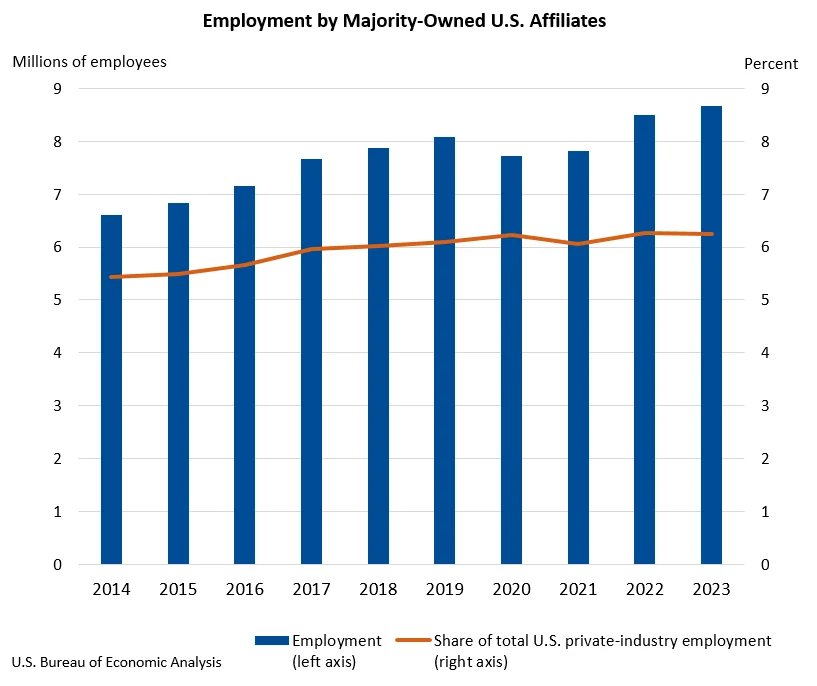
The economic landscape of the United States in 2023 was significantly shaped by the robust activity of majority-owned U.S. affiliates of foreign multinational enterprises (MNEs). These entities, representing a substantial segment of the American economy, collectively employed 8.66 million workers, marking a notable increase of 1.9 percent from the 8.5 million individuals employed in 2022. This growth, detailed in the latest statistics released by the U.S. Bureau of Economic Analysis (BEA), underscores the continued vital role of foreign investment in driving job creation and contributing to the nation’s economic output.
While the absolute number of jobs grew, the proportion of total private-industry employment attributed to these foreign-owned affiliates saw a marginal decrease, falling to 6.2 percent in 2023 from 6.3 percent in the previous year. This slight shift, however, does not diminish the overall positive trend in employment figures. The BEA’s comprehensive report, which provides an in-depth look at the operations and finances of these U.S. subsidiaries of global corporations, also revealed significant gains in their economic contributions.
Key Economic Contributions in 2023
The economic impact of these majority-owned U.S. affiliates extends beyond employment figures, encompassing substantial contributions to the nation’s Gross Domestic Product (GDP). The current-dollar value added by these entities, a key metric reflecting their direct contribution to U.S. economic output, surged by an impressive 6.3 percent, reaching a total of $1.47 trillion in 2023. This robust growth in value added signals increased productivity and a deeper integration of these foreign-backed operations into the fabric of the American economy.
Investment in the nation’s infrastructure and productive capacity also saw a significant uptick. Expenditures for property, plant, and equipment by these affiliates rose by 6.3 percent, totaling $322.7 billion. This substantial investment in physical assets is a strong indicator of long-term commitment and expansion plans by foreign MNEs, suggesting confidence in the U.S. market and its future growth potential. Such capital expenditures not only create jobs in construction and related industries but also enhance the operational capabilities and competitiveness of these businesses.
Innovation and the pursuit of new technologies remain a priority for foreign-affiliated companies operating in the U.S. Research and development (R&D) activities performed by these affiliates increased by 1.1 percent, amounting to $87.8 billion. While the growth rate in R&D spending was more modest compared to other economic indicators, it still represents a significant investment in the intellectual capital and future technological advancements within the United States. This consistent investment in R&D is crucial for maintaining a competitive edge in the global marketplace and fostering a knowledge-based economy.
A Deeper Dive into the BEA Data
The statistics released by the BEA provide a granular view of the activities of U.S. affiliates of foreign MNEs, offering insights into various facets of their operations. These include detailed information on sales, balance sheet and income statement items, compensation of employees, and international trade activities. The availability of data at industry, country, and state levels further allows for a nuanced understanding of the geographical distribution and sectoral impact of foreign investment.
The BEA’s interactive data application and comprehensive data tables offer a treasure trove of information for policymakers, researchers, businesses, and the public. These resources enable users to explore trends, conduct comparative analyses, and gain a deeper appreciation for the multifaceted contributions of foreign-owned enterprises to the U.S. economy.
Revisions and Updates to Historical Data
It is important to note that the BEA regularly revises its statistical data to incorporate newly available and updated source information. The statistics for 2022, which were initially released in a preliminary format in November 2024, have undergone revisions. These revisions, highlighted in the December 2024 issue of the Survey of Current Business in an article titled "Activities of U.S. Affiliates of Foreign Multinational Enterprises in 2022," reflect a more accurate picture of the economic activities during that year.
For instance, the revised estimate for the number of employees in 2022 increased to 8,503.1 thousand from the preliminary estimate of 8,351.0 thousand. Similarly, value added for 2022 was revised upward to $1,382.1 billion from $1,350.1 billion. Expenditures for property, plant, and equipment also saw an upward revision to $303.5 billion from $299.1 billion, and research and development expenditures were adjusted to $86.8 billion from $80.3 billion. These revisions are a standard part of the statistical process, ensuring the highest degree of accuracy in economic reporting.
Historical Context and Trends
The presence of foreign multinational enterprises in the U.S. economy is not a recent phenomenon. For decades, foreign direct investment (FDI) has played a significant role in shaping American industries, bringing capital, technology, management expertise, and jobs. The BEA’s data collection efforts aim to track and quantify this impact, providing a consistent historical record of foreign investment activities.
The period following World War II saw a gradual increase in FDI as global trade and investment barriers began to fall. The 1980s and 1990s witnessed a significant acceleration in FDI flows into the United States, driven by factors such as a large and growing domestic market, a stable political and economic environment, and a skilled workforce. This trend has largely continued into the 21st century, although global economic shifts and geopolitical considerations can influence the pace and direction of FDI.
The data on employment, value added, and investment by U.S. affiliates of foreign MNEs provides a critical lens through which to understand these historical trends. For example, the steady increase in employment figures over the years, punctuated by periods of more rapid growth, reflects the evolving nature of global business and the attractiveness of the U.S. as an investment destination. Similarly, the fluctuations in investment in property, plant, and equipment can be correlated with broader economic cycles, technological advancements, and shifts in global manufacturing and service industries.
Broader Economic Implications and Analysis
The consistent growth in employment and economic output from majority-owned U.S. affiliates of foreign MNEs has several important implications for the U.S. economy.
-
Job Creation and Labor Market Stability: These companies are significant employers, providing a substantial number of jobs across various sectors. Their continued investment and expansion contribute to a more stable and dynamic labor market, offering diverse career opportunities and supporting household incomes. The 1.9 percent employment growth in 2023, translating to hundreds of thousands of new jobs, is a testament to this ongoing contribution.
-
Contribution to GDP and Economic Growth: The substantial value added by these affiliates directly contributes to the nation’s GDP. A $1.47 trillion contribution in 2023 signifies their role as a powerhouse within the U.S. economy, driving consumption, investment, and overall economic expansion.
-
Capital Formation and Technological Advancement: Investments in property, plant, and equipment are crucial for upgrading the nation’s industrial base, enhancing productivity, and fostering innovation. The billions invested in R&D by these foreign-backed firms also play a vital role in pushing the boundaries of scientific and technological development within the U.S.
-
Competition and Market Dynamics: The presence of foreign MNEs can foster healthy competition within domestic markets, potentially leading to lower prices for consumers, improved product quality, and greater efficiency across industries. They also bring new management practices and technologies that can be adopted by domestic firms, spurring overall economic dynamism.
-
International Trade and Global Integration: The activities of these affiliates are intrinsically linked to international trade. They import raw materials and intermediate goods, and export finished products, contributing to the U.S.’s global economic engagement. Their operations facilitate the flow of goods, services, and capital across borders, integrating the U.S. economy more deeply into the global marketplace.
Official Perspectives and Policy Relevance
The U.S. Bureau of Economic Analysis plays a critical role in providing the data that informs economic policy decisions. The statistics on foreign MNE activities are closely watched by government agencies, including the Department of Commerce and the Treasury, as well as by international trade organizations and economic think tanks.
While the BEA itself remains neutral in its reporting, the data it generates is invaluable for:
- Trade Policy: Understanding the extent of foreign investment and its impact on domestic industries is crucial for formulating effective trade policies that balance the benefits of open markets with the need to protect domestic interests.
- Investment Promotion: The BEA’s data helps identify sectors and regions that are attractive for foreign investment, guiding efforts to attract further capital and expertise into the U.S.
- Economic Forecasting: These statistics are incorporated into broader economic models and forecasts, providing a more complete picture of the U.S. economic outlook.
- International Relations: The data offers insights into the economic relationships between the U.S. and other countries, informing diplomatic and economic dialogues.
Future Outlook and Data Dissemination
The BEA has indicated a shift in how it disseminates its data, moving away from including extensive tables within the body of its news releases. This change aims to leverage digital platforms more effectively, directing users to its Interactive Data Application and comprehensive data tables for detailed information. This approach is intended to provide a more dynamic and user-friendly experience for accessing and analyzing the data.
However, this transition also means that some previously published tables, including those detailing statistics on U.S. affiliates with 50 percent or less foreign ownership and supplemental industry statistics, will be impacted or discontinued as of December 5, 2025. While selected annual data tables have been archived, this change signifies a recalibration of the BEA’s data dissemination strategy.
The BEA’s commitment to providing timely and accurate economic statistics remains paramount. The next release concerning the Activities of U.S. Affiliates of Foreign Multinational Enterprises is scheduled for July 10, 2026, which will cover the data for 2024. This ongoing reporting ensures that stakeholders have access to the latest information to understand the evolving landscape of foreign investment in the United States.
In conclusion, the 2023 data from the U.S. Bureau of Economic Analysis paints a picture of continued strength and growth for majority-owned U.S. affiliates of foreign multinational enterprises. Their increasing employment numbers, substantial contributions to GDP, and significant investments in capital and innovation underscore their integral role in the vitality and dynamism of the American economy. As these global players continue to invest and expand within the United States, their impact on job creation, economic output, and technological advancement is set to remain a critical factor in the nation’s prosperity.