Lana Rhoades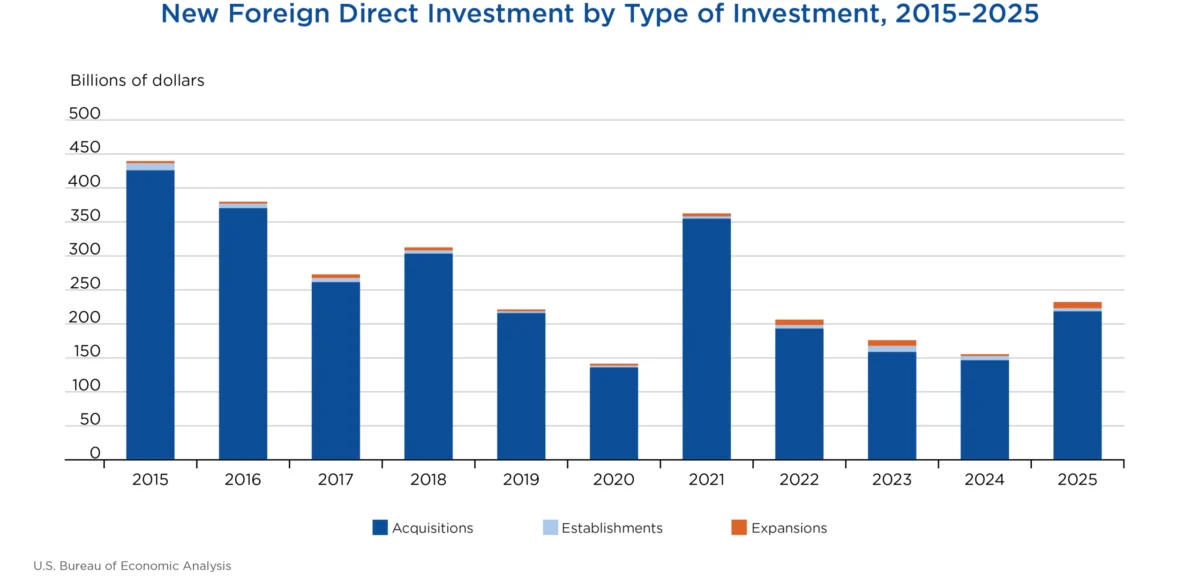
WASHINGTON D.C. – Foreign direct investors poured a significant $232.2 billion into the United States in 2025, marking a robust 49.5 percent increase from the previous year, according to preliminary statistics released by the U.S. Bureau of Economic Analysis (BEA). This surge in investment underscores a continued global appetite for U.S. enterprises, with the acquisition of existing businesses remaining the dominant avenue for foreign capital deployment. The $76.8 billion leap in expenditures from 2024 signals a dynamic economic environment attracting substantial international capital.
The BEA’s comprehensive report details that acquisitions of established U.S. businesses were the primary driver of this growth, accounting for a staggering $218.4 billion of the total outlay. In contrast, the establishment of new U.S. businesses by foreign entities attracted $4.6 billion, while expansions of existing foreign-owned operations garnered $9.2 billion. These figures represent first-year expenditures, with planned total expenditures, encompassing both initial investments and projected future outlays, reaching an even more substantial $284.5 billion. This indicates a long-term commitment from foreign investors beyond immediate operational needs.
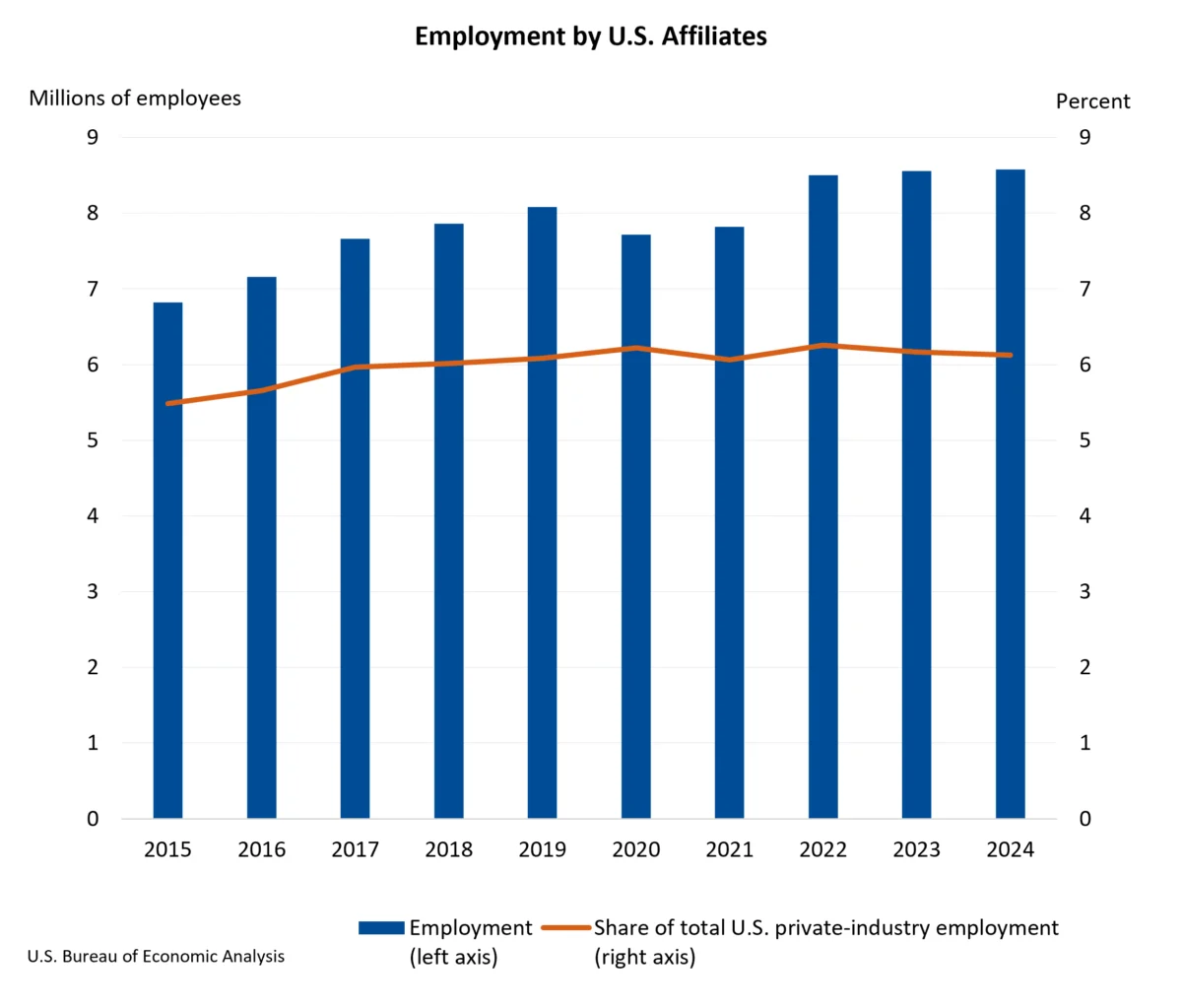
The impact of this influx of foreign capital is directly reflected in employment figures. In 2025, newly acquired, established, or expanded foreign-owned businesses in the United States provided employment for 213,100 individuals. This figure is a crucial indicator of the tangible economic benefits generated by foreign direct investment, contributing to job creation and workforce development across various sectors.
Key Sectors and Geographic Distribution of Investment
The manufacturing sector emerged as a powerhouse for foreign direct investment in 2025, capturing $121.8 billion, which constituted 52.5 percent of all expenditures. Within this broad sector, specific industries demonstrated exceptional appeal. Publishing industries led the charge with $50.7 billion in new direct investment, followed closely by chemicals manufacturing at $45.4 billion. The plastics and rubber products manufacturing sector also saw significant interest, attracting $19.0 billion. This concentration in manufacturing highlights the continued importance of U.S. industrial capabilities and its role in global supply chains.
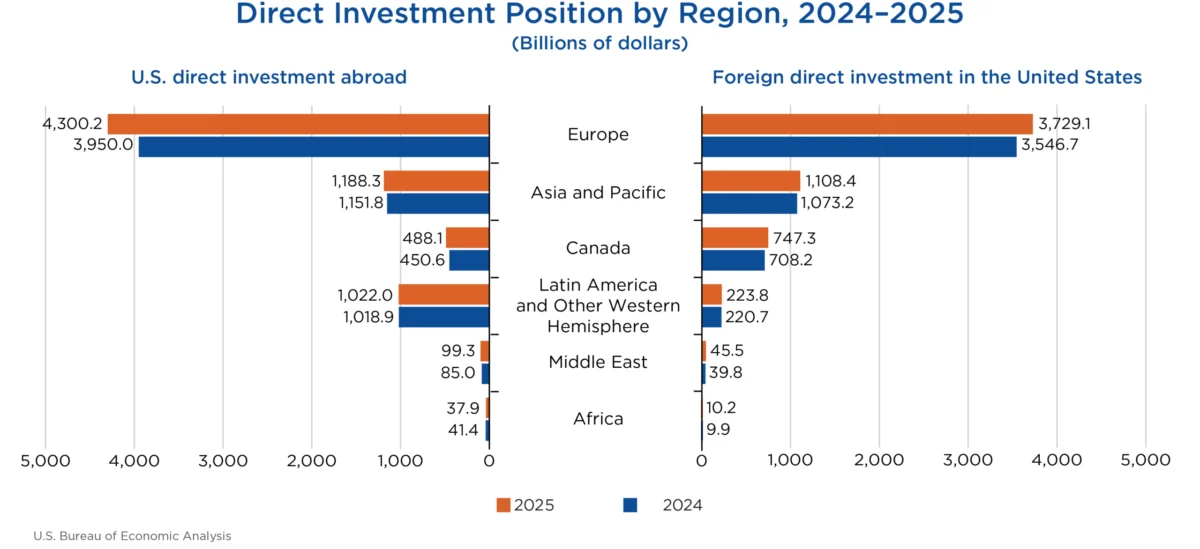
On a country-by-country basis, Japan was the leading investor in the U.S. in 2025, injecting $50.5 billion into American businesses. Germany followed with $26.7 billion, and Canada contributed $23.5 billion. Regionally, Europe was the most significant source of new investment, with $116.6 billion, representing 50.2 percent of the total. The Asia and Pacific region also demonstrated strong engagement, contributing $71.9 billion in expenditures. These patterns suggest established economic ties and strategic interests that continue to favor U.S. market access.
Geographically within the United States, California once again proved to be a prime destination for foreign capital, attracting $59.7 billion in first-year investment expenditures. Texas secured the second-highest amount with $21.5 billion, followed by Pennsylvania at $20.9 billion. These states, known for their robust economies, skilled workforces, and favorable business environments, continue to be magnets for international investment.
Greenfield Investments: A Look at New Ventures and Expansions
Beyond acquisitions, greenfield investments, which involve establishing new businesses or expanding existing foreign-owned ones, also saw notable activity. In 2025, greenfield expenditures totaled $13.8 billion. The transportation and warehousing sector attracted the largest share of greenfield investment ($3.6 billion), followed by computers and electronics products manufacturing ($2.0 billion), and chemicals manufacturing ($1.8 billion). This indicates a strategic focus on building new operational capacities and modernizing existing ones.
Investors from the Asia and Pacific region were particularly active in greenfield projects, contributing $8.3 billion. Australia led this regional surge with $3.0 billion, followed by South Korea ($2.2 billion) and Japan ($1.7 billion). At the state level, Louisiana led greenfield investment with $3.0 billion, demonstrating its growing appeal for new business development. Arizona ($2.7 billion) and Texas ($1.9 billion) also received substantial greenfield capital. Planned total expenditures for greenfield investments initiated in 2025 were projected at $66.1 billion, signaling further growth and development in the coming years.
Employment Dynamics Across Industries and Regions
The employment generated by new foreign direct investment in 2025 paints a detailed picture of the labor market impact. Current employment in acquired enterprises stood at 211,700. When factoring in planned employment for newly established businesses and expansions, the total projected workforce reached 232,400.
By industry, plastics and rubber parts manufacturing accounted for the largest number of current employees, with 21,800 individuals. Transportation equipment manufacturing followed with 17,300 employees, and primary and fabricated metals manufacturing employed 16,400. On a country of origin basis, Mexico was the largest contributor to current employment, with 54,600 employees in foreign-owned enterprises, followed by Canada (29,500) and the United Kingdom (26,800). Within the U.S., California led in current employment resulting from new foreign direct investment, with 37,200 jobs, followed by Illinois (17,600) and Texas (16,500).
Revisions to 2024 Data and Future Outlook
The BEA also released updated figures for 2024, indicating a revision in previously published statistics for new foreign direct investment. First-year expenditures for 2024 were revised upward to $155.3 billion from an earlier estimate of $151.0 billion. This upward revision was driven by increased acquisition activity, with expenditures for U.S. businesses acquired revised to $146.4 billion from $143.0 billion. Similarly, expenditures for expanding U.S. businesses saw an increase to $2.5 billion from $1.8 billion. Planned total expenditures for 2024 were also revised to $164.0 billion from $157.0 billion, reflecting a more comprehensive understanding of future investment commitments.
The consistent upward trend in foreign direct investment, particularly in 2025, suggests a favorable outlook for the U.S. economy. This sustained interest from international investors can be attributed to several factors, including the stability of the U.S. market, its large consumer base, a highly skilled workforce, and a robust legal and regulatory framework that protects property rights and ensures contractual enforcement. The BEA’s data provides a critical barometer for economic health and international confidence in the United States.
Analysis and Implications
The substantial increase in foreign direct investment in 2025, especially driven by acquisitions, indicates a strategic move by foreign entities to gain immediate market access, leverage existing infrastructure, and integrate into established U.S. industries. This can lead to rapid integration of global best practices and technologies into American businesses, potentially boosting productivity and competitiveness. However, it also raises questions about the long-term ownership and strategic direction of key U.S. assets.
The strong performance in manufacturing, particularly in chemicals and plastics, suggests that the U.S. remains a critical hub for production and innovation in these vital sectors. The significant investment from European and Asian nations highlights the interconnectedness of the global economy and the strategic importance of the U.S. market for these regions.
The BEA’s commitment to refining its data collection and disclosure methods, as noted in their updated disclosure avoidance policy, ensures that more granular and timely information can be made available to the public while maintaining confidentiality. This transparency is crucial for businesses, policymakers, and researchers seeking to understand the dynamics of international investment.
The next release from the BEA on foreign direct investment is anticipated in June 2027, which will provide data for 2026. This upcoming report will offer further insights into the continuing trends and the evolving landscape of global capital flows into the United States. The BEA’s consistent reporting on foreign direct investment is invaluable for economic forecasting, policy development, and understanding the United States’ role in the global economic order. The robust figures from 2025 suggest a continued trajectory of international capital flowing into the American economy, bolstering its growth and global standing.
The detailed breakdown of investment by industry, country, and state allows for a nuanced understanding of where foreign capital is being deployed and the specific sectors benefiting most. This granular data is essential for targeted economic development strategies and for identifying emerging areas of foreign interest. As the global economic landscape continues to shift, the U.S. remains a cornerstone for international investment, a testament to its enduring economic strengths and strategic advantages. The data from 2025 serves as a powerful indicator of this continued confidence and the ongoing mutual benefits derived from cross-border capital flows.