Lana Rhoades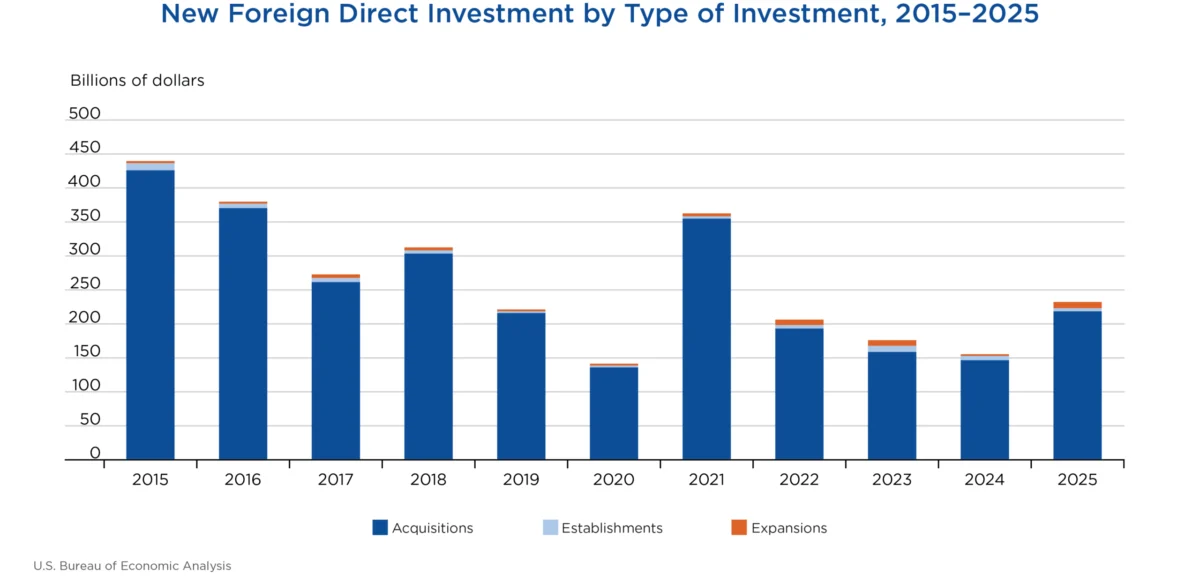
Expenditures by foreign direct investors to acquire, establish, or expand U.S. businesses totaled an impressive $232.2 billion in 2025, according to preliminary statistics released today by the U.S. Bureau of Economic Analysis (BEA). This represents a significant increase of $76.8 billion, or 49.5 percent, from the $155.3 billion recorded in 2024, highlighting a robust surge in international capital flowing into the American economy. As has been the prevailing trend in previous years, the acquisition of existing U.S. businesses constituted the dominant portion of these expenditures, underscoring the continued appeal of established enterprises for foreign investors.
The BEA’s detailed breakdown reveals that acquisition expenditures alone reached $218.4 billion in 2025. This substantial figure reflects a strong appetite for mergers and acquisitions within the U.S. market. Expenditures to establish entirely new U.S. businesses, often referred to as greenfield investments, amounted to $4.6 billion, while outlays for the expansion of existing foreign-owned businesses contributed another $9.2 billion. Beyond the initial first-year spending, planned total expenditures, encompassing both immediate outlays and projected future investments, reached an even more substantial $284.5 billion. This forward-looking figure suggests a sustained commitment from foreign investors to grow their U.S. operations beyond the immediate fiscal year.
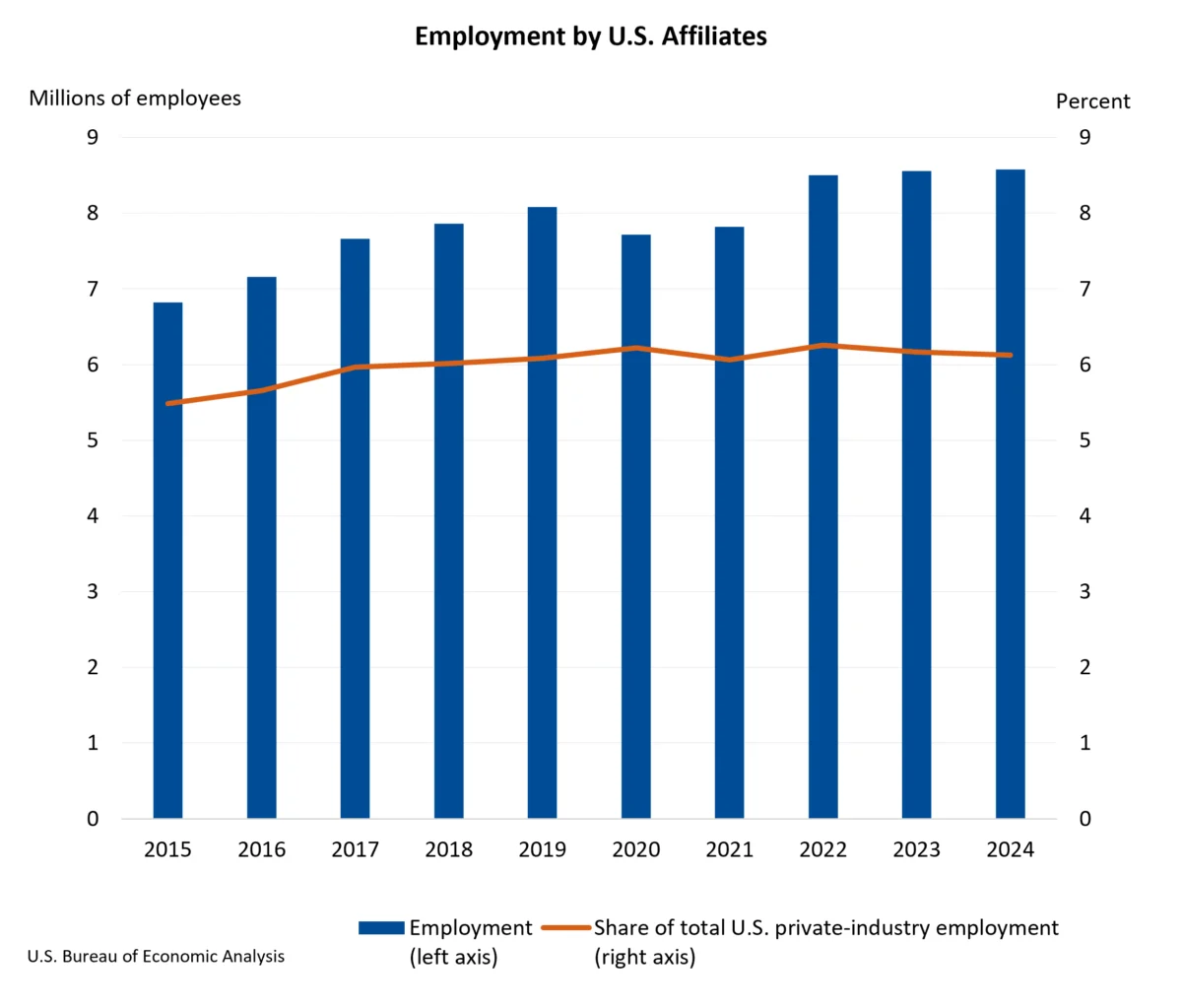
The impact of this heightened foreign direct investment (FDI) on the U.S. labor market is also notable. In 2025, employment at newly acquired, established, or expanded foreign-owned businesses reached 213,100 employees. This figure encompasses both the initial hiring at new establishments and expansions, as well as the retention and potential growth of employees within acquired companies. Current employment within these entities stood at 211,700, with total planned employment, accounting for the full operational capacity of new businesses and planned expansions, projected to reach 232,400. This indicates a net positive contribution to job creation and economic activity across the nation.
Manufacturing Sector Dominates Investment Landscape
The manufacturing sector emerged as a primary recipient of foreign direct investment in 2025, accounting for a significant 52.5 percent of total expenditures, or $121.8 billion. Within this broad sector, specific sub-industries attracted substantial capital. Publishing industries led the pack with $50.7 billion in new direct investment, followed closely by chemicals manufacturing at $45.4 billion. The plastics and rubber products manufacturing sector also saw considerable investment, drawing $19.0 billion. This strong performance in manufacturing suggests that foreign investors perceive significant opportunities for growth and innovation within the U.S. industrial base, potentially driven by factors such as skilled labor availability, advanced technological infrastructure, and robust consumer demand.
Global Investors Eye U.S. Market
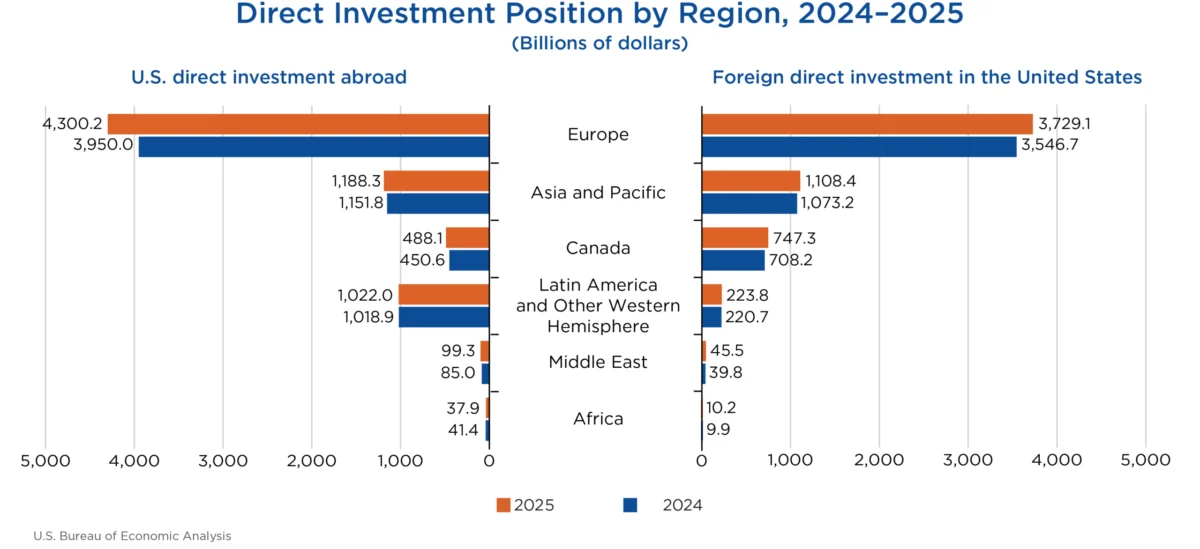
Geographically, investors from Japan were the most prominent contributors to FDI in the United States in 2025, injecting $50.5 billion into the U.S. economy. Germany followed with $26.7 billion, and Canada with $23.5 billion. On a regional level, Europe collectively represented the largest source of new investment, contributing $116.6 billion, or 50.2 percent of all new FDI. The Asia and Pacific region was the second-largest investing bloc, with expenditures totaling $71.9 billion. These figures underscore the global reach of U.S. investment opportunities and the confidence international partners place in the stability and potential of the American market. The classification of country of origin is based on the country of the ultimate beneficial owner (UBO), a methodology that provides a comprehensive view of where the ultimate control and economic interest of the investment resides.
California Leads as Top Investment Destination
At the state level, California once again demonstrated its allure for foreign investors, attracting the largest share of first-year investment expenditures with $59.7 billion. Texas followed with $21.5 billion, and Pennsylvania secured the third position with $20.9 billion. These states, known for their diverse economies, strong labor markets, and supportive business environments, continue to be magnets for international capital. The distribution of investment across states reflects a broad engagement with various regional economies, contributing to localized job creation and economic development.
Greenfield Investments Highlight Future Growth Potential
While acquisitions dominated the overall FDI landscape, greenfield investments – expenditures dedicated to establishing new businesses or expanding existing foreign-owned ones – totaled $13.8 billion in 2025. These investments are crucial indicators of long-term growth and the creation of new economic assets. The transportation and warehousing sector attracted the largest share of greenfield investment at $3.6 billion, signaling potential infrastructure development and logistics expansion. Computers and electronics products manufacturing followed with $2.0 billion, and chemicals manufacturing with $1.8 billion.
Investors from the Asia and Pacific region led in greenfield expenditures, contributing $8.3 billion. Australia was the leading individual country within this region, investing $3.0 billion, followed by South Korea ($2.2 billion) and Japan ($1.7 billion). At the state level, Louisiana emerged as a significant destination for greenfield investment, receiving $3.0 billion, followed by Arizona ($2.7 billion) and Texas ($1.9 billion). These states may be attracting greenfield investments due to factors such as competitive operating costs, access to specific resources, or government incentives aimed at fostering new business development. Planned total expenditures for greenfield investments initiated in 2025 reached $66.1 billion, indicating a substantial pipeline of future projects and expansions.
Employment Dynamics Across Industries and Regions
The employment impact of FDI is multifaceted. In 2025, current employment within acquired enterprises accounted for 211,700 jobs. When considering the planned employment of newly established businesses and expansions, the total projected workforce rises to 232,400. By industry, plastics and rubber parts manufacturing reported the largest number of current employees at 21,800, reflecting the significant capital infusion into this sector. Transportation equipment manufacturing followed with 17,300 employees, and primary and fabricated metals manufacturing with 16,400.
By country of origin, Mexico accounted for the largest number of current employees at 54,600, followed by Canada with 29,500, and the United Kingdom with 26,800. This data suggests a strong linkage between FDI from these nations and employment generation within the U.S. workforce. California once again led as the state with the largest current employment resulting from new FDI, with 37,200 employees. Illinois followed with 17,600, and Texas with 16,500. These figures highlight the concentrated impact of FDI on job creation in key economic hubs.
Revisions to 2024 Data Signal Growing Trend
The release of the 2025 FDI statistics also includes important revisions to the previously published 2024 data. These revisions offer valuable insights into the trajectory of foreign investment. First-year expenditures for new FDI in 2024 were revised upwards to $155.3 billion from an initial estimate of $151.0 billion. This upward revision was primarily driven by an increase in acquisitions of U.S. businesses, which were revised to $146.4 billion from $143.0 billion. Expenditures for the establishment of new U.S. businesses and the expansion of existing ones also saw modest upward adjustments.
Planned total expenditures for 2024 were similarly revised to $164.0 billion from $157.0 billion. These revisions, particularly the upward adjustments in acquisitions and expansions, suggest that the robust FDI activity observed in 2025 may be part of a broader, strengthening trend that began in the preceding year. Such revisions are common in preliminary statistical releases as more comprehensive data becomes available, and they serve to refine our understanding of economic trends.
Broader Economic Implications and Future Outlook
The surge in foreign direct investment in 2025 carries significant implications for the U.S. economy. The influx of $232.2 billion not only represents a substantial boost to capital markets but also signifies foreign confidence in the long-term economic prospects of the United States. The focus on manufacturing, particularly in sectors like chemicals and plastics, indicates a potential resurgence or continued strength in these critical industrial areas. Furthermore, the substantial employment figures associated with this investment underscore its role in job creation and economic vitality across various states.
The BEA’s commitment to releasing detailed supplemental data tables allows for in-depth analysis by researchers, policymakers, and businesses. These tables provide granular data on expenditures by industry, country of ultimate beneficial owner, and state, as well as detailed breakdowns of greenfield investments and employment figures. This transparency is crucial for understanding the nuances of FDI and its localized impacts.
The next release of FDI statistics, scheduled for June 2027, will cover data for 2026, providing an opportunity to assess whether the strong growth observed in 2025 continues. Analysts will be closely watching for trends in acquisition versus greenfield investment, the continued strength of the manufacturing sector, and the evolving geographical distribution of foreign capital. The BEA’s updated disclosure avoidance method, which employs coarsening techniques like rounding and aggregation, aims to publish more data while maintaining confidentiality, further enhancing the utility of these important economic indicators. The robust performance in 2025 suggests a dynamic and attractive environment for international investors, with potential for sustained economic growth and job creation in the years to come.