Lana Rhoades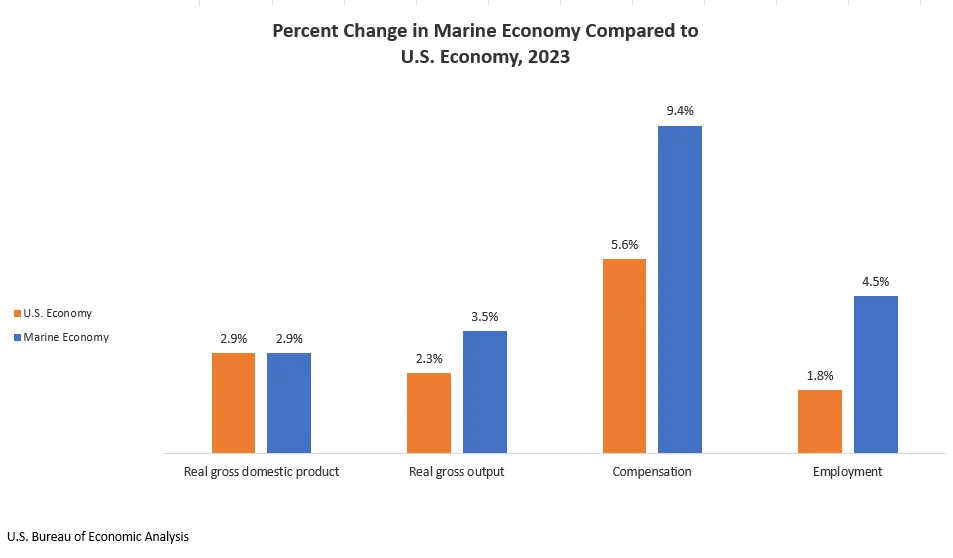
The United States marine economy played a significant role in the nation’s economic landscape in 2023, contributing $511.0 billion, or 1.8 percent, to the current-dollar U.S. gross domestic product (GDP). This marks a notable increase from the $482.4 billion recorded in 2022, underscoring the sector’s sustained vitality. The U.S. Bureau of Economic Analysis (BEA), through its release of the Marine Economy Satellite Account (MESA) statistics today, has provided a comprehensive overview of this crucial economic engine. Beyond GDP, the marine economy’s total gross output reached an impressive $826.6 billion in 2023, representing 1.7 percent of the national total.
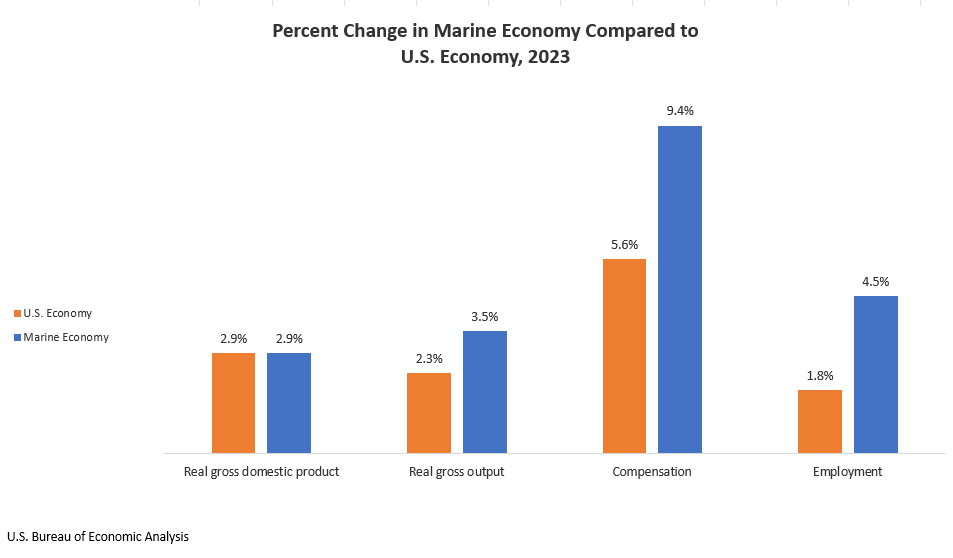
The report further highlights that the real (inflation-adjusted) GDP for the marine economy experienced a substantial increase of 2.9 percent from 2022 to 2023. This growth rate mirrors the overall U.S. economy’s expansion during the same period, indicating that the marine sector is not only growing but is doing so in lockstep with the broader national economic trends. This parallel growth is a positive indicator of the marine economy’s integration and importance within the larger economic framework.
Beyond output and value creation, the MESA data reveals significant gains in employment and compensation within the marine sector. Compensation for marine economy workers saw a robust increase of 9.4 percent, adding $19.1 billion to the sector’s payrolls. Employment figures also climbed by a significant 4.5 percent, translating to an addition of 111,000 full- and part-time jobs. These figures suggest a dynamic and expanding labor market within the marine industries, attracting and retaining a growing workforce.
Comprehensive Data Updates and Methodology
The latest release from the BEA includes updated statistics spanning from 2014 to 2022. These revisions are a result of the 2023 comprehensive update and the 2024 annual update of the National Economic Accounts, which encompass the Industry Economic Accounts. The incorporation of newly available and revised source data ensures that the MESA statistics are as accurate and representative as possible, providing a more precise picture of the marine economy’s historical performance and current standing.
The Marine Economy Satellite Account is a specialized framework developed by the BEA to meticulously measure the economic activity associated with the nation’s oceans, coasts, and Great Lakes. It achieves this by reorganizing existing industry value added and gross output statistics. This unique approach allows for a detailed analysis of marine-related activities, isolating their contributions to the broader economy. The MESA is built upon the BEA’s established supply and use framework, which offers an in-depth view of inter-industry relationships and their contributions to GDP. Essentially, the MESA is a sophisticated rearrangement of these tables, employing new estimation methods to specifically identify and quantify marine-related spending and production. A diverse array of public and private data sources are consulted to achieve this precision.
A key feature distinguishing the MESA is its presentation of estimates for both gross output and value added by marine economic activity, in addition to the traditional industry-based reporting. This dual perspective is crucial for understanding economic activity that may span multiple industries but is fundamentally linked to marine resources or environments. The geographic scope of the MESA is extensive, covering the Atlantic, Pacific, and Arctic Oceans within the U.S. Exclusive Economic Zone, as well as marginal seas like the Chesapeake Bay, Puget Sound, Long Island Sound, and San Francisco Bay. The U.S. shoreline directly adjacent to these bodies of water is also included, as are the Great Lakes up to the international boundary with Canada.
Marine Economy by Activity: Key Drivers of Growth
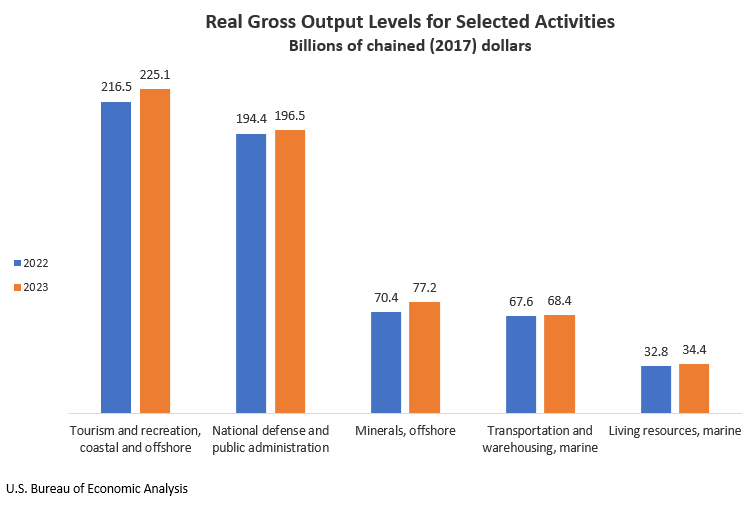
The BEA’s analysis breaks down the marine economy into ten general categories of activity. While the specific details of these categories were not fully enumerated in the provided text, the overall real gross output for the marine economy, which measures inflation-adjusted sales and receipts including sales to final users (GDP) and intermediate inputs to other industries, saw a significant increase of 3.5 percent, or $22.7 billion, in 2023. This growth in gross output suggests increased demand and production across various marine-related sectors.
This growth in real gross output is particularly encouraging when viewed in the context of specific marine economy activities. While the specific highlights for 2023 were not fully detailed in the provided text, this metric serves as a broad indicator of the sector’s dynamism. For instance, if sectors like marine transportation, shipbuilding, offshore energy, or marine tourism experienced strong performance, this would contribute to the overall increase in gross output. The BEA’s methodology allows for a granular examination of these individual activities, offering insights into which segments are driving the most economic value. The accompanying chart (Chart 2) likely illustrates the relative sizes and growth rates of these key marine economy activities, providing a visual representation of their economic impact. Understanding these drivers is crucial for policymakers and industry leaders seeking to foster continued expansion and resilience in the marine economy.
Marine Economy by Industry: Sectoral Contributions
The MESA also provides a breakdown of the marine economy by industry, detailing the contributions of various sectors to value added (GDP), gross output, employment, and compensation. This perspective highlights how different industries, whether directly or indirectly involved in marine activities, contribute to the overall economic picture. The provided text indicates that there were specific industry highlights for 2023, though these were not explicitly detailed.
However, the presence of Chart 3, illustrating the "Industry Composition of Marine Economy Value Added, 2023," suggests that the BEA’s analysis identifies and quantifies the economic contribution of numerous industries to the marine economy. These could range from traditional maritime industries like fishing, shipbuilding, and shipping to newer sectors such as offshore wind energy, marine biotechnology, and coastal tourism. The BEA’s comprehensive approach ensures that indirect contributions are also captured, for example, the economic impact of suppliers to shipbuilding firms or the service industries that support coastal tourism.
The BEA’s methodology for defining marine economic activity is designed to be inclusive, capturing a wide spectrum of economic endeavors that are intrinsically linked to the marine environment. This approach allows for a more holistic understanding of the marine economy’s true economic footprint, moving beyond narrow definitions that might overlook significant contributions. The detailed industry breakdowns are invaluable for understanding the specific strengths and potential vulnerabilities within the marine economy, informing targeted investment and policy decisions.
Background and Historical Context of the Marine Economy
The study of the marine economy is not a new endeavor, but the MESA represents a more sophisticated and standardized approach to quantifying its impact. Historically, the economic importance of oceans and coastal regions has been recognized through various lenses, including resource extraction, transportation, and defense. However, the increasing complexity of marine-based industries and their interconnectedness with other sectors of the economy necessitated a more integrated statistical framework.
The development of the MESA, in partnership with the National Oceanic and Atmospheric Administration (NOAA), reflects a growing awareness of the oceans’ multifaceted role in the U.S. economy. NOAA, with its mandate to understand and predict changes in the Earth’s environment, particularly the oceans and coasts, brings vital scientific and environmental data to the partnership. This collaboration ensures that the economic analysis is grounded in a comprehensive understanding of the marine environment and its resources.
The timeline for the MESA data collection and release is structured to provide timely insights. The annual updates, coupled with periodic comprehensive updates of the National Economic Accounts, ensure that the statistics remain relevant and reflect the latest economic developments. The "Next release: Spring 2026" for the 2024 Marine Economy Satellite Account data indicates a regular cadence of reporting, allowing for consistent monitoring of trends and impacts.
Broader Implications and Future Outlook
The robust growth in the U.S. marine economy, as evidenced by the 2023 MESA statistics, carries significant implications for national economic policy, resource management, and technological innovation. The increase in GDP contribution, employment, and compensation suggests that the marine sector is a vital engine for job creation and economic prosperity. This could encourage further investment in marine-related infrastructure, research and development, and workforce training programs.
The parallel growth in marine economy GDP with the overall U.S. economy suggests a healthy integration and resilience. However, it also underscores the importance of sustainable practices within the marine sector. As the economy grows, so does the potential for increased pressure on marine ecosystems. Therefore, the BEA’s detailed breakdowns by activity and industry become critical for identifying areas where economic expansion might pose environmental risks and for developing policies that promote sustainable growth.
The partnership with NOAA is particularly important in this regard. By combining economic data with scientific understanding, policymakers can make more informed decisions about balancing economic development with environmental conservation. For example, growth in offshore renewable energy sectors, while economically beneficial, will require careful environmental impact assessments. Similarly, the sustainable management of fisheries is crucial for the long-term viability of both the fishing industry and the marine ecosystems they depend on.
The detailed statistics available through the MESA also provide valuable insights for businesses operating within or looking to enter the marine economy. Understanding which activities and industries are experiencing the most significant growth can help companies identify new market opportunities and investment strategies. For instance, if data reveals a surge in demand for marine biotechnology products or services, this could signal an attractive area for new ventures and innovation.
Looking ahead, the continued development and refinement of the MESA will be crucial for tracking the evolving landscape of the marine economy. As new technologies emerge and global economic conditions shift, the BEA’s ability to adapt its methodologies and data sources will be paramount. The upcoming release of the 2024 data in Spring 2026 will undoubtedly provide further insights into the ongoing trends and transformations within this vital sector of the U.S. economy. The marine economy, with its vast potential and inherent complexities, remains a critical area of focus for economic analysis and strategic planning.