Lana Rhoades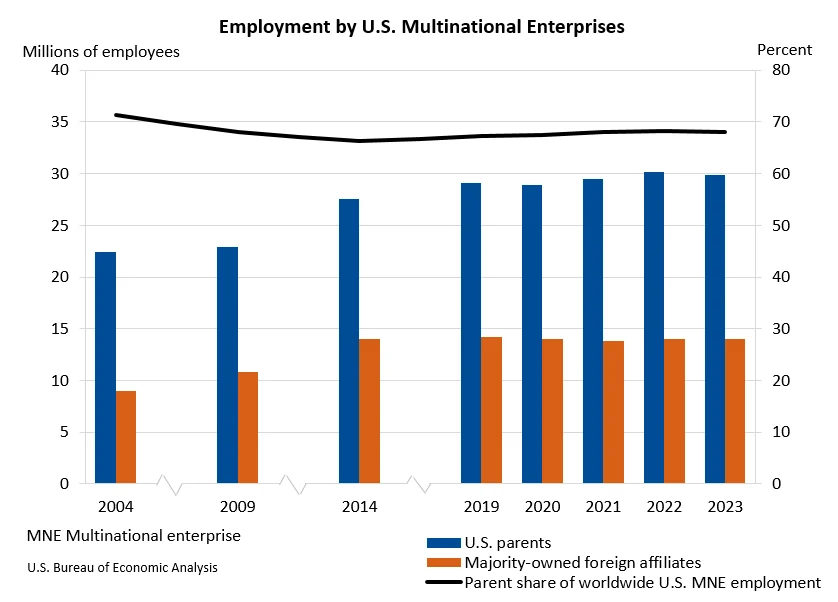
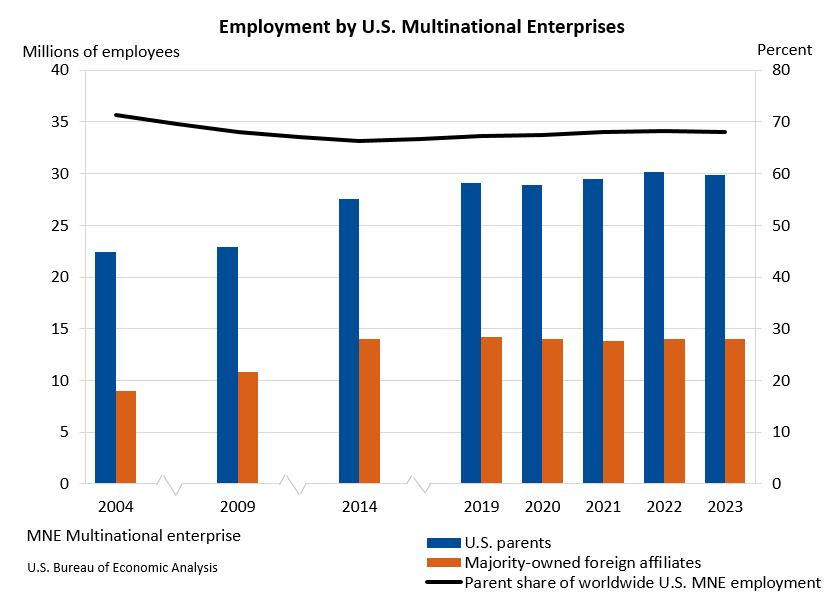
Worldwide employment by U.S. multinational enterprises (MNEs) experienced a marginal decrease of 0.4 percent in 2023, falling to 43.9 million workers from a revised 44.1 million in the preceding year, according to the latest statistics released by the U.S. Bureau of Economic Analysis (BEA). This preliminary data, reflecting the operational and financial activities of U.S. parent companies and their foreign affiliates, provides a nuanced snapshot of global corporate labor footprints in a dynamic economic environment.
The slight contraction in overall employment signals a complex interplay of factors influencing multinational operations. While the overall number of workers employed by U.S. MNEs dipped, a closer examination reveals contrasting trends between domestic and international employment. Employment within the United States by U.S. parent companies saw a more pronounced decrease of 0.8 percent, reaching 29.9 million workers. Despite this decline, U.S. parents still constituted the significant majority of worldwide employment, accounting for 68.1 percent of the total, a marginal drop from 68.3 percent in 2022. Conversely, employment abroad by foreign affiliates of U.S. MNEs exhibited modest growth, increasing by 0.2 percent to 14.0 million workers, representing 31.9 percent of the global workforce for these enterprises.
This divergence suggests a potential recalibration of U.S. multinational strategies, with a greater emphasis on international expansion or retention of workforce abroad compared to domestic operations. The data underscores the interconnectedness of the global economy and the critical role U.S. MNEs play in shaping employment trends across various regions.
Shifting Employment Dynamics: Domestic vs. International
The BEA’s detailed breakdown highlights that U.S. parents accounted for 21.9 percent of total private industry employment in the United States in 2023, a slight decrease from 22.5 percent in 2022. This indicates that while U.S. MNEs remain a substantial employer domestically, their share of the overall U.S. private sector workforce has marginally eroded. The manufacturing sector continued to be a primary source of employment for U.S. parents, alongside significant contributions from "other industries," notably transportation and warehousing, and the retail trade sector.
In contrast, employment abroad by majority-owned foreign affiliates saw an uptick. The data points to India, Mexico, and the United Kingdom as the leading destinations for employment by these foreign entities. This pattern suggests strategic investments and operational expansions in these regions, potentially driven by market access, labor costs, or specific industry strengths.
Economic Output and Investment Trends
Beyond employment figures, the BEA report also sheds light on the economic contributions of U.S. MNEs. Worldwide current-dollar value added, a key measure of economic output, for U.S. MNEs decreased by 0.6 percent to $6.9 trillion. Value added by U.S. parents, which directly contributes to the U.S. gross domestic product (GDP), experienced a more significant decline of 1.0 percent, totaling $5.3 trillion. This reduction brought the share of U.S. parents in total U.S. private-industry value added down to 21.4 percent from 23.1 percent in 2022.
However, the value added by majority-owned foreign affiliates demonstrated resilience, increasing by 0.8 percent to $1.6 trillion. This growth in foreign affiliate value added outpaced the domestic contribution, further emphasizing the trend of international operational strength. The United Kingdom, Canada, and Ireland emerged as the top contributors to value added by foreign affiliates, indicating their significance as economic hubs for U.S. multinational operations.
In terms of investment, the report reveals a robust increase in expenditures for property, plant, and equipment (capital expenditures) by U.S. MNEs, which grew by 7.5 percent to $1.1 trillion. Of this total, U.S. parents accounted for $886.1 billion, while majority-owned foreign affiliates contributed $216.2 billion. This substantial increase in capital investment suggests a forward-looking strategy by U.S. MNEs, potentially aimed at modernizing facilities, expanding production capacity, or investing in new technologies across their global operations.
Research and development (R&D) expenditures also saw a notable increase, rising by 7.5 percent to $558.3 billion worldwide. U.S. parents were the primary drivers of R&D investment, accounting for $476.6 billion, while foreign affiliates contributed $81.7 billion. This sustained and increased investment in R&D underscores the critical role of innovation in the long-term strategy of U.S. multinational enterprises, signaling a commitment to developing new products, services, and processes to maintain competitive advantage in the global marketplace.
Context and Background: The Evolving Global Business Landscape
The statistics released today by the BEA are part of a comprehensive annual survey that tracks the activities of U.S. multinational enterprises. This survey provides crucial data for understanding the economic impact of these globally integrated companies, which play a pivotal role in international trade, investment, and employment. The data collection process involves extensive data gathering from U.S. parent companies and their foreign affiliates, ensuring a broad and detailed view of their operations.
The period covered by the report, 2023, was marked by a complex global economic environment. Factors such as persistent inflation, geopolitical uncertainties, shifts in global supply chains, and varying interest rate policies across major economies likely influenced the operational decisions of U.S. MNEs. The slight decrease in overall employment, coupled with the divergence between domestic and international workforce trends, can be interpreted as a response to these macro-economic pressures and opportunities. Companies may have been optimizing their global workforce allocation, potentially shedding jobs in areas facing greater economic headwinds while expanding or maintaining employment in regions offering greater growth potential or cost efficiencies.
Revisions and Data Updates: Enhancing Accuracy
The BEA also provided updated statistics for 2022, incorporating newly available and revised source data. These revisions are a standard part of the BEA’s statistical process, aimed at ensuring the highest level of accuracy and comprehensiveness in its economic reporting. The preliminary statistics for 2022, initially released in August 2024, were further refined and highlighted in the September 2024 issue of the Survey of Current Business in an article titled "Activities of U.S. Multinational Enterprises in 2022."
The table detailing the updates to 2022 statistics shows marginal adjustments across key metrics like the number of employees, value added, and expenditures for property, plant, and equipment, as well as R&D expenditures. For instance, the number of employees for U.S. parents was revised from a preliminary estimate of 30,240.8 thousand to a revised 30,120.1 thousand. Similarly, value added figures for both U.S. parents and foreign affiliates saw minor adjustments. These revisions, while often small in percentage terms, are crucial for providing policymakers, businesses, and researchers with the most accurate data for economic analysis and decision-making.

Implications and Broader Economic Impact
The observed trends in employment and economic output have several potential implications for the U.S. and global economies. The slight decline in domestic employment by U.S. parents, while not dramatic, could signal a need for ongoing analysis into the factors driving this trend. While U.S. MNEs remain a cornerstone of the American economy, shifts in their employment patterns can have ripple effects on local communities and the national labor market.
The growth in employment and value added by foreign affiliates suggests that U.S. multinational enterprises are continuing to expand their international footprint. This expansion can lead to increased foreign direct investment, technology transfer, and job creation in host countries, contributing to global economic development. However, it also raises questions about the balance of economic activity between the U.S. and its international operations, and the potential impact on the U.S. trade balance and domestic industrial competitiveness.
The substantial increase in capital expenditures and R&D spending by U.S. MNEs worldwide is a positive indicator of future economic growth and innovation. These investments are crucial for enhancing productivity, developing new technologies, and maintaining a competitive edge in the global marketplace. The strong emphasis on R&D, in particular, highlights the strategic importance of innovation for long-term corporate success and economic progress.
Future Outlook and Data Availability
The BEA’s commitment to providing detailed and timely data on U.S. multinational enterprises is invaluable for economic analysis. The agency offers extensive resources on its website, including interactive data applications and comprehensive data tables, allowing users to delve deeper into specific industries, countries, and financial metrics.
The next release of statistics on the activities of U.S. MNEs is scheduled for November 2026, covering the 2024 activities. This forthcoming data will provide further insights into the ongoing evolution of global business operations and their impact on employment and economic output. It will also allow for a comparative analysis of trends over time, offering a clearer picture of the long-term trajectory of U.S. multinational enterprises in the global economy.
Furthermore, the BEA has noted the discontinuation of certain data tables, including those related to foreign affiliates with 50 percent or less U.S. ownership and supplemental industry statistics. While these tables have been archived, their discontinuation signifies a strategic adjustment in the BEA’s data dissemination strategy, potentially driven by evolving data needs or resource allocation. Users seeking this specific historical data are directed to the BEA’s Data Archive.
In conclusion, the preliminary 2023 data from the BEA paints a picture of U.S. multinational enterprises navigating a complex global economic landscape. While overall employment saw a slight dip, the trends in domestic versus international operations, alongside robust investment in capital and R&D, suggest a strategic recalibration aimed at long-term growth and competitiveness. The continued availability of detailed statistical data from the BEA remains essential for understanding and responding to these evolving economic dynamics.