Lana Rhoades
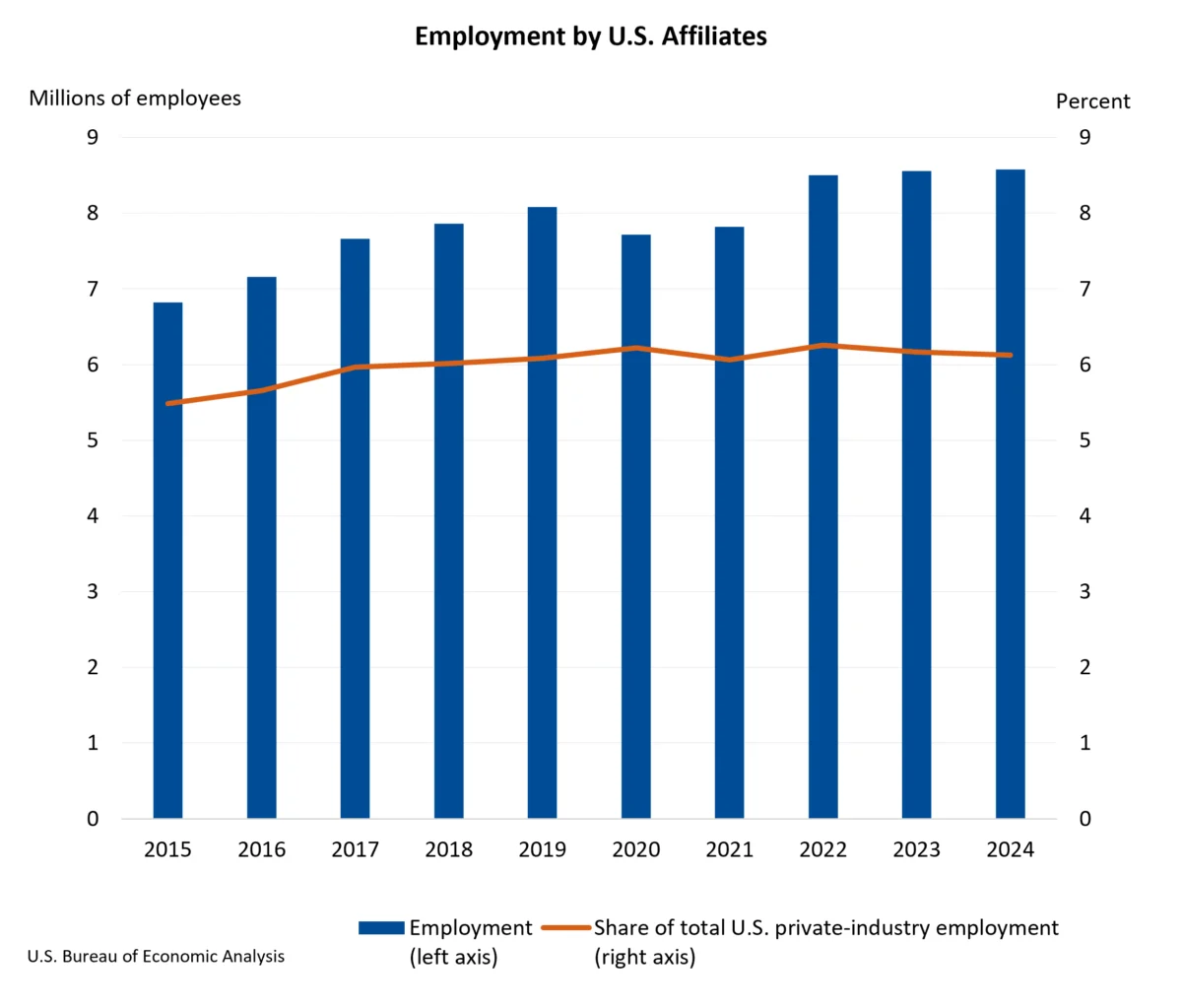
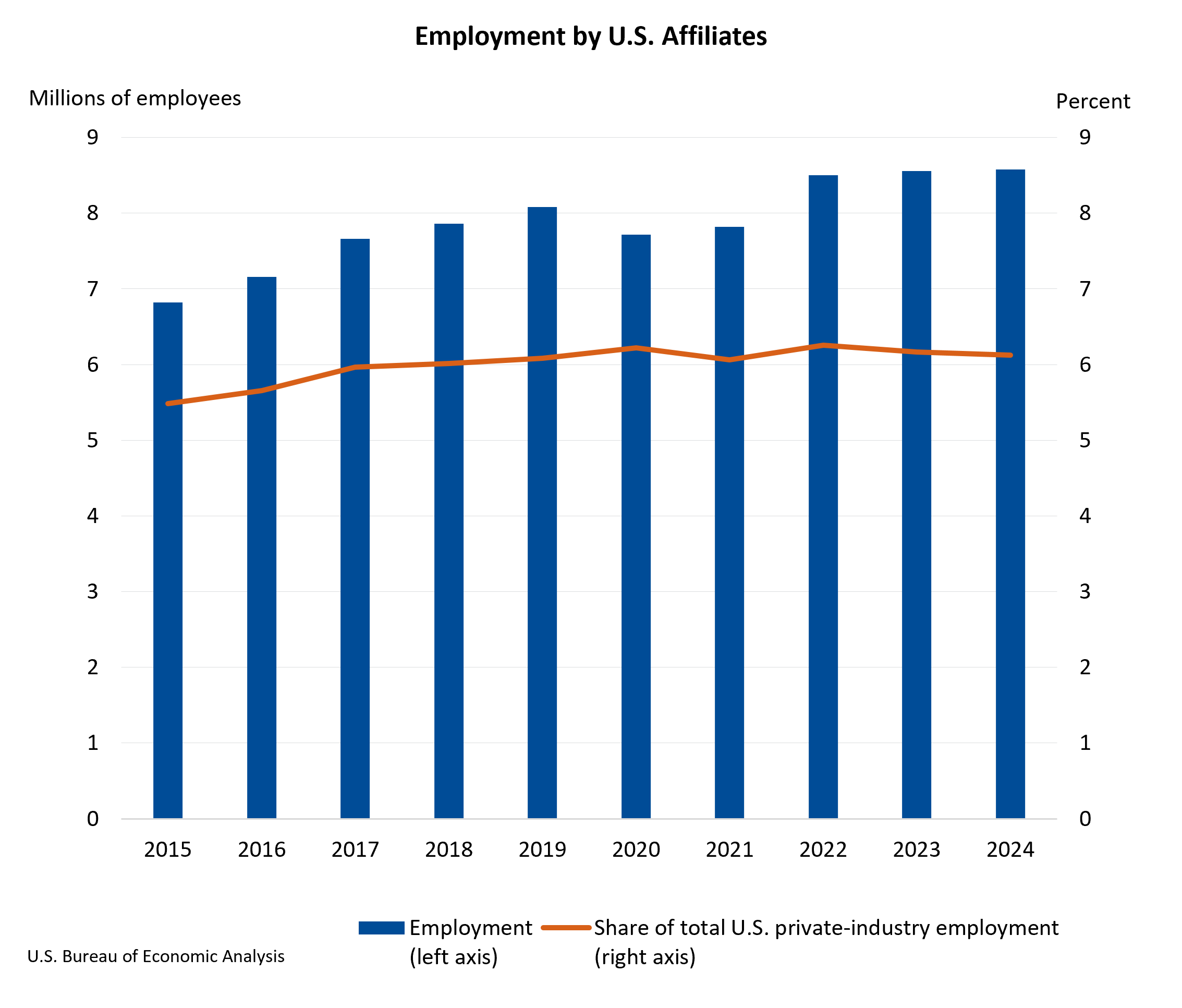
Majority-owned U.S. affiliates of foreign multinational enterprises (MNEs) provided employment for 8.57 million workers across the United States in 2024. This figure represents a marginal increase of 0.2 percent from the 8.56 million workers employed in 2023, according to the latest statistics on U.S. affiliate operations and finances released by the U.S. Bureau of Economic Analysis (BEA). While the overall employment number shows a slight upward trend, the share of total private-industry employment attributable to these foreign-owned entities dipped slightly from 6.2 percent in 2023 to 6.1 percent in 2024, underscoring the dynamic nature of the U.S. labor market and the continuous contributions of international investment.
The manufacturing and retail trade sectors continue to be the largest employers of workers within U.S. affiliates of foreign MNEs. These sectors have historically been significant recipients of foreign direct investment due to their scale, market access, and established infrastructure. The data further highlights that the United Kingdom, Japan, and Germany remain the principal countries of ultimate beneficial ownership for the largest contributors to employment through their U.S. affiliates. This sustained investment from these key economic partners reflects ongoing confidence in the U.S. economy and its potential for growth and innovation.
Beyond employment figures, the economic footprint of these U.S. affiliates extends significantly into the nation’s Gross Domestic Product (GDP). In 2024, the current-dollar value added by these affiliates, a key measure of their direct contribution to U.S. economic output, surged by 4.3 percent to reach an impressive $1.52 trillion. This growth outpaced the slight increase in employment, indicating enhanced productivity and greater economic value generated per employee. Despite this robust growth in value added, these affiliates accounted for 6.7 percent of total U.S. business-sector value added, a fractional decrease from 6.8 percent in the preceding year. This slight dip in their proportional contribution, while their absolute value added increased, suggests that the broader U.S. business sector may have experienced even faster growth in value added during the same period.
Investment in the future of their U.S. operations is also evident in the capital expenditure data. Expenditures for property, plant, and equipment by U.S. affiliates rose by 3.3 percent, reaching $328.0 billion in 2024. This sustained investment in physical assets signifies a commitment to expanding operational capacity, modernizing facilities, and potentially introducing new technologies. Furthermore, a strong emphasis on innovation is demonstrated by the 5.3 percent increase in research and development (R&D) performed by these affiliates, totaling $95.5 billion. Their significant role in driving U.S. innovation is further underscored by the fact that they accounted for 12.4 percent of all U.S. business R&D in 2024, making them critical players in the nation’s technological advancement.
Geographically, employment within U.S. affiliates is concentrated in key economic hubs. California led the nation with 885,200 jobs provided by these entities, followed by Texas with 717,400 jobs, and New York with 556,700 jobs. In all three of these leading states, the manufacturing sector was the dominant source of employment generated by foreign-owned affiliates, reflecting the ongoing importance of this industry in absorbing a significant portion of the foreign-invested workforce.
Historical Context and Trends
The presence of foreign multinational enterprises in the U.S. economy is not a new phenomenon. Foreign direct investment (FDI) has been a cornerstone of U.S. economic policy for decades, recognized for its ability to create jobs, stimulate innovation, and enhance competitiveness. The BEA’s data on U.S. affiliates of foreign MNEs provides a crucial lens through which to monitor these contributions.
In the years leading up to 2024, the landscape of foreign investment has been shaped by global economic shifts, trade policies, and technological advancements. While the overall trend has been one of growth, the pace and nature of this growth can fluctuate. For instance, the period between 2017 and 2019 saw a robust increase in employment by U.S. affiliates, driven by a favorable business climate and tax reforms. The onset of the COVID-19 pandemic in 2020 and 2021 presented significant challenges, leading to temporary disruptions in employment and investment. However, the subsequent recovery has demonstrated the resilience of foreign investment in the U.S. market. The figures for 2023 and 2024 indicate a return to steady, albeit modest, growth, suggesting a stabilization and renewed confidence in the long-term economic prospects of the United States.
The BEA’s statistical releases are part of an ongoing effort to track and analyze these trends. The data released today includes revised estimates for 2023, which incorporate newly available and revised source data. This revision process is critical for ensuring the accuracy and reliability of economic indicators. For 2023, the revised estimate for the number of employees stands at 8,556.9 thousand, slightly lower than the preliminary estimate of 8,661.8 thousand. Similarly, value added for 2023 was revised to $1,456.3 billion from a preliminary estimate of $1,469.1 billion. Expenditures for property, plant, and equipment were also revised downwards from $322.7 billion to $317.6 billion, while research and development expenditures saw an upward revision from $87.8 billion to $90.6 billion. These revisions highlight the iterative nature of economic data collection and analysis, providing a more refined picture of economic activity over time.
Key Sectors and Contributors
The distribution of employment and economic activity across various sectors provides deeper insights into the nature of foreign investment. As mentioned, manufacturing and retail trade remain paramount. In manufacturing, foreign-owned companies are involved in a wide array of sub-sectors, from automobiles and chemicals to machinery and electronics, contributing significantly to the U.S. industrial base. The retail sector, on the other hand, encompasses a vast network of stores and distribution centers, playing a vital role in bringing goods to American consumers.
Beyond these dominant sectors, other areas also benefit from foreign MNE involvement. The professional, scientific, and technical services sector, for example, is increasingly a focus for foreign investment, particularly in areas requiring specialized expertise and innovation. Similarly, the finance and insurance sector, as well as the wholesale trade sector, also represent significant areas of operation for U.S. affiliates of foreign MNEs.
The top countries of ownership – the United Kingdom, Japan, and Germany – have consistently been major sources of FDI into the U.S. These nations have deep economic ties with the United States, characterized by substantial trade volumes and long-standing investment relationships. Their continued presence and investment underscore the strategic importance of the U.S. market for their global business strategies. Other significant investing countries, such as Canada, France, and the Netherlands, also contribute substantially to the overall employment and economic output generated by foreign-owned enterprises in the United States.
Broader Economic Implications and Analysis
The consistent presence and growth of U.S. affiliates of foreign MNEs have several important implications for the U.S. economy. Firstly, they represent a stable source of employment, offering competitive wages and benefits, and contributing to the overall dynamism of the labor market. The fact that employment grew, even if marginally, in 2024 is a positive signal, particularly in an economic climate that can be subject to various pressures.
Secondly, the significant investment in R&D by these affiliates positions them as key drivers of innovation. By establishing research centers and laboratories in the U.S., foreign companies not only contribute to the advancement of science and technology but also foster the development of a highly skilled workforce and create spillover effects for domestic firms. This inflow of knowledge and technological know-how is invaluable for maintaining U.S. competitiveness on the global stage.
Thirdly, the capital expenditures in property, plant, and equipment indicate a long-term commitment to the U.S. market. This investment is crucial for infrastructure development, job creation, and enhancing the productivity of the U.S. economy. It signals that foreign investors view the United States as a stable and profitable destination for their capital, contributing to economic stability and growth.
However, the slight decrease in the proportional share of total private-industry employment and U.S. business-sector value added, despite absolute increases, warrants attention. This could indicate that domestic U.S. businesses are also experiencing robust growth, or that shifts in investment patterns are favoring sectors with different employment intensities or value-added contributions. A deeper analysis of these trends would involve examining the growth rates of domestic versus foreign-owned entities across specific industries.
Data Availability and Future Outlook
The U.S. Bureau of Economic Analysis provides a wealth of detailed data on the activities of U.S. affiliates of foreign MNEs, accessible through its Interactive Data Application and comprehensive data tables. This includes information on sales, balance sheet and income statement items, compensation of employees, trade, and more. The availability of industry-, country-, and state-level details allows for nuanced analysis of foreign investment trends and their impact on specific regions and economic sectors.
The BEA also employs advanced methods to protect the confidentiality of its survey respondents while maximizing data publication. Recent updates to its disclosure avoidance method, incorporating techniques like rounding and aggregation, aim to enable the publication of more data without compromising respondent privacy.
Looking ahead, the BEA anticipates releasing the next set of statistics on the activities of U.S. affiliates of foreign MNEs in the Spring of 2027, covering the year 2025. This forward-looking release schedule allows policymakers, businesses, and researchers to stay abreast of the evolving landscape of foreign investment and its contributions to the U.S. economy. The ongoing collection and analysis of this data are essential for understanding the intricate relationships between global capital flows and domestic economic performance, guiding future investment strategies and policy decisions. The consistent reporting of these figures serves as a vital barometer for the health and attractiveness of the U.S. as a destination for international business.