Lana Rhoades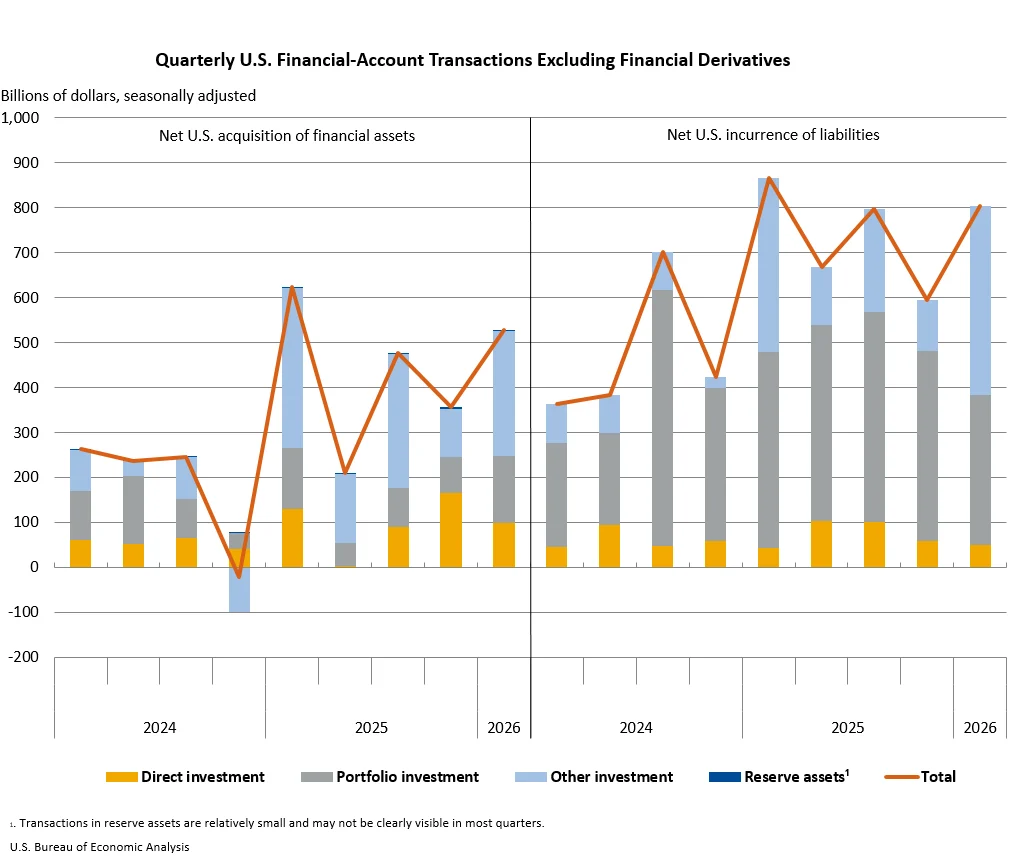
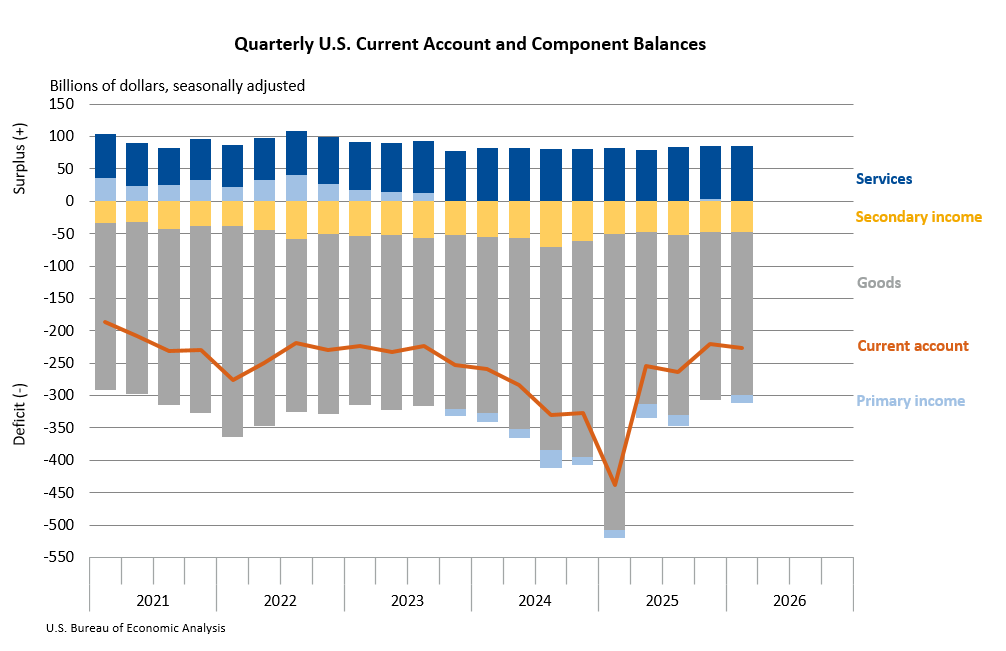
The U.S. current-account deficit, a broad measure of the nation’s international economic transactions, expanded by $5.8 billion, or 2.6 percent, to $226.8 billion in the first quarter of 2026. This widening, revealed in statistics released by the U.S. Bureau of Economic Analysis (BEA), signals a notable shift in the country’s balance of trade and income flows with the rest of the world. The revised deficit for the fourth quarter of 2025 stood at $221.1 billion, indicating a clear upward trend in the deficit. As a proportion of current-dollar gross domestic product (GDP), the first-quarter deficit represented 2.9 percent, an increase from 2.8 percent in the preceding quarter, underscoring its growing significance in the national economic landscape.
This expansion of the current-account deficit was primarily driven by a significant reversal in the primary income balance, which moved from a surplus in the fourth quarter of 2025 to a deficit in the first quarter of 2026. This shift was partially mitigated by a reduction in the deficit on goods, suggesting that while the trade in physical goods saw some improvement, the flow of income earned by U.S. residents from foreign investments and by foreign residents from U.S. investments experienced a significant deterioration.
Errata Correction and Data Integrity
It is important to note a minor correction to the data released. A typographical error affected only the figure for net financial transactions, which was initially reported as -$209.0 billion. This figure has since been corrected to include the appropriate negative sign, now accurately reflecting -$209.0 billion. This specific numerical typo did not impact any other data points in the news release and was correctly presented in the BEA’s Interactive Data Application and Application Programming Interface, ensuring that comprehensive and accurate data remains accessible to the public and analysts. The corrected net financial-account transactions figure for the first quarter of 2026 is -$209.0 billion.
Key Drivers of the Widening Deficit
The widening of the current-account deficit in the first quarter of 2026 was a complex interplay of various components. The primary income balance, which includes earnings from investments abroad and income paid to foreign investors in the U.S., swung from a surplus of $3.4 billion in the fourth quarter of 2025 to a deficit in the first quarter of 2026. This reversal points to a substantial change in the net flow of income generated by international financial activities. While specific details on the composition of this shift are not fully elaborated in the initial release, such movements can be influenced by changes in dividend payments, interest income, and reinvested earnings on foreign direct investments.
Concurrently, the deficit on goods, which represents the difference between the value of exported and imported physical products, saw a reduction. This indicates an improvement in the U.S. trade balance for goods, potentially driven by increased exports or decreased imports, or a combination of both. However, this positive development was not substantial enough to offset the negative impact of the primary income balance’s decline, leading to an overall widening of the current account.
Trade in Goods and Services
Total exports of goods and services to, and income received from, foreign residents saw a robust increase of $50.0 billion, reaching a total of $1.38 trillion in the first quarter of 2026. This growth was largely propelled by an uptick in goods exports. However, this positive momentum was somewhat tempered by a decrease in primary (earned) income receipts from abroad. This suggests that while U.S. companies and individuals were selling more goods and services internationally, the income they generated from their foreign holdings and operations did not keep pace.
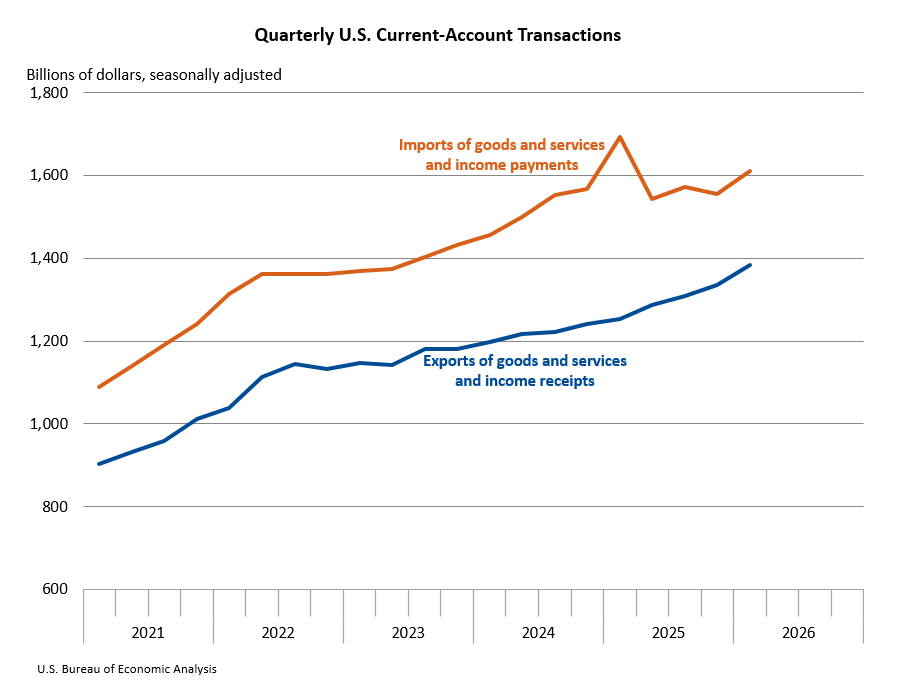
On the import side, imports of goods and services from, and income paid to, foreign residents experienced a larger increase of $55.8 billion, bringing the total to $1.61 trillion. This rise was attributed to increases in both goods imports and primary (earned) income payments to foreign residents. The greater increase in imports compared to exports, coupled with the deterioration in primary income, contributed significantly to the overall widening of the current-account deficit.
Capital Transfers and Financial Account
In terms of capital transfers, which represent one-sided transactions such as inheritances or grants, receipts increased by $3.3 billion to $3.4 billion in the first quarter. Conversely, capital transfer payments saw a decrease of $0.9 billion, settling at $2.0 billion. These movements had a relatively minor impact on the overall current account compared to the trade and income balances.
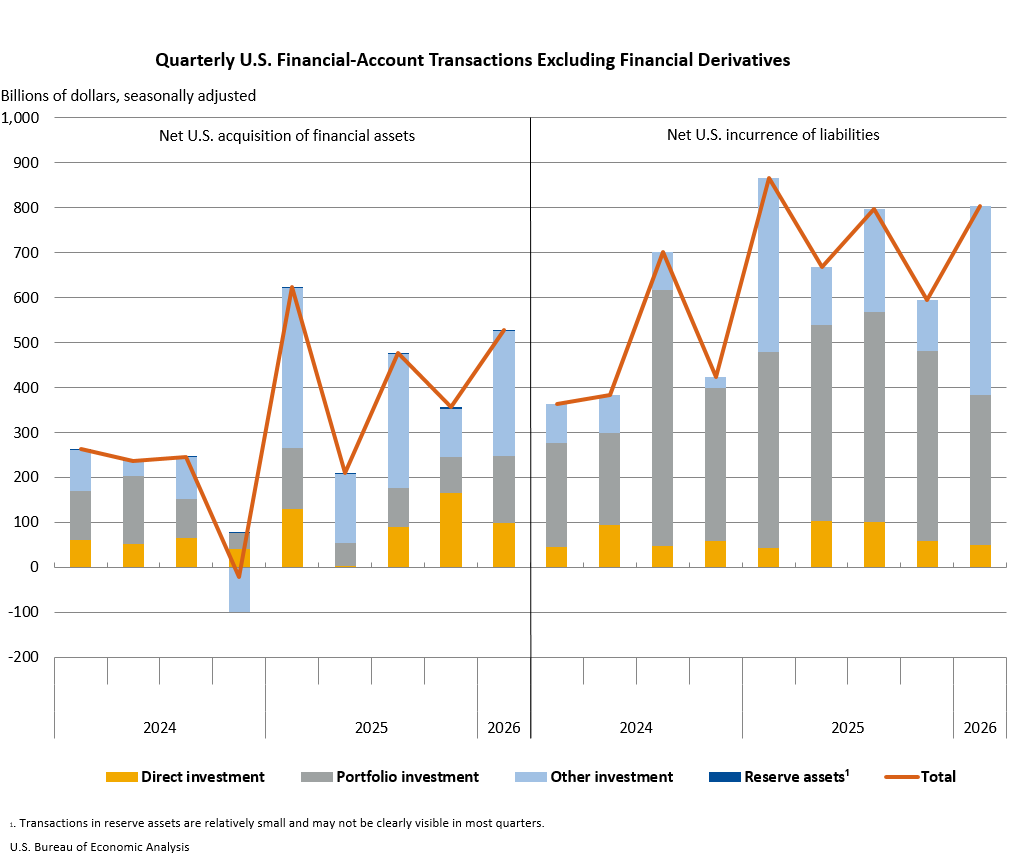
The financial account, which tracks international investment flows, recorded net transactions of -$209.0 billion in the first quarter of 2026. This negative figure signifies net U.S. borrowing from foreign residents, meaning that foreigners invested more in the U.S. than U.S. residents invested abroad. During this period, U.S. residents’ foreign financial assets increased by $527.3 billion, while U.S. liabilities to foreign residents grew by a larger $803.7 billion. This substantial net inflow of foreign capital is a crucial component of the balance of payments, financing the current-account deficit.
U.S. International Investment Position
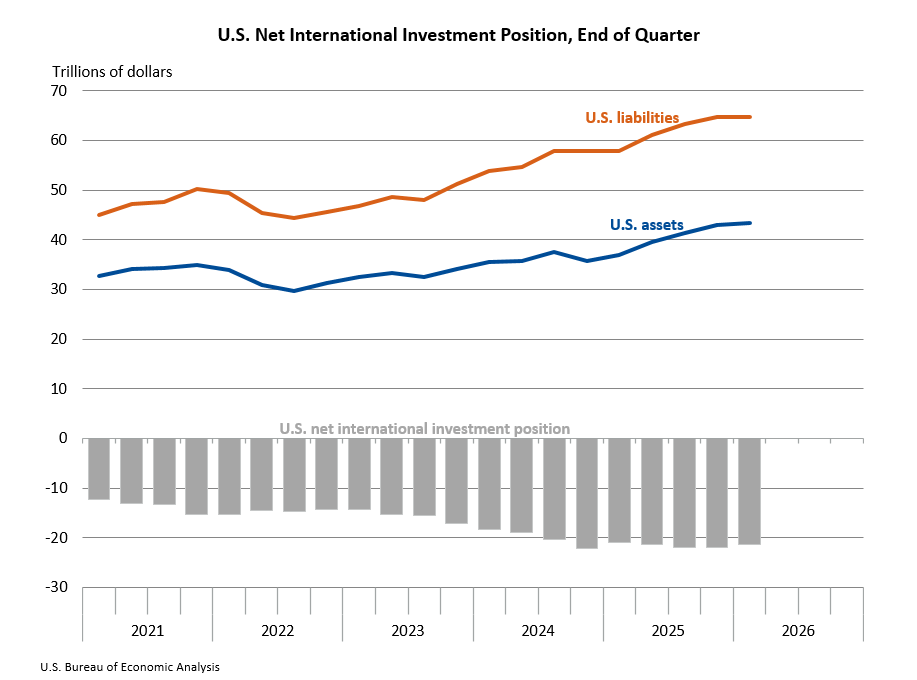
At the close of the first quarter of 2026, the U.S. net international investment position—the difference between U.S. residents’ foreign financial assets and liabilities—stood at -$21.27 trillion. This represents a significant net debtor position for the United States. Total U.S. assets abroad amounted to $43.37 trillion, while U.S. liabilities to foreign residents totaled $64.64 trillion. This position reflects the cumulative result of decades of international transactions. The net investment position saw a revision from -$21.87 trillion at the end of the fourth quarter of 2025, indicating a slight improvement in the net debt position, primarily driven by valuation changes.
Changes in U.S. Assets and Liabilities
The value of U.S. assets held abroad increased by $462.9 billion during the first quarter. This growth was broad-based across most major investment categories, with the exception of direct investment. The financial transactions contributed $527.3 billion to this increase, but this was partially offset by unfavorable exchange-rate changes, which reduced the value of foreign assets by $357.1 billion when translated back into U.S. dollars.
Conversely, U.S. liabilities to foreign residents decreased by $140.4 billion in the first quarter. This decline was mainly due to a reduction in portfolio investment, although this was partially counterbalanced by increases in other major investment categories. The overall decrease in liabilities was significantly influenced by price changes, which led to a substantial decrease of $1.18 trillion in the reported value of foreign-held U.S. assets. However, new financial transactions by foreigners into the U.S. added $803.7 billion to these liabilities, tempering the overall decline.
Annual Updates and Data Revisions
The statistics released for the first quarter of 2026 incorporate the annual updates to the U.S. International Transactions Accounts (ITAs) and the International Investment Position (IIP) Accounts. These comprehensive updates involve the integration of newly available and revised source data, as well as recalculations of seasonal and trading-day adjustments. These annual revisions, which have been conducted by the BEA since statistics for 1999, aim to enhance the accuracy and completeness of the nation’s international economic data.
Key data providers contributing to these updates include the BEA itself, the U.S. Census Bureau, and the U.S. Department of the Treasury. The BEA provided benchmark and quarterly insurance services surveys, quarterly international services surveys, and benchmark, annual, and quarterly direct investment surveys, covering various periods up to 2025. The U.S. Census Bureau provided revised source data for Census-basis goods for the years 2023-2025. The U.S. Department of the Treasury contributed annual portfolio investment surveys (2024-2025) and quarterly and monthly portfolio and other investment surveys (2023-2025). These extensive data integrations ensure that the reported figures reflect the most current and comprehensive economic activity.
Broader Economic Context and Implications
The widening U.S. current-account deficit in the first quarter of 2026, particularly the shift in the primary income balance, warrants close observation. A persistent and growing current-account deficit implies that the U.S. is consuming more goods and services than it produces, financed by borrowing from or selling assets to foreign countries. While foreign investment can fuel domestic growth and development, a substantial and sustained deficit can lead to increased foreign claims on U.S. assets and income streams, potentially impacting long-term economic stability and policy decisions.
The BEA’s commitment to data integrity, as evidenced by the prompt correction of the errata, is crucial for maintaining confidence in economic reporting. The annual updates signify a continuous effort to refine the measurement of complex international economic flows. The BEA’s disclosure avoidance method has also been updated to a coarsening approach, involving rounding, aggregation, and the use of ranges, which aims to publish more data while protecting the confidentiality of survey respondents.
The next release of U.S. International Transactions and Investment Position statistics, covering the second quarter of 2026, is scheduled for September 24, 2026. These upcoming figures will provide further insight into the trajectory of the U.S. current-account balance and its underlying components, offering a more complete picture of the nation’s economic engagement with the global economy. The BEA will continue to update its comprehensive data archives and methodological publications to reflect these ongoing statistical refinements.