Lana Rhoades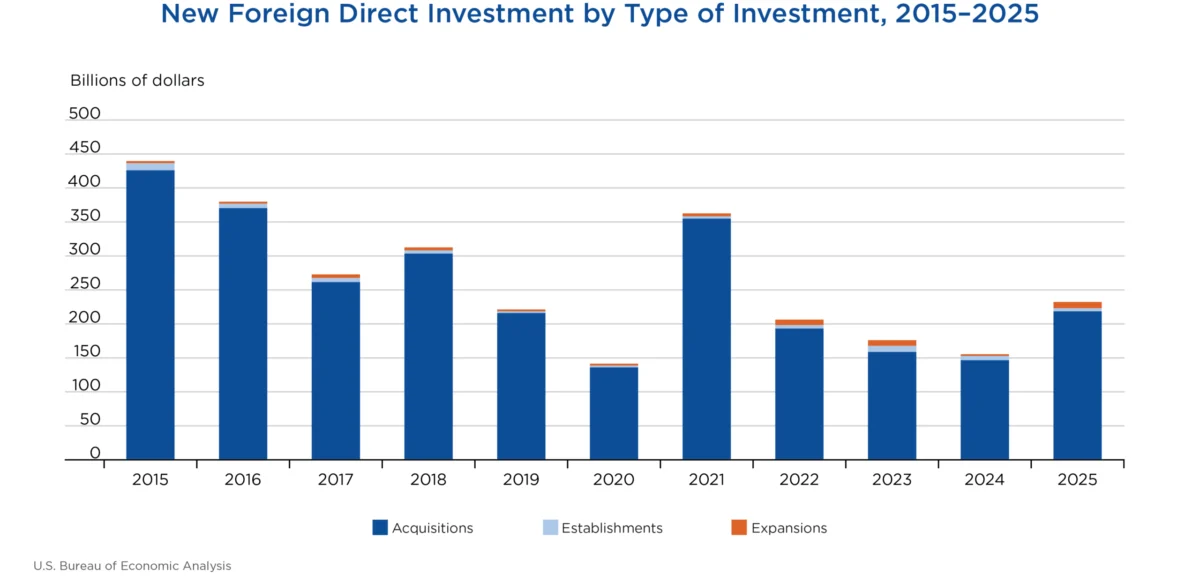
Expenditures by foreign direct investors to acquire, establish, or expand U.S. businesses reached a significant $232.2 billion in 2025, marking a substantial increase of $76.8 billion, or 49.5 percent, from the previous year’s levels. These preliminary statistics, released today by the U.S. Bureau of Economic Analysis (BEA), underscore a robust period of international capital inflow into the American economy. As has been the trend in recent years, the acquisition of existing U.S. businesses remained the primary driver of this investment activity, accounting for the vast majority of the total outlay.
The detailed breakdown reveals that acquisition expenditures alone amounted to an impressive $218.4 billion in 2025. In contrast, expenditures aimed at establishing entirely new U.S. businesses totaled $4.6 billion, while investments to expand existing foreign-owned businesses contributed $9.2 billion. Looking ahead, planned total expenditures, encompassing both initial first-year outlays and projected future investments, were estimated at $284.5 billion, indicating sustained investor interest and commitment to the U.S. market. This surge in foreign direct investment (FDI) is anticipated to have a tangible impact on employment, with 213,100 jobs created or sustained at newly acquired, established, or expanded foreign-owned businesses in 2025.
Manufacturing Sector Dominates Investment Landscape
The manufacturing sector emerged as a powerhouse in attracting foreign direct investment in 2025, accounting for a substantial $121.8 billion, or 52.5 percent, of all new direct investment. Within this broad sector, specific industries demonstrated exceptional appeal. Publishing industries attracted the largest share of investment at $50.7 billion, followed closely by chemicals manufacturing with $45.4 billion. The plastics and rubber products manufacturing sector also saw significant inflows, totaling $19.0 billion. This concentration in manufacturing highlights the continued global confidence in the resilience and future growth potential of American industrial production.
Global Investors Target U.S. Opportunities
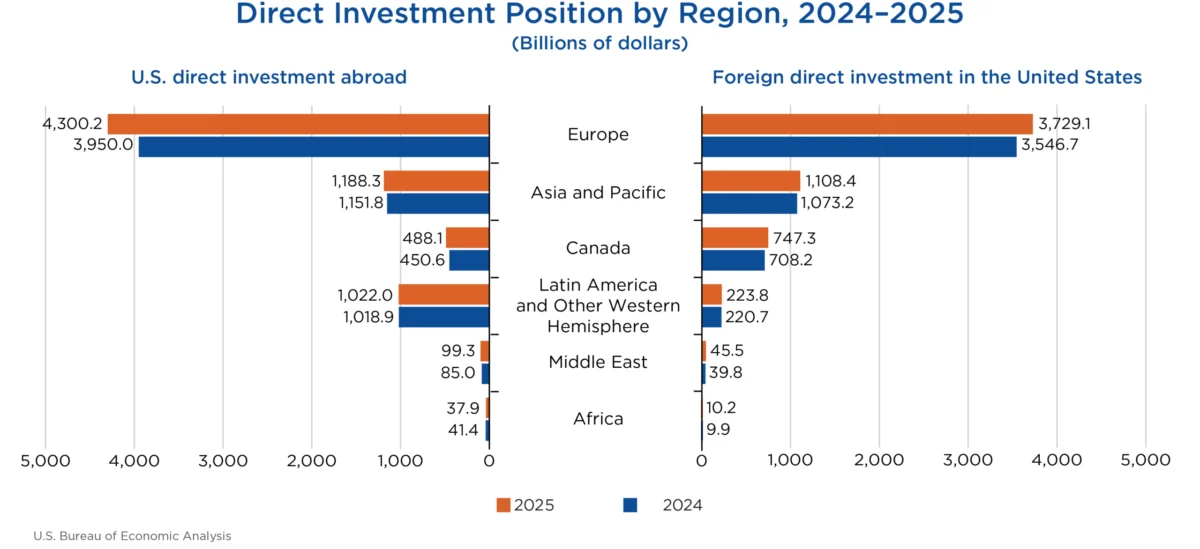
Japan led the pack of investing nations in 2025, with its investors committing $50.5 billion to U.S. businesses. Germany followed as the second-largest investor, contributing $26.7 billion, while Canada rounded out the top three with $23.5 billion. On a regional basis, Europe demonstrated the strongest appetite for U.S. assets, injecting $116.6 billion, representing 50.2 percent of all new investment. The Asia and Pacific region also proved to be a significant source of capital, with expenditures totaling $71.9 billion. This diverse geographical spread of investment underscores the broad international appeal of the U.S. economy as a destination for capital.
Geographically within the United States, California once again proved to be the most attractive state for foreign direct investment, attracting a considerable $59.7 billion in first-year expenditures. Texas followed with $21.5 billion, and Pennsylvania secured the third position with $20.9 billion. These leading states are often characterized by their large economies, skilled workforces, and robust business environments, making them prime targets for international investors.
Greenfield Investments Show Strong Growth
Greenfield investments, which involve establishing new businesses or expanding existing ones from the ground up, also experienced a notable upswing. These expenditures totaled $13.8 billion in 2025. The transportation and warehousing sector was a primary beneficiary of greenfield investment, attracting $3.6 billion. Computers and electronics products manufacturing secured $2.0 billion, and chemicals manufacturing received $1.8 billion.
Investors from the Asia and Pacific region were particularly active in greenfield initiatives, contributing the highest dollar value of $8.3 billion. Australia led this regional group with $3.0 billion, followed by South Korea ($2.2 billion) and Japan ($1.7 billion). Within the U.S., Louisiana emerged as a significant recipient of greenfield investment, drawing $3.0 billion, with Arizona ($2.7 billion) and Texas ($1.9 billion) also experiencing substantial inflows. The planned total expenditures for greenfield investment initiated in 2025, including future commitments, were projected to reach $66.1 billion, signaling a long-term investment horizon for these new ventures.
Employment Outlook Tied to FDI Surge
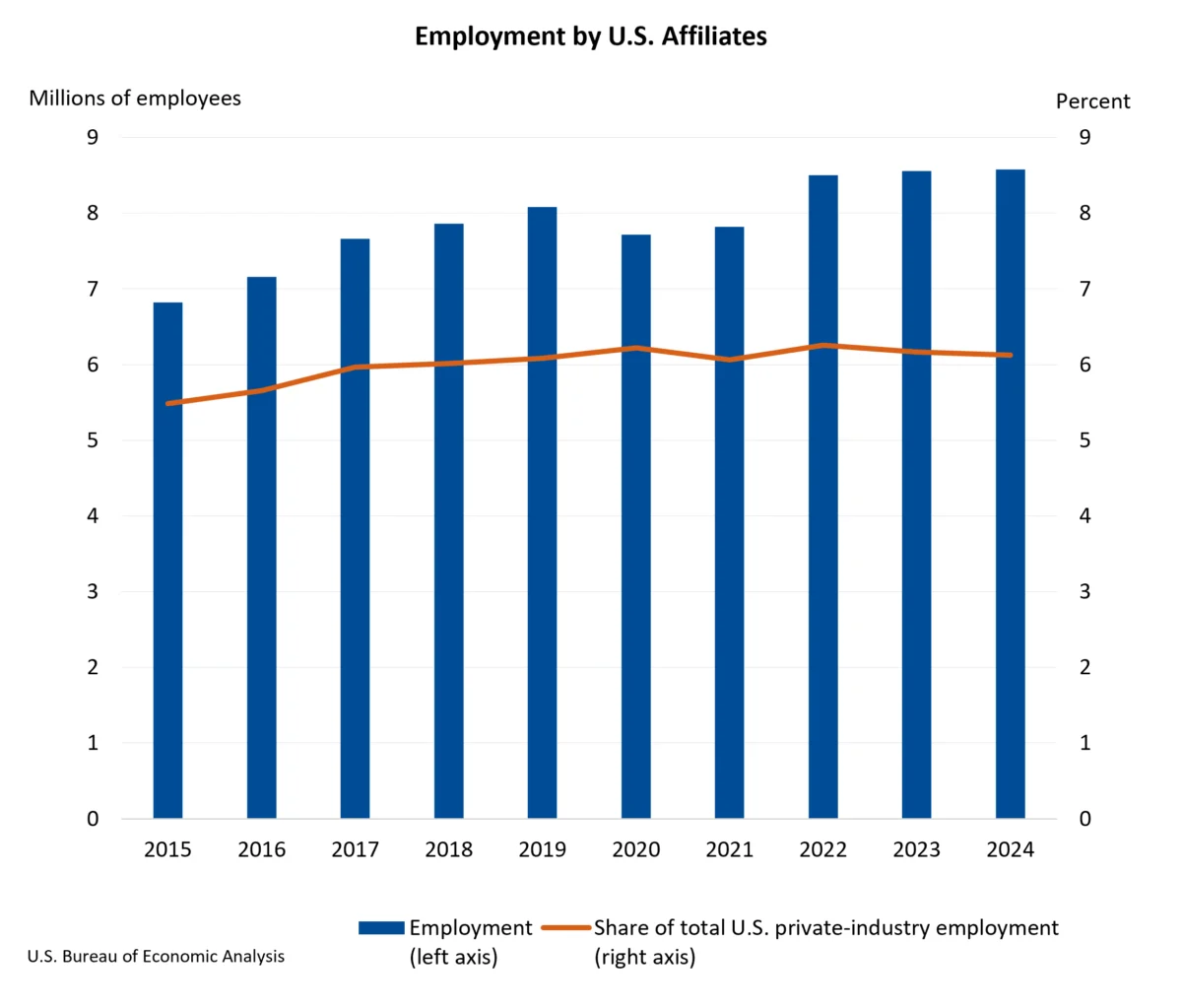
The influx of foreign direct investment in 2025 is expected to translate into significant job creation and retention. Current employment at acquired enterprises stood at 211,700. When considering the planned employment at newly established businesses upon full operation and the projected expansion of existing foreign-owned entities, the total planned employment associated with this year’s FDI surge reaches an impressive 232,400.
By industry, plastics and rubber parts manufacturing reported the largest number of current employees at 21,800, followed by transportation equipment manufacturing with 17,300 employees, and primary and fabricated metals manufacturing employing 16,400. On a country-of-origin basis, companies with ultimate beneficial ownership in Mexico accounted for the largest number of current employees, with 54,600, followed by Canada (29,500) and the United Kingdom (26,800). California led the states in terms of current employment generated by new FDI, with 37,200 jobs, followed by Illinois (17,600) and Texas (16,500).
Revisions to Prior Year Data Reflect Growing Trend
The Bureau of Economic Analysis also provided revised figures for 2024, indicating that the previously reported trends were potentially understated. First-year expenditures for new foreign direct investment in the United States in 2024 were revised upward to $155.3 billion from the previously published $151.0 billion. This revision was driven by increases in the acquisition of U.S. businesses ($146.4 billion from $143.0 billion) and expansions of existing businesses ($2.5 billion from $1.8 billion), though the establishment of new businesses saw a slight downward revision.
Planned total expenditures for 2024 were also revised upwards to $164.0 billion from $157.0 billion. These revisions suggest a stronger underlying momentum in foreign investment than initially assessed, providing further context for the remarkable surge observed in 2025.
Context and Implications of Increased FDI
The substantial increase in foreign direct investment in 2025 can be attributed to a confluence of factors. The U.S. economy, despite facing global economic headwinds, has demonstrated resilience and continued growth, making it an attractive safe haven for international capital. Furthermore, policy initiatives aimed at fostering domestic manufacturing and innovation may have further incentivized foreign companies to establish or expand their operations within the United States to gain direct access to these markets and technological advancements.
The BEA’s methodology for collecting and reporting FDI data, which includes revisions to disclosure avoidance methods like coarsening, rounding, and the use of ranges, allows for the publication of more granular data while safeguarding respondent confidentiality. This enhanced data availability is crucial for policymakers, businesses, and researchers seeking to understand and leverage international investment trends.
The surge in FDI, particularly in the manufacturing sector, has broader economic implications. It can lead to increased productivity, the transfer of technology and management expertise, and enhanced competitiveness for U.S. industries. The creation of jobs, as indicated by the projected employment figures, directly benefits American workers and communities. Moreover, a strong inflow of FDI can contribute to a more favorable balance of payments and bolster the overall economic standing of the United States on the global stage.
Looking ahead, the BEA’s next release, scheduled for June 2027, will provide the 2026 data for new foreign direct investment in the United States, offering further insights into the continuation of these investment trends. The consistent growth and significant scale of foreign direct investment underscore the enduring attractiveness of the U.S. as a premier destination for global capital, signaling continued opportunities for economic development and job creation. The BEA’s commitment to providing detailed and updated statistics on FDI is instrumental in navigating and understanding these dynamic economic forces.