Nila Kartika Wati
Minnesota has long cultivated a national reputation as a bastion of civic progressivism and high quality of life. In the fictionalized lore of Garrison Keillor’s Lake Wobegon, the state is a place where "all the women are strong, all the men are good-looking, and all the children are above average." For decades, this self-deprecating humor mirrored the state’s actual economic data—provided the data was viewed through a monolithic lens. By nearly every aggregate metric, Minnesota leads the nation: it boasts the lowest poverty rate in the United States, consistently high rankings in educational attainment, and a tax code frequently cited as among the least regressive in the country. However, when these statistics are disaggregated by race, the narrative of prosperity collapses, revealing what economists have termed the "Minnesota Paradox."
The Minnesota Paradox describes a state that ranks at the top of national quality-of-life measures in the aggregate but sits near the bottom when measuring racial disparities in unemployment, wages, incarceration, homeownership, and school discipline. Recent data underscores the severity of this divide: the Twin Cities metropolitan area currently maintains the widest Black-White homeownership gap of any comparable metro area in the nation. Furthermore, the state’s overall racial wealth gap is ranked as the sixth worst in the United States, with progress toward narrowing that gap stalling in the bottom third of national rankings. As Samuel Myers Jr., the economist who coined the term, has observed, African Americans in Minnesota often face worse economic outcomes than their counterparts in almost every other state.
The Chronology of Stagnation and the Mapping Initiative
Despite hundreds of millions of dollars in philanthropic investment and decades of programmatic interventions, the economic reality for Black Minnesotans has remained remarkably static. In the 1980s, Black homeownership in the Twin Cities stood at approximately 25 percent; today, that figure has moved only marginally to 29 percent. This stagnation suggests that the issue is not a lack of effort or funding, but a fundamental misunderstanding of the system producing these outcomes.

In the spring of 2026, a collaborative effort involving the Institute on Race, Power, and Political Economy, the African American Leadership Forum, and a cohort of 20 experts from the nonprofit, philanthropic, and governmental sectors set out to move beyond merely measuring disparities. Utilizing a methodology known as "issue mapping," the group sought to trace the causal connections between various social and economic factors to understand why traditional interventions have failed to close the gap.
The mapping sessions identified 187 distinct issues that were initially grouped into six priority areas: structural racism, the absence of intergenerational wealth, lack of financial freedom, unequal access to labor markets, inadequate healthcare, and an unjust public safety system. However, the analysis revealed that these were not six separate problems, but rather one interconnected system held together by five "hub issues" that recurred across every cluster: an unfair tax code, zero wealth to transfer, lack of access to capital, disproportionate incarceration, and structural racism.
Supporting Data: The Mechanics of the Wealth Gap
To understand the resilience of the Minnesota Paradox, one must examine the specific data points that fuel the systemic loop. Wealth, unlike income, represents the cumulative assets a household can pass down to future generations. In Minnesota, the disparity in wealth is far more profound than the disparity in earnings.
- Income Persistence: Minnesota has some of the highest rates of income persistence in the country. While this sounds positive, it means that workers who start in the bottom income quartile are statistically more likely to remain there. Black and American Indian workers are disproportionately represented in this bottom quartile, facing systemic barriers to upward mobility that transcend individual effort.
- The Devaluation of Assets: Nationally, homes in Black neighborhoods are valued roughly 23 percent lower than comparable homes in White neighborhoods. In the seven-county Twin Cities region, data from the Minneapolis Federal Reserve shows that as the share of residents of color in a census tract increases, the median estimated market value of homes decreases.
- Tax Inequities: Paradoxically, while their homes are valued lower, Black homeowners often face a higher relative tax burden. Research indicates that homes in Black neighborhoods are frequently taxed 10 to 13 percent higher relative to their market value than homes in White neighborhoods.
- The Homeownership Loop: Down-payment assistance programs, a staple of nonprofit intervention, often fail to move the needle because they operate in a vacuum. A family may receive assistance to purchase a home, but the lack of inherited wealth and the systemic undervaluation of property in their neighborhood prevent that home from becoming the wealth-building engine it is for White families.
The Wicked Problem and Cumulative Causation
Public management scholars categorize the racial wealth gap as a "wicked problem"—a challenge with no agreed-upon definition, tangled causes, and stakeholders with conflicting values. The mapping exercise illustrated what economist Gunnar Myrdal described in 1944 as "cumulative causation." In this model, discrimination depresses living standards, which are then used by the system to justify further discrimination and disinvestment.
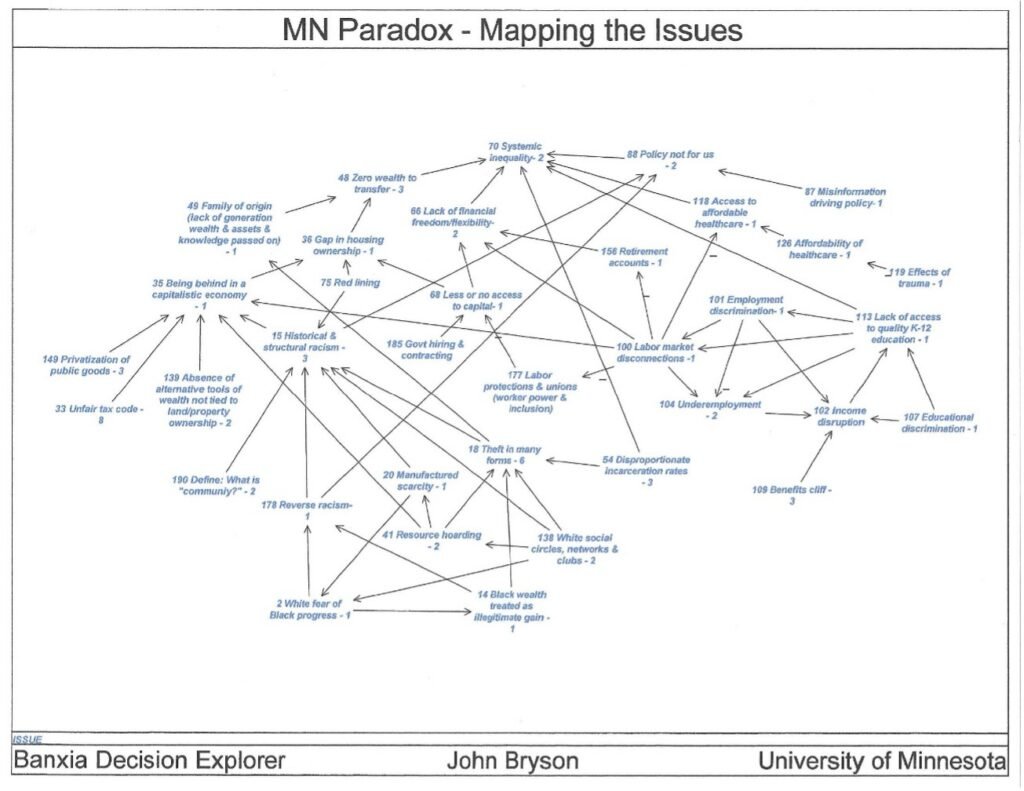
A primary historical example of this in Minnesota is redlining. Banks and insurance companies historically designated Black neighborhoods as "high risk," starving them of investment. This lack of investment naturally depressed property values and credit access, which the financial industry then used to justify continued high-risk designations. This reinforcing loop ensures that a system’s structure shapes outcomes more powerfully than any single intervention can change them.
Stakeholder Analysis: A Collection, Not a Coalition
A critical component of the 2026 study was a stakeholder mapping exercise, which sorted over 190 organizations on a power-versus-interest grid. The findings were revealing: while many organizations had high interest in closing the wealth gap, very few possessed the systemic power to enact structural change. The study concluded that Minnesota currently possesses a "collection of stakeholders" rather than a "coalition."
When the group analyzed support for specific policy proposals, such as "baby bonds"—government-funded trust accounts for children—they found a significant asymmetry. Over 140 stakeholder groups, including labor unions, faith organizations, and major corporations, were identified as potential supporters. Conversely, only 13 stakeholders, primarily concentrated in private equity housing interests and a small subset of elected officials, were identified as opposition. Despite this broad potential support, the lack of a coordinated, accountable structure has prevented these stakeholders from acting as a unified political force.
The Failure of Siloed Interventions
The nonprofit sector in Minnesota is robust, yet its structure often incentivizes competition over coordination. The "nonprofit starvation cycle" describes a phenomenon where funders’ expectations push organizations to underinvest in the very coordination capacity required to solve systemic issues.

Philanthropy typically rewards "big bets" on single organizations rather than field-building. Research from the Bridgespan Group found that over a 14-year period, only 7 percent of grants of $10 million or more went toward field-building. Consequently, most nonprofits focus on executing their specific missions—such as providing job training or housing assistance—within the existing rules of the system. This optimizes individual programmatic outcomes but leaves the overarching architecture of the tax code, lending rules, and public policy unchanged.
Two major initiatives in the Twin Cities provide contrasting lessons in this regard:
- The GroundBreak Coalition: Launched in 2022, this coalition has mobilized nearly $1 billion in capital for Black homeownership and business lending. While significant, its scope is currently limited to "access to capital," only one of the five hub issues identified in the mapping.
- Generation Next: Utilizing a collective-impact model, this initiative has worked for over a decade to close the Black-White graduation gap. While the gap narrowed from 23 points in 2017 to 14 points in 2025, it remains wider than the national average. Analysts suggest that while the initiative was successful, it worked within the existing school funding formula rather than fundamentally restructuring it.
Broader Impact and the Path Forward
The conclusion of the systemic mapping project is clear: individual-level and philanthropic interventions are insufficient to close a gap of this magnitude. Economists Darrick Hamilton and William Darity Jr. argue that structural wealth gaps are intergroup phenomena that require large-scale government redistribution and policy reform. As Darren Walker, former president of the Ford Foundation, noted, philanthropy cannot achieve solutions at scale; only public policy can provide the pathway to equity.
To move beyond the Minnesota Paradox, the study proposes a shift toward "field catalysts"—entities designed not to deliver programs, but to align existing actors around a model-tested, shared agenda. This approach involves:

- System Dynamics Modeling: Converting the issue map into a formal simulation to test how different policy interventions interact before spending political and financial capital.
- Universal Goals with Targeted Strategies: Adopting programs like Connecticut’s baby bonds, which use Medicaid enrollment as a proxy for eligibility. This targets the families most affected by the wealth gap without relying solely on racial definitions that can be politically polarizing.
- The Five C’s Framework: Ensuring that any coalition possesses the necessary Coordination, Capacity, Capital, Coalition-power, and commitment to systemic Change.
The myth of Lake Wobegon suggests that good intentions and individual effort are enough to ensure that everyone is "above average." Minnesota’s history proves otherwise. The state’s persistent racial wealth gap is not a result of neglect, but the predictable output of a reinforcing system. Closing that gap requires a transition from a collection of well-meaning programs to a unified coalition capable of rewriting the rules of the state’s economic architecture. Minnesota, having faced the reality of its paradox, now has the opportunity to build the map and the model that other states can follow.